
Convex mirrors are one of the most practical road safety products used to improve visibility in streets, parking areas, warehouses, factories, schools, hospitals, commercial buildings, residential communities, and industrial facilities. They help drivers, pedestrians, cyclists, security staff, and equipment operators see blind spots before accidents happen. A properly installed convex mirror can improve traffic flow, reduce collision risks, and make dangerous corners safer without the need for major construction work.
Installing a convex mirror may look simple, but correct installation is very important. If the mirror is placed too high, too low, too far from the viewing point, or at the wrong angle, it may not provide the visibility needed. A convex safety mirror only works well when it is installed in the right location, with the right mounting hardware, at the right viewing angle, and at the correct height.
For businesses, municipalities, contractors, facility managers, road safety suppliers, warehouse operators, and commercial property owners, proper convex mirror installation is part of a wider safety plan. Whether the mirror is used as an outdoor traffic mirror, driveway mirror, parking lot convex mirror, industrial safety mirror, warehouse mirror, road safety mirror, or blind spot mirror, the goal is the same. It should help people see hidden areas clearly before moving into a risk zone.
Understanding the Purpose of a Convex Mirror Before Installation
Before installing a convex mirror, it is important to understand why the mirror is being installed. A convex mirror is not just a reflective object placed on a pole or wall. It is a safety device designed to solve a specific visibility problem. The location, mirror size, mounting height, and viewing angle all depend on the type of blind spot or traffic risk that needs to be controlled.
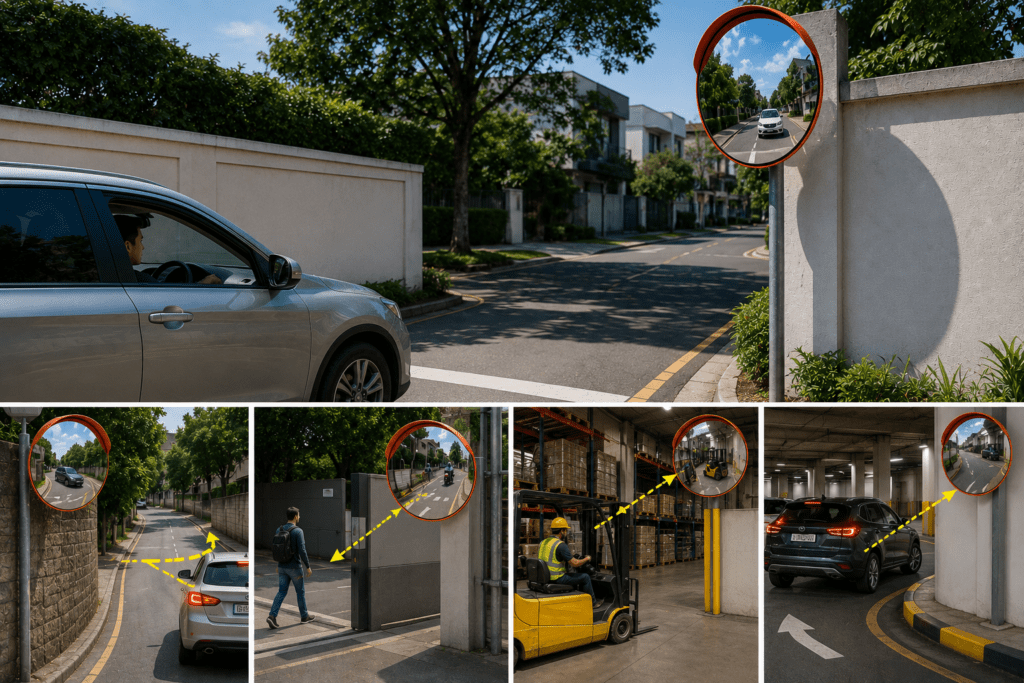
In street applications, convex mirrors are usually installed at road corners, narrow intersections, sharp turns, private road exits, parking entrances, and driveways. In commercial buildings, they are often used near basement parking exits, loading areas, service roads, and vehicle access points. In warehouses and factories, convex mirrors are installed at forklift crossings, aisle intersections, internal roads, gatehouses, and loading bays.
The first step is to identify the exact visibility problem. The installer should stand in the position where the driver, pedestrian, or equipment operator normally needs to make a decision. This could be the driver’s seat at a driveway exit, the turning point at a blind corner, or the operator’s path near a warehouse aisle. From that position, the installer should check what area is hidden from direct view. The convex mirror should be positioned so that this hidden area becomes visible.
You can also refer to this article(a comprehensive guide about Convex Mirrors): Click Here or click the below image

Choosing the Right Location for Convex Mirror Installation
The location of the convex mirror is the most important factor in the installation process. A good-quality mirror installed in the wrong location will not solve the safety problem. The mirror must be placed where the user can see it before reaching the danger point. If the driver only sees the mirror after entering the blind spot, the installation has failed.
For street visibility, the mirror should usually be installed across from the driver’s approach direction, facing the hidden road area. At a T-junction, the mirror may be placed on the opposite side of the intersection to show traffic coming from the left and right. At a sharp bend, the mirror should be installed near the curve so drivers can see oncoming traffic before entering the turn. At a driveway exit, the mirror should show approaching pedestrians, motorcycles, cars, or commercial vehicles from both sides of the street.
For warehouse and industrial use, the mirror should be installed at the corner where forklifts, pallet trucks, workers, and vehicles may cross paths. In parking lots, it should be positioned near ramps, wall corners, blind exits, or tight turning points. In commercial properties, it should be visible to drivers before they move out of a gate, parking zone, or service lane.
The mirror should not be blocked by trees, signs, walls, vehicles, gates, fences, columns, or other equipment. It should also not be placed where sunlight, glare, or shadows make the reflection difficult to see. The best installation location provides a clear reflection of the blind spot and allows users to check the mirror naturally without stopping in an unsafe position.
Selecting the Correct Convex Mirror Size
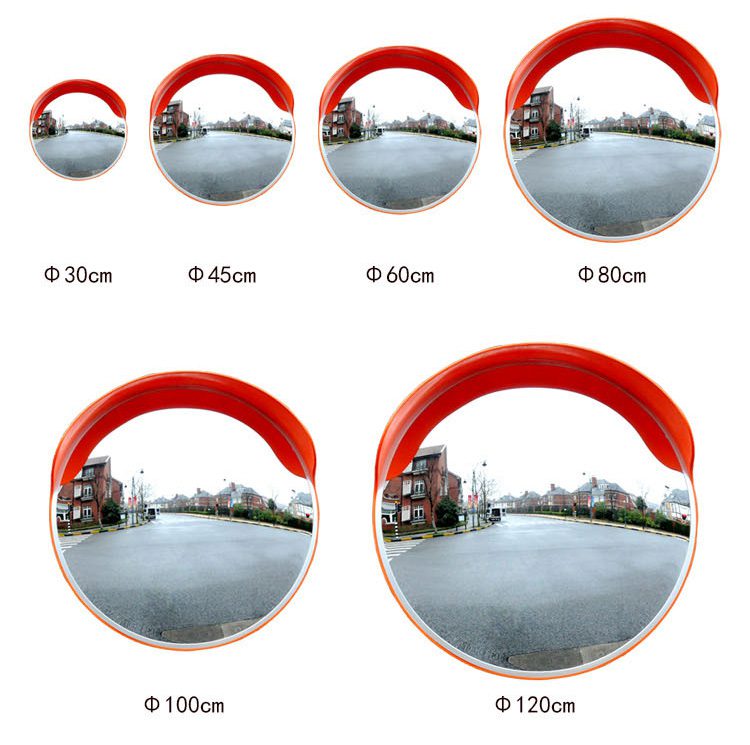
Choosing the right mirror size is essential for clear visibility. Convex mirrors are available in different diameters, and each size is suitable for a different viewing distance. A small mirror may work well for a short driveway or indoor aisle, but it may not be suitable for a wide road or long-distance street corner. A larger mirror gives better visibility over a longer distance, but it must be matched to the site requirements.
For small indoor areas, such as narrow corridors, retail stockrooms, or compact warehouse aisles, a smaller convex mirror may be enough. For parking exits, basement ramps, private driveways, and short-distance blind spots, a medium-size convex mirror is usually more practical. For street intersections, industrial roads, public road corners, truck routes, and high-traffic commercial areas, a larger outdoor convex traffic mirror is often the better choice.
The size of the convex mirror should be selected based on the distance between the viewer and the mirror. The farther the viewer is from the mirror, the larger the mirror should be. If the mirror is too small for the distance, objects may appear too tiny and difficult to identify. This can reduce reaction time and make the mirror less useful.
B2B buyers should also consider the type of traffic in the area. A warehouse with forklifts and workers may require a different mirror size than a municipal road with cars and motorcycles. A logistics center with large trucks may need a wider viewing area than a small apartment parking exit. Mirror size should always be based on visibility needs, not only on price.
Choosing the Right Mirror Material
Convex mirrors are made from different materials, and the right material depends on the installation environment. Common options include acrylic convex mirrors, polycarbonate convex mirrors, stainless steel convex mirrors, and glass convex mirrors. Each material has its own strengths, and choosing the wrong material can affect durability, visibility, and maintenance.
Acrylic convex mirrors are lightweight and provide clear reflection. They are commonly used in parking areas, commercial buildings, offices, schools, residential communities, and general road safety applications. Acrylic mirrors are suitable for many outdoor and indoor locations, but they may not be the best choice for high-impact industrial environments.
Polycarbonate convex mirrors are stronger and more impact-resistant than acrylic mirrors. They are suitable for warehouses, factories, logistics centers, industrial roads, loading bays, and areas where damage risk is higher. If forklifts, heavy vehicles, equipment, or public exposure are involved, a polycarbonate safety mirror can be a more durable choice.
Stainless steel convex mirrors are highly durable and suitable for harsh environments. They are often used in industrial facilities, food processing plants, chemical areas, coastal environments, and locations where weather resistance and vandal resistance are important. Stainless steel mirrors may not always provide the same sharp reflection as acrylic or polycarbonate, but they offer strong long-term durability.
For outdoor convex mirror installation, buyers should look for weather-resistant materials, UV-resistant surfaces, strong frames, anti-rust brackets, and stable mounting hardware. A low-quality outdoor mirror may become cloudy, faded, cracked, loose, or misaligned over time. In road safety and commercial safety applications, mirror quality directly affects performance.
Checking the Mounting Surface
Before installing the convex mirror, the mounting surface should be checked carefully. The mirror can be installed on a wall, pole, column, fence, gate structure, or dedicated mirror post. The surface must be strong enough to hold the mirror securely in all normal conditions.
For wall-mounted convex mirrors, the wall should be solid, stable, and suitable for drilling. Concrete walls, brick walls, and strong structural surfaces are usually suitable. Weak plaster, thin panels, unstable fences, or damaged walls may not hold the mirror properly. If the wall is weak, the mirror can become loose or fall, creating a safety hazard instead of solving one. Humanity’s talent for creating new hazards while fixing old ones remains undefeated.
For pole-mounted convex mirrors, the pole must be properly fixed into the ground or attached to a strong base. Outdoor traffic mirrors installed on roads, parking areas, and industrial sites should use durable poles that can resist wind, vibration, rain, and daily exposure. The pole diameter should match the mirror bracket system, and the pole height should allow the mirror to be installed at the correct level.
For warehouse and indoor use, mirrors may be installed on columns, beams, racks, or dedicated brackets. The selected surface should not interfere with operations or create a new obstruction for vehicles, forklifts, workers, or pedestrians.
Preparing the Required Installation Tools
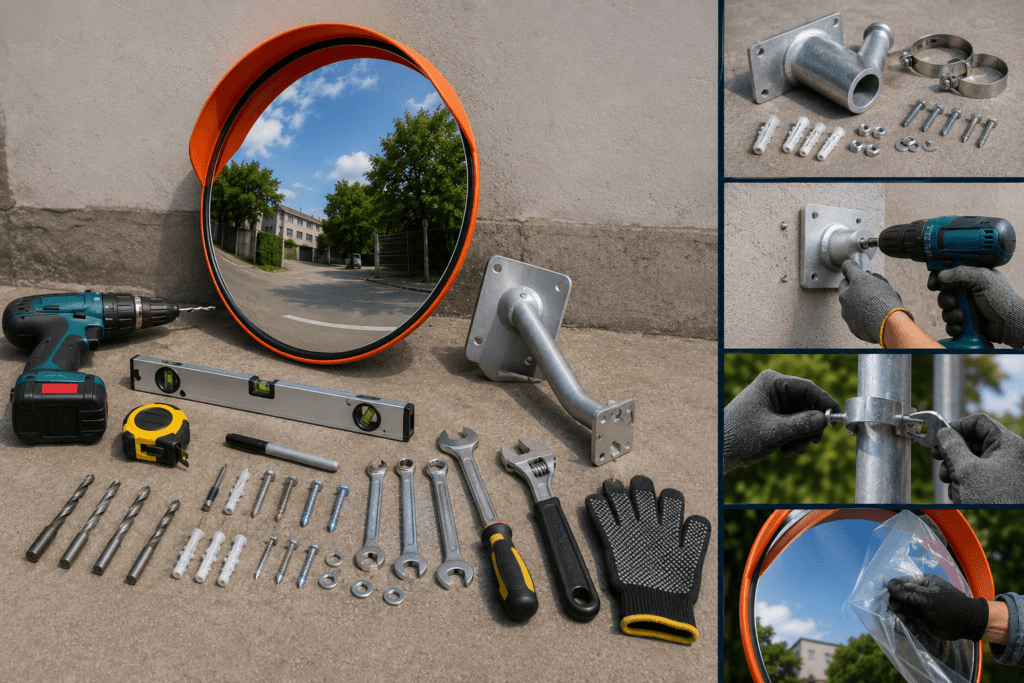
The tools needed for convex mirror installation depend on the mirror type, mounting bracket, and surface. Most convex mirrors come with mounting hardware, but installers should check the package before starting. Missing screws, wrong brackets, weak anchors, or incorrect pole clamps can delay the installation or result in poor mounting.
For wall installation, common tools include a drill machine, drill bits, wall plugs, screws, anchors, measuring tape, marker, screwdriver, wrench, level tool, and safety equipment. For pole installation, tools may include pole clamps, bolts, nuts, spanners, adjustable brackets, and a stable ladder if the mirror is installed at height.
For outdoor convex traffic mirrors, stronger fixing hardware is usually required. Wind load, vibration, and weather exposure can loosen weak fittings over time. In public road or industrial applications, the mirror should be installed with durable metal brackets and secure fasteners. A poorly fixed mirror may move out of position, shake in wind, or fall during bad weather.
Before installation, the mirror surface should be handled carefully to avoid scratches. Protective film should usually remain on the mirror during the installation process and be removed only after the mirror is securely fixed and adjusted. This helps protect the reflective surface from dust, fingerprints, and tool damage.
Deciding the Correct Installation Height
The installation height of a convex mirror affects how well users can see the reflection. If the mirror is installed too low, it may be blocked by vehicles, pedestrians, equipment, or parked objects. If it is installed too high, drivers may not be able to check it quickly or comfortably.
For road and street applications, convex mirrors are usually installed high enough to remain visible above normal obstructions but low enough for drivers to view easily. The correct height depends on the road layout, vehicle type, mirror size, and viewing distance. In many outdoor applications, the mirror is mounted on a pole or wall at a height that allows approaching drivers to see the reflected area without looking too far upward.
For parking lots and basement ramps, the mirror should be placed where drivers can see it before reaching the exit or turn. In warehouses, the mirror should be positioned at a height visible to forklift operators and workers. In pedestrian-heavy areas, the mirror should not be installed so low that people can hit it or tamper with it.
The goal is simple. The mirror should be visible, useful, protected from obstruction, and easy to check from the normal approach path. Installation height should always be tested from the actual user’s viewing position before final tightening.
Setting the Correct Viewing Angle
The viewing angle is one of the most important parts of convex mirror installation. A convex mirror works by reflecting a wide area, but it still needs to be aimed correctly. If the mirror faces the wrong direction, it may show the sky, ground, wall, parked vehicles, or an irrelevant area instead of the blind spot.
After mounting the mirror loosely, the installer should stand at the normal viewing position and adjust the mirror angle. The reflected image should clearly show the hidden traffic area. At a street corner, the mirror should show approaching vehicles from the blind side. At a parking exit, it should show pedestrians and vehicles approaching from both directions. At a warehouse aisle, it should show crossing movement before operators enter the intersection.
The mirror should not be aimed only for one person standing close to it. It should be adjusted for the real user position, such as the driver’s seat, forklift operator’s path, or pedestrian approach. This small detail matters because a reflection that looks correct from the installer’s standing position may not be useful from a vehicle.
Once the correct viewing angle is found, the bracket should be tightened securely. After tightening, the angle should be checked again because the mirror may shift slightly during fixing. This is one of those basic steps humans skip, then later blame the mirror like it developed personal ambitions.
Installing a Convex Mirror on a Wall
Wall-mounted convex mirrors are commonly used in parking lots, buildings, warehouses, factories, commercial facilities, residential complexes, and indoor traffic areas. They are suitable when a strong wall or column is available in the correct position.
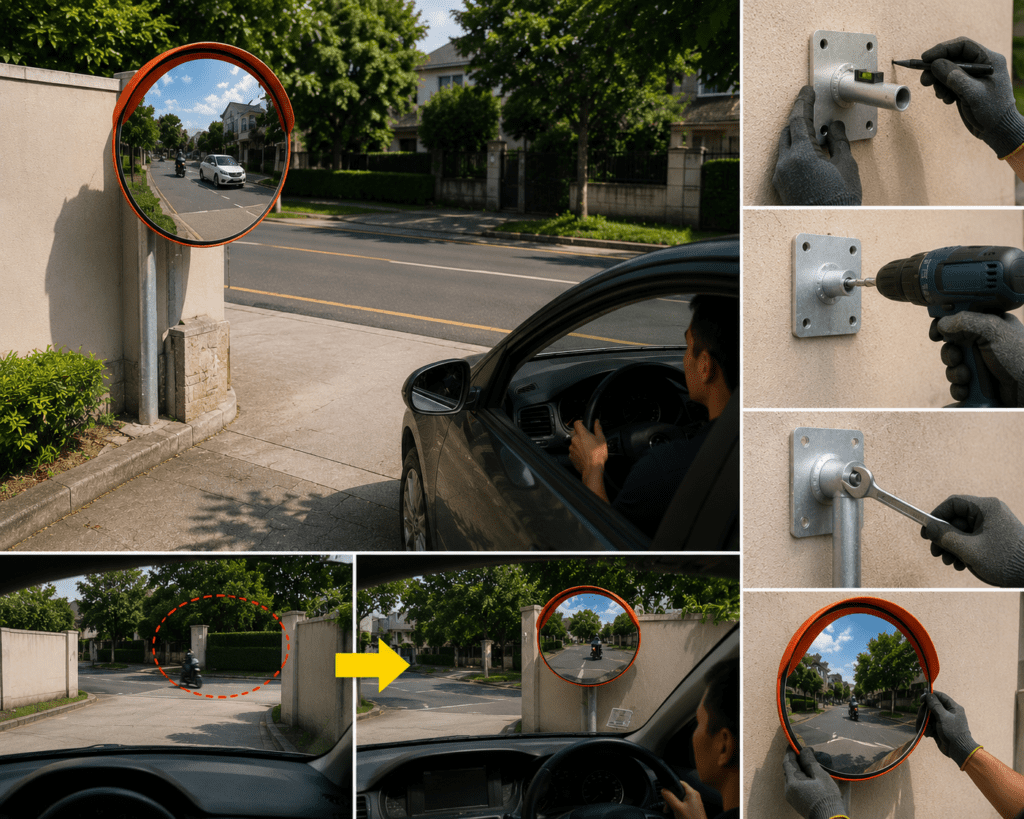
The installation should begin by selecting the exact wall location. The installer should mark the fixing points according to the mirror bracket. The marked points should be checked for alignment before drilling. The drill holes should match the wall plugs or anchors provided with the mirror. Once the holes are prepared, the bracket should be fixed firmly to the wall.
After the bracket is mounted, the convex mirror should be attached to the bracket according to the manufacturer’s instructions. The mirror should not be fully tightened immediately. It should remain adjustable until the correct viewing angle is set. The installer should then stand at the intended viewing point and adjust the mirror until the blind spot is clearly visible.
After adjustment, all screws, nuts, and bolts should be tightened. The mirror should be gently checked for movement. If it shakes, slips, or tilts too easily, the bracket may need stronger fixing. For outdoor wall-mounted mirrors, anti-rust hardware and weather-resistant brackets are important for long-term performance.
Installing a Convex Mirror on a Pole
Pole-mounted convex mirrors are widely used on streets, roads, industrial sites, driveways, parking areas, and public safety locations. This installation method is useful when there is no suitable wall near the blind spot or when the mirror needs to be positioned at a specific angle.
The pole must be installed securely before the mirror is attached. For permanent outdoor installation, the pole should be fixed into a stable base or concrete foundation. The pole should stand straight and resist movement. If the pole is weak or unstable, the mirror may vibrate, rotate, or fall in strong wind.
Once the pole is ready, the mirror bracket should be attached using pole clamps or mounting hardware. The bracket should fit the pole properly. Loose or mismatched clamps can cause the mirror to shift over time. The mirror should then be connected to the bracket and adjusted to show the required blind spot.
For road safety applications, pole-mounted convex mirrors should be positioned where they do not obstruct pedestrians, vehicles, signage, or visibility of other road features. The installation should also consider wind direction, road clearance, and possible vehicle impact. In busy commercial and municipal locations, protective bollards or barriers may be used around the pole if vehicle contact is possible.
Installing a Convex Mirror at a Driveway Exit
Driveway exits are one of the most common locations for convex mirror installation. A driveway mirror helps drivers see vehicles, pedestrians, motorcycles, bicycles, and other road users before entering the main street. This is especially useful where boundary walls, gates, parked cars, trees, or building edges block visibility.
The mirror should be installed opposite the driveway exit or at a position that reflects both sides of the street. The driver should be able to stop before entering the road and check the mirror clearly. The mirror angle should show the hidden traffic path, not only the driveway itself.
For residential driveways, a medium-size outdoor convex mirror may be enough. For commercial driveways, factory gates, school entrances, hospital exits, or logistics facilities, a larger road safety mirror may be required. The mirror should be weather-resistant and mounted securely because outdoor driveway mirrors are exposed to sun, rain, dust, wind, and vibration.
After installation, the driver’s view should be tested from inside an actual vehicle. This test is important because the viewing angle from a standing person may be different from the viewing angle from a seated driver. If the mirror does not clearly show approaching traffic from the driver’s position, the angle should be adjusted.
Installing a Convex Mirror in a Parking Lot
Parking lots need convex mirrors because visibility is often blocked by walls, parked vehicles, ramps, pillars, and tight corners. Convex parking mirrors are used at exits, entry points, basement ramps, turning areas, pedestrian crossings, and blind corners.
The mirror should be installed where drivers can check cross traffic before moving forward. At basement ramps, the mirror should show vehicles coming from the opposite direction before drivers enter the ramp. At parking exits, the mirror should show pedestrians and road traffic outside the exit. At blind turns inside parking areas, the mirror should show vehicles approaching from the hidden side.
For commercial parking areas, shopping malls, hospitals, hotels, office buildings, apartment complexes, and public parking facilities, durable convex mirrors are important because they may be used continuously throughout the day. The mirror should be large enough for the viewing distance and strong enough for the environment.
Lighting should also be considered. If the parking lot is dim, the mirror should be placed where it receives enough light to provide a clear reflection. In low-light areas, additional lighting may be needed near the mirror or blind spot.
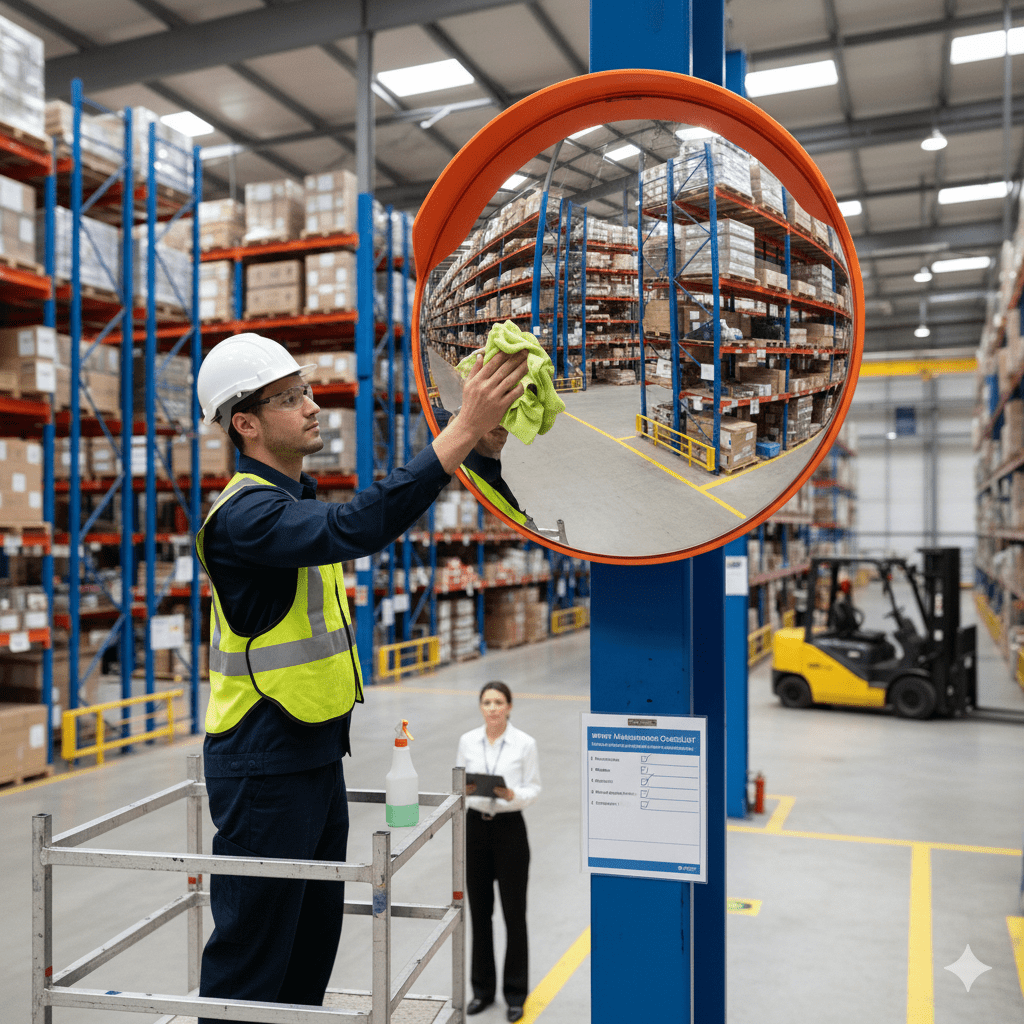
Installing a Convex Mirror in a Warehouse
Warehouses use convex mirrors to improve safety around forklifts, pallet movers, workers, delivery vehicles, storage racks, loading docks, and internal traffic routes. Blind corners inside warehouses can be dangerous because equipment and people often move at the same time.
The mirror should be installed at aisle intersections, rack corners, doorways, loading zones, and crossing points where visibility is restricted. The mirror angle should allow forklift operators and workers to see approaching movement before entering the intersection.
Warehouse convex mirrors should be strong, impact-resistant, and easy to clean. Polycarbonate mirrors are often preferred in areas where damage risk is high. Stainless steel mirrors may be used in harsher industrial environments. Wall-mounted or column-mounted installation is common in warehouses, depending on the layout.
The installation height should match the viewing level of forklift operators and pedestrians. If the mirror is too high, workers may not use it naturally. If it is too low, it may be hit by equipment or blocked by stored goods. Regular inspections are important because warehouse layouts change, and a mirror that was useful before may become blocked by pallets, racks, or inventory.
Installing a Convex Mirror on Roads and Streets
Road and street convex mirrors are usually installed to improve visibility at intersections, sharp bends, narrow roads, private road exits, village roads, mountain roads, and commercial streets. These installations require extra care because public traffic safety is involved.
The mirror should be placed where drivers can see hidden traffic before entering the risk area. At intersections, the mirror may need to show vehicles approaching from both directions. At sharp bends, it should show oncoming traffic around the curve. At narrow roads, it should help drivers detect vehicles before both sides enter the restricted space.
Outdoor road mirrors must be weather-resistant and stable. They should be installed with strong poles, anti-rust brackets, and secure fittings. The mirror surface should resist sunlight, rain, dust, and temperature changes. In areas with heavy wind or public exposure, stronger mounting systems may be needed.
For municipal road safety projects, installation should also consider local road rules, visibility standards, road authority approval, and public safety requirements. A convex traffic mirror should never distract drivers, block signs, or create confusion. It should support safe decision-making by clearly showing the blind spot.

Installing a Convex Mirror at a Factory Gate
Factory gates often have heavy vehicle movement, including trucks, vans, staff vehicles, motorcycles, and security traffic. Visibility may be blocked by boundary walls, guard rooms, gates, parked vehicles, or nearby roads. A convex mirror at a factory gate helps drivers and security staff monitor approaching traffic before entry or exit.
The mirror should be positioned to show the external road and internal gate area clearly. For large factories, mirrors may be needed on both sides of the gate or at multiple approach angles. Heavy-duty convex mirrors are usually recommended because factory gates experience frequent use and outdoor exposure.
The installation should allow truck drivers and smaller vehicle drivers to see the reflection clearly. Since truck drivers sit higher than car drivers, the mirror angle may need to be adjusted carefully. If both vehicle types use the gate, the mirror should be positioned to serve the most practical range of visibility.
For factories, convex mirrors are often installed along with speed bumps, road signs, security barriers, warning lights, and lane markings. Together, these products improve traffic control and reduce risk at busy entry and exit points.
Installing a Convex Mirror for Forklift Safety
Forklift movement creates serious safety risks in warehouses, factories, distribution centers, and loading areas. Forklifts can have limited visibility, especially when carrying loads. Blind corners and crossing aisles can become dangerous if operators cannot see pedestrians or other equipment.
A convex mirror for forklift safety should be installed at crossing points, aisle intersections, doorways, and loading areas. The mirror should allow operators to see movement from the side before entering the blind area. It should be positioned at a height suitable for forklift operators, not only for pedestrians.
The mirror should also be large enough for the distance and clear enough to show movement quickly. In busy forklift areas, impact-resistant mirrors are recommended. If the mirror is installed where equipment may hit it, protective placement and strong brackets are important.
Forklift safety mirrors should be checked regularly. If a mirror becomes misaligned, dirty, cracked, or blocked by inventory, it loses its value. In industrial safety management, convex mirrors should be included in regular site inspections.
Checking Visibility After Installation
After installing the convex mirror, visibility must be tested properly. This step should not be skipped. The installer should check the mirror from the actual viewing position, such as the driver’s seat, forklift operator path, pedestrian approach, or security control point.
The reflected image should show the blind spot clearly. It should help the user detect approaching vehicles, people, equipment, or traffic before reaching the danger area. If the mirror shows too much irrelevant area or does not show the hidden zone, the angle should be adjusted.
Testing should also be done at different times of the day if the mirror is outdoors. Sunlight, shadows, glare, rain, and night lighting can affect visibility. In some locations, the mirror may need a slightly different angle to reduce glare or improve reflection.
For commercial and public safety installations, it is useful to have more than one person test the mirror. A driver, site manager, security staff member, or safety officer can confirm whether the mirror solves the visibility problem. Practical testing is better than guessing from the installation ladder like civilization depends on vibes.
Common Installation Mistakes to Avoid
One common mistake is installing the convex mirror too far from the blind spot. If the mirror is too far away, the reflected image may be too small or unclear. Users may not be able to identify approaching vehicles or pedestrians in time.
Another mistake is choosing the wrong mirror size. A small mirror may be cheaper, but it may not provide enough visibility for wide roads, industrial sites, or long-distance viewing. In safety applications, saving a small amount on mirror size can reduce the effectiveness of the entire installation.
Incorrect angle is also a major issue. If the mirror is aimed too high, it may reflect the sky. If it is aimed too low, it may reflect the ground. If it faces the wrong direction, it may show a wall, parked car, or empty area instead of the actual blind spot.
Weak mounting is another problem. Outdoor mirrors must handle wind, rain, vibration, and daily exposure. If the bracket is weak or the surface is unstable, the mirror may move out of alignment. Once the mirror angle changes, the visibility benefit is reduced.
Another mistake is ignoring maintenance. A dirty, faded, cracked, or loose convex mirror cannot perform properly. Businesses should treat convex mirrors as active safety equipment, not decoration for lonely poles.
Maintenance After Installation
Convex mirrors require regular maintenance to stay effective. Outdoor mirrors collect dust, rain marks, pollution, bird droppings, and surface stains. Indoor mirrors can collect dust, fingerprints, warehouse dirt, and industrial residue. Cleaning helps maintain clear reflection.
The mirror should be cleaned with suitable materials that do not scratch the surface. Harsh chemicals or rough cloths may damage acrylic or polycarbonate mirrors. For stainless steel mirrors, cleaning should follow the manufacturer’s recommendations.
The mounting hardware should also be inspected. Screws, bolts, clamps, brackets, and poles can become loose over time, especially outdoors or in high-vibration environments. If the mirror moves from its original angle, it should be readjusted.
Facility managers should include convex mirror inspection in regular safety checks. In warehouses, factories, parking lots, schools, hospitals, and commercial properties, mirrors should be inspected after storms, site changes, construction work, or traffic incidents. If the mirror surface is damaged or the reflection becomes unclear, replacement may be required.

When to Replace a Convex Mirror
A convex mirror should be replaced when it no longer provides clear visibility or safe performance. Surface cracks, deep scratches, fading, cloudiness, broken frames, loose brackets, and distorted reflection are signs that replacement may be needed.
Outdoor convex mirrors may also need replacement if weather exposure damages the reflective surface. In high-traffic locations, mirrors may be hit by vehicles, equipment, or vandalism. A damaged mirror can give a poor reflection and reduce driver confidence.
For businesses and public facilities, delaying replacement can create safety risks. If the mirror is part of a traffic safety system, it should remain functional at all times. Replacing a damaged mirror is usually far cheaper than dealing with an accident, vehicle damage, injury claim, or operational disruption.
Safety Benefits of Proper Convex Mirror Installation
A properly installed convex mirror improves visibility and gives users more time to react. It helps drivers see around corners, check hidden traffic, avoid pedestrians, detect motorcycles, manage parking exits, and move safely through narrow areas. In industrial and commercial locations, it helps prevent collisions between vehicles, forklifts, workers, and equipment.
For road safety suppliers and B2B buyers, convex mirrors are valuable because they are affordable, simple to install, and useful in many environments. They improve safety without requiring complex technology or major infrastructure changes.
Correct installation increases the value of the product. A high-quality convex mirror installed correctly can serve for years and support daily safety. A mirror installed carelessly may fail within days or provide little benefit. The difference is not only the product, but also the planning, positioning, mounting, and testing.
Final Thoughts
Installing a convex mirror is a simple but important safety improvement for streets, driveways, parking lots, warehouses, factories, schools, hospitals, residential communities, and commercial properties. The key steps are choosing the right location, selecting the correct mirror size and material, using strong mounting hardware, setting the proper height, adjusting the viewing angle, and checking visibility after installation.
A convex mirror should always be installed to solve a real blind spot problem. It should be visible from the user’s approach position and should clearly show hidden vehicles, pedestrians, cyclists, forklifts, or road traffic. When installed correctly, it improves awareness, reduces accident risks, supports smoother traffic flow, and creates safer movement for everyone using the area.
For B2B buyers, contractors, facility managers, and road safety planners, convex mirror installation is a low-cost safety measure with long-term value. Whether it is used as a road safety mirror, outdoor convex mirror, driveway mirror, parking lot mirror, warehouse safety mirror, or industrial traffic mirror, proper installation makes all the difference.
Looking for a custom convex mirror manufacturer or supplier? Struggling to find the right factory to bring your vision to life? We’ve got you covered! At our place, we craft top-quality convex mirrors with precision and care. Big or small, your needs are our mission. Let’s launch your mirror project and take your product line to the next level! Click here to contact