Welcome to Shanghai Jessubond International CO.,Ltd.
What is a convex safety mirror used for?
What is a convex safety mirror used for?
A convex safety mirror is one of those products that looks deceptively simple from the outside. It is a curved reflective surface mounted on a wall, pole, or ceiling. It costs a fraction of what most safety technology investments cost. It requires no power, no software, no ongoing subscription, and minimal maintenance. And yet, across warehouses, logistics yards, retail stores, hospitals, manufacturing plants, public roads, and parking facilities worldwide, it is one of the most relied-upon safety tools in the built environment.
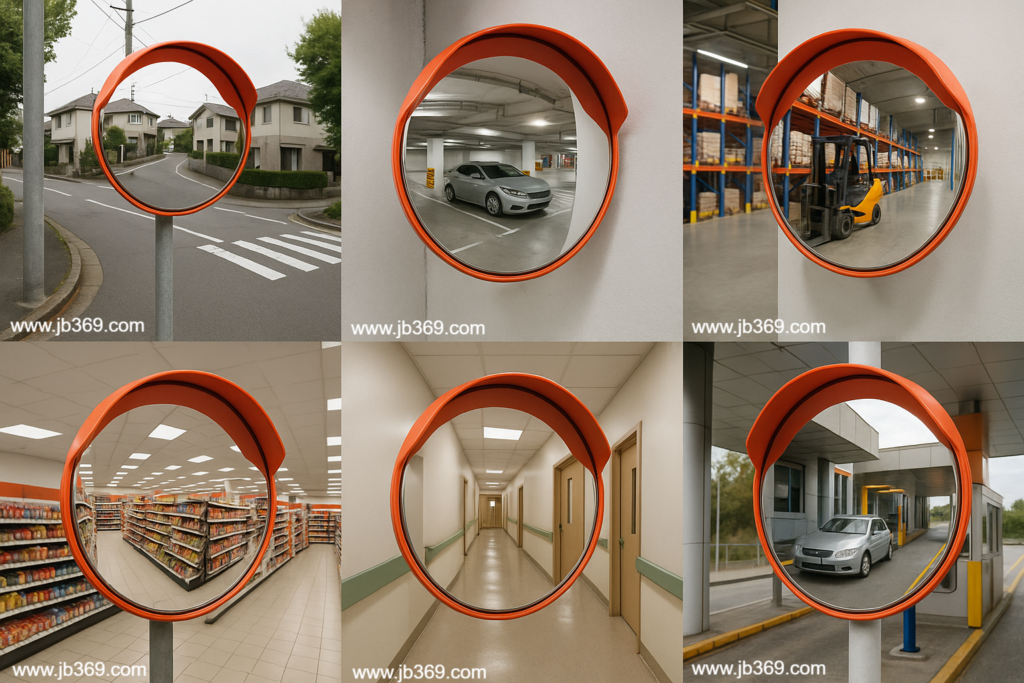
Convex safety mirrors are predominantly used in traffic management to reduce blind spots, in retail establishments to deter theft and prevent accidents, and in warehouses and industrial environments to enhance visibility and reduce the risk of collisions. For B2B buyers, procurement managers, EHS officers, and safety equipment distributors, understanding the full range of applications for convex safety mirrors is the foundation of making well-informed sourcing and specification decisions.
This article covers what a convex safety mirror is, how it works, and the complete landscape of B2B applications where it delivers measurable safety value across commercial and industrial environments.
What Is a Convex Safety Mirror
A convex safety mirror is a wide-angle mirror with an outward-curving reflective surface. Unlike a flat mirror, which reflects only what is directly in front of it at a one-to-one ratio, a convex mirror curves outward to spread the reflected image across a significantly wider arc. This gives the viewer a panoramic perspective of the surrounding area, compressing a much larger field of view into the visible reflected image.
The curvature of the lens determines the field of view. Standard convex safety mirrors for commercial and industrial use typically deliver a viewing angle between 130 and 160 degrees. Wide-angle convex safety mirrors for specific applications can deliver up to 180 degrees of panoramic coverage. Full-dome safety mirrors, which are a related product category, deliver 360-degree overhead coverage from a single ceiling-mounted unit.
Objects reflected in a convex safety mirror appear smaller than they would in a flat mirror, because the same reflective surface area is covering a much larger actual area. This is the trade-off that comes with the wide-angle advantage, and it is why correct mirror sizing for the viewing distance is a critical part of any convex safety mirror specification.
“A well-placed convex safety mirror does not just show drivers and workers what is around the corner. It changes the risk profile of an entire intersection, aisle, or driveway exit by converting a blind spot into a monitored zone.”
convex mirror for roadway traffic safety
The Primary Uses of Convex Safety Mirrors Across B2B Environments
1. Driveway Exit Blind Spot Elimination
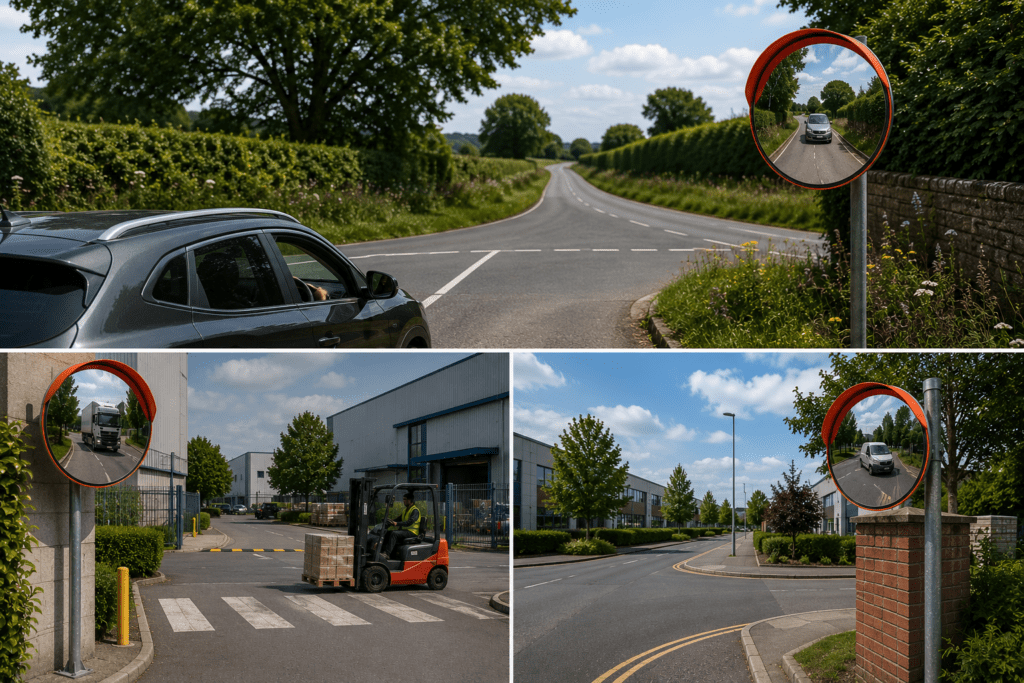
The most widespread single application for outdoor convex safety mirrors in the B2B context is the elimination of blind spots at commercial and industrial driveway exits onto public roads. When a vehicle exits a facility driveway onto a road where approaching traffic is obscured by walls, hedgerows, buildings, or road geometry, a correctly positioned and sized convex road safety mirror allows the driver to see approaching traffic before pulling out of the exit.
a. Commercial Property Driveway Mirrors
Retail parks, office complexes, logistics facilities, healthcare campuses, and manufacturing sites all share the same fundamental driveway safety challenge. Vehicles exiting onto public roads need sightlines that the physical environment does not naturally provide. Outdoor convex driveway safety mirrors for commercial properties are the standard engineering control for this hazard, and they are a routine specification in commercial property safety audits and planning approval conditions.
b. Industrial and Logistics Facility Driveway Mirrors
For logistics facilities and distribution centers where heavy goods vehicles exit driveways onto public roads multiple times per day, the sightline challenge is amplified by the height and length of the vehicles involved. Truck cab driver eye levels are significantly higher than car driver eye levels, requiring mirror mounting heights and sizes to be specified accordingly. Large-format outdoor convex safety mirrors for HGV driveway exits, typically 36 inches to 48 inches in diameter, are the correct specification for these applications.
60cm Convex Traffic Mirror – Best Use Cases and Specifications
2. Road Junction and Intersection Visibility
Beyond individual driveway exits, convex road safety mirrors are widely installed at road junctions and intersections where sightlines are structurally limited by terrain, buildings, or vegetation. Municipal road safety programs, highway departments, and local authorities specify convex traffic mirrors at rural junctions with restricted visibility, sharp bends on minor roads where oncoming vehicles cannot be seen until dangerously close, and residential street intersections where building lines create blind corners.
a. Rural Road Junction Mirrors
Rural road junctions where hedgerows, trees, walls, or terrain features block driver sightlines are among the highest-risk intersection types for vehicle collisions. Convex road junction safety mirrors installed on posts opposite the give-way point allow drivers to see approaching traffic on the main road before committing to the junction. These are a standard specification in rural road safety improvement programs and a routine procurement item for local authority highways departments and road safety contractors.
b. Internal Site Road Junction Mirrors
Within industrial estates, manufacturing campuses, logistics parks, and hospital sites, internal road networks create their own junction hazard profile. Vehicles, forklifts, pedestrians, and cyclists may share the same internal road network. Convex safety mirrors for internal site road junctions are a standard element of site traffic management plans and workplace transport safety assessments.
Road Junction and Intersection Visibility
3. Forklift and Pedestrian Conflict Zone Management
One of the highest-demand B2B applications for convex safety mirrors is inside warehouses, distribution centers, and manufacturing facilities where forklifts and pedestrian workers share the same floor space. Racking aisle intersections, facility entrance points, loading dock approach zones, and cross-aisle junctions are all locations where forklift operators have limited or zero visibility of approaching pedestrians until the point of potential collision.
a. Warehouse Aisle Intersection Mirrors
Convex safety mirrors for warehouse aisle intersections are a recognized engineering control for forklift and pedestrian collision hazard mitigation. OSHA guidelines on powered industrial truck safety and pedestrian separation in industrial facilities directly drive demand for correctly specified and positioned convex aisle intersection mirrors. For EHS managers conducting workplace transport risk assessments, blind aisle intersections without mirror coverage represent a documented hazard that requires a control measure.
b. Loading Dock and Bay Approach Mirrors
Loading docks present a specific blind spot challenge where trucks reverse into bays, dock levelers are raised and lowered, and pedestrian workers move between bays. Convex safety mirrors positioned at loading dock approach points allow both truck drivers and ground-level dock workers to monitor the approach zone before moving into it. Wide-angle convex safety mirrors for loading dock applications, typically 24 inches to 30 inches in diameter, are a standard specification in distribution center safety equipment programs.
4. Manufacturing Plant Internal Road and Pedestrian Safety
Manufacturing plants and heavy industrial sites often operate internal road networks used simultaneously by heavy goods vehicles, fork trucks, personnel vehicles, and on-foot workers. Blind corners between buildings, at facility entrance gates, and at internal road junctions create collision risk that internal site traffic management plans are required to address.
a. Factory Site Internal Road Mirrors
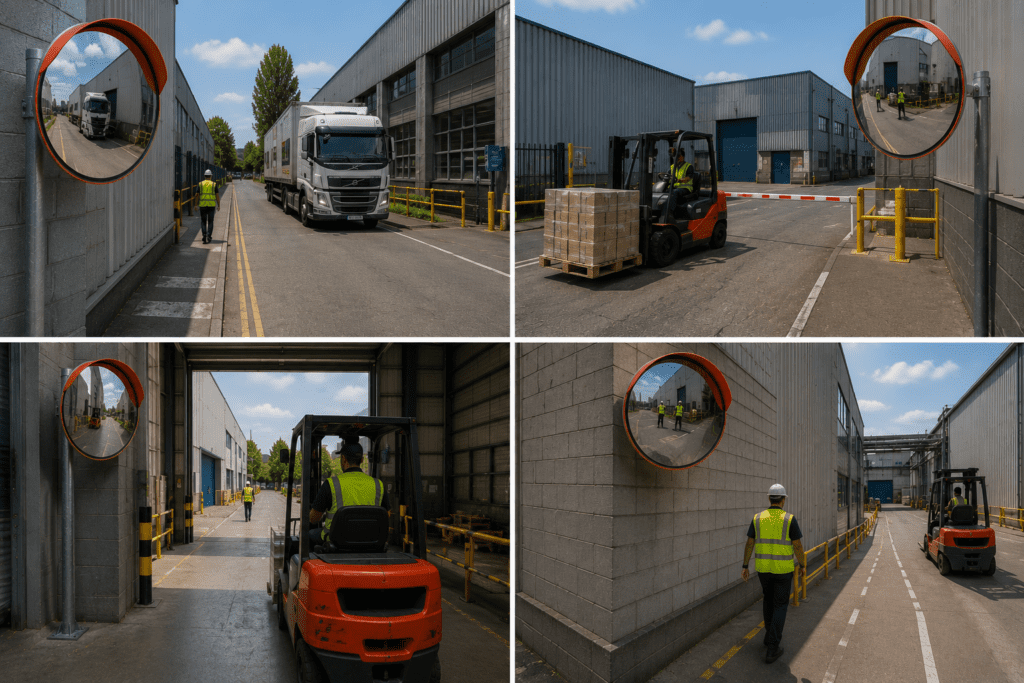
Convex safety mirrors for factory site internal roads are specified at building corner blind spots, internal road junctions, gate entry and exit points, and anywhere on the site road network where driver sightlines are restricted by structures or equipment. For procurement managers sourcing safety equipment for large manufacturing sites, bulk convex safety mirror procurement for internal road networks is a significant recurring category.
b. Blind Corner Mirrors for Industrial Sites
Building corners on industrial sites are among the most consistently hazardous blind spots in any facility environment. A vehicle or forklift emerging from around a building corner has zero visibility of pedestrians or other vehicles approaching from the perpendicular direction until the moment of potential collision. Convex blind corner safety mirrors mounted at building corners on industrial sites are the standard engineering control for this hazard and are universally specified in site traffic management documentation.
Manufacturing Plant Internal Road and Pedestrian Safety
5. Retail Loss Prevention and Store Safety
The application of convex mirrors has increased in ATMs and surveillance points, educational institutions and commercial stores for added security and determent of shoplifters. For retail loss prevention managers and store operations teams, convex security mirrors serve two simultaneous functions: they deter opportunistic theft by making shoppers and staff aware that blind areas are monitored, and they improve general store safety by giving staff visibility of aisles and areas that would otherwise be out of sightline.
a. Retail Store Aisle and Corner Mirrors
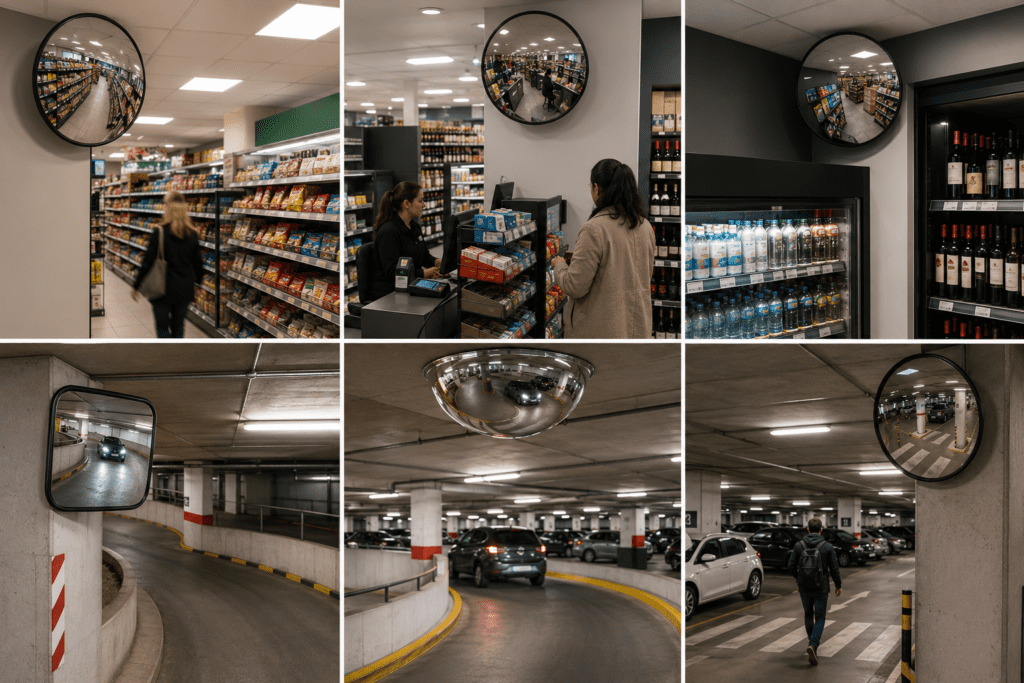
Large format retail, convenience stores, pharmacies, and off-licences all use convex security mirrors for aisle coverage, checkout area monitoring, and corner visibility. For retail procurement teams and facilities managers sourcing safety and security equipment across multiple store locations, convex safety mirrors for retail environments represent a high-volume, recurring procurement category. Indoor convex safety mirrors for retail use are typically acrylic construction in 18-inch to 24-inch diameter, providing a good balance of optical clarity and cost efficiency for indoor commercial environments.
b. Parking Facility and Multi-Storey Car Park Mirrors
Retail and commercial parking facilities are a major application sector for convex safety mirrors. Ramp junctions in multi-storey car parks, tight corner turns at parking deck level transitions, and pedestrian crossing points within parking structures all benefit from correctly positioned convex parking facility safety mirrors. Half-dome ceiling-mounted convex mirrors are particularly effective in covered parking structures where ceiling mounting is possible and 180-degree overhead coverage of a junction or ramp is required from a single mirror unit.
Retail Loss Prevention and Store Safety
6. Hospital and Healthcare Campus Safety
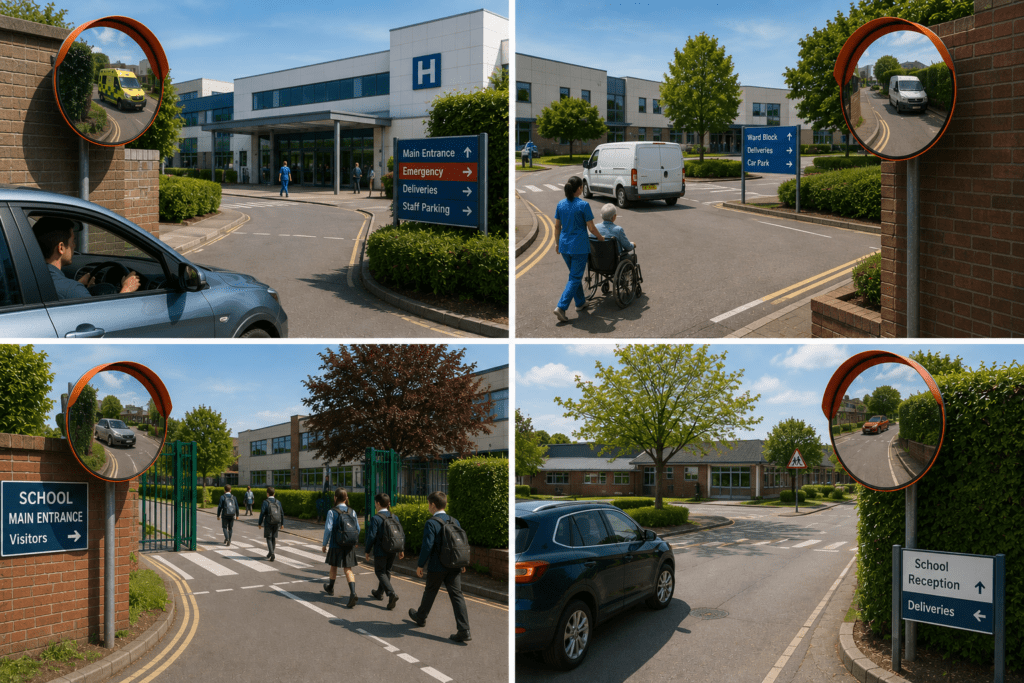
Hospital campuses present a uniquely complex traffic environment. Ambulances, patient transport vehicles, staff cars, delivery trucks, and large numbers of pedestrians including patients with mobility challenges all share the same driveway and access road infrastructure. Convex safety mirrors for hospital driveways and campus road junctions are a standard component of healthcare facility traffic management plans.
a. Hospital Driveway and Access Road Mirrors
The mix of emergency and routine vehicle movements on hospital sites, combined with the presence of vulnerable pedestrians including patients in wheelchairs, on crutches, or accompanied by medical equipment, makes sightline management at hospital driveway junctions a patient safety issue as well as a general road safety compliance matter. Wide-angle outdoor convex safety mirrors for hospital access roads are typically specified at 30 inches to 36 inches in diameter to provide adequate viewing distance coverage for the scale of hospital site road junctions.
b. School Zone and Educational Campus Mirrors
School driveways and campus access roads combine high pedestrian density, vehicles driven by parents who may be unfamiliar with the site layout, and delivery vehicles, during the busiest periods of the school day. Convex safety mirrors for school zone driveways and educational campus junctions are a standard element of school travel plan safety assessments and a routine procurement item for local authority education facilities teams.
Hospital and Healthcare Campus Safety
7. ATM and Financial Services Security
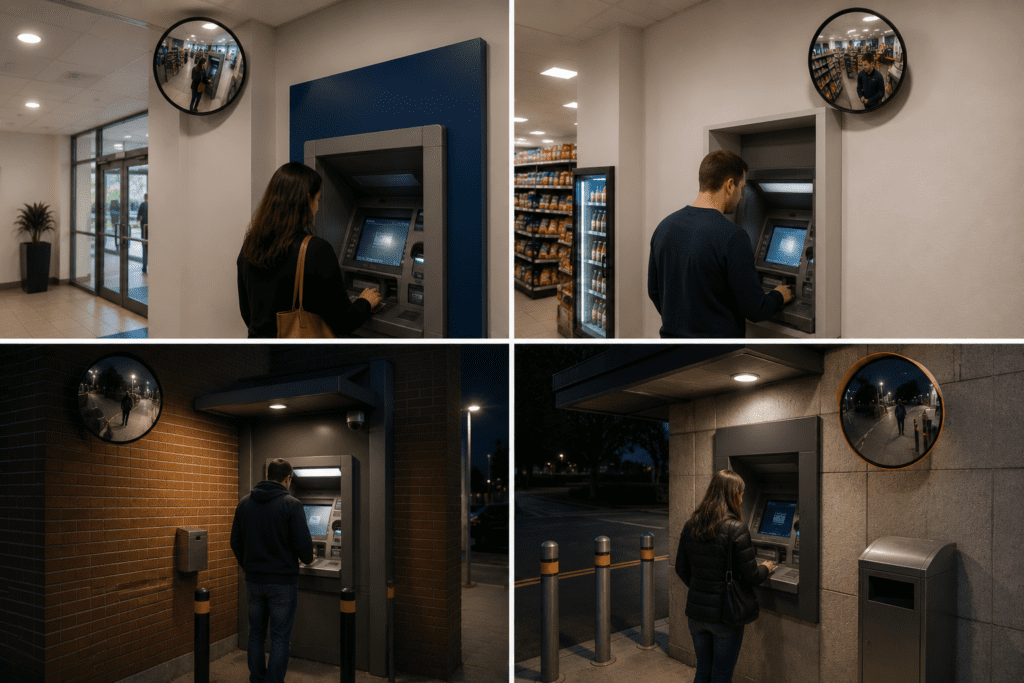
The application of convex safety mirrors has increased in ATMs and surveillance points. Convex security mirrors installed at ATM locations allow users to monitor their immediate surroundings while conducting transactions, providing a deterrent to opportunistic crime and improving personal security awareness. For banks, building societies, and independent ATM operators sourcing security equipment for ATM locations, convex security mirrors are a low-cost, zero-maintenance security enhancement.
a. Indoor ATM Location Mirrors
Indoor ATM locations in bank branches, supermarkets, and convenience stores use small-format convex security mirrors, typically 12 inches to 18 inches in diameter, positioned to give ATM users a reflected view of the immediate area behind them. These mirrors serve a personal security function for ATM users and contribute to the overall security environment of the installation location.
b. Outdoor ATM Security Mirrors
Outdoor ATM installations face a broader security environment challenge. Convex security mirrors for outdoor ATM locations are specified for weather resistance as well as optical performance, with polycarbonate or stainless steel construction appropriate depending on the exposure level and vandalism risk of the specific location.
ATM and Financial Services Security
8. Food Production and Clean Room Facility Applications
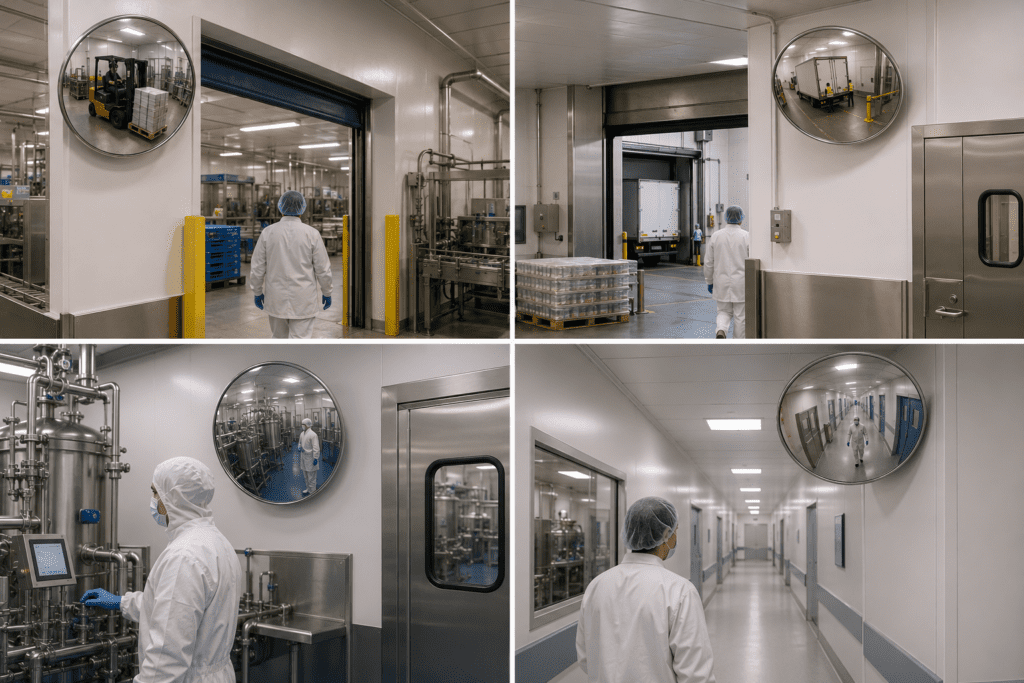
Food and beverage manufacturing facilities, pharmaceutical production environments, and clean room industrial settings present a specialist application context for convex safety mirrors. In these environments, hygiene compliance requirements mean that standard acrylic or polycarbonate mirrors may not be appropriate, and stainless steel convex safety mirrors are the specified product.
a. Stainless Steel Convex Mirrors for Food Manufacturing
Stainless steel convex safety mirrors for food production facility driveways, internal access roads, and loading areas meet hygiene compliance requirements that plastic alternatives cannot. Grade 316 stainless steel is the standard specification for food manufacturing environments because its molybdenum content provides corrosion resistance to the cleaning chemicals routinely used in food production facility maintenance programs.
b. Pharmaceutical and Clean Room Facility Mirrors
Pharmaceutical manufacturing and clean room environments specify convex safety mirrors that can withstand frequent chemical cleaning without surface degradation. Stainless steel convex mirrors with smooth, non-porous surfaces that can be disinfected without damage are the correct product specification for these applications.
Food Production and Clean Room Facility Applications
The Market Context for Convex Safety Mirror Procurement
The scale of the convex safety mirror market reflects the breadth and depth of B2B demand across these application sectors. The safety mirrors market size stands at USD 78.5 billion in 2025 and is projected to reach USD 127.9 billion by 2035, growing at 5.0% CAGR, with convex mirrors representing the leading product segment.
This growth is primarily driven by increasing safety concerns across various sectors including traffic management, industrial safety, and retail security, alongside rising demand for traffic and road safety measures and technological advancements in mirror materials such as polycarbonate enhancing durability and visibility.
For safety equipment distributors and procurement managers, this market trajectory confirms that convex safety mirror demand across B2B sectors is not a static or declining category. It is a growing market driven by tightening workplace safety regulation, increasing commercial property development, expanding logistics infrastructure, and rising awareness of the total cost of workplace accidents.
Conclusion: A Versatile Safety Tool Across the Entire B2B Landscape
The convex safety mirror is used for one fundamental purpose across every one of its B2B applications: converting a blind spot into a monitored zone. Whether that blind spot is a driveway exit onto a busy road, a warehouse aisle intersection where a forklift and a pedestrian might meet, a retail store corner where shoplifters operate, or a hospital campus junction where ambulances and pedestrians share the same access road, the convex safety mirror delivers the same core safety benefit.
For B2B procurement teams, EHS managers, facilities contractors, and safety equipment distributors, the practical implication is straightforward. Any environment where vehicles and pedestrians share space, where sightlines are restricted by physical structures or terrain, or where security coverage of blind areas is a compliance or loss prevention requirement, is a potential convex safety mirror application. Getting the size, material, and positioning right for each specific application is what transforms that potential into a genuine, measurable safety outcome.
Looking for a custom convex mirror manufacturer or supplier? Struggling to find the right factory to bring your vision to life? We’ve got you covered! At our place, we craft top-quality convex mirrors with precision and care. Big or small, your needs are our mission. Let’s launch your mirror project and take your product line to the next level! Click here to contact