
If you manage a warehouse, logistics facility, commercial property, or municipal infrastructure, blind spots are not just an inconvenience, they are a liability. Every unmonitored corner, every obscured intersection, and every narrow aisle with limited sightlines is a potential accident waiting to happen. That is exactly where traffic mirrors come in.
Traffic mirrors are one of the most cost-effective, low-maintenance, and instantly deployable road safety tools available to facility managers, procurement teams, safety officers, and infrastructure planners. Yet many B2B decision-makers overlook them in favor of technology-heavy solutions, not realizing that a well-placed convex safety mirror can eliminate dangerous blind spots faster and cheaper than almost anything else on the market.
This guide breaks down what traffic mirrors are, how they work, where they are used across industries, what to look for when sourcing them in bulk, and why they should be part of every commercial road safety compliance strategy.
What Is a Traffic Mirror?
A traffic mirror is a wide-angle reflective device installed at locations where natural sightlines are obstructed. The most common type is the convex traffic mirror, which features an outward-curving reflective surface that expands the field of view significantly beyond what a flat mirror could provide.
Because the surface curves outward, light is reflected across a broader arc, giving the viewer a panoramic perspective of areas that would otherwise be hidden. A standard convex road safety mirror can offer a viewing angle of up to 160 degrees, allowing drivers, forklift operators, and pedestrians to see around corners, through narrow aisles, and across busy intersections before entering a potential collision zone.
Traffic mirrors are also known by several related terms across the B2B procurement space:
- Convex safety mirrors
- Wide-angle road mirrors
- Industrial blind spot mirrors
- Driveway safety mirrors
- Outdoor security mirrors
- Warehouse visibility mirrors
- Corner safety mirrors for facilities
Understanding these terminology variations matters when sourcing products, writing procurement specifications, or aligning purchasing decisions with OSHA workplace safety standards and local traffic safety compliance requirements.

How Does a Traffic Mirror Work?
The physics behind a convex traffic mirror are straightforward but powerful. When light from objects within the mirror’s field of view hits the curved reflective surface, it diverges outward. This divergence is what creates the wide-angle panoramic image.
Unlike flat mirrors that only reflect what is directly in front of them at a one-to-one ratio, a convex outdoor driveway mirror compresses a much larger area into the reflected image. Objects appear smaller but significantly more of the surrounding environment is visible at once.
This is particularly useful in:
- Forklift and pedestrian conflict zones inside distribution centers
- Loading dock blind spots where trucks back in without full sightlines
- Parking lot corner mirrors at commercial properties
- Narrow road intersections on industrial estates or logistics parks
- Building exit points where vehicles emerge onto shared pedestrian pathways
The wider the curvature, the broader the field of view, but also the smaller objects appear. For this reason, selecting the right size traffic mirror for the right viewing distance is a critical part of the procurement decision. Most commercial-grade convex traffic mirrors for warehouses are sized between 12 inches and 36 inches in diameter, with larger mirrors required for longer viewing distances.
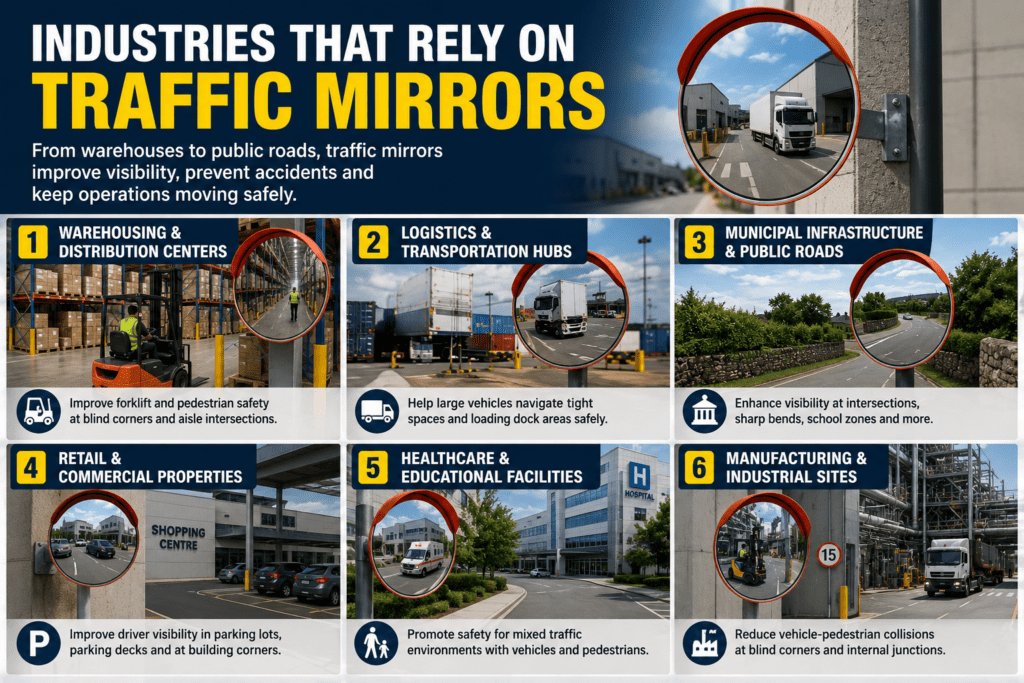
Key Industries That Rely on Traffic Mirrors
Traffic mirrors are not limited to roadside installations. Across the B2B landscape, they serve a diverse range of industries and facility types.
1. Warehousing and Distribution Centers
One of the highest-demand applications for industrial blind spot mirrors is inside warehouses and fulfillment centers. With forklifts, pallet jacks, and pedestrian workers sharing the same floor space, blind corners in racking aisles are a significant injury risk.
OSHA guidelines around forklift safety and pedestrian separation directly drive demand for convex safety mirrors for distribution centers. Facility safety auditors and EHS (Environmental Health and Safety) managers routinely specify mirror placement at aisle intersections, loading dock approaches, and facility entrance points as part of workplace hazard mitigation programs.
For bulk procurement managers sourcing safety equipment for large fulfillment operations, wholesale convex mirrors for warehouse facilities represent a high-volume, recurring purchasing category.
2. Logistics and Transportation Hubs
Truck depots, freight terminals, and intermodal logistics hubs all feature environments where large vehicles operate in confined spaces with limited driver visibility. Traffic safety mirrors for loading docks help truck drivers judge clearance distances, avoid collision with dock structures, and safely navigate tight yard layouts.
In facilities where driver turnaround speed is a key performance metric, eliminating blind spots with well-placed outdoor safety mirrors directly supports operational efficiency alongside safety compliance.
3. Municipal Infrastructure and Public Roads
Local governments, highway departments, and municipal contractors are significant B2B buyers of outdoor convex road mirrors for public intersections. These are commonly installed at:
- Rural road junctions with limited sightlines caused by hedgerows, walls, or terrain
- Sharp bends on minor roads and residential streets
- School zone crossings and pedestrian-heavy urban intersections
- Parking facility exits onto public roads
For suppliers and distributors targeting the public sector, compliance with local traffic authority specifications and weather resistance standards are the primary procurement criteria. Galvanized steel traffic mirrors with UV-resistant polycarbonate lenses are the most commonly specified product for outdoor municipal applications.
4. Retail and Commercial Properties
Shopping centers, retail parks, and large commercial premises use parking lot convex safety mirrors to improve driver visibility at multi-lane entrances, tight parking deck ramps, and building corner blind spots.
Property management companies and facilities maintenance contractors often source these mirrors through wholesale safety equipment distributors as part of broader property safety compliance programs. The ability to offer bulk pricing on commercial safety mirrors with consistent lead times is a key differentiator for distributors serving this market.
5. Healthcare and Educational Facilities
Hospitals, university campuses, and school grounds present unique traffic safety challenges. Mixed traffic environments, where ambulances, delivery vehicles, staff cars, and pedestrians coexist, demand careful sightline management. Wide-angle safety mirrors for hospital driveways and convex mirrors for school parking zones are a growing procurement category as institutions strengthen their duty-of-care obligations.
6. Manufacturing and Industrial Sites
Heavy manufacturing plants and industrial estates often have internal road networks used by heavy goods vehicles, forklifts, and site personnel simultaneously. Industrial traffic mirrors for factory sites reduce the risk of vehicle-pedestrian collisions, particularly at blind corners near facility entry points, between buildings, and at internal road junctions.
Types of Traffic Mirrors Available for B2B Procurement
Understanding the product landscape is essential for procurement teams evaluating options:
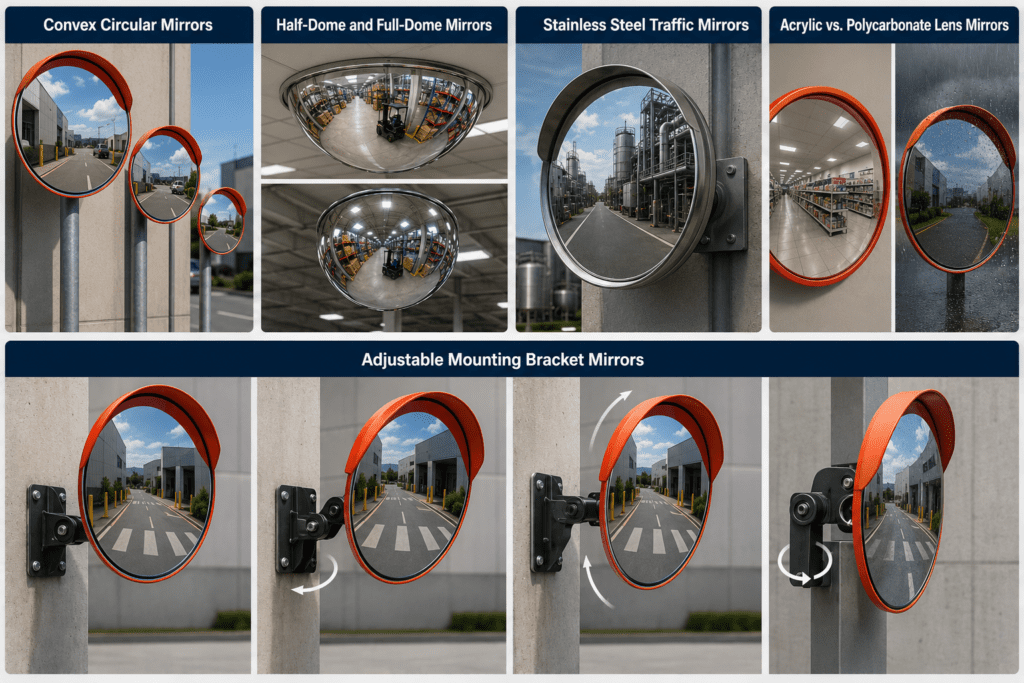
Convex Circular Mirrors
The most widely used type. Available in diameters from 12 to 48 inches, suitable for both indoor and outdoor applications. The standard choice for bulk purchase of safety mirrors for warehouses and parking facilities.
Half-Dome and Full-Dome Mirrors
Dome mirrors provide 180-degree or 360-degree panoramic coverage respectively. These are particularly effective for indoor retail security and warehouse intersection monitoring. Full-dome security mirrors for distribution centers are a premium option for high-traffic intersections where coverage from all directions is required.
Stainless Steel Traffic Mirrors
For outdoor environments with high exposure to weather, vandalism, or corrosive industrial atmospheres, stainless steel convex road mirrors offer superior durability. These are preferred in coastal locations, chemical plants, and food processing facilities where stainless is required for hygiene compliance.
Acrylic vs. Polycarbonate Lens Mirrors
- Acrylic mirrors offer excellent optical clarity at a lower price point, suitable for indoor retail and light commercial use
- Polycarbonate convex mirrors for outdoor use are impact-resistant, UV-stabilized, and better suited for harsh weather environments and industrial settings
Adjustable Mounting Bracket Mirrors
For facilities where installation angles need to be modified after installation, adjustable bracket traffic safety mirrors provide flexibility. These are particularly valued by facility managers who want the ability to optimize mirror placement without replacing the mounting hardware.
What to Look for When Sourcing Traffic Mirrors in Bulk
For procurement managers, safety equipment buyers, and facilities contractors, several key criteria determine supplier selection for bulk traffic mirror orders:
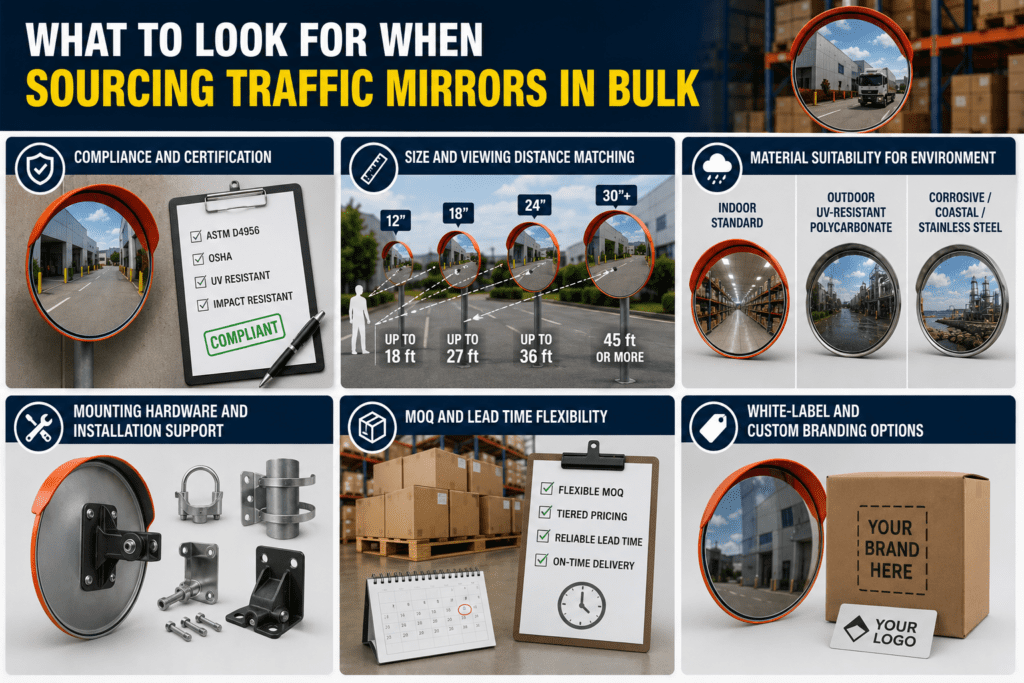
Compliance and Certification
The most professionally credible suppliers will provide products that meet relevant safety and materials standards. Look for:
- ASTM D4956 compliance for retroreflective materials
- OSHA-aligned specifications for industrial safety equipment
- UV resistance certification for outdoor polycarbonate mirrors
- Impact resistance ratings appropriate for the installation environment
Size and Viewing Distance Matching
Sourcing the wrong size mirror for the viewing distance is one of the most common procurement mistakes. A reputable B2B supplier of traffic safety mirrors will provide clear guidance on optimal mirror diameter based on the required viewing distance:
- 12-inch mirrors: effective up to approximately 18 feet
- 18-inch mirrors: effective up to approximately 27 feet
- 24-inch mirrors: effective up to approximately 36 feet
- 30-inch and above: designed for long-distance visibility at 45 feet or more
Material Suitability for Environment
Indoor versus outdoor, standard versus corrosive environment, and standard versus anti-vandal specifications all affect the appropriate product selection.
Mounting Hardware and Installation Support
For large-scale facility deployments, traffic mirror installation hardware packages and technical support from the supplier reduce installation time and costs. Leading commercial safety mirror suppliers offer complete mounting kits, pole-mount options, and wall-bracket configurations.
MOQ and Lead Time Flexibility
For distributors and procurement managers purchasing at scale, minimum order quantities, tiered pricing structures, and reliable lead times are critical evaluation criteria. Wholesale traffic mirror suppliers with flexible MOQ policies are preferred by contractors managing multiple site deployments simultaneously.
White-Label and Custom Branding Options
Some B2B distributors require custom-branded road safety mirrors for resale or for corporate facility branding programs. Manufacturers offering white-label services with custom color, logo, or packaging options add significant value for these buyers.
Traffic Mirrors and Workplace Safety Compliance
For EHS managers and safety compliance officers, traffic mirrors are not just a convenience purchase, they are a documented component of hazard mitigation programs.
OSHA’s General Duty Clause requires employers to provide a workplace free from recognized hazards. In environments where forklifts and pedestrians share space, forklift blind spot mirrors for OSHA compliance are a straightforward and auditor-recognized control measure.
Beyond OSHA, ISO 45001 occupational health and safety management systems encourage organizations to implement engineering controls to reduce workplace risks. Traffic mirrors qualify as an engineering control because they physically modify the environment to reduce hazard exposure, rather than relying on administrative procedures or personal protective equipment alone.
For companies operating across multiple sites, having a standardized traffic mirror specification for multi-site facility safety programs ensures consistent compliance levels and simplifies maintenance and replacement procurement.
How to Calculate How Many Traffic Mirrors Your Facility Needs
A practical approach to traffic mirror deployment planning involves a structured site assessment:
- Map all vehicle and pedestrian traffic routes within the facility or site
- Identify blind spots and restricted sightline zones at intersections, corners, and exit points
- Assess viewing distance requirements at each identified location to determine appropriate mirror size
- Determine indoor versus outdoor installation requirements and specify materials accordingly
- Check local compliance requirements for any public road interfaces or regulated work environments
- Develop a mirror placement schedule with priority ranking based on accident risk severity
For large distribution centers or multi-building industrial campuses, partnering with a commercial safety mirror supplier offering site assessment support can significantly streamline this process.
The ROI Case for Traffic Mirrors in Commercial Facilities
For B2B buyers who need to justify safety equipment investment to finance or operations leadership, the return on investment case for traffic mirrors is straightforward.
The average cost of a workplace vehicle accident includes direct costs such as medical treatment, equipment repair, and regulatory fines, as well as indirect costs including lost productivity, insurance premium increases, reputational damage, and potential legal liability. A single serious forklift-pedestrian collision can easily generate six-figure costs.
A commercial-grade convex safety mirror for warehouse use costs a fraction of that risk exposure. For facilities sourcing mirrors at bulk wholesale pricing, the cost-per-installation is typically well under $200 per mirror, with a service life of five to ten years for quality polycarbonate or stainless steel units.
The math for procurement decision-makers is compelling. A relatively modest investment in industrial blind spot prevention equipment generates measurable risk reduction that typically satisfies safety audit requirements, reduces insurance claim frequency, and supports a documented duty-of-care record.
Conclusion: Traffic Mirrors as a Strategic Safety Infrastructure Investment
Traffic mirrors occupy an important place in the B2B road safety equipment landscape precisely because they are simple, reliable, cost-effective, and immediately impactful. Whether you are equipping a single warehouse facility, rolling out a multi-site safety improvement program, or supplying safety products to municipalities and commercial property managers, convex traffic mirrors for commercial and industrial use deliver measurable value with minimal ongoing maintenance requirements.
For procurement managers, EHS officers, facility managers, and safety equipment distributors, the key takeaways are clear. Invest in the right size and material for each specific installation environment. Source from suppliers who can demonstrate compliance certifications and offer reliable bulk pricing. Treat traffic mirror placement as a structured engineering control within your broader workplace safety management system, not just an ad-hoc purchase.
The road to a safer facility starts with being able to see what is around the corner. Traffic mirrors make that possible.
Looking for a custom convex mirror manufacturer or supplier? Struggling to find the right factory to bring your vision to life? We’ve got you covered! At our place, we craft top-quality convex mirrors with precision and care. Big or small, your needs are our mission. Let’s launch your mirror project and take your product line to the next level! Click here to contact