
Dome mirrors are important safety and visibility products used in places where people need to see more than one direction at the same time. They are commonly installed in warehouses, factories, hospitals, schools, retail stores, parking areas, office buildings, corridors, public facilities, transport terminals, and industrial sites. Their main purpose is to reduce blind spots, improve awareness, prevent collisions, support security monitoring, and make movement safer in busy areas.
A dome mirror is a curved safety mirror that gives a wide-angle view of the surrounding area. Unlike a flat mirror, which shows only one direct reflection, a dome mirror can reflect a much wider space. Depending on its design, it can show two directions, three directions, or a full 360-degree view. This makes dome mirrors highly useful in locations where people, forklifts, pallet trucks, carts, vehicles, and workers move through shared spaces.
For B2B buyers, dome mirrors are practical safety products because they are easy to install, affordable, low-maintenance, and useful in many commercial and industrial environments. Facility managers, warehouse operators, school administrators, hospital managers, retail store owners, logistics companies, factories, and public building managers use dome safety mirrors to improve visibility and reduce accident risks. The main types of dome mirrors include full dome mirrors, half dome mirrors, quarter dome mirrors, ceiling dome mirrors, wall-mounted dome mirrors, acrylic dome mirrors, polycarbonate dome mirrors, and outdoor dome mirrors.
Full Dome Mirrors
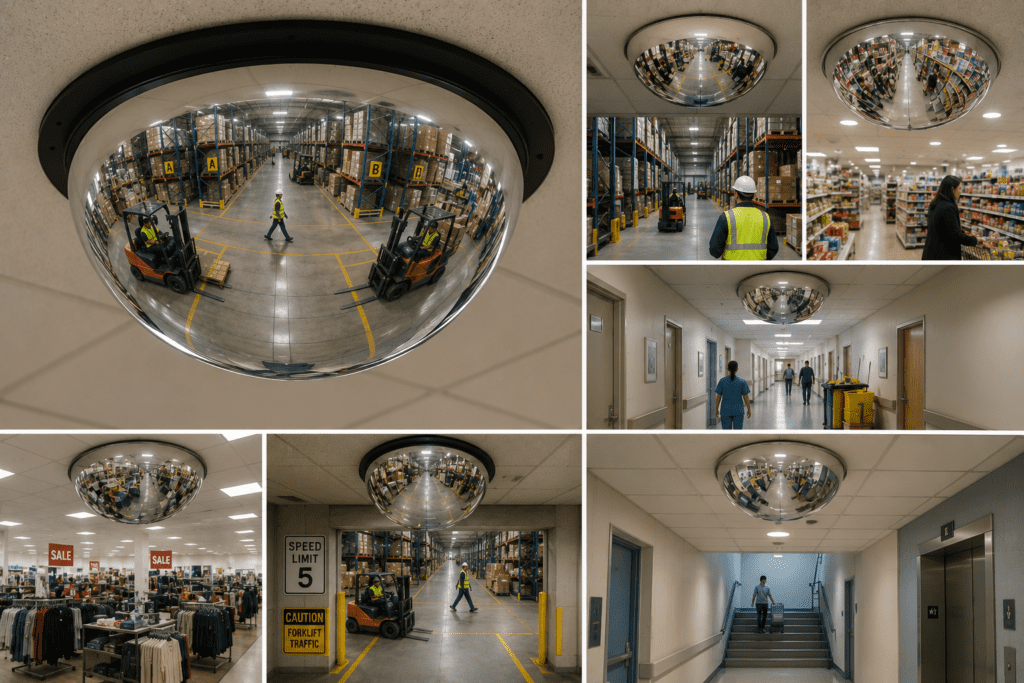
Full dome mirrors are designed to provide a complete 360-degree view. They are usually installed on ceilings in open areas where visibility is needed in all directions. Because of their round dome shape, they allow people to see movement from every side. This makes them one of the most common types of dome mirrors used for safety in warehouses, factories, retail stores, schools, hospitals, and public buildings.
A full dome mirror is useful at four-way intersections, central corridors, open warehouse crossings, supermarket aisles, and large indoor workspaces. When installed above an intersection, it allows workers, pedestrians, forklift operators, and equipment users to see approaching movement from all directions before entering the area.
In warehouses and logistics centers, full dome mirrors are often used at aisle crossings where forklifts and workers may approach from multiple directions. These locations can be dangerous because operators may not hear or see each other in time. A ceiling-mounted full dome mirror helps reduce collision risks by improving visibility across the entire crossing area.
Retail stores also use full dome mirrors for safety and security. In large shops, supermarkets, and department stores, they help staff monitor multiple aisles from one position. They can improve customer safety by reducing blind spots near display racks and corners. They also support loss prevention by making hidden areas more visible to staff.
For commercial buildings and public facilities, full dome mirrors are useful in corridors, lobbies, stairway areas, and service zones. They help people see around corners and avoid collisions with carts, wheelchairs, cleaning equipment, or other pedestrians. In busy facilities, this can reduce daily movement risks and create a safer environment.
Half Dome Mirrors
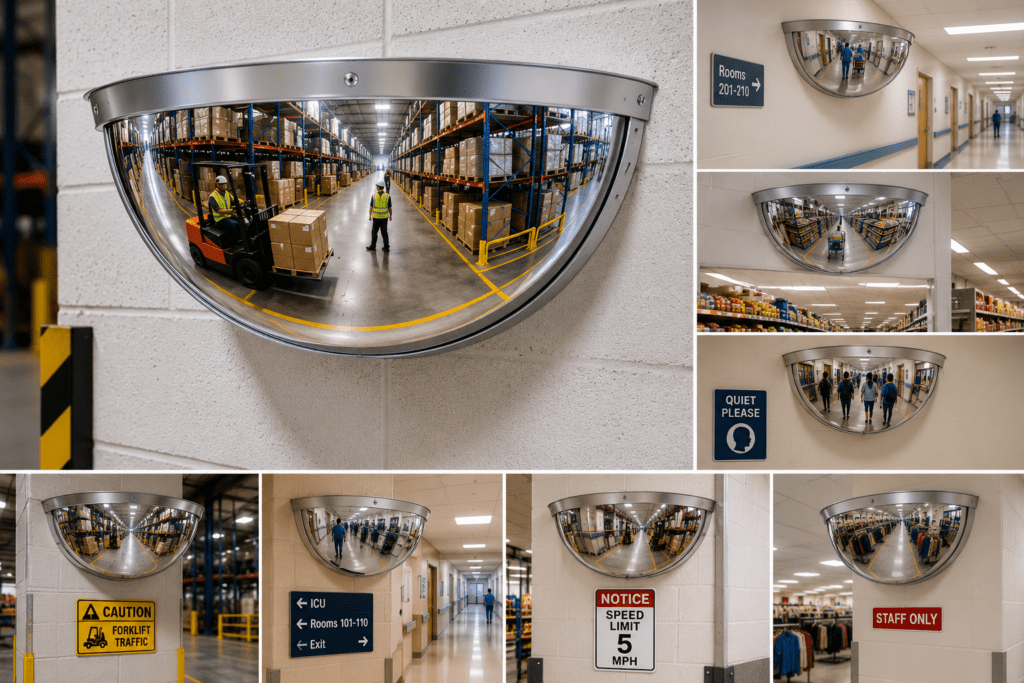
Half dome mirrors provide a 180-degree view. They are usually installed on walls where visibility is needed in front of the mirror and along both sides. Unlike full dome mirrors, which are installed in the center of a ceiling area, half dome mirrors are designed for wall-mounted applications.
A half dome mirror is useful in corridors, hallways, warehouse aisles, retail aisles, hospital passages, school corridors, and office buildings. It helps users see movement coming from the left and right sides before they step or drive into an open area. This makes it useful in locations where the mirror is placed against a wall and does not need to show the area behind it.
In warehouses, half dome mirrors can be installed at the end of aisles to improve visibility where forklifts, pallet trucks, and workers cross paths. In hospitals, they can help staff pushing wheelchairs, stretchers, carts, or medical equipment see around hallway intersections. In schools, they can reduce collisions in busy corridors where students and staff move quickly between rooms.
Half dome mirrors are also useful in retail environments. A store can place a half dome mirror on a wall near an aisle end to help staff monitor customer movement and reduce blind corners. In shopping centers and commercial facilities, they can improve safety near service corridors, maintenance zones, and staff-only areas.
For B2B buyers, half dome mirrors are a good choice when 360-degree visibility is not required. They provide wide coverage from a wall position and are usually easier to install than ceiling-mounted full dome mirrors. They are also practical for narrow spaces where a full dome mirror would not be necessary.
Quarter Dome Mirrors
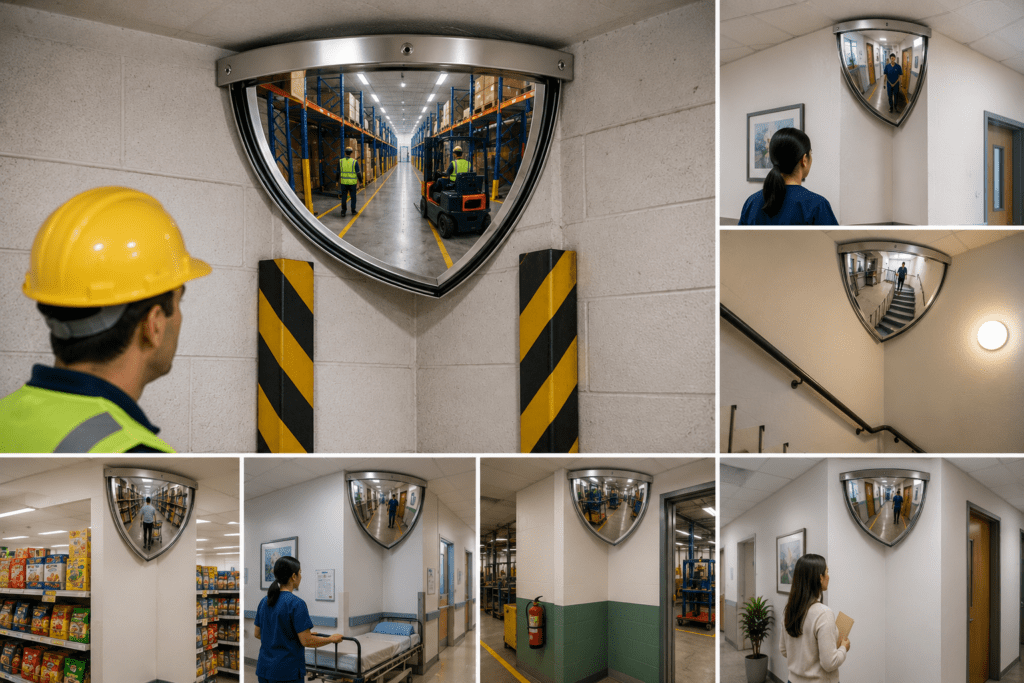
Quarter dome mirrors provide a 90-degree view and are usually installed in corners. They are designed for locations where visibility is needed around a corner but not across a full open area. Because of their compact design, quarter dome mirrors are commonly used in tight indoor spaces, hallways, stair corners, warehouse corners, retail aisles, and office corridors.
A quarter dome mirror is especially useful where two walls meet and people need to see movement around the corner. It allows users to check the hidden side before turning. This can prevent collisions between pedestrians, workers, carts, forklifts, and small equipment.
In offices and public buildings, quarter dome mirrors can be installed at hallway corners to reduce the chance of people bumping into each other. In hospitals and clinics, they are useful near corridor turns where staff may be moving with wheelchairs, beds, medicine carts, or patient transport equipment. In schools, they help improve visibility at corners where students may walk or run without noticing others.
In warehouses and industrial facilities, quarter dome mirrors are used at rack corners, storage zones, production areas, and internal pedestrian routes. They are not always suitable for large forklift intersections because they provide a smaller field of view than full dome mirrors or half dome mirrors. However, for compact blind spots and corner visibility, they are practical and cost-effective.
Quarter dome mirrors are also suitable for retail stores where shelves or product displays create blind corners. A small safety mirror placed in the corner can help staff see hidden customer movement and improve security coverage. For small businesses and facility managers, quarter dome mirrors are a simple way to solve localized visibility problems.
Ceiling-Mounted Dome Mirrors
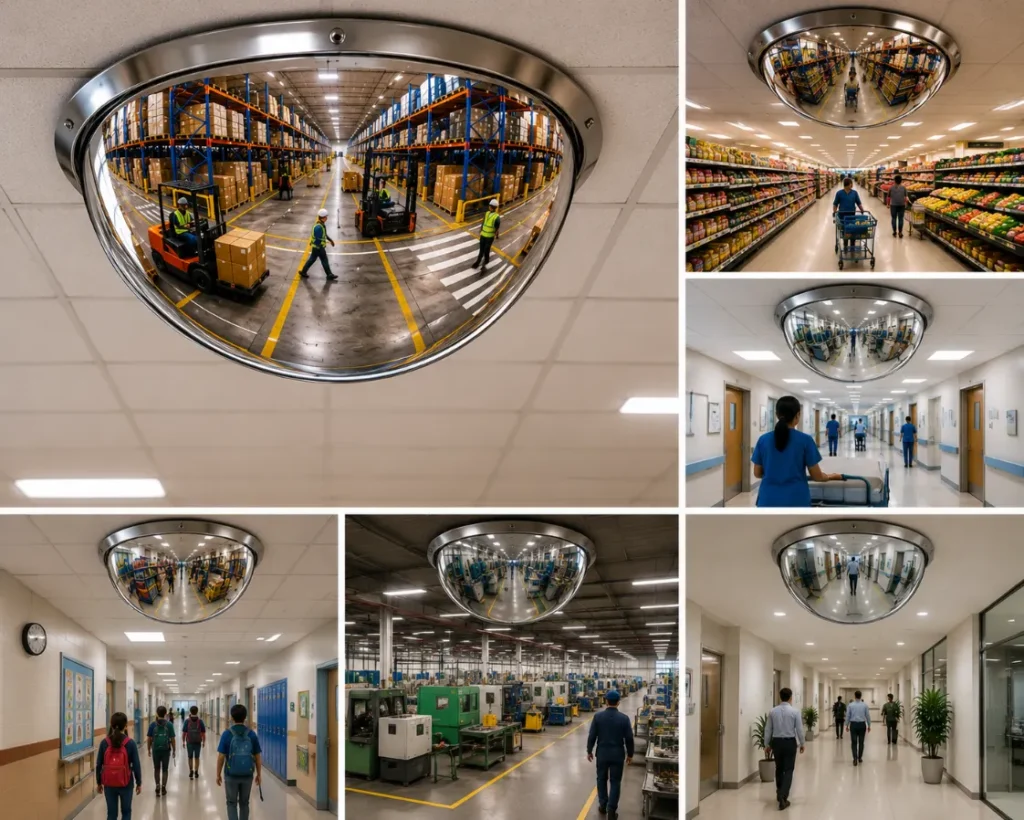
Ceiling-mounted dome mirrors are installed above the viewing area and are commonly used in open indoor spaces. They may be full dome mirrors, half dome mirrors, or other dome designs depending on the application. Their main advantage is that they provide visibility from above, making them suitable for corridors, aisles, intersections, and open facility areas.
A ceiling dome mirror is often used in warehouses, supermarkets, hospitals, schools, factories, office buildings, and public facilities. It can be installed above an aisle crossing, corridor junction, entrance area, or workspace where people need to see movement from different directions.
In warehouses, ceiling-mounted safety mirrors help forklift operators and workers see approaching movement before entering a crossing. In retail stores, they improve visibility over aisles and reduce hidden areas. In hospitals, they support safer movement for staff, patients, wheelchairs, and equipment. In schools, they help monitor corridor intersections and reduce accidents during busy movement times.
Ceiling-mounted mirrors are especially effective when the space has no suitable wall for installation. They also provide a more balanced view in central locations. However, the ceiling height must be suitable. If the mirror is installed too high, the reflected image may become too small or difficult to use. If it is too low, it may obstruct movement or be more exposed to damage.
For B2B purchasing, ceiling-mounted dome mirrors should be selected based on mirror diameter, ceiling height, viewing distance, material quality, and mounting system. A larger mirror may be needed for high ceilings or wide viewing areas. Strong mounting hardware is important to keep the mirror stable and secure.
Wall-Mounted Dome Mirrors
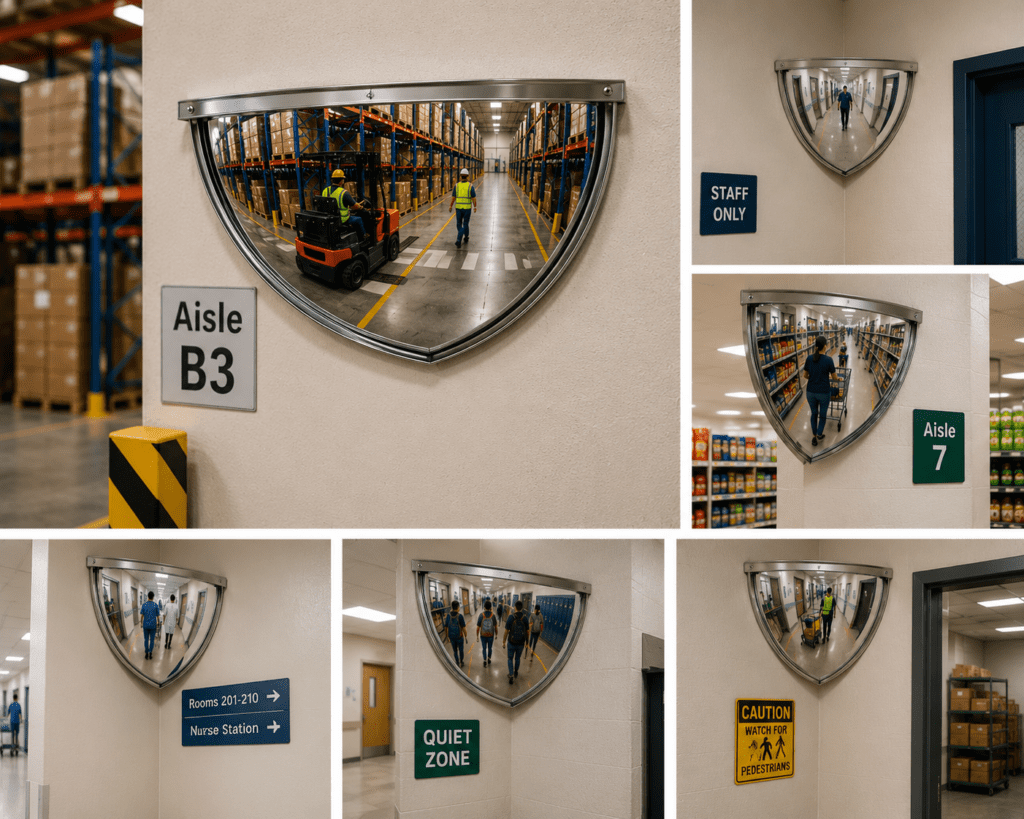
Wall-mounted dome mirrors are installed on walls and are commonly used in corridors, hallways, retail stores, warehouses, hospitals, offices, schools, and industrial sites. These mirrors are usually half dome or quarter dome designs because they are meant to provide visibility from a wall or corner position.
A wall-mounted dome mirror helps users see hidden movement before entering a hallway, turning a corner, crossing an aisle, or moving through a doorway. It is useful in locations where a ceiling mirror is not practical or where visibility is needed only from one side.
In warehouses, wall-mounted dome mirrors can improve safety at aisle ends, pedestrian crossings, storage room entrances, and loading areas. In offices and public buildings, they can reduce collisions in blind corridors. In schools, they help students and staff see around corners. In hospitals, they support safer movement in busy hallways and service corridors.
Wall-mounted dome mirrors are also common in retail security. They can be placed near aisles, stockrooms, checkout areas, and store corners to help staff monitor hidden spaces. They provide instant visibility without requiring electricity or camera systems.
For commercial buyers, wall-mounted dome mirrors are easy to install and maintain. They are a practical option when the safety problem is located near a wall, entrance, corridor, or corner. Proper installation height and angle are important because the mirror should show the blind area clearly from the user’s normal approach position.
Acrylic Dome Mirrors
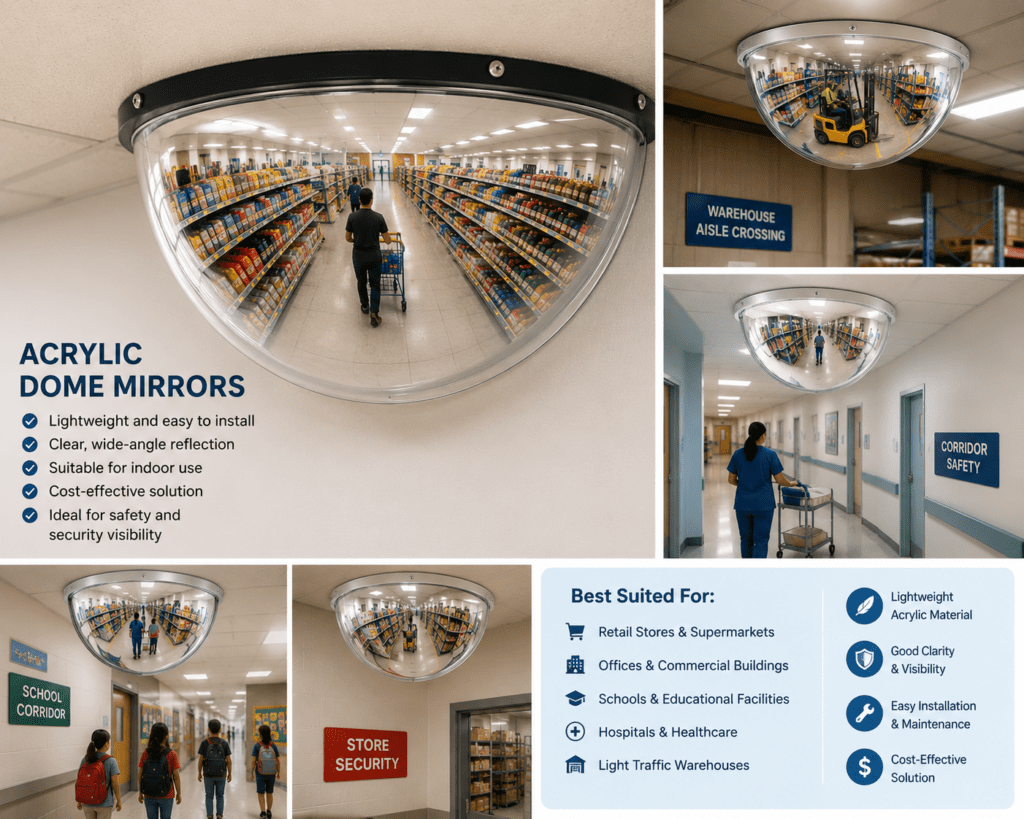
Acrylic dome mirrors are one of the most common types used for general safety and visibility applications. Acrylic is lightweight, clear, and suitable for many indoor environments. It provides a good reflective surface and is easier to handle during installation than heavier mirror materials.
Acrylic dome mirrors are used in retail stores, offices, schools, hospitals, corridors, warehouses, supermarkets, and commercial buildings. They are suitable for areas where impact risk is moderate and where a clear, wide-angle reflection is required. Many ceiling dome mirrors, full dome mirrors, half dome mirrors, and quarter dome mirrors are made from acrylic because it offers a practical balance of clarity, weight, and cost.
For retail businesses, acrylic dome mirrors are useful for aisle visibility and security monitoring. For offices and schools, they help reduce blind spots in corridors. For warehouses, they can be used in areas where traffic is not too heavy or where the mirror is protected from direct impact.
Acrylic mirrors should be installed in locations where they are not likely to be hit by heavy equipment. Although acrylic is durable enough for many commercial applications, it may scratch or crack if exposed to strong impact. Cleaning should also be done carefully to avoid damaging the reflective surface.
For B2B buyers, acrylic dome mirrors are a good option for general-purpose safety visibility. They are cost-effective, lightweight, and available in many sizes. They are best suited for indoor safety, retail security, corridor visibility, and light commercial use.
Polycarbonate Dome Mirrors
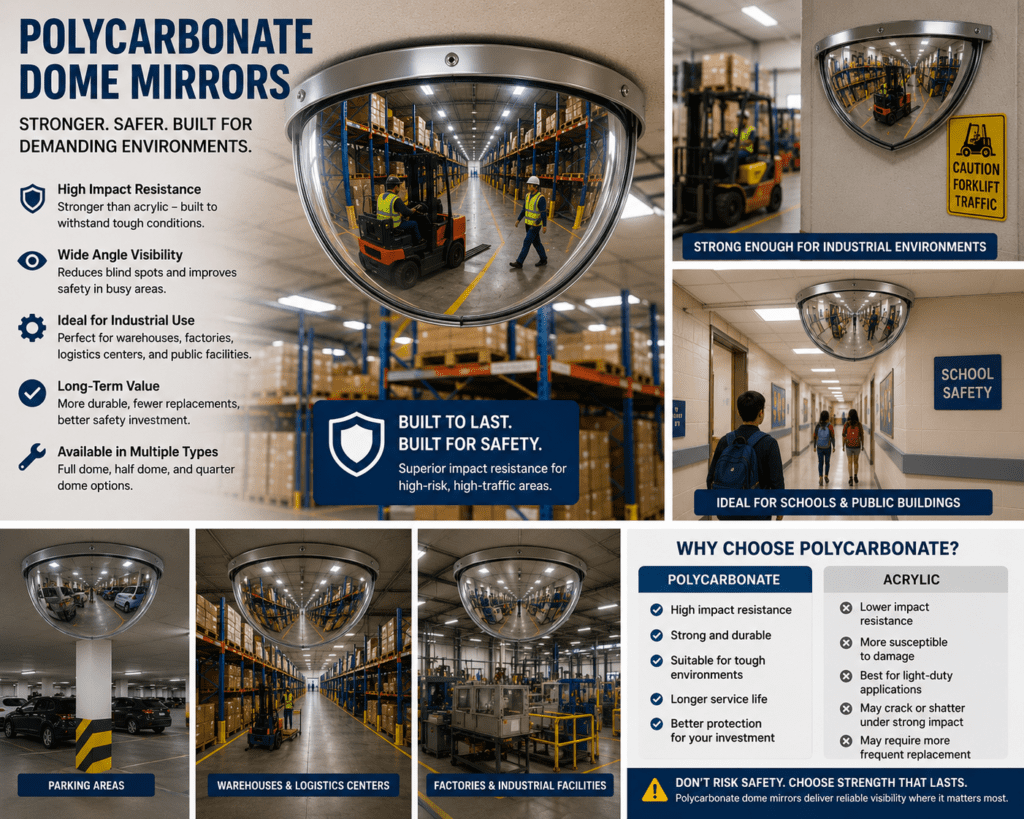
Polycarbonate dome mirrors are stronger and more impact-resistant than acrylic mirrors. They are used in environments where durability is more important, such as warehouses, factories, logistics centers, schools, public buildings, parking areas, and industrial facilities.
A polycarbonate dome mirror is a good choice where the mirror may be exposed to impact, vibration, accidental contact, or rough conditions. In warehouses, forklifts, pallets, carts, and equipment can create damage risks. In schools and public facilities, mirrors may face more frequent contact or misuse. Polycarbonate mirrors offer better resistance in these situations.
These mirrors are commonly used for industrial safety, warehouse visibility, forklift route safety, public area monitoring, and high-traffic facility management. They can be used as full dome, half dome, or quarter dome mirrors depending on the viewing requirement.
For businesses, polycarbonate dome mirrors may cost more than acrylic options, but they can provide better long-term value in demanding areas. Replacing a damaged mirror repeatedly is usually more expensive than choosing a stronger safety mirror from the start. Shocking discovery: buying the cheapest thing for an industrial site sometimes fails. Civilization survives another lesson.
Polycarbonate mirrors are especially useful in B2B environments where safety equipment must perform reliably every day. They help reduce blind spots while offering stronger protection against damage.
Outdoor Dome Mirrors
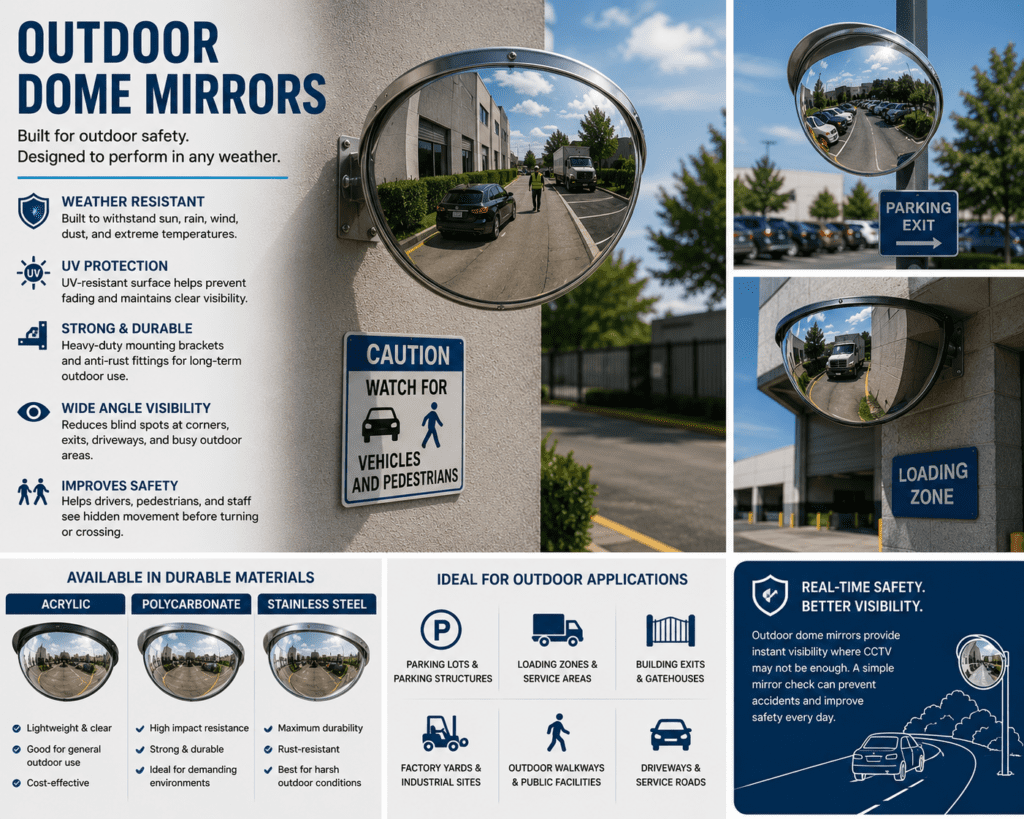
Outdoor dome mirrors are designed for external areas where weather resistance is required. They are used in parking lots, loading zones, building exits, service roads, outdoor walkways, public facilities, factory yards, and commercial properties. Unlike standard indoor mirrors, outdoor dome mirrors must handle sunlight, rain, wind, dust, temperature changes, and environmental exposure.
Outdoor dome mirrors may be made from acrylic, polycarbonate, or stainless steel materials depending on the level of durability needed. They should include strong mounting brackets, UV-resistant surfaces, weather-resistant frames, and anti-rust fittings. If an outdoor mirror is not built for weather exposure, it may fade, crack, loosen, or lose reflection quality over time.
These mirrors are useful in areas where people or vehicles move around external building corners, parking structures, gatehouses, and service entrances. They can help drivers, security staff, pedestrians, and equipment operators see hidden movement before turning or crossing.
For facility managers and commercial property owners, outdoor dome mirrors can improve safety in areas where CCTV cameras may not provide instant visibility to users. A driver or pedestrian can check the mirror immediately before moving, which makes it a practical real-time safety tool.
Indoor Dome Mirrors
Indoor dome mirrors are used inside buildings to improve visibility, safety, and security. They are common in warehouses, factories, retail stores, offices, hospitals, schools, supermarkets, shopping centers, public buildings, and storage facilities. Indoor environments usually do not require the same weather resistance as outdoor areas, but they still require proper mirror size, clear reflection, and strong installation.
In indoor safety applications, dome mirrors help people see around corners, across aisles, through hallway intersections, and into hidden areas. They are useful where pedestrians, carts, forklifts, wheelchairs, cleaning machines, and staff equipment move through shared spaces.
Retail stores use indoor dome mirrors for theft prevention and aisle monitoring. Warehouses use them for forklift and worker safety. Hospitals use them in corridors and service areas. Schools use them in hallways and busy movement zones. Offices use them in blind corners and facility corridors.
For B2B buyers, indoor dome mirrors are available in different sizes and shapes depending on visibility needs. A full dome mirror may be best for ceiling intersections, a half dome mirror may suit wall-mounted corridor visibility, and a quarter dome mirror may be ideal for corner blind spots.
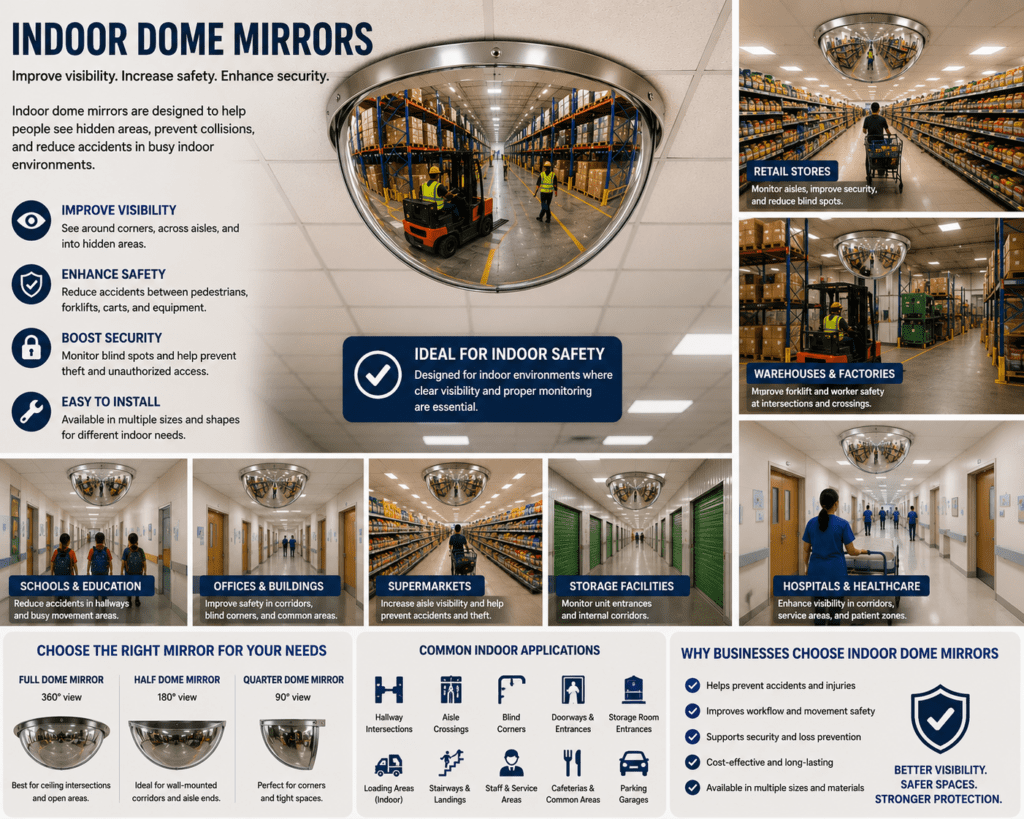
Dome Mirrors for Warehouse Safety
Warehouse safety is one of the most important applications for dome mirrors. Warehouses often have blind spots created by storage racks, stacked goods, loading docks, walls, doors, and equipment. Forklifts, pallet jacks, workers, delivery drivers, and supervisors may all move through the same area.
A dome warehouse mirror helps improve visibility at crossing points and corners. Full dome mirrors are useful at four-way aisle intersections, while half dome mirrors can be mounted on walls near aisle ends. Quarter dome mirrors can be used for small blind corners. The correct type depends on the warehouse layout and the direction of movement.
Using dome mirrors in warehouses can reduce forklift accidents, worker collisions, product damage, and operational delays. They help operators see movement before entering a blind area. This supports safer and smoother material handling.
For logistics companies, distribution centers, manufacturing warehouses, and storage facilities, dome mirrors are a practical part of internal traffic control. They work well with floor markings, warning signs, speed control measures, pedestrian lanes, and safety barriers.
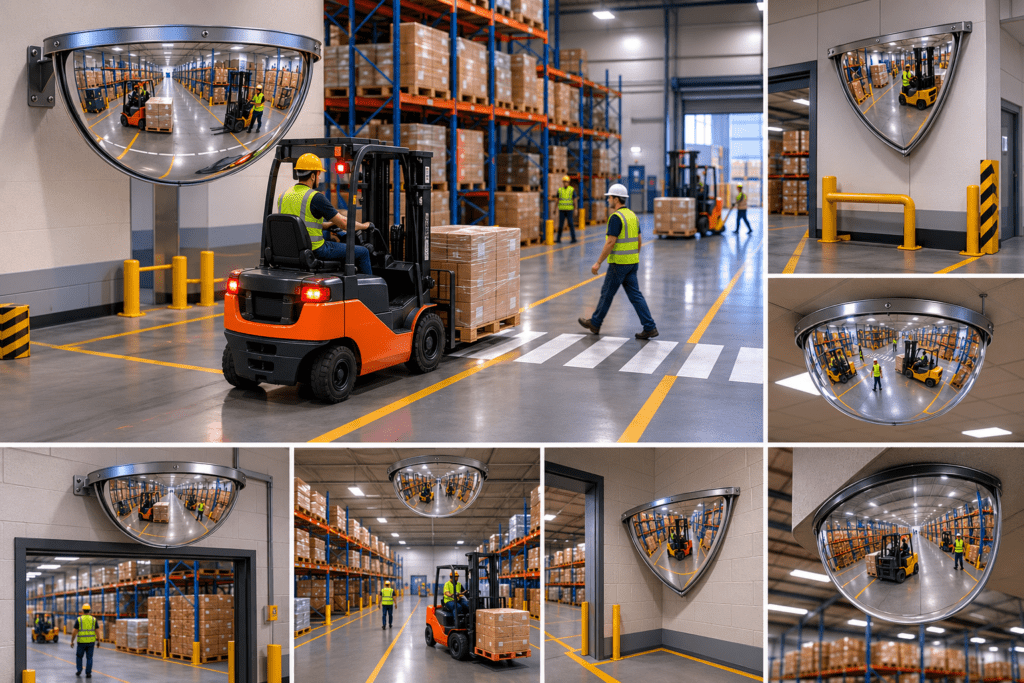
Dome Mirrors for Retail Security
Retail stores use dome mirrors for both safety and security. In supermarkets, department stores, pharmacies, convenience stores, and shopping outlets, shelves and displays can create hidden areas that are difficult for staff to monitor. Dome mirrors help increase visibility across these spaces.
Full dome mirrors can be installed above central aisles to monitor multiple directions. Half dome mirrors can be placed on walls to cover aisle ends. Quarter dome mirrors can be installed in corners to reduce blind spots. These mirrors help staff observe customer movement, reduce theft risk, and improve aisle safety.
Dome mirrors are also useful near checkout areas, stockroom entrances, fitting room corridors, and high-value product sections. They provide a simple visibility solution without requiring power, screens, or recording systems. While CCTV is still important for many stores, dome mirrors give immediate visual coverage that employees can use in real time.
For retailers, dome mirrors are low-cost security products that also improve customer and staff safety. They can prevent collisions with carts, reduce blind corners, and help staff manage store visibility more effectively.
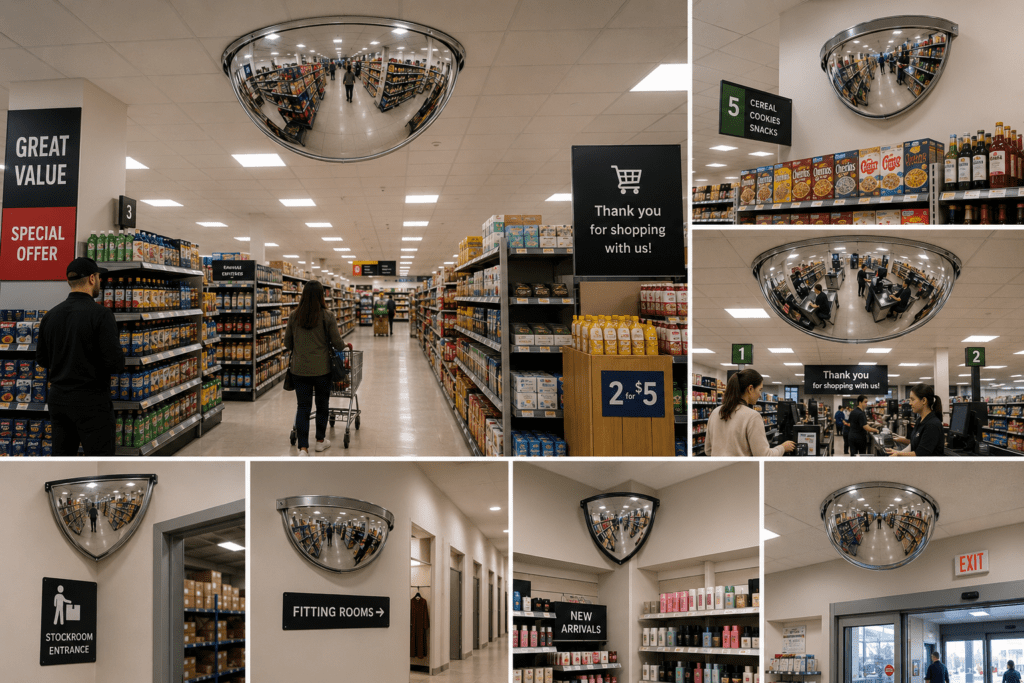
Dome Mirrors for Hospitals and Schools
Hospitals and schools use dome mirrors because these environments have high pedestrian movement and frequent blind spots. In hospitals, staff may move quickly with wheelchairs, patient beds, medicine carts, cleaning equipment, and emergency supplies. In schools, students, teachers, parents, and visitors move through corridors, gates, and common areas.
Full dome mirrors can be installed at hallway intersections to provide visibility in all directions. Half dome mirrors are useful on corridor walls. Quarter dome mirrors can be installed at tight corners. These mirrors help reduce collisions and improve awareness.
In hospitals, dome safety mirrors support smoother movement in corridors, service zones, emergency access areas, and parking facilities. In schools, they help make hallways, stair corners, gates, and playground access points safer. They are especially useful during busy times when many people are moving at once.
For facility managers in healthcare and education, dome mirrors are practical safety tools. They are easy to install, require little maintenance, and improve daily visibility without creating complex operational demands.
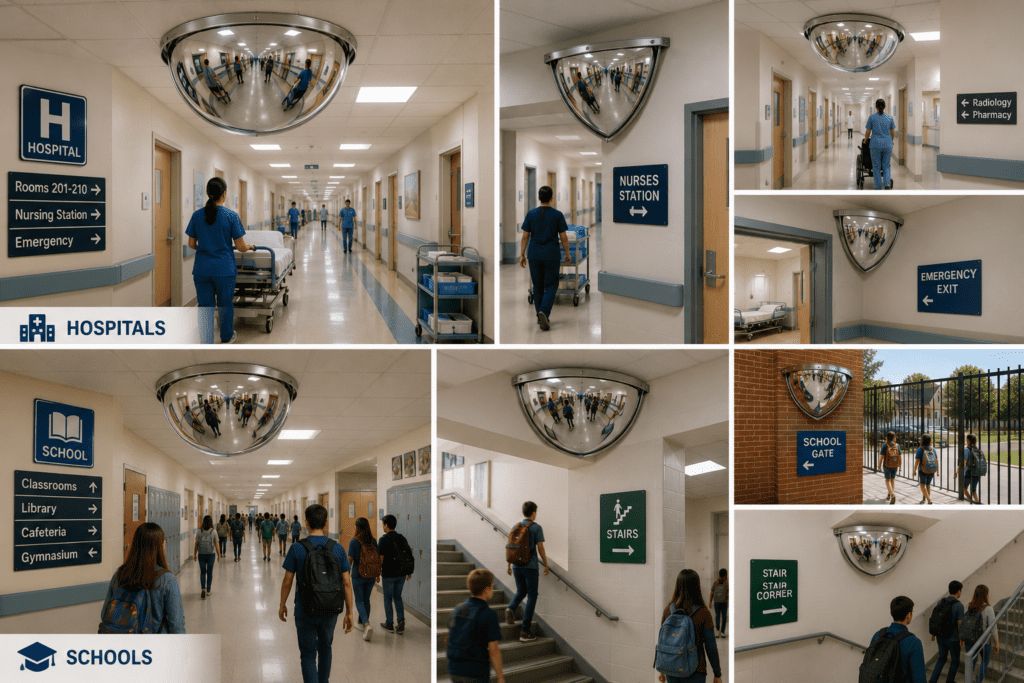
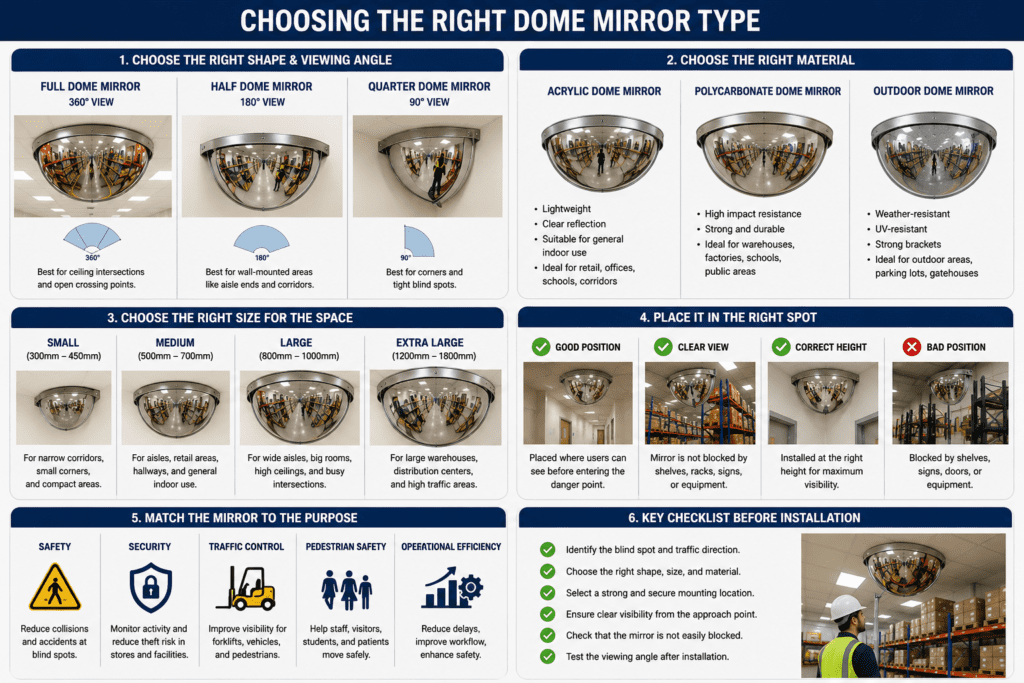
Choosing the Right Dome Mirror Type
Choosing the right dome mirror depends on the location, viewing angle, installation surface, traffic type, and safety purpose. A full dome mirror is suitable when visibility is needed in all directions, especially at ceiling intersections and open crossing points. A half dome mirror is better for wall-mounted areas where a 180-degree view is enough. A quarter dome mirror is best for corners where a 90-degree view solves the blind spot.
The material also matters. Acrylic dome mirrors are suitable for general indoor use and retail visibility. Polycarbonate dome mirrors are better for impact resistance and industrial safety. Outdoor dome mirrors should be weather-resistant and built with strong brackets and durable frames.
The mirror size should match the viewing distance. A larger dome mirror is needed for wider spaces, high ceilings, large warehouses, or busy facility intersections. Smaller mirrors may be suitable for compact corridors, retail corners, and narrow indoor spaces.
Installation is just as important as mirror selection. The dome mirror should be placed where users can see it before entering the danger point. It should not be blocked by signs, shelves, racks, doors, lights, or equipment. A poorly placed mirror may look installed, but it will not provide real safety value. Humanity has already mastered decorative safety equipment, sadly.
Final Thoughts
The main types of dome mirrors used for safety include full dome mirrors, half dome mirrors, quarter dome mirrors, ceiling-mounted dome mirrors, wall-mounted dome mirrors, acrylic dome mirrors, polycarbonate dome mirrors, indoor dome mirrors, and outdoor dome mirrors. Each type is designed for a specific visibility need and installation environment.
Full dome mirrors provide 360-degree visibility and are best for open intersections and ceiling installations. Half dome mirrors provide 180-degree visibility and are useful on walls. Quarter dome mirrors provide 90-degree visibility and are ideal for corners. Acrylic dome mirrors are lightweight and cost-effective for general indoor use, while polycarbonate dome mirrors offer better impact resistance for industrial and high-traffic areas.
For warehouses, factories, schools, hospitals, retail stores, offices, parking areas, commercial buildings, and public facilities, dome mirrors are practical safety products that reduce blind spots and improve movement. They support accident prevention, security monitoring, workplace safety, pedestrian protection, and better traffic flow.
When selected and installed correctly, a dome safety mirror gives people the visibility they need before entering a risky area. That simple improvement can prevent collisions, protect property, reduce injuries, and make daily operations safer in many commercial and public environments.
Looking for a custom convex mirror manufacturer or supplier? Struggling to find the right factory to bring your vision to life? We’ve got you covered! At our place, we craft top-quality convex mirrors with precision and care. Big or small, your needs are our mission. Let’s launch your mirror project and take your product line to the next level! Click here to contact