
Driveway blind spots are responsible for a significant share of preventable vehicle collisions on commercial and industrial properties every year. Whether it is a delivery truck pulling out of a logistics facility onto a busy road, a forklift crossing a warehouse exit ramp, or a fleet vehicle navigating a tight commercial yard, restricted sightlines at driveway entry and exit points are a persistent safety risk that facility managers and procurement teams cannot afford to ignore.
Traffic mirrors are one of the most reliable, cost-effective, and low-maintenance solutions for eliminating driveway blind spots across commercial, industrial, and public sector environments. But not all traffic mirrors are the same. The right choice depends on the installation environment, the nature of the traffic hazard, the required viewing distance, and the durability demands of the setting.
This guide covers the best types of traffic mirrors for driveway safety, with a specific focus on what B2B buyers, facilities managers, safety equipment distributors, and procurement officers need to know before specifying or sourcing at scale.
“The right mirror for a driveway blind spot is not about finding the most expensive option. It is about matching the mirror type, size, and material to the specific hazard, viewing distance, and environmental conditions of each installation.”
Why Driveway Mirror Selection Matters for Commercial and Industrial Facilities
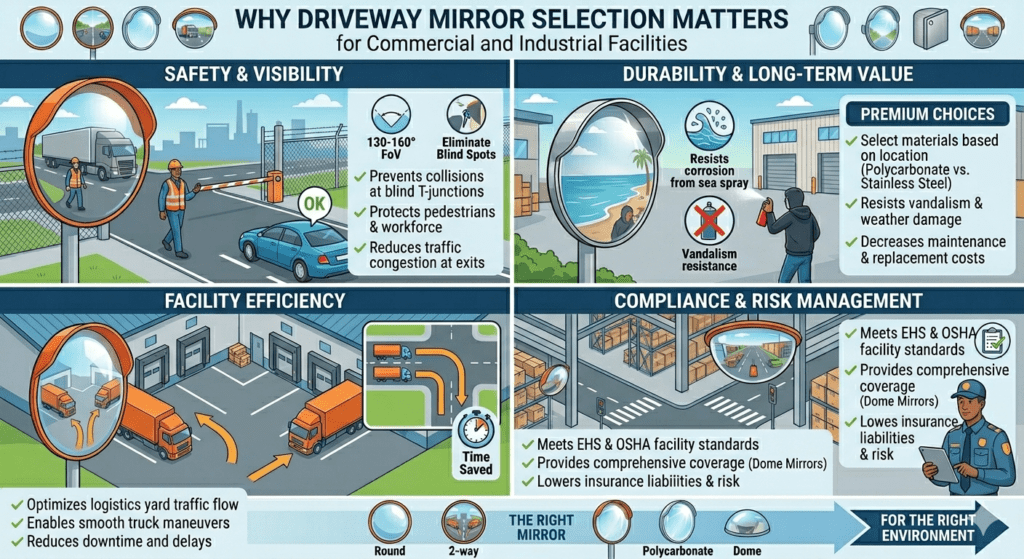
For residential properties, a basic convex driveway mirror will often suffice. The stakes and the traffic volumes are relatively low. In a commercial or industrial context, however, the consequences of getting this wrong are significantly higher.
A logistics facility driveway might see dozens of heavy goods vehicles exiting onto a public road each day. A manufacturing plant might have pedestrian workers crossing vehicle exit routes every few minutes. A hospital campus might have ambulances, patient transport vehicles, and delivery trucks all sharing the same narrow driveway infrastructure.
In these environments, the size of the mirror, the material it is made from, the mounting configuration, and the viewing angle it provides are all critical variables. Procurement decisions that treat all traffic mirrors as equivalent typically result in under-sized mirrors, wrong materials for the installation environment, or inadequate coverage for the actual blind spot being addressed.
For EHS managers and safety compliance officers building driveway safety mirror specifications for multi-site programs, understanding the full product landscape is an essential starting point.
The Main Types of Traffic Mirrors for Driveway Safety
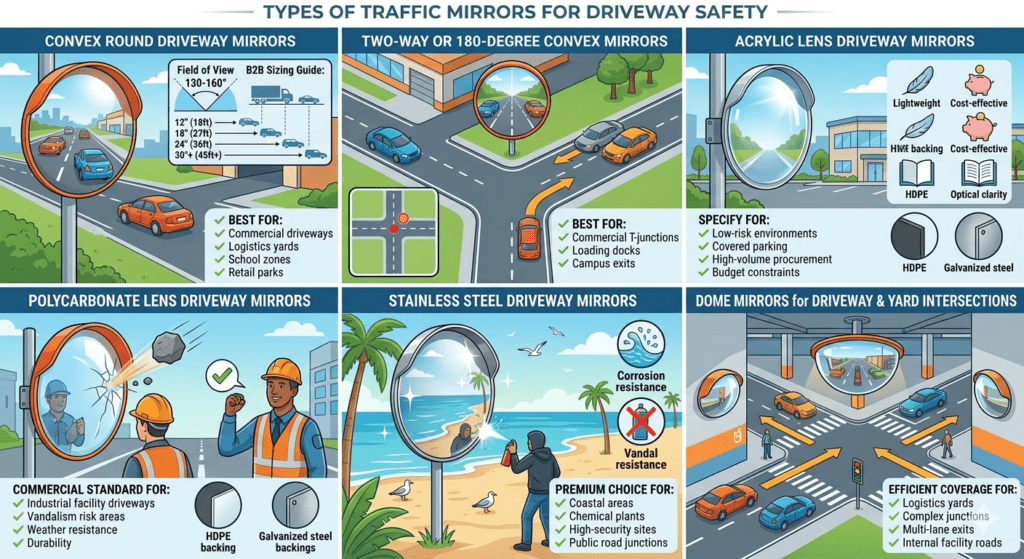
1. Convex Round Driveway Mirrors
What They Are
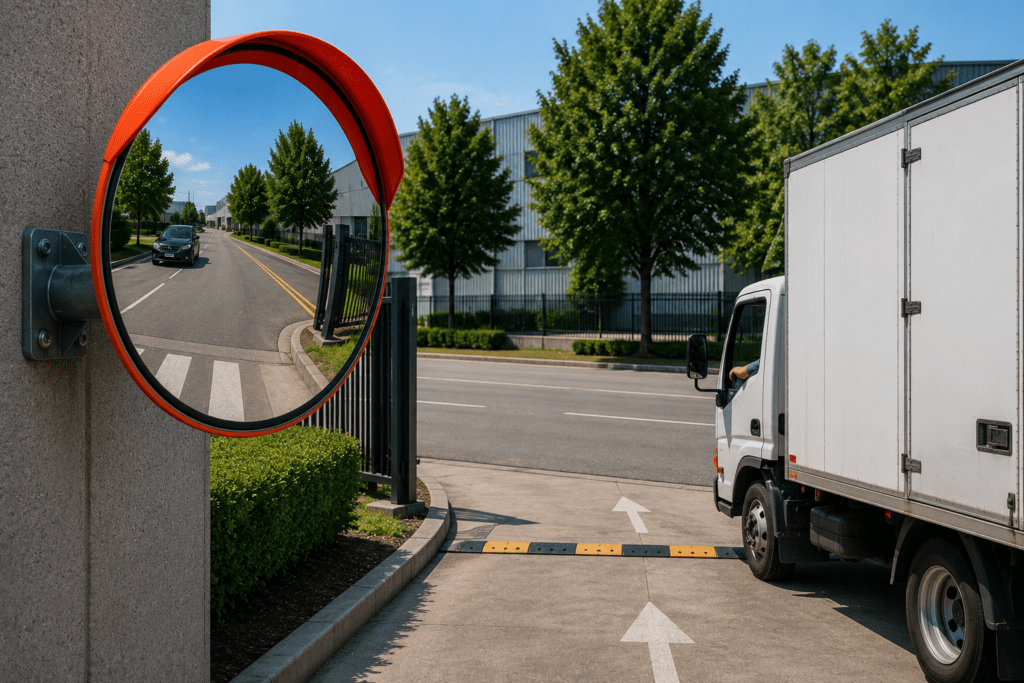
The convex round driveway mirror is the most widely used traffic mirror type across both commercial and industrial settings. Its outward-curving circular reflective surface distributes the reflected image across a broad arc, typically delivering a field of view between 130 and 160 degrees depending on the curvature and size.
Why They Work for Driveways
Round convex driveway safety mirrors are effective at single-direction driveway exits where the primary hazard comes from one side. A vehicle exiting a commercial property driveway onto a road with traffic approaching from the left benefits from a mirror positioned opposite the exit point that allows the driver to see approaching vehicles before pulling out.
B2B Sizing Guide
Selecting the right size is one of the most common procurement challenges with convex outdoor driveway mirrors for commercial use. The general rule is that the viewing distance determines the mirror diameter:
- 12-inch mirrors: effective viewing distance up to approximately 18 feet, suitable for tight indoor driveways and short-range applications
- 18-inch mirrors: effective up to approximately 27 feet, a common size for residential and light commercial driveway exits
- 24-inch mirrors: effective up to approximately 36 feet, recommended for most commercial property driveways
- 30-inch and above: effective at 45 feet or more, the standard for industrial facility driveways, logistics yards, and municipal road junctions
For fleet yards, distribution centers, and commercial logistics facilities, 30-inch to 36-inch polycarbonate convex driveway mirrors with galvanized steel or HDPE backing are typically the minimum specification.
Best For
Commercial property driveways, logistics facility exits, fleet yard entry points, school zone driveway safety, hospital campus vehicle exits, retail park access roads.
2. Two-Way or 180-Degree Convex Driveway Mirrors
What They Are
A two-way convex driveway mirror provides a 180-degree viewing angle across both directions simultaneously, rather than reflecting only the traffic approaching from one side. These mirrors are designed specifically for T-intersection style driveway exits where the driver needs to check traffic in both directions before pulling onto a road.
Why They Work for Driveways
At a driveway exit onto a two-way road, a standard single-direction convex road safety mirror covers only part of the hazard. A driver checking the mirror can see traffic from one direction but still has a blind spot in the other. Two-way driveway safety mirrors solve this by presenting both directions in a single mirror unit, reducing the need for multiple mirror installations at the same exit point.
B2B Applications
Two-way wide-angle driveway mirrors are particularly valued at:
- Commercial driveway exits onto two-way roads with high traffic volumes
- Loading dock approach points where trucks need clearance visibility in both directions
- Industrial estate road junctions where pedestrian and vehicle traffic converge
- Campus facility exit driveways at universities, hospitals, and corporate parks
For procurement managers sourcing driveway safety equipment for multiple sites with T-intersection exits, specifying two-way convex driveway mirrors as a standard configuration reduces per-site mirror count while improving overall coverage.
Best For
Logistics facility driveways with two-way road exits, hospital and campus entry points, industrial estate junctions, fleet yard exit gates.
3. Acrylic Lens Driveway Mirrors
What They Are
Acrylic driveway safety mirrors use a polymethylmethacrylate (PMMA) lens as the reflective surface. Acrylic is a lightweight, shatter-resistant plastic that offers excellent optical clarity, transmitting up to 92% of light. This gives acrylic convex mirrors a bright, clear reflected image.
Material Properties Relevant to Procurement
For B2B buyers comparing acrylic versus polycarbonate driveway mirrors, the key differentiators are:
- Optical clarity: acrylic offers superior image brightness and clarity compared to polycarbonate
- Cost: acrylic mirrors are typically significantly cheaper than equivalent polycarbonate units, making them attractive for high-volume procurement programs
- Impact resistance: acrylic is approximately 17 times stronger than glass but considerably less impact-resistant than polycarbonate
- Weather resistance: acrylic performs well in outdoor conditions but is better suited to environments without high vandalism risk or heavy physical impact exposure
- Lifespan: quality acrylic outdoor driveway mirrors deliver approximately 10 years of service life in appropriate environments
When to Specify Acrylic
Acrylic convex driveway mirrors are the right specification for:
- Lower-risk commercial driveways where vandalism is not a concern
- Indoor driveway applications such as covered parking facility exits
- High-volume procurement programs where budget is a primary constraint
- Facilities where mirror replacement cycles are already built into maintenance budgets
For safety equipment distributors serving the commercial property and light industrial sectors, acrylic driveway safety mirrors represent strong volume sales opportunities due to their competitive price point and broad applicability.
Best For
Commercial property driveways in low-vandalism environments, covered parking exits, retail park access points, light industrial facility driveways.
4. Polycarbonate Lens Driveway Mirrors
What They Are
Polycarbonate convex driveway mirrors use a lens made from polycarbonate sheet, a thermoplastic material that offers significantly greater impact resistance than acrylic. Polycarbonate is approximately 200 times stronger than glass and around 30 times stronger than acrylic, making it the material of choice for demanding outdoor driveway applications.
“Polycarbonate mirrors are virtually unbreakable under normal conditions. Customers have reported their mirrors withstanding being hit with a sledgehammer without breaking.”
Why Polycarbonate is the Commercial Standard for Demanding Environments
For logistics facilities, industrial driveways, and public sector installations, polycarbonate outdoor traffic mirrors for driveway safety are the default specification for good reason. In environments where vehicles approach mirrors at close range, where vandalism is a realistic risk, or where the mirror is installed in an exposed outdoor location subject to wind, UV exposure, and temperature cycling, polycarbonate durability delivers a significantly lower total cost of ownership than acrylic despite the higher unit cost.
Polycarbonate is also UV-stabilized in quality commercial mirror products, preventing the lens yellowing that degrades image quality in lower-specification outdoor mirrors over time.
Backing Options for Polycarbonate Driveway Mirrors
The backing material paired with a polycarbonate lens is an important secondary specification decision:
- HDPE (High-Density Polyethylene) backing: lightweight, rust-proof, and cost-effective. The preferred backing for most commercial driveway mirror installations
- Galvanized steel backing: heavier and more expensive than HDPE but specified for high-wind exposure locations, coastal environments, or public road installations where long-term structural integrity is a regulatory requirement
Best For
Industrial facility driveways, logistics yard exits, public road junctions, school zone driveway mirrors, coastal or high-wind installation environments, high-vandalism risk settings.
5. Stainless Steel Driveway Mirrors
What They Are
Stainless steel driveway safety mirrors use a highly polished stainless steel reflective surface rather than a plastic lens. They represent the premium tier of the traffic mirror product range, combining maximum durability with corrosion resistance and anti-vandal properties.
Key Properties for B2B Procurement
- Vandal resistance: the stainless steel surface is extremely difficult to deface or scratch compared to plastic alternatives, making these mirrors the preferred choice for high-vandalism public and semi-public locations
- Corrosion resistance: stainless steel does not rust or corrode, making it suitable for coastal environments, food processing facility driveways, chemical plant access roads, and other corrosive atmosphere settings
- Longevity: stainless steel driveway mirrors typically offer the longest service life of any traffic mirror type, reducing long-term replacement costs for facilities with high-durability requirements
- Weight and installation: stainless steel units are heavier than plastic alternatives, requiring appropriately rated mounting hardware and more robust installation
Cost Consideration
Stainless steel driveway mirrors carry a significantly higher unit cost than acrylic or polycarbonate alternatives. For procurement managers, this cost premium is justified by total cost of ownership calculations in environments where vandalism, corrosion, or extreme durability requirements would result in frequent replacement of lower-specification mirrors.
For distributors targeting the public sector, coastal infrastructure, food and beverage processing facilities, and high-security commercial properties, stainless steel wide-angle driveway mirrors represent a premium product category with strong margin potential.
Best For
Public road junctions in high-vandalism areas, coastal facility driveways, chemical and food processing plant access roads, high-security commercial properties, long-term infrastructure deployments.
6. Dome Mirrors for Driveway and Yard Intersections
What They Are
While technically distinct from standard traffic mirrors, dome mirrors are increasingly specified alongside convex driveway mirrors in commercial facility driveway and yard safety programs. Half-dome mirrors provide 180-degree panoramic coverage while full-dome mirrors provide up to 360 degrees of simultaneous coverage.
B2B Applications in Driveway Safety
Dome mirrors are most effectively deployed at complex driveway junctions and internal facility yard intersections where vehicle and pedestrian traffic converges from multiple directions simultaneously. Rather than requiring multiple individual convex mirrors to cover all approach angles, a single full-dome security mirror can provide comprehensive coverage of an entire intersection from one mounting point.
For EHS managers specifying driveway safety solutions for complex logistics yards, manufacturing plant internal roads, or multi-lane commercial parking facility exits, dome mirrors offer a compelling coverage-per-installation-point efficiency.
Best For
Complex multi-directional facility yard junctions, internal road intersections on industrial campuses, multi-lane driveway exits at commercial properties, covered parking facility internal junctions.
How to Specify the Right Traffic Mirror for Your Driveway Application
For procurement teams building driveway safety mirror specifications, a structured assessment process ensures the right product is selected for each installation point:
Step 1: Define the Blind Spot Type
Is the hazard a single-direction blind spot at a driveway exit, a two-way sightline obstruction at a road junction, or a multi-directional intersection challenge? This determines whether a standard convex driveway mirror, a two-way mirror, or a dome mirror is the right starting point.
Step 2: Determine the Required Viewing Distance
The distance between the mirror and the furthest point from which drivers need to see hazards determines the minimum mirror diameter. Use the 1.5x rule as a baseline: the optimal viewing distance is approximately 1.5 times the mirror diameter in feet.
Step 3: Assess the Installation Environment
Indoor or outdoor installation, exposure to weather, vandalism risk, proximity to corrosive atmospheres, and wind load all determine the appropriate lens material and backing specification. This is where the acrylic versus polycarbonate versus stainless steel decision is made.
Step 4: Check Compliance Requirements
Public road installations and regulated workplace environments may have specific compliance requirements that affect product specification. Municipal road junction mirrors typically require polycarbonate construction with galvanized steel backing to meet local authority specifications. OSHA-compliant warehouse driveway mirrors for forklift safety programs should meet documented industrial safety standards.
Step 5: Evaluate Mounting Configuration
The available mounting surface, the required mirror height, and whether an adjustable bracket is needed for post-installation angle optimization all affect the mounting hardware specification. Telescoping brackets with adjustable reach are particularly valuable for building corner and fence-line installations where the mounting surface is set back from the optimal mirror position.
Bulk Procurement Considerations for Safety Equipment Distributors
For safety equipment distributors and facilities management contractors sourcing driveway traffic mirrors at scale, several supply chain factors significantly affect total program cost:
Tiered pricing structures from manufacturers or wholesale traffic mirror suppliers reduce unit cost on volume orders. For multi-site facility safety programs, consolidating driveway mirror specifications to a limited range of standard sizes and materials simplifies procurement, reduces inventory complexity, and enables volume pricing. Suppliers offering consistent lead times and in-stock inventory across standard sizes reduce program delivery risk. For contractors managing multiple simultaneous site deployments, reliable availability of 24-inch and 30-inch polycarbonate convex driveway mirrors with HDPE backing is typically more operationally important than marginal unit cost savings.
White-label options from manufacturing partners allow distributors to supply branded safety mirror programs to large commercial or public sector clients, adding value and reinforcing supplier relationships beyond pure commodity pricing competition.
Conclusion: Matching the Mirror to the Hazard
The best type of traffic mirror for driveway safety is not a single product. It is the right product for the specific combination of blind spot type, viewing distance, installation environment, compliance requirements, and budget that defines each individual driveway safety challenge.
For most standard commercial property driveways, a 24-inch to 30-inch polycarbonate convex outdoor driveway mirror with HDPE backing represents the optimum balance of performance, durability, and cost. For more demanding environments, stainless steel anti-vandal driveway mirrors or two-way wide-angle convex mirrors may be the correct specification. For complex facility yard junctions, half-dome or full-dome safety mirrors can deliver better coverage efficiency than multiple individual convex units.
What matters most for B2B procurement teams, EHS officers, and safety equipment distributors is building a specification process that starts with the hazard and the installation environment, not with the product catalogue. Get that process right, and selecting the best driveway safety mirror for every application becomes a straightforward, repeatable procurement decision that delivers consistent safety outcomes across facilities of any size or complexity.
Looking for a custom convex mirror manufacturer or supplier? Struggling to find the right factory to bring your vision to life? We’ve got you covered! At our place, we craft top-quality convex mirrors with precision and care. Big or small, your needs are our mission. Let’s launch your mirror project and take your product line to the next level! Click here to contact