
Warehouse corners are where the physical geometry of a building collides, repeatedly and predictably, with the operational reality of heavy equipment, high throughput, and time pressure. Forklift operators rounding aisle ends, delivery vehicles reversing toward loading bays, and pedestrians crossing paths with powered industrial trucks at blind intersections: every one of these situations concentrates risk at exactly the same points in a warehouse layout, again and again, across every shift. The question facing safety managers, facilities procurement teams, and warehouse operators is not whether to invest in corner protection, but which type of protection addresses which risk, and where each belongs in a coherent warehouse safety programme.
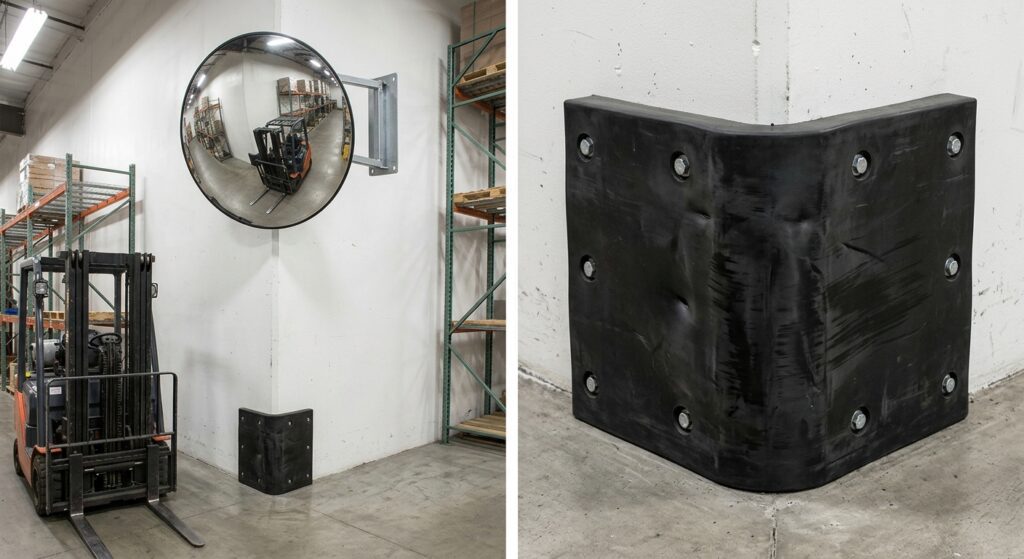
Two product categories dominate the warehouse corner protection conversation: convex safety mirrors and rubber wall guards. They are often discussed as alternatives to each other, but that framing misses a critical distinction. They do not protect against the same type of risk. A convex mirror prevents collisions from happening. A rubber wall guard manages the damage when a collision has already occurred. Understanding this distinction clearly is the starting point for deploying both correctly and getting full value from the investment in each.
What Each Product Actually Does in a Warehouse Environment
1. The Function of a Convex Safety Mirror at a Warehouse Corner
A convex safety mirror mounted at a warehouse corner or aisle intersection gives forklift operators and pedestrians advance visual information about what is approaching from the direction they cannot directly see. The outward-curving surface of a convex mirror compresses a wide field of view into a single reflective image, typically spanning between 120 and 160 degrees depending on the mirror diameter and mounting angle. This allows a forklift driver approaching a blind corner from one aisle to see a pedestrian or another vehicle approaching from the cross aisle before either party enters the conflict zone.
The operational value of this is not abstract. It is the difference between a collision that happens and a collision that does not. A driver who sees a pedestrian in the mirror at ten metres of approach distance has time to stop. A driver who does not see the pedestrian until they are two metres away does not. The convex mirror intervenes at the point of greatest leverage: before impact, when the incident can still be avoided entirely.
2. The Function of a Rubber Wall Guard at a Warehouse Corner
A rubber wall guard fitted to a warehouse wall corner does something categorically different. It does not give any visual information to anyone. It does not reduce the likelihood that a forklift will strike the corner. What it does is absorb and distribute the impact energy when the strike occurs, protecting the wall structure from damage, reducing the risk of injury from impact with a hard unprotected edge, and eliminating the maintenance cost of repeated corner repair on unprotected masonry, drywall, or concrete block.
In a warehouse environment, rubber wall guards at corners adjacent to forklift routes, rack end positions, doorways, loading bay entrances, and column bases are a standard component of building protection. They exist because the volume of traffic and the operational pace of a busy distribution center make incidental contact with wall corners essentially inevitable, regardless of how well the facility is managed in other respects. The rubber guard accepts that contact is going to happen and converts a destructive event into a manageable one.
Where Each Product Belongs in a Warehouse Safety Layout
1. Convex Mirrors: The Right Tool for Blind Intersections and Aisle Ends
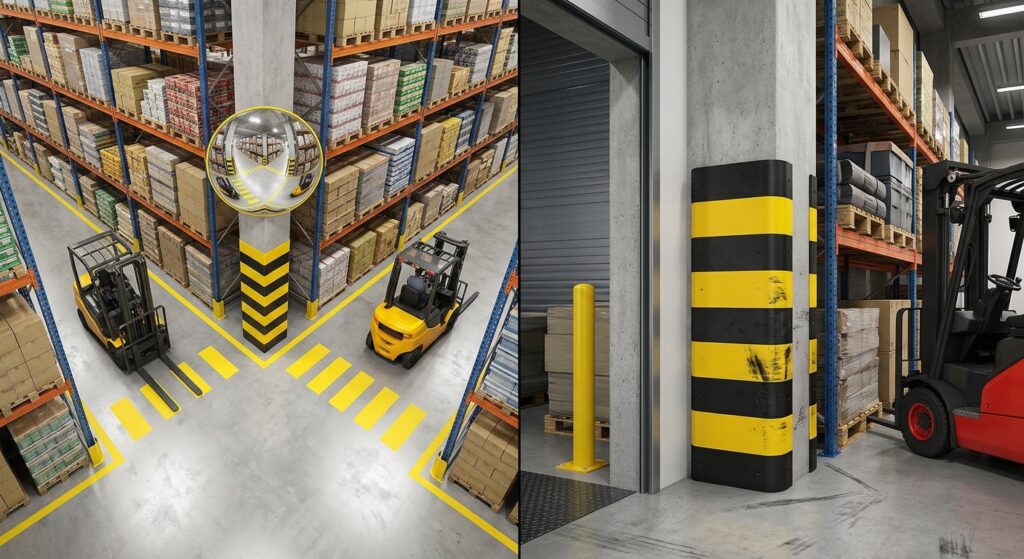
Convex safety mirrors for warehouse use are the correct specification for locations where the hazard is a collision between two moving parties, neither of whom can see the other in time to stop without assistance. The most common of these locations in a warehouse are aisle-to-cross-aisle intersections where racking creates a blind corner, T-junctions where a primary forklift route meets a pedestrian walkway, loading dock approach corridors where reversing vehicles and inbound pedestrian traffic share an uncontrolled crossing, and internal doorways where forklifts exit storage areas into pedestrian zones without a clear line of sight to the corridor beyond.
At each of these locations, the convex mirror functions as a low-cost, zero-power, zero-maintenance sightline extension that works at the moment of greatest need, the approach to the hazard point, without requiring any action from a monitoring team or a control system. One inch of mirror diameter provides approximately one foot of effective viewing distance. For most warehouse aisle intersections, a 30 to 36 inch diameter mirror provides adequate coverage of the cross-aisle approach. At four-way intersections where traffic approaches from all directions, a dome or full-sphere mirror offering 360-degree coverage is the appropriate specification.
The material specification for indoor warehouse convex mirrors is typically polycarbonate or acrylic. Polycarbonate offers superior impact resistance for locations where the mirror itself is at risk of being struck by a passing vehicle or load, and is the recommended material in racking aisles and dock approach routes. Acrylic provides excellent optical clarity at a lower cost and is appropriate for locations where direct impact with the mirror is unlikely. Both materials are significantly lighter and more shatter-resistant than glass, which is not an appropriate specification for any warehouse convex mirror application.
2. Rubber Wall Guards: The Right Tool for Impact Absorption at Structural Corners
Rubber wall guards for warehouse corner protection are the correct specification for locations where repeated physical contact between vehicles or equipment and the wall corner is a foreseeable part of normal operations. The distinction between a location that needs a convex mirror and one that needs a rubber wall guard is not always immediately obvious, but the key question is whether the contact at that location is the result of a failure to see, or the result of tight clearances that make occasional contact essentially unavoidable regardless of operator visibility.
A forklift rounding the end of a racking aisle in a tight-clearance warehouse faces a situation where the combination of vehicle dimensions, load overhang, turning radius, and available aisle width may make occasional corner contact unavoidable even for experienced operators in full view of the space ahead. A rubber wall guard at that corner does not prevent the contact. It makes the contact harmless to both the wall and the operator. In contrast, a convex mirror at the same location addresses a different risk: the risk that a pedestrian or another vehicle is approaching the corner from the other side of the aisle without either party knowing it.
Both products are needed at that corner, serving different functions simultaneously. This is why the most effective warehouse corner protection programmes use convex mirrors and rubber wall guards in combination rather than treating them as alternatives.
Comparing Performance Across Key Warehouse Safety Criteria
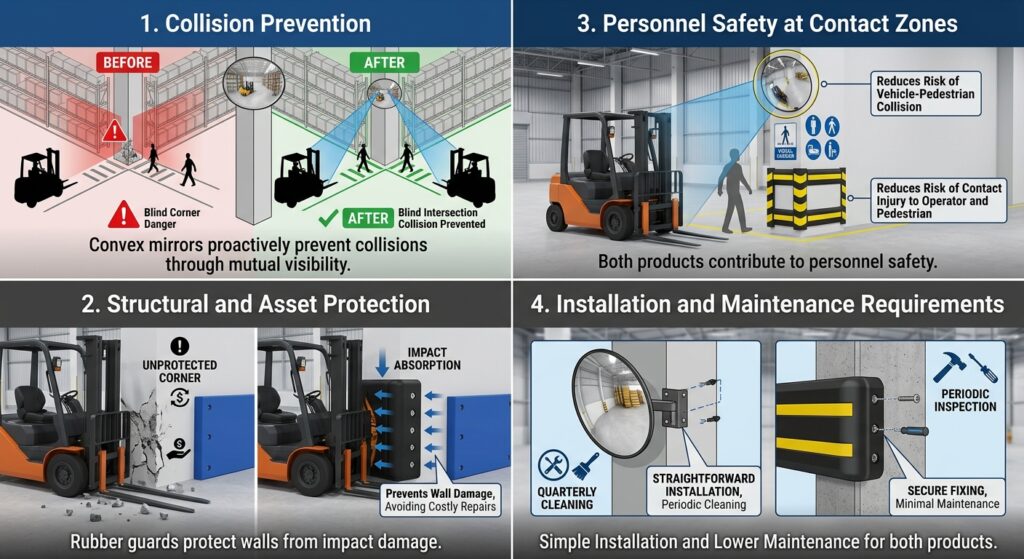
1. Collision Prevention
Convex mirrors are the only product in this comparison that prevents collisions from occurring. A rubber wall guard plays no role in collision prevention whatsoever. It does not alter the behavior of the approaching vehicle, does not warn the operator, and does not reduce approach speed. If a forklift strikes a pedestrian at a corner, the presence or absence of a rubber wall guard on that corner has no effect on the injury outcome for the pedestrian. The guard protects the wall, not the person.
Convex mirrors, correctly positioned and sized for the viewing distance required, reduce the frequency of blind-corner collisions by giving both parties advance visibility of each other before they reach the conflict point. In facilities where convex mirrors have been deployed systematically at all blind intersections, near-miss incident rates at those locations fall measurably. This is the specific outcome that warehouse safety programmes, OSHA compliance frameworks, and risk assessment requirements are primarily concerned with.
2. Structural and Asset Protection
Rubber wall guards are the only product in this comparison that protects the wall structure. A convex mirror mounted on a wall corner does not protect that corner from forklift contact. When a forklift strikes a mirrored corner, the mirror and its bracket absorb some energy but the wall behind them will sustain damage. A rubber wall guard directly mounted to the corner surface absorbs impact energy across its full contact area, distributing the load through the rubber body and protecting the wall finish, corner bead, and structural substrate from damage.
For warehouse operators managing facilities with significant investment in the building fabric, the avoided cost of corner repairs that rubber wall guards prevent across their service life is a straightforward return on investment calculation. A heavy-duty rubber corner guard installed at a high-impact location and replaced once every three to five years costs a fraction of the wall repair programme it replaces. In concrete block or masonry warehouses where corner repair is particularly disruptive and expensive, the economic case is even more clear-cut.
3. Personnel Safety at Contact Zones
At corners where both vehicle-to-vehicle collisions and vehicle-to-wall contacts are realistic scenarios, personnel safety considerations apply to both product choices. A convex mirror reduces the risk of a vehicle-pedestrian collision by improving mutual visibility before the conflict point. A rubber wall guard reduces the risk of injury from contact with an unprotected hard corner edge, both to forklift operators whose vehicles strike the corner and to pedestrians who might be physically impacted against a corner surface during a collision.
High-visibility rubber wall guards, manufactured in yellow and black hazard banding rather than plain black rubber, also serve a passive warning function by marking corner locations visually for pedestrians and operators. This does not replicate the active sightline function of a convex mirror, but it contributes to awareness of corner locations in the general traffic flow, particularly for personnel new to the facility.
4. Installation and Maintenance Requirements
Convex safety mirrors for warehouse use are mounted on wall surfaces, column faces, racking uprights, or ceiling brackets using adjustable bracket systems that allow the mirror angle to be set correctly for the specific viewing geometry required at each location. Installation is straightforward and can typically be completed by maintenance staff without specialist equipment. The ongoing maintenance requirement is limited to periodic cleaning to maintain reflective clarity and inspection of the bracket mounting for tightness, which on a standard indoor warehouse installation is a quarterly task.
Rubber wall guards are fixed to the wall corner surface using mechanical fasteners into the wall substrate, adhesive bonding, or a combination of both. The fixing method depends on the wall construction and the severity of expected impact. In masonry and concrete block walls, mechanical fixings drilled into the substrate provide the most secure installation for heavy-duty rubber guards subject to repeated forklift contact. In drywall partitions, the guard must be fixed through the drywall into the structural framing behind it to provide any meaningful resistance to impact loading. Ongoing maintenance for rubber wall guards is minimal: periodic inspection for deformation, cracking, or fastener loosening, with replacement when the guard surface shows significant wear through to the point where impact absorption is compromised.
The Specific Warehouse Locations Where Each Product Applies
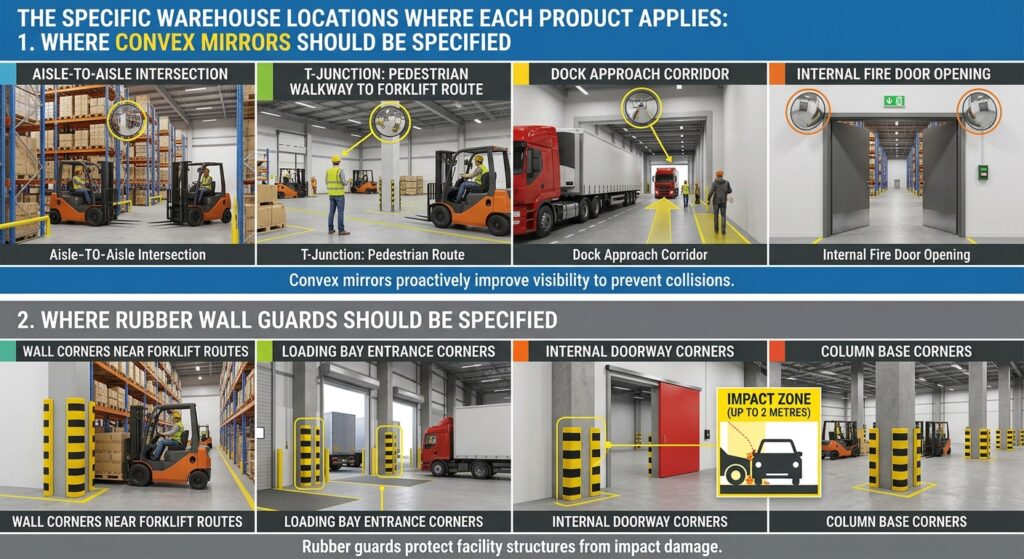
1. Where Convex Mirrors Should Be Specified
At aisle-to-aisle intersections where racking creates a 90-degree blind corner with no direct sightline between approaching vehicles: this is the primary application for warehouse convex safety mirrors. At every T-junction in a pedestrian walkway that meets a forklift route, convex mirrors give pedestrians visibility of approaching forklifts before stepping into the vehicle path. At dock approach corridors where reversing vehicles and inbound foot traffic share an uncontrolled space, a convex mirror mounted at the corridor entrance gives both parties advance warning of the other’s presence. At internal fire door openings where forklifts and pedestrians approach from opposite sides of the door with no visibility through it, a convex mirror mounted above the door on each approach gives operators and pedestrians a view of the space beyond the door before opening it.
2. Where Rubber Wall Guards Should Be Specified
At all wall corners within or adjacent to forklift circulation routes, including the corners of aisles, the corners of loading bay entrances, the corners of doorways through which forklifts pass, and the base corners of columns within the forklift operating area. At rack end positions where forklift turning movements bring the vehicle close to the wall corner adjacent to the rack end. At loading dock bumper zones where vehicles reverse toward the building and lateral drift can bring vehicle corners or load edges into contact with the building structure. At all corners within the lower two metres of wall height throughout the forklift operating area, as this is the impact zone for most vehicle-to-wall contacts in warehouse environments.
Procurement Considerations for Warehouse Corner Protection Programmes
1. Specifying a Combined Programme
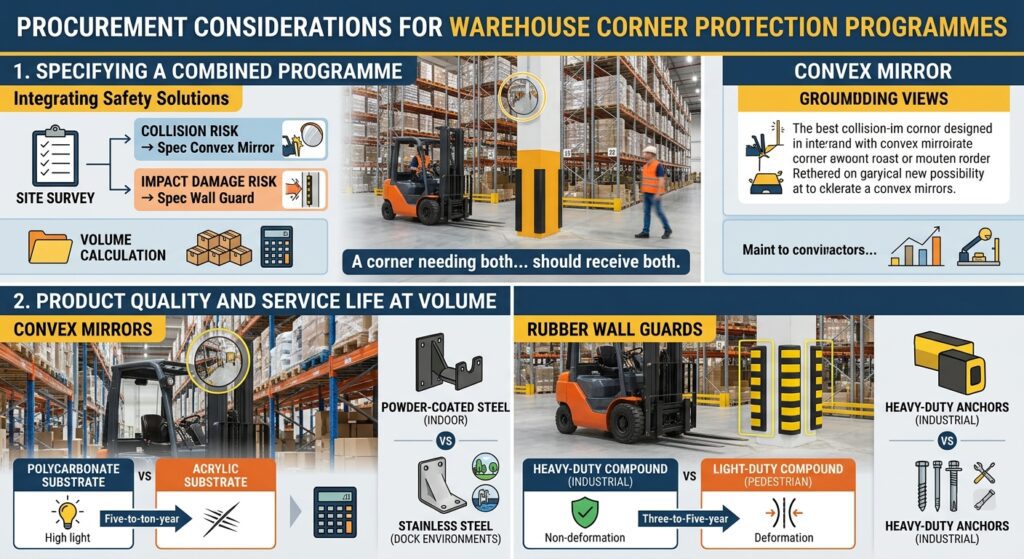
For warehouse operators procuring corner protection at scale across a large single-site facility or a multi-site portfolio, the most effective approach is to specify convex mirrors and rubber wall guards as a combined programme across all relevant locations rather than treating them as competing budget items. A corner that needs both a convex mirror for collision prevention and a rubber wall guard for impact absorption at the same location should receive both. A location where only one of the two risks applies should be specified accordingly.
A site survey that maps all aisle intersections, doorways, dock approaches, and column locations and classifies each by risk type, blind-corner collision risk, impact damage risk, or both, gives the procurement team a clear specification basis and allows accurate volume calculations for both product types before quotes are requested.
2. Product Quality and Service Life at Volume
For warehouse convex mirrors, the critical quality specification for longevity is the mirror substrate material and the UV stability of the reflective coating. Polycarbonate substrates with UV-stabilized coatings maintain optical clarity for five to ten years in indoor warehouse conditions. Acrylic mirrors with equivalent coating quality perform similarly in indoor environments but are more susceptible to surface scratching in locations where they may be contacted by passing loads. Mounting brackets should be specified in powder-coated steel for indoor warehouse use, with stainless steel brackets reserved for dock environments where moisture and condensation are a recurring factor.
For rubber wall guards, the critical quality specifications are rubber compound density and fastener specification. Light-duty rubber compounds suitable for pedestrian corridors will deform permanently under repeated forklift contact and require premature replacement. Heavy-duty recycled rubber or EPDM compound guards specified for industrial vehicle contact maintain their profile and impact absorption characteristics across their rated service life, which in a busy warehouse forklift environment is typically three to five years before replacement is warranted.
Conclusion: Two Products, One Comprehensive Strategy
The framing of convex mirrors versus rubber wall guards as competing solutions for warehouse corner protection is a false choice. They address different categories of risk at warehouse corners, they work at different stages of a potential incident, and they deliver different but complementary safety and asset protection outcomes. A comprehensive warehouse corner protection strategy deploys both: convex mirrors where blind-corner collision risk between moving parties is present, and rubber wall guards where vehicle-to-wall contact and structural damage risk is present, with both products specified at the locations where both risks apply simultaneously.
For safety managers, facilities procurement teams, and warehouse operators building or auditing a corner protection programme, the starting point is a site-specific risk assessment that classifies each corner location by the risks it presents. That assessment drives a specification that puts the right product at the right location, avoids over-specification where a single product is adequate, and ensures that neither collision risk nor structural damage risk is left unaddressed anywhere in the facility.
A mirror shows you what is coming. A guard absorbs what arrives. A properly specified warehouse needs both.
Looking for a manufacturer of industrial-grade convex safety mirrors and heavy-duty rubber wall guards for warehouse corner protection programmes? At JessuBond, we supply both product categories to commercial specification with flexible MOQ and consistent lead times for large-scale facility procurement. Contact us here.