
A traffic cone that tips over is not a passive inconvenience. On a coastal highway project, an overturned cone entering the travel lane during high-speed traffic creates an immediate collision hazard. On an offshore platform or marine terminal, a cone displaced by wind gusts into an active work area can interfere with heavy lifting operations, obstruct emergency egress routes, or strike personnel. In environments where wind is a constant and significant variable, the weight and base design of every cone deployed is a safety specification decision, not a procurement detail.
Standard traffic cones, the lightweight PVC models that serve adequately in parking lots, indoor facilities, and low-speed road zones, are not engineered for coastal or offshore deployment. Specifying them for high-wind environments is one of the most common and consequential errors in safety equipment procurement for exposed sites. This article covers the weight requirements, material specifications, and deployment standards that safety managers and procurement teams need to understand before sourcing traffic cones for high-wind coastal and offshore work sites.
Why Wind Changes Everything About Cone Specification
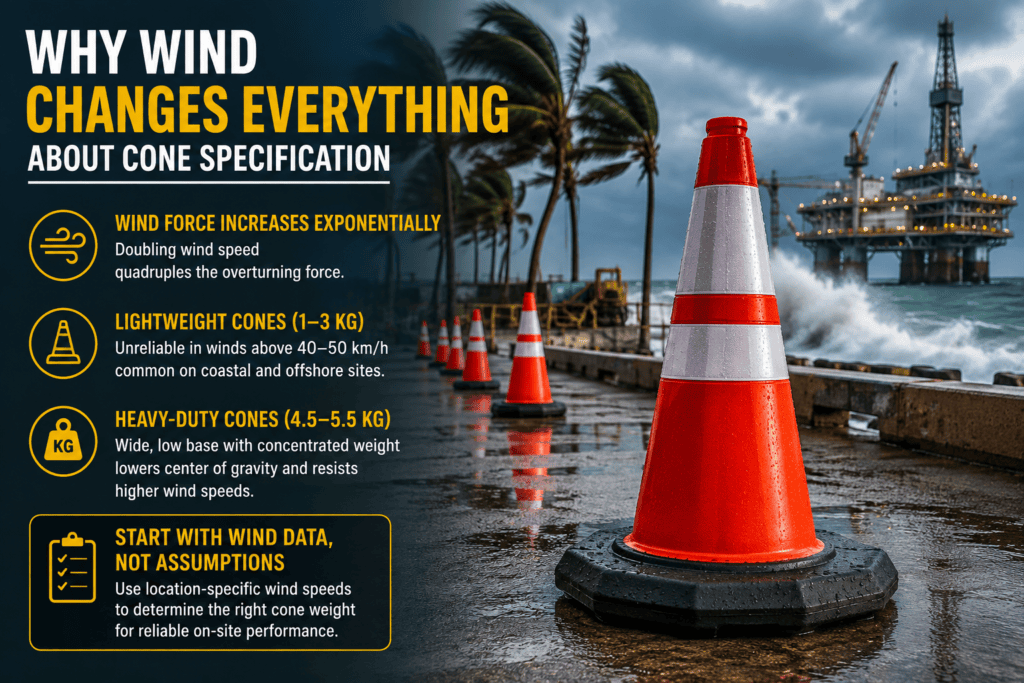
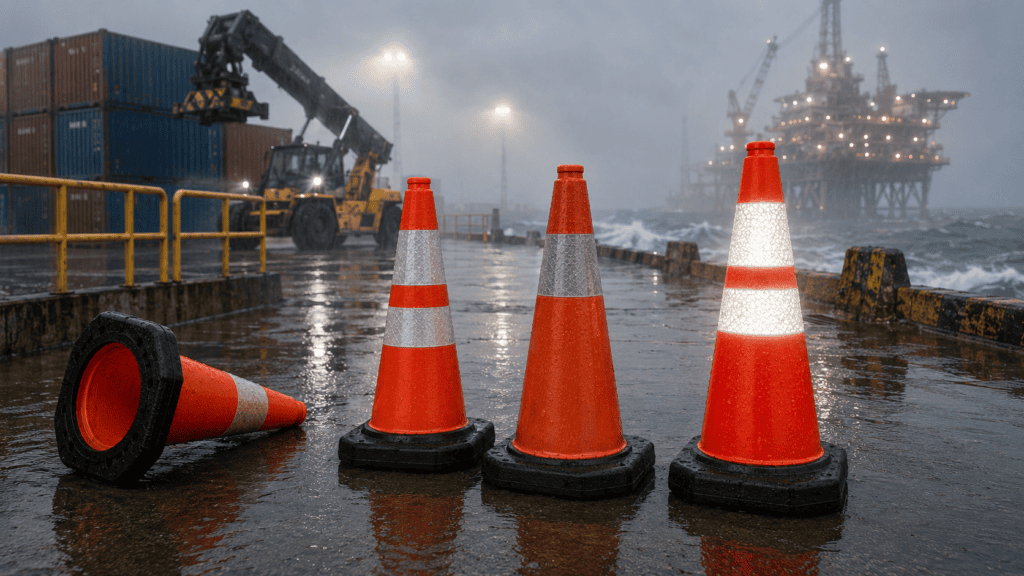
The physics of traffic cone stability under wind loading are straightforward. A cone remains upright when the restoring moment generated by its weight and base geometry exceeds the overturning moment applied by wind force on its body. As wind speed increases, the overturning moment increases with the square of wind velocity, meaning that doubling wind speed quadruples the overturning force the cone must resist. A cone that stands reliably at twenty kilometres per hour of wind may begin tipping at forty and will be displaced consistently at sixty.
Standard lightweight PVC cones weigh between 1 and 3 kilograms depending on height. At wind speeds above 40 to 50 kilometres per hour, which are entirely routine conditions on exposed coastal construction sites and offshore platforms, these cones provide unreliable stability at best. Heavy-duty weighted cones designed for high-wind deployment weigh between 4.5 and 5.5 kilograms, with the majority of that weight concentrated in a wide, low base. That weight distribution lowers the cone’s centre of gravity, significantly increasing the wind speed threshold at which tipping occurs.
For procurement managers sourcing cones for coastal and offshore sites, wind speed data for the specific location should be the starting point for weight specification, not the ending point of a post-purchase rationalization.
Weight Benchmarks by Application and Wind Exposure
Standard Road and Construction Sites
For most road construction and maintenance work zones in non-coastal, non-exposed environments, traffic cones in the 3 to 4.5 kilogram range represent the standard specification. These cones, typically 70 to 90 centimetres in height, deliver adequate stability at the wind speeds common to sheltered urban and suburban road environments. The MUTCD standard in the United States specifies that cones used in roadway work zones with speeds above 70 kilometres per hour must be at least 70 centimetres tall, and the European Standard EN 13422 establishes base weight and structural requirements for cones in EU member state applications.
These standard weight benchmarks are the baseline from which coastal and offshore specifications must step up significantly.
Coastal Highway and Exposed Road Construction
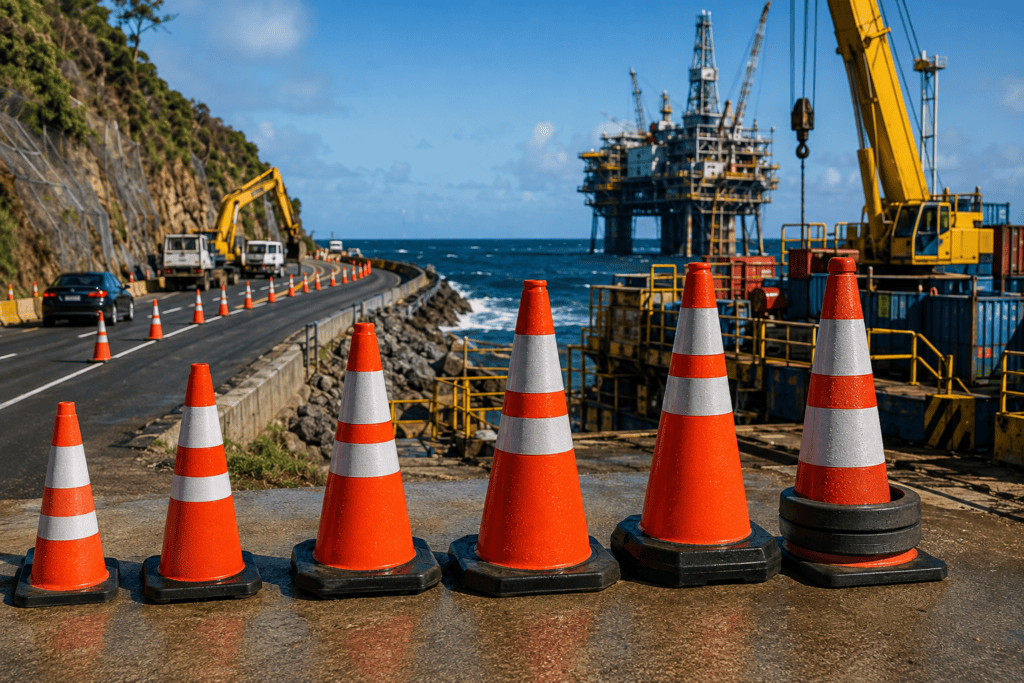
Coastal road construction sites, particularly those on headlands, causeways, bridge approaches, and shoreline corridors, are subject to sustained coastal winds and periodic gusts that exceed the stability threshold of standard-weight cones. For these environments, cones in the 4.5 to 5.5 kilogram range with a 70 to 90 centimetre height are the appropriate minimum specification.
The base design matters as much as total weight at these locations. Cones with a wide, flat base of 40 centimetres or more in diameter distribute their mass over a larger footprint, increasing resistance to overturning moments from lateral wind loading. Narrow-base designs concentrate weight more centrally and are less effective against angled or gusting wind conditions, even at equivalent total weights.
For coastal sites with documented sustained wind speeds above 60 kilometres per hour, or sites subject to unpredictable gusting from sea breezes or storm weather windows, the 5 to 5.5 kilogram specification with a rubber or recycled rubber base is the appropriate minimum. In these conditions, the additional cost per unit relative to a standard 3 kilogram PVC cone is recovered many times over in reduced cone-retrieval labour, eliminated replacement costs from wind-damaged cones, and the safety incidents that overturned cones in live traffic zones would otherwise generate.
Marine Terminals and Exposed Port Environments
Marine terminal environments combine the coastal wind exposure challenge with the additional complication of wash turbulence from large vehicles. Reach stackers, straddle carriers, and articulated port trucks generate powerful air displacement as they move through terminal lanes, which creates a localized turbulence effect that can displace lightweight cones independently of ambient wind conditions.
For marine terminal deployment, the minimum cone weight specification should be 4.5 to 5.5 kilograms, and the material specification must account for salt air corrosion. Standard black rubber bases are generally adequate in this respect, but cone bodies with UV-stabilized pigmentation are important for terminals in high-UV coastal locations where unstabilized orange pigment will fade to a pale, low-visibility colour within one to two seasons of outdoor deployment.
Offshore Platform and Wind Turbine Installation Sites
Offshore platforms represent the most demanding environment for traffic cone deployment in any industrial context. Fixed offshore oil and gas platforms, floating production units, and offshore wind turbine installation vessels all experience sustained wind speeds that regularly exceed 60 to 80 kilometres per hour, with gusting above 100 kilometres per hour not uncommon during weather windows that may still require operational activity.
In these environments, standard traffic cones are functionally unsuitable regardless of their weight category. The combination of sustained high wind, platform deck vibration, moving heavy lift equipment, and the severe consequences of a displaced cone entering an active crane or lifting zone requires a different approach to temporary hazard delineation entirely.
For offshore platform decks, the appropriate specification is either maximum-weight rubber cones in the 5 to 5.5 kilogram range deployed with interlocking chain or barrier connections between units, or purpose-built offshore-rated delineation systems that use deck-mounted anchor points rather than freestanding bases. Where freestanding cones must be used, ballast weights, which are purpose-made cast iron or rubber rings that clip around the cone base to add additional mass, can supplement the base weight of a standard 90 centimetre cone to bring the total assembly weight above 7 kilograms.
Material Considerations for Coastal and Offshore Cones
Weight alone does not complete the specification for high-wind coastal and offshore traffic cones. The material composition of both the cone body and the base must be suited to the specific environmental stresses of maritime deployment.
Rubber vs. PVC vs. Polyethylene in Coastal Environments
PVC traffic cones are the market standard for inland road applications. In coastal environments, PVC performs adequately in terms of structural integrity but offers relatively low base weight, which limits its effectiveness in high-wind deployment. The material’s UV resistance varies significantly between manufacturers, and lower-grade PVC formulations will begin losing colour vibrancy and surface integrity within two to three seasons of constant coastal UV exposure.
Rubber traffic cones and rubber-base PVC hybrid cones address the weight limitation directly. Rubber is denser than PVC by a significant margin, meaning that a rubber-base cone achieves meaningfully higher base weight without requiring an oversized base footprint. A 90 centimetre rubber-base PVC cone with 80 percent of its total weight concentrated in the rubber base delivers both the low centre of gravity and the total mass needed for stable deployment in sustained coastal winds. Rubber bases also provide superior grip on hard surfaces, resisting displacement from both wind and vehicle wash turbulence more effectively than PVC bases on smooth asphalt or concrete.
High-density polyethylene (HDPE) cone bodies represent a middle option with better impact recovery than PVC in cold coastal climates, where standard PVC can become brittle and crack when struck by vehicles or equipment at low temperatures. For offshore and sub-Arctic coastal applications, HDPE-body cones with rubber bases are a specification worth considering over standard PVC for exactly this reason.
Reflectivity Requirements in Coastal and Offshore Conditions
High-wind coastal and offshore work sites frequently operate during reduced visibility conditions: sea fog, rain squalls, dawn and dusk transitions, and night operations on terminals and platforms that run around the clock. The reflective sleeve specification for cones in these environments is therefore a safety-critical detail that must be addressed alongside weight.
For coastal road construction sites, MUTCD-compliant retroreflective sleeves are the baseline requirement. For offshore and marine terminal environments, double-sleeve configurations that provide retroreflective coverage from a wider range of horizontal angles are preferable, because the viewing angles in these environments are less predictable than in a standard road work zone where all approaching drivers are within a defined lane.
Retroreflective sleeves must be specified with adhesive or mechanical attachment that resists wind peel and salt air degradation. Sleeves that rely on weak adhesive attachment and fail within a season of coastal deployment create a compliance and visibility gap that defeats the purpose of the reflective specification.
Supplementary Stability Systems for Extreme Wind Conditions
Where the weight specification alone is insufficient to guarantee cone stability in the most extreme wind conditions encountered at coastal and offshore sites, supplementary stability systems bridge the gap between what a freestanding weighted cone can achieve and what the site conditions demand.
Cone Ballast Weights
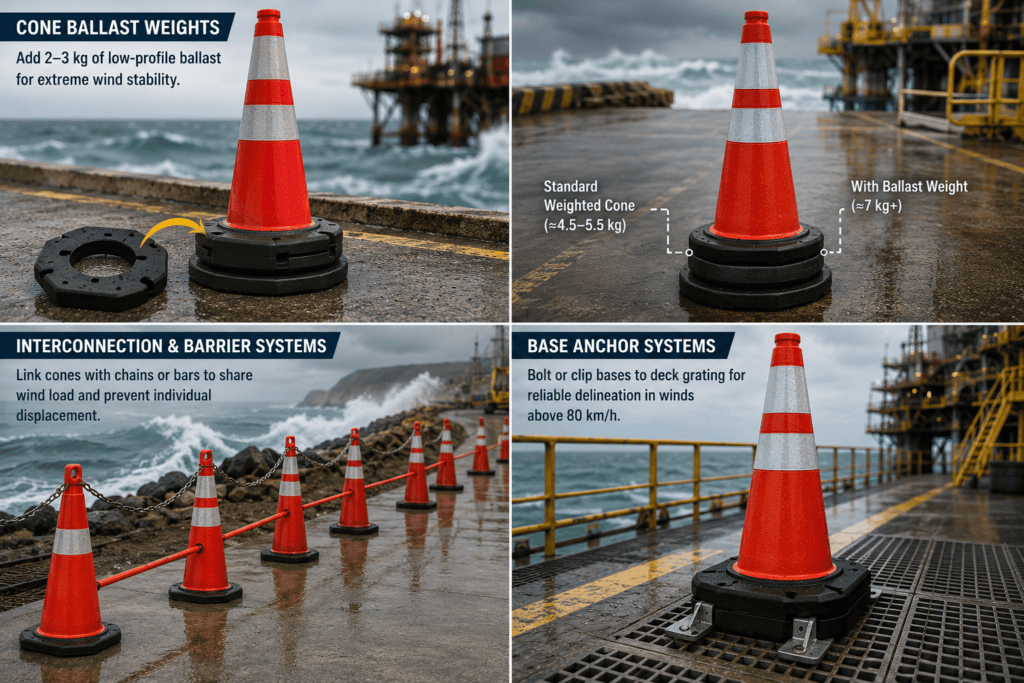
Cone ballast weights are purpose-manufactured cast rubber or composite rings that clip or slip over the base of a standard traffic cone, adding 2 to 3 kilograms of additional mass at the lowest point of the cone’s profile. A 36 inch, approximately 90 centimetre, weighted-base cone with an additional ballast weight attached brings the total assembly weight to 7 kilograms or above, which delivers meaningful stability improvement in sustained wind conditions above 70 kilometres per hour.
Ballast weights are compatible with standard cone sizes and add minimal bulk, which means they do not significantly complicate stacking and transport logistics. For procurement managers sourcing for sites where wind conditions are variable, a standard heavy-duty cone inventory supplemented with a proportional stock of ballast weights provides deployment flexibility that a fixed-weight specification cannot offer.
Interconnection and Barrier Systems
For long-run perimeter delineation on coastal construction sites and offshore platform decks, interconnected cone and barrier systems that link individual cones with chains, ropes, or rigid connector bars between bases reduce the likelihood of individual cone displacement by distributing wind loading across the full run of connected units. A single cone standing alone at the end of a run remains vulnerable to overturning even at weights that resist tipping within a connected series.
For offshore platform deck delineation around hazardous equipment, open hatchways, or exclusion zones around active lifting operations, base anchor systems that bolt or clip to deck grating provide a more reliable delineation solution than any freestanding cone at wind speeds above 80 kilometres per hour.
Procurement Considerations for High-Wind Coastal and Offshore Deployments
Safety managers and procurement teams sourcing traffic cones for coastal and offshore sites should build their specification around three parameters in sequence: first the wind speed data for the deployment location, second the cone height and weight required to achieve stability at that wind speed, and third the material specification for body and base suited to the environmental conditions.
Requesting wind speed documentation for the project site from the project engineer or environmental survey report before finalizing the cone specification is not an excessive step. It converts a procurement decision that is often made on price into one that is grounded in the actual physical requirements of the deployment environment.
For large-scale coastal infrastructure projects, port expansions, offshore construction programs, and wind farm installation vessels, the volume of traffic cones in service at any one time is substantial, and the consequences of a specification error are amplified across every displaced cone. Getting the weight and material specification right from the outset is the lowest-cost safety intervention available at the procurement stage, and it is the one that protects both the site workforce and the procurement team from the consequences of a specification that was never adequate for the environment it was deployed in.
Looking for a Custom Traffic Cones Manufacturer or Supplier? Struggling to find the right factory to bring your vision to life? We’ve got you covered! At our place, we craft top-quality traffic cones with precision and care. Big or small, your needs are our mission. Let’s launch your cones project and take your product line to the next level! Click here to contact