
Complex industrial construction and maintenance projects involve multiple contractors, diverse work activities, and layered operational hazards requiring sophisticated visual communication systems that convey critical safety information to workers, equipment operators, and site visitors. Manufacturing plant expansions, petrochemical facility turnarounds, power generation infrastructure projects, and large-scale industrial maintenance operations deploy thousands of traffic cones serving purposes far beyond simple traffic delineation. Facility safety managers, project coordinators, and site superintendents increasingly implement standardized color-coding protocols that transform basic traffic cones into comprehensive visual communication tools, enabling workers to instantly recognize work zone boundaries, hazard classifications, utility locations, and access restrictions through systematic color assignments. Strategic color-coding implementation requires careful protocol development, comprehensive personnel training, and rigorous enforcement mechanisms that ensure consistent application across complex projects involving hundreds of workers from multiple organizations operating simultaneously within confined industrial environments.
Industrial Safety Communication Challenges
Large industrial projects create extraordinarily complex work environments where simultaneous activities including heavy equipment operation, confined space entry, hot work operations, electrical installations, and process equipment maintenance occur within overlapping spaces. Traditional safety communication methods including signage, barricades, and verbal instructions prove inadequate for conveying the dynamic, multi-layered hazard landscape that characterizes these environments. Workers navigating through industrial sites encounter dozens of distinct work zones daily, each presenting unique hazards requiring specific safety precautions and access authorizations.
Project coordination becomes increasingly challenging as project scale increases and multiple prime contractors, specialty subcontractors, and facility operations personnel share common work areas. Communication barriers emerge from diverse organizational safety cultures, language differences among multinational workforces, and the sheer volume of safety information that workers must process continuously. Color-coded traffic cone systems address these challenges by providing instantly recognizable visual indicators that transcend language barriers and organizational boundaries, creating standardized safety communication frameworks that all project participants understand regardless of their employer, native language, or specific trade discipline.
Regulatory Framework and Industry Best Practices
Occupational Safety and Health Administration regulations establish fundamental requirements for hazard communication and work zone protection but do not mandate specific color-coding protocols for traffic control devices. OSHA’s hazard communication standard (29 CFR 1910.1200) requires employers to inform workers about chemical hazards through labels, safety data sheets, and training programs, while construction safety standards (29 CFR 1926) address physical hazards including excavations, confined spaces, and fall protection. Traffic cone color-coding systems complement these regulatory requirements by providing additional visual hazard identification that enhances worker awareness and supports compliance with underlying safety obligations.
Industry consensus standards including those developed by the American National Standards Institute (ANSI), National Fire Protection Association (NFPA), and American Petroleum Institute (API) provide guidance addressing facility safety marking and hazard identification. ANSI Z535 safety color code standards establish recognized color associations for safety communication, designating red for fire protection and danger, orange for warning of hazardous machine parts or energized equipment, yellow for caution regarding physical hazards, and green for safety information and first aid. While these standards primarily address permanent facility markings, their color conventions inform temporary traffic cone color-coding protocols to maintain consistency with established safety communication frameworks that workers already understand.
Standard Traffic Cone Color Options and Meanings
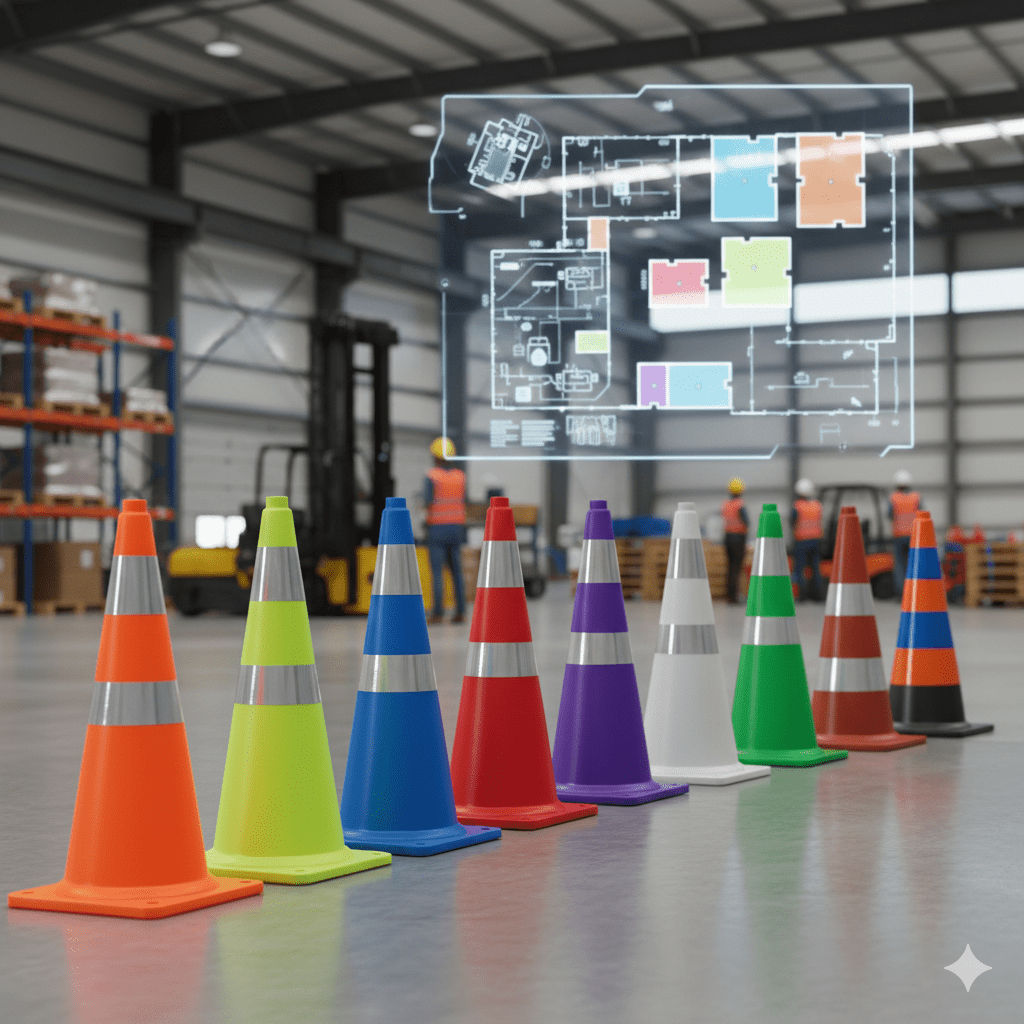
Traffic cone manufacturers offer products in diverse colors beyond standard fluorescent orange, enabling project teams to implement comprehensive color-coding protocols tailored to specific project requirements. Procurement specifications should identify required color assortments and verify that manufacturers can supply sufficient quantities in each specified color to meet project deployment needs throughout construction duration.
Orange Cones for General Traffic Control
Fluorescent orange represents the standard traffic cone color universally recognized for temporary traffic control and general work zone delineation. MUTCD specifications require orange for traffic control devices on public roadways, establishing strong cultural association between orange cones and traffic management applications. Industrial projects should reserve orange cones for basic traffic control purposes including vehicle path delineation, general work zone boundaries, and temporary parking restrictions where no specific hazard classification requires specialized color designation.
Maintaining orange cones for general traffic control purposes preserves consistency with public expectations and prevents confusion when workers transition between industrial project sites and public roadway environments. Project specifications should procure adequate orange cone inventories to satisfy general traffic control needs while providing sufficient quantities of specialized colors for hazard-specific applications requiring visual differentiation.
Lime-Yellow Cones for Pedestrian Pathways
Lime-yellow or fluorescent yellow-green cones provide high-visibility alternatives to orange that enable visual differentiation for specific applications. Many industrial projects designate lime-yellow cones exclusively for pedestrian walkway delineation, creating designated safe routes for personnel movement through complex work sites. This color assignment enables workers to quickly identify safe walking paths separate from vehicle traffic lanes, reducing pedestrian-vehicle collision risk in congested industrial construction areas.
Lime-yellow achieves superior daytime visibility compared to orange under certain lighting conditions, particularly in environments with substantial orange equipment or infrastructure where orange cones would blend into backgrounds. The distinctive yellow-green hue creates visual contrast that draws attention and communicates special status distinct from standard orange traffic control applications.
Blue Cones for Utility Infrastructure Protection
Blue traffic cones frequently designate underground utility protection zones, particularly for water and sewer systems following color conventions established by the American Public Works Association (APWA) uniform color code for utility marking. Industrial projects involving complex underground utilities including potable water, process water, wastewater collection, and stormwater drainage benefit from blue cone deployment marking utility locations and establishing protection zones preventing excavation damage.
Blue cone deployment should coordinate with underground utility marking practices using blue paint or flags to indicate water system locations, creating comprehensive visual communication systems that combine temporary cones with semi-permanent markings. Project excavation permits and dig-safe protocols should reference blue cone meanings, ensuring that excavation contractors understand that blue-coned areas require special precautions including hand digging, vacuum excavation, or other protective measures preventing utility strikes.
Red Cones for Fire Protection and Emergency Access
Red cones serve critical safety functions designating fire protection equipment locations, emergency access routes, and fire hazard zones requiring heightened awareness. Industrial facilities maintain fire hydrants, fire department connections, emergency exit routes, and fire assembly areas that must remain accessible at all times. Red cone deployment around these critical features prevents contractors from blocking access through material storage, equipment parking, or temporary construction activities that could compromise emergency response capabilities.
Fire marshals and insurance underwriters scrutinize fire protection system accessibility during facility inspections, with blocked fire protection equipment representing serious code violations potentially resulting in stop-work orders or insurance policy cancellations. Red cone protocols create visual barriers preventing inadvertent access blockage while immediately communicating to all personnel that designated areas serve critical fire protection functions requiring absolute protection from interference.
White Cones for Visitor and VIP Areas
White traffic cones designate visitor parking areas, VIP tour routes, and client observation locations at industrial project sites. Large capital projects frequently host facility owner representatives, financial stakeholders, regulatory inspectors, and corporate executives requiring site access under controlled conditions. White cone deployment creates visual boundaries separating visitor areas from active construction zones, reducing risk of unauthorized visitor entry into hazardous areas while providing clear wayfinding for approved visitor movement.
White cone protocols support comprehensive visitor management programs that protect non-construction personnel from industrial hazards while enabling necessary site access for project oversight and stakeholder communication. Security personnel and site escorts recognize white-coned areas as designated visitor zones requiring enhanced housekeeping standards and hazard mitigation appropriate for personnel lacking construction safety training and personal protective equipment.
Purple Cones for Radiation Hazard Zones
Purple cones designate radiation hazard areas at industrial facilities including power generation plants, research facilities, and industrial radiography operations. The distinctive purple color aligns with Nuclear Regulatory Commission (NRC) requirements and ANSI standards establishing purple as the designated color for radiation warning signs. Industrial projects at nuclear facilities or involving industrial radiography for weld inspection deploy purple cones establishing exclusion zones around radiation sources, preventing inadvertent personnel exposure during radiographic testing operations.
Purple cone protocols require strict enforcement with access control measures including locked barriers, security personnel, or other physical controls supplementing visual cone boundaries. Radiation safety officers specify required exclusion zone dimensions based on radiation source strength and exposure duration limits, with purple cone placement marking calculated safe distances preventing personnel from receiving radiation doses exceeding regulatory limits.
Green Cones for First Aid and Emergency Equipment
Green traffic cones mark first aid station locations, emergency eyewash and shower equipment, and automated external defibrillator (AED) placement. ANSI safety color standards designate green for safety information including emergency equipment locations, creating logical extension of these conventions to traffic cone color-coding. Industrial projects with work areas distributed across large facility footprints require multiple emergency equipment stations positioned within prescribed access distances from all work locations, with green cone deployment making these critical resources immediately visible to workers requiring emergency assistance.
Green cone protocols should integrate with facility emergency response plans and worker safety training programs, ensuring all personnel understand that green cones indicate emergency equipment locations. Emergency response drills should verify that green cone visibility enables rapid equipment location during simulated emergency scenarios, validating that cone placement adequately serves its intended purpose.
Custom Colors for Project-Specific Applications
Some industrial projects implement additional custom cone colors for specialized applications beyond standard color assignments. Examples include:
- Pink cones for temporary survey control points requiring protection from disturbance
- Brown cones for environmental protection zones including wetlands, protected species habitat, or archaeological sites
- Black cones for radiation-free zones within nuclear facilities or areas where radiography is explicitly prohibited
- Striped cones combining multiple colors indicating overlapping conditions such as orange-and-blue striped cones marking traffic control zones with underlying utilities
Custom color protocols require comprehensive documentation and intensive training ensuring that specialized meanings are universally understood. Project teams should limit custom color proliferation, as excessive color variety creates confusion and dilutes the communication effectiveness that color-coding systems provide.
Protocol Development and Standardization
Effective color-coding implementation begins with comprehensive protocol development establishing clear color assignments, deployment procedures, and enforcement mechanisms. Project safety plans should include detailed traffic cone color-coding sections that specify:
- Complete color inventory with precise meanings for each color
- Cone placement authority designating which personnel or organizations may deploy each color
- Quality standards for cone condition including cleanliness, damage thresholds, and replacement criteria
- Documentation requirements for cone deployment locations
- Inspection procedures verifying correct color usage and placement
- Violation response protocols addressing improper cone usage
Protocol documentation should incorporate visual examples including photographs demonstrating correct cone applications and common error patterns requiring correction. Laminated reference cards distributed to foremen, safety representatives, and equipment operators provide field-accessible guidance that workers can consult when questions arise about proper cone usage.
Coordination Among Multiple Contractors
Complex industrial projects involving multiple prime contractors and numerous subcontractors require careful coordination ensuring color-coding consistency across all organizations working at project sites. Pre-construction meetings should address traffic cone protocols with representatives from all contractors, establishing unanimous agreement regarding color meanings and deployment procedures. Project specifications should incorporate color-coding requirements as contractual obligations, creating enforceable standards rather than voluntary guidelines that contractors might implement inconsistently.
General contractors or construction managers leading multi-contractor projects should consider centralized cone inventory management, purchasing all traffic cones in required colors and issuing equipment to contractors through controlled distribution systems. This centralized approach ensures color consistency, prevents contractors from introducing non-standard cone colors, and enables accurate inventory tracking facilitating efficient equipment management throughout project duration.
Procurement Considerations for Color-Coded Systems
Implementing comprehensive color-coding protocols requires procurement planning that extends beyond typical traffic cone purchasing, addressing color availability, order lead times, and quality consistency across colors. Not all cone manufacturers maintain inventory in all colors, with specialty colors sometimes requiring custom production runs with extended lead times and minimum order quantities. Project procurement schedules should identify specialty color requirements early, initiating orders with adequate lead time preventing schedule delays from equipment unavailability.
Color Consistency and Quality Standards
Traffic cone colors must maintain consistency within each color category and adequate differentiation between colors to enable reliable visual discrimination. Color specifications should reference Federal Standard 595C color chips or RAL color standards providing objective color definitions that manufacturers must match. Procurement acceptance procedures should include color verification comparing delivered cones against reference standards, rejecting shipments with colors falling outside acceptable tolerance ranges.
Fluorescent pigments used in high-visibility cone formulations exhibit color variation between manufacturers and production lots, potentially creating visual inconsistency when cones from different sources or production batches deploy together. Large projects should consider single-source procurement for each color category, ensuring consistent color appearance across equipment inventories. Procurement contracts should include provisions requiring manufacturers to maintain color consistency across multiple delivery installments, preventing color drift as projects procure additional equipment over multi-year construction periods.
Retroreflective Sheeting Color Coordination
Retroreflective sheeting applied to traffic cones typically comes in standard colors including white, yellow, orange, red, and lime-yellow, with specialty colors available at premium pricing or extended lead times. Color-coding protocols must ensure that retroreflective sheeting colors coordinate logically with cone body colors, avoiding confusing combinations such as orange sheeting on blue cones that send conflicting visual messages. Standard practice applies white retroreflective sheeting to all cone colors except orange, which receives orange retroreflective material per MUTCD requirements, and lime-yellow cones which may use matching yellow-green reflective bands.
Projects requiring nighttime operations should specify enhanced retroreflectivity for all cone colors, ensuring that color differentiation remains effective under vehicle headlight illumination. Some dark cone colors including blue, purple, and green exhibit reduced nighttime visibility compared to bright orange or lime-yellow, requiring wider retroreflective bands or higher-performance retroreflective materials maintaining adequate visibility in low-light conditions.
Training and Communication Programs
Color-coding system effectiveness depends critically on comprehensive personnel training ensuring that all site workers understand color meanings and deployment protocols. Multi-modal training approaches incorporating classroom instruction, visual aids, field demonstrations, and ongoing reinforcement create the knowledge retention necessary for successful system implementation.
New Hire Orientation Integration
Color-coding protocols should integrate into mandatory new hire orientation programs that all workers complete before receiving site access authorization. Orientation curricula should include:
- Visual presentation of each cone color with corresponding meaning
- Explanation of rationale for color-coding system and safety benefits
- Demonstration of correct cone placement and spacing
- Discussion of consequences for violating color-coding protocols
- Knowledge verification through written tests or verbal questioning confirming understanding
Orientation documentation should record that workers received color-coding training and demonstrated comprehension of cone meanings, creating accountability records supporting disciplinary action if workers subsequently violate established protocols.
Multilingual Training Materials
Industrial construction projects frequently employ diverse workforces including significant percentages of workers with limited English proficiency. Training programs must provide effective communication regardless of language barriers through multiple strategies including:
- Training materials translated into languages spoken by substantial worker populations
- Visual training aids using photographs and diagrams minimizing text dependence
- Bilingual trainers who can deliver instruction in workers’ native languages
- Demonstration-based training showing correct practices rather than relying on verbal instruction
- Verification testing using visual color recognition rather than text-based questions
OSHA requires that safety training be presented in languages and vocabularies that workers comprehend, making multilingual training not merely best practice but regulatory obligation. Projects serving diverse workforces should budget for professional translation services and multilingual trainers, recognizing these investments as essential components of compliant safety programs.
Ongoing Reinforcement and Toolbox Talks
Initial orientation training requires reinforcement through ongoing communication maintaining awareness of color-coding protocols as projects progress. Weekly toolbox talks should periodically revisit color-coding topics, addressing observed compliance issues and reminding workers of specific color meanings relevant to current project activities. Toolbox talk topics might include:
- Proper placement of red cones protecting fire equipment access
- Distinction between orange and lime-yellow cone applications
- Protocols for requesting specialized color cones for hazardous areas
- Recent incidents or near-misses involving cone color confusion
- Updates to color-coding protocols reflecting project evolution
Visual reminders including posters displayed in break areas, stickers on equipment, and graphics on distribution of personal protective equipment reinforce training messages through multiple touchpoints throughout work days.
Quality Control and Compliance Monitoring
Systematic quality control programs monitor color-coding implementation, identifying non-compliance requiring correction and verifying that deployed cones maintain acceptable condition throughout service life. Safety inspectors, quality control personnel, and contractor supervision staff share responsibility for color-coding oversight, conducting regular inspections and documenting observations.
Daily Inspection Protocols
Designated personnel should conduct daily walkthrough inspections of work areas specifically evaluating traffic cone deployment including:
- Verification that deployed cone colors match authorized uses for specific locations
- Assessment of cone condition including cleanliness, structural integrity, and retroreflective sheeting condition
- Confirmation that cone quantities and spacing satisfy project standards
- Identification of unauthorized cone colors or improvised traffic control not following established protocols
- Documentation of deficiencies requiring contractor correction
Inspection findings should be documented using digital inspection applications or standardized paper forms that create permanent records of observations and corrective actions. Repeated violations by specific contractors may indicate training deficiencies or deliberate non-compliance requiring escalated enforcement responses.
Non-Compliance Response Procedures
Color-coding protocols require enforcement mechanisms ensuring that violations receive appropriate responses ranging from immediate field correction to formal stop-work orders for severe or repeated violations. Progressive disciplinary frameworks might include:
- First occurrence: Verbal warning with immediate correction and documentation in contractor file
- Second occurrence: Written notice requiring contractor safety representative meeting and retraining of affected workers
- Third occurrence: Financial penalties per contract provisions or temporary work suspension until corrective actions complete
- Critical violations: Immediate work stoppage when incorrect color usage creates imminent safety hazards such as blocking fire protection equipment
Enforcement consistency across all contractors proves essential for maintaining system credibility. Selective enforcement or preferential treatment for certain contractors undermines the standardization benefits that color-coding provides and creates resentment among contractors held to standards that others violate with impunity.

Integration with Digital Project Management Systems
Advanced construction management increasingly incorporates digital technologies including project management software, mobile applications, and geographic information systems that can enhance color-coding system effectiveness through digital integration.
Digital Color-Coding Maps
Geographic information system (GIS) platforms enable creation of digital maps documenting traffic cone deployment locations with color-coding visible on digital displays. Project coordinators can overlay cone locations on facility base maps, creating comprehensive visual references showing work zone boundaries, pedestrian routes, utility protection zones, and emergency access corridors. These digital maps support project coordination meetings, enable rapid assessment of potential work area conflicts, and provide documentation of safety measure implementation.
Mobile applications enable field personnel to access digital color-coding maps using tablets or smartphones, providing real-time reference information during site activities. GPS-enabled mobile devices can display user location on color-coded maps, helping workers navigate through complex industrial environments while respecting established work zone boundaries and safety protocols.
Inventory Management System Integration
Color-coded traffic cone inventories can integrate with construction equipment management systems tracking equipment checkout, location, and condition. Barcode or RFID tagging systems enable automated inventory updates as colored cones deploy to and return from work areas, maintaining accurate color-specific inventory counts that inform procurement decisions and identify potential equipment shortages before they impact operations. Equipment tracking data also supports accountability systems identifying contractors responsible for lost or damaged equipment in specific colors.
Cost-Benefit Analysis of Color-Coding Implementation
Color-coding system implementation involves incremental costs beyond standard orange cone procurement, including specialty color purchase premiums, enhanced training program expenses, and quality control oversight labor. Project teams must evaluate whether these additional investments deliver sufficient safety and operational benefits justifying expenditure.
Quantifiable Safety Benefits
Color-coding systems contribute to injury reduction through multiple mechanisms including:
- Reduced pedestrian-vehicle collisions through dedicated walkway marking with lime-yellow cones
- Prevented utility strikes through enhanced underground infrastructure visibility using blue cones
- Improved emergency response through instant identification of emergency equipment locations marked with green cones
- Reduced fire code violations through red cone protection of fire protection equipment access
While directly attributing injury prevention to color-coding implementation proves challenging given multiple simultaneous safety interventions on complex projects, historical comparisons between projects with and without formal color-coding systems suggest meaningful safety improvements. Even modest injury reduction produces substantial financial benefits when considering workers compensation costs, schedule impacts from incidents, and legal liabilities from serious injuries.
Operational Efficiency Improvements
Color-coded systems improve operational efficiency by reducing confusion, minimizing work area conflicts, and streamlining coordination among multiple contractors. Workers spend less time seeking information about work zone boundaries, access restrictions, and hazard locations when visual color cues provide instant communication. Project coordinators spend less time resolving contractor conflicts over work area access when color-coded boundaries clearly delineate which areas each contractor controls.
Efficiency improvements prove difficult to quantify precisely but manifest through smoother project execution, fewer coordination delays, and reduced supervisory time addressing preventable conflicts. Project managers implementing color-coding systems consistently report qualitative improvements in site organization and reduced frequency of coordination issues requiring management intervention.
Continuous Improvement and Lessons Learned
Color-coding protocols should evolve throughout project lifecycles as teams identify opportunities for improvement and adapt protocols to address emerging challenges. Regular protocol review sessions bringing together safety managers, contractor representatives, and project leadership evaluate system effectiveness and consider modifications enhancing communication clarity or operational efficiency.
Post-project reviews should document color-coding system performance including:
- Safety incident correlation with cone color confusion or deployment errors
- Contractor feedback regarding protocol clarity and operational impact
- Identified gaps where additional color designations would provide value
- Equipment condition and replacement rates for various colors
- Training effectiveness assessment based on observed compliance rates
- Recommendations for future project protocol improvements
These lessons learned inform protocol development for subsequent projects, enabling organizations to refine color-coding approaches through experience accumulated across multiple project implementations.
Conclusion: Visual Communication Excellence for Industrial Safety
Traffic cone color-coding systems represent sophisticated visual communication frameworks that transform simple traffic control devices into comprehensive safety and coordination tools appropriate for complex industrial construction environments. Facility managers and project leaders who invest in developing clear color-coding protocols, procuring quality equipment inventories, implementing comprehensive training programs, and enforcing consistent compliance create safer, more efficiently coordinated work sites that protect workers while optimizing project execution. While color-coding implementation requires more planning and investment than deploying standard orange cones alone, the safety and operational benefits deliver compelling returns that justify the incremental effort and expense. As industrial projects increase in complexity and regulatory expectations for hazard communication intensify, systematic color-coding approaches will likely transition from competitive differentiators to industry standard practices that stakeholders expect from professional construction organizations committed to safety excellence and operational efficiency.
Looking for a Custom Traffic Cones Manufacturer or Supplier? Struggling to find the right factory to bring your vision to life? We’ve got you covered! At our place, we craft top-quality traffic cones with precision and care. Big or small, your needs are our mission. Let’s launch your cones project and take your product line to the next level! Click here to contact