
Traffic cones are the foundation of temporary hazard delineation across road construction, industrial facility management, event safety, and airport ground operations. But cones alone are rarely sufficient. In most professional deployment scenarios, the cone is the anchor point for a system of accessories that extend its function, increase its visibility, create continuous barriers, and communicate specific hazard information to approaching road users and personnel.
For B2B buyers, distributors, and safety equipment resellers, traffic cone accessories represent both a significant commercial opportunity and a sourcing challenge. The accessory market is fragmented, product quality varies enormously across manufacturers and price points, and compatibility between accessories and cone models is not standardized across the industry. A cone bar that fits one manufacturer’s 90 centimetre cone may sit loosely or not at all on another brand’s product of the same stated size. An LED topper specified for amber flash in one jurisdiction may not meet the photometric requirements of another.
This guide breaks down each major category of traffic cone accessory, its specifications and performance criteria, the B2B applications that drive demand, and the sourcing considerations that procurement teams need to apply before committing to a supplier relationship.
Cone Chains and Plastic Barrier Chains
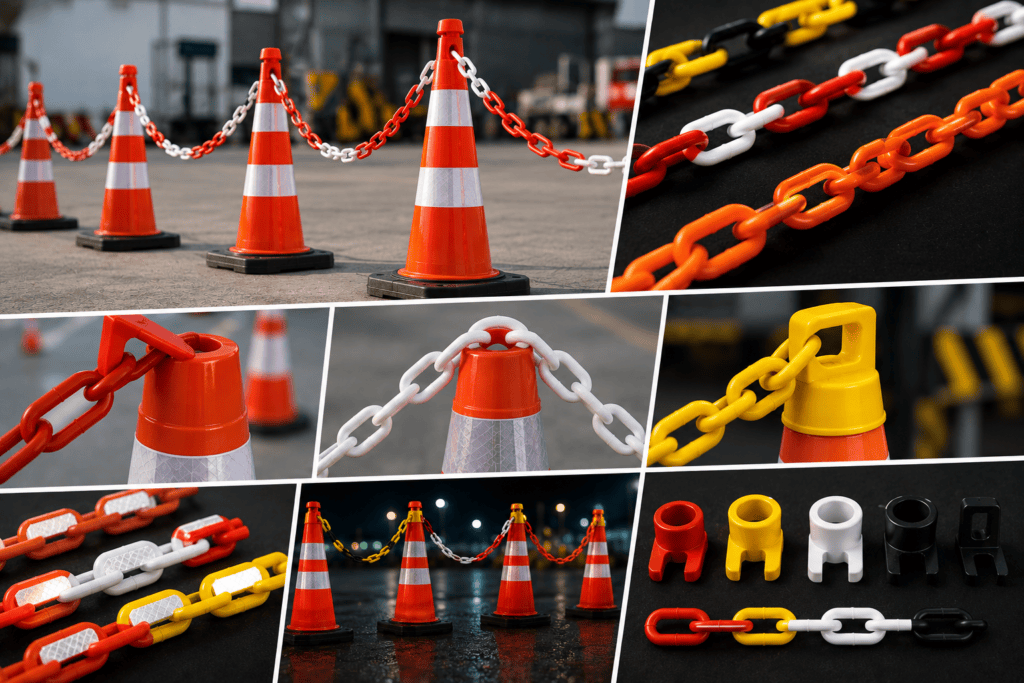
Chains are the simplest and most widely deployed traffic cone accessory category. They connect individual cones into a continuous visual barrier that is more effective at guiding pedestrian and vehicle behaviour than a row of standalone cones with open gaps between them.
Types and Material Specifications
Plastic barrier chains for cone deployment are manufactured from polyethylene or polypropylene in link sizes typically ranging from 25mm to 50mm. The two most common link configurations in the B2B market are the open-link chain, which connects directly to cone bodies or purpose-made cone adapters, and the loop-top chain, which drops over the apex of the cone without requiring an adapter. For outdoor applications, chains must be specified with UV stabilizers to prevent the material from becoming brittle under prolonged sun exposure. Unstabilized polyethylene chains deployed outdoors will begin showing brittleness and link failures within one to two seasons, making replacement frequency and total cost of ownership significantly higher than for UV-stabilized alternatives.
Chains are available in standard safety colours: yellow and black alternating links for hazard perimeter marking, red and white for exclusion zones and emergency delineation, and solid orange for standard road work applications. For high-visibility night operations, retroreflective chain links with a foil insert are available and are increasingly specified for road construction perimeter applications where the chain line must be visible from vehicle headlight distances.
Cone Compatibility and Connector Systems
One of the most important sourcing considerations for cone chains at B2B scale is compatibility with the cone inventory the buyer is already operating. Most chain connector adapters are designed around cone apex diameters that vary between manufacturers. Before placing a bulk chain order, procurement managers should verify that the chain connector system they are sourcing is compatible with the specific cone models in their fleet, either by requesting compatibility data from the supplier or by testing a sample set against representative cones from their existing stock.
For buyers building a new cone and accessory program from scratch, the simplest approach is to source cones and chains from the same manufacturer or to specify cones whose apex dimensions are confirmed compatible with the chain system being ordered. This eliminates the compatibility ambiguity that generates significant waste and frustration in accessory procurement programs that treat cones and accessories as independent purchasing decisions.
LED Cone Lights and Flashing Warning Toppers
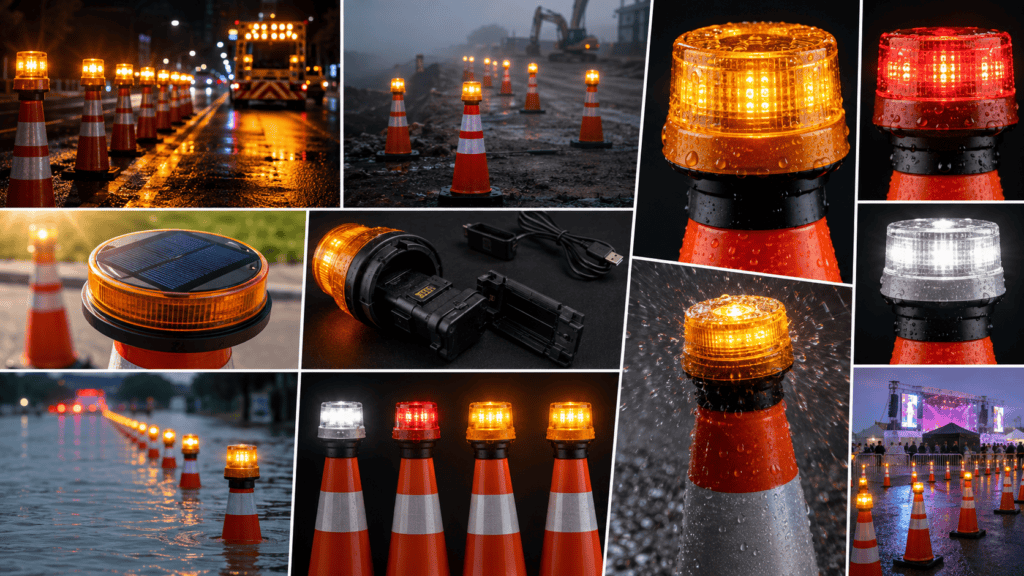
LED cone lights transform a standard traffic cone into a highly visible active warning device. They are the fastest-growing accessory category in the professional traffic safety market, driven by the shift away from passive reflective delineation toward active lighting in road work zones, construction sites, and event management applications where nighttime or low-visibility deployment is routine.
Battery-Powered vs. Solar-Powered Options
The LED cone light market divides into two primary power source configurations, each with distinct advantages and trade-offs for B2B buyers.
Battery-powered LED cone lights offer consistent performance regardless of prior sun exposure. They can be deployed immediately in any lighting environment without a daytime charging period, and their output is predictable across the full battery discharge cycle. The operational limitation is battery replacement or recharging logistics, which adds cost and management overhead for large cone inventories deployed across multiple sites. Battery life varies significantly between products: entry-level battery cone lights may run for 20 to 40 hours on a full charge, while premium models equipped with 5000mAh lithium cells can sustain continuous flashing for 18 to 20 hours on a single charge with solar backup extending effective runtime meaningfully beyond that figure.
Solar-powered LED cone toppers eliminate the battery management overhead by recharging during daylight hours and automatically activating in low-light conditions via a built-in photosensor. Quality solar toppers with a 0.4W solar panel and 6 LEDs can sustain continuous night-time flashing through multiple consecutive overcast days without manual intervention, which makes them particularly well-suited to long-duration work zone deployments where daily maintenance access is impractical. The limitation is reduced first-night output if the unit is deployed without a prior daytime charging period, which matters for emergency deployments or late-day setup operations.
For B2B buyers building a large cone light inventory, a mixed specification approach often delivers the best operational result: solar toppers for permanent or semi-permanent installations where daily setup and pack-down does not occur, and battery-powered units for event applications, emergency response equipment, and situations where units are packed away between deployments and cannot rely on pre-deployment solar charging.
Flash Pattern and Colour Specifications
LED cone lights are available in amber, red, white, and blue flash configurations, and in multiple flash patterns including single flash, double flash, alternating, and steady burn. The appropriate colour and pattern for any given application is determined by the regulatory requirements of the jurisdiction and the specific operational context.
Amber is the universal standard for road construction and work zone delineation in most markets. Red cone lights are specified for exclusion zones, emergency scene perimeters, and high-hazard area delineation in industrial environments. In the United States, blue flashing lights are restricted to law enforcement use in most states and must not be specified for general work zone applications. White steady-burn cone lights serve specific indoor industrial and event applications where colour-coded delineation is not required.
For B2B buyers sourcing across multiple markets, confirming the regulatory restrictions on flash colour and pattern in each target jurisdiction before placing a bulk order is an essential step that is easily overlooked when procurement is driven primarily by unit price.
IP Rating and Durability for Professional Deployment
LED cone toppers for professional road and industrial applications must be rated to at least IP65 for dust and water resistance. This rating confirms that the unit is dust-tight and protected against water projected from any direction, which covers the rain and splash conditions encountered during normal outdoor deployment. For applications involving full water immersion risk, such as flood barrier delineation or coastal construction, IP67 or IP68 rated units are the appropriate specification.
Working temperature range is equally important for buyers in markets with extreme climate conditions. Quality professional-grade LED cone lights specify an operating temperature range of minus 20 degrees Celsius to plus 70 degrees Celsius, covering both cold-climate and high-temperature tropical deployment environments. Products that do not specify temperature range, or that list only ambient rather than operating temperature, should be evaluated cautiously for deployment in climate-challenging environments.
Cone Bars and Extendable Barrier Rods
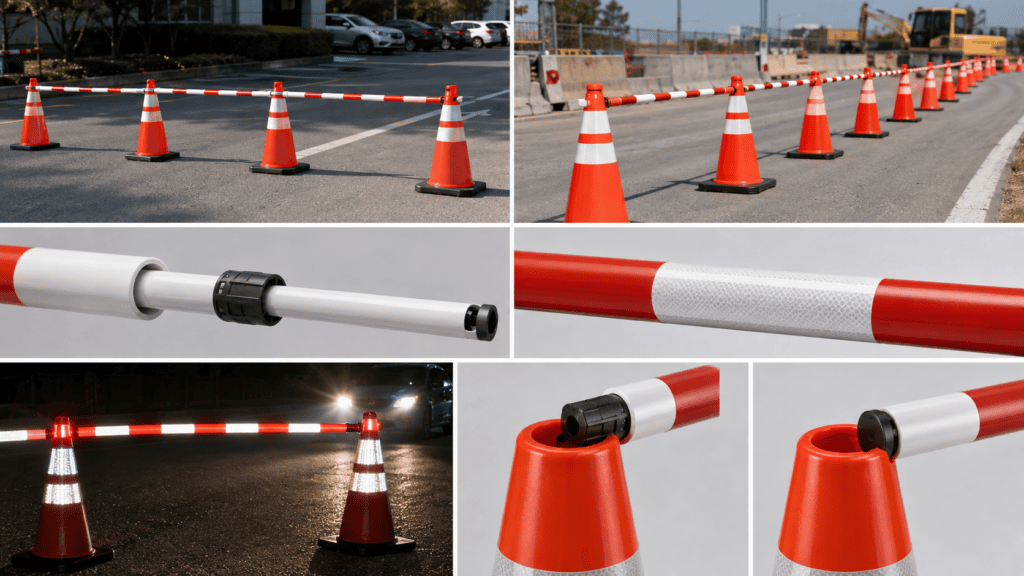
Cone bars are rigid or semi-rigid connecting rods that bridge between adjacent cones to create a physical barrier rather than simply a visual line. They are widely used in parking management, crowd control, construction site access control, and lane closure applications where the gap between cones needs to be physically closed rather than merely marked.
Fixed Length vs. Extendable Bars
The B2B cone bar market offers two primary configurations. Fixed-length bars are manufactured in standard lengths matching standard cone spacing intervals, typically 1.0 to 1.5 metres, and provide a rigid, consistent barrier profile. Extendable bars with a telescoping mechanism adjust across a range such as 1.2 to 2.1 metres, allowing a single bar model to accommodate variable cone spacing. Extendable bars are the more versatile choice for buyers managing diverse deployment scenarios, but they require a more robust locking mechanism than fixed bars to maintain their set length under the lateral loading from pedestrians or slow-moving vehicles contacting the barrier line.
For high-traffic work zone applications where physical barrier integrity is critical, fixed-length bars manufactured from impact-resistant ABS or polypropylene with a minimum wall thickness of 3mm are the appropriate specification. Thinner-walled extendable bars from lower-tier manufacturers frequently fail at the telescoping joint under repeated impact loading, generating a replacement cost that outweighs the per-unit saving on initial purchase.
Reflectivity and Visibility Standards
Cone bars for road and construction applications should incorporate retroreflective striping or retroreflective panels to maintain barrier visibility during night operations and low-visibility conditions. The reflective standard applicable to cone bars in road work zone applications follows the broader work zone device visibility requirements of the relevant jurisdiction. In the United States, this means retroreflective material meeting MUTCD visibility requirements for channelizing devices used at road speeds above 70 kilometres per hour. In EU member states, EN 13422 and its associated reflectivity requirements apply.
Buyers sourcing cone bars for markets with defined retroreflective performance requirements should request photometric test data from the supplier confirming that the retroreflective panels on the bars meet the applicable standard, not simply a claim of compliance without supporting evidence.
Cone Toppers, Message Boards, and Flag Attachments
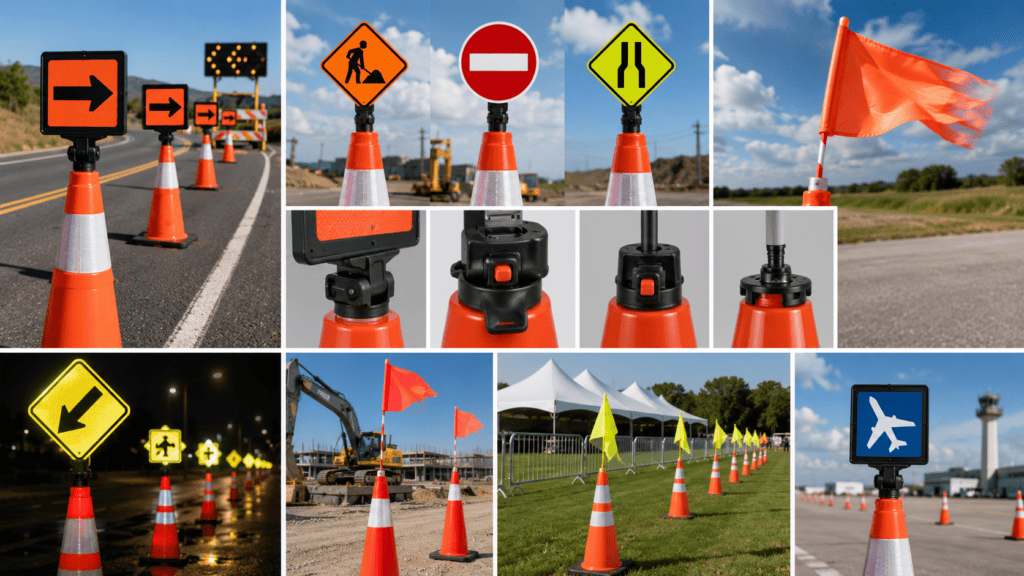
Beyond LED lights, the cone topper category includes a range of functional attachments that extend the information-carrying capability of a standard traffic cone.
Message Board Toppers
Clip-on message board toppers attach to the apex of a standard cone and display a pre-printed or customizable safety message or directional instruction. Common standard messages include Lane Closed, Caution, Danger, No Entry, and directional arrows. For applications requiring custom messaging, such as branded event management, airport-specific instructions, or facility-specific hazard identification, suppliers offering silkscreen-printed custom message toppers at defined minimum order quantities are available across the B2B market.
Message board toppers must be specified with UV-stabilized material and retroreflective text or symbols for outdoor applications. A message board that fades to illegibility within one season of outdoor deployment, or that is not retroreflective and therefore invisible at night, does not serve its safety function and represents a total cost of ownership problem regardless of its initial unit price.
Flag and Antenna Toppers
Warning flag toppers provide high-visibility movement-based alerting in conditions where a static reflective or illuminated device is insufficient, particularly in daytime conditions with complex visual backgrounds where stationary warnings can be overlooked. Flexible antenna flags in fluorescent orange or yellow fabric are a standard accessory for construction site pedestrian safety applications, event perimeter marking, and any deployment scenario where movement adds meaningful visual distinctiveness.
For outdoor and high-wind applications, flag topper attachment systems must be specified with a secure locking mechanism rather than a friction fit that can be dislodged by wind. Antenna-style flexible flags that bend under wind loading without detaching from the cone are preferable to rigid flag holders where displacement risk is a concern.
Sourcing Traffic Cone Accessories at B2B Scale
The accessory market presents several sourcing dynamics that differ from cone procurement itself and that B2B buyers need to manage carefully.
Manufacturer vs. Aftermarket Accessories
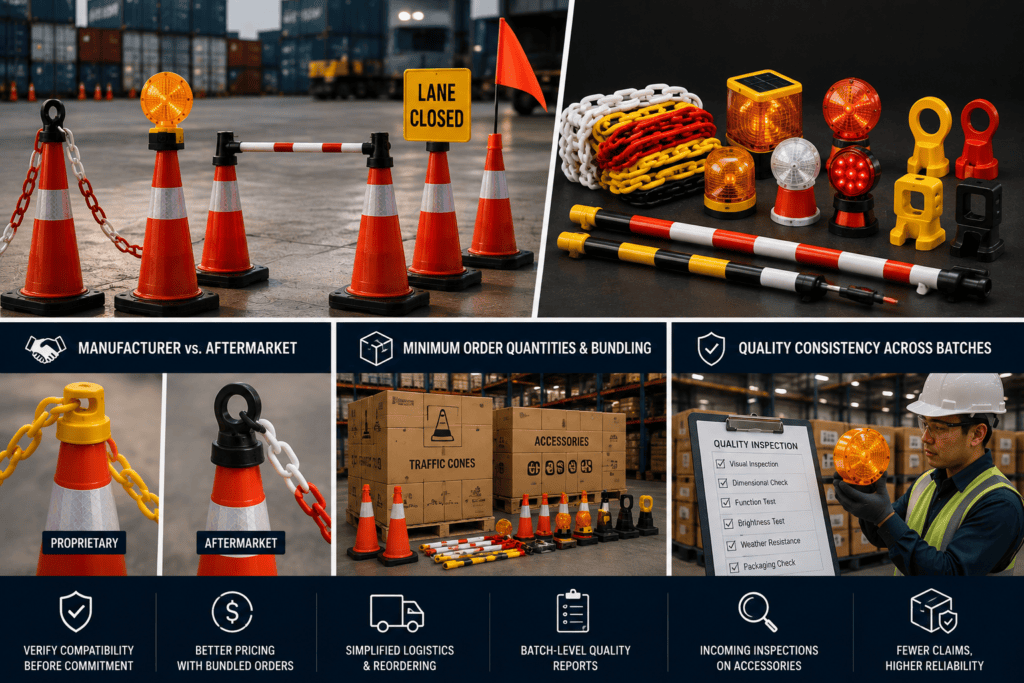
Cone manufacturers typically offer a proprietary accessory range designed and tested for compatibility with their own cone models. Aftermarket accessory suppliers offer generic accessories designed to fit a broad range of cone sizes and profiles, often at lower unit costs. For B2B buyers managing a standardized cone fleet from a single manufacturer, the proprietary accessory route eliminates compatibility uncertainty but limits price competition. For buyers managing a mixed cone fleet from multiple sources, aftermarket accessories with verified compatibility data covering their specific cone models provide more flexibility.
The critical sourcing discipline in either case is compatibility verification before bulk commitment. A batch of cone bars or chain adapters that do not fit the buyer’s cone inventory is not a discounted accessory purchase. It is a total loss.
Minimum Order Quantities and Bundling
Accessory MOQs from manufacturers vary significantly by product category. LED cone lights typically have lower MOQs than cone bars or chain systems because the component standardization in LED lighting manufacturing allows smaller production runs without tooling cost implications. For buyers building a complete cone and accessory program, bundled ordering of cones and accessories from a single supplier typically unlocks better unit pricing on both and simplifies the logistics of delivery, warranty management, and reorder coordination.
For distributors building a private label accessory range alongside a private label cone program, the minimum order thresholds for custom-branded accessories are generally higher than for generic accessories, and lead times are longer due to the additional production steps involved in custom branding. Building the accessory range launch into the cone program planning timeline from the outset, rather than treating it as a follow-on phase, avoids the common situation where a well-executed private label cone launch is delayed by an accessory range that was not ready to ship alongside the cones.
Quality Consistency Across Batches
Accessory quality consistency is a more significant procurement management challenge than cone quality consistency, because accessories involve more diverse manufacturing processes, more component assemblies, and more interaction between different materials. An LED cone topper involves electronics, a housing, a solar panel or battery system, and a mounting adapter. Each component has its own quality control requirements, and a failure in any one of them produces an accessory that does not perform to specification. Requiring batch-level quality inspection reports from the supplier, and conducting incoming goods inspection on accessory shipments rather than only on cone deliveries, is a procurement discipline that pays dividends in reduced warranty claims and customer returns for distributors managing a professional-grade accessory program.
Are you Looking for a Custom Traffic Cones Manufacturer or Supplier? Struggling to find the right factory to bring your vision to life? We’ve got you covered! At our place, we craft top-quality traffic cones with precision and care. Big or small, your needs are our mission. Let’s launch your cones project and take your product line to the next level! Click here to contact