
Flexible delineator posts are one of the most volume-intensive products in road safety procurement. They are deployed across highway shoulders, urban bike lanes, parking facilities, construction zones, industrial sites, and pedestrian separation schemes in quantities that make material specification a decision with significant cost and performance consequences at scale. Two materials dominate the flexible delineator post market globally: thermoplastic polyurethane, commonly referred to as TPU, and polyethylene, referred to as PE. Both produce posts that look broadly similar in catalogue photographs, both flex under vehicle contact and return upright, and both are available in the standard heights and colors that most procurement specifications require.
The similarities end there. The two materials differ fundamentally in molecular structure, mechanical behavior under repeated impact, temperature performance range, UV stability, abrasion resistance, service life under high-frequency contact, and unit cost at wholesale. For procurement officers, road safety contractors, municipal authorities, and facilities managers sourcing delineator posts in volume, understanding exactly where each material outperforms the other and where each represents the more appropriate cost point for the application is the foundation of a specification decision that delivers both compliance and value over the product’s operational life.
This article covers both materials in full technical and commercial detail, maps each to the deployment environments where it is the correct specification, and provides a structured comparison framework for procurement teams evaluating suppliers and quotes.
Understanding the Two Materials at a Molecular Level
1. What TPU Is and Why Its Structure Matters for Delineator Performance
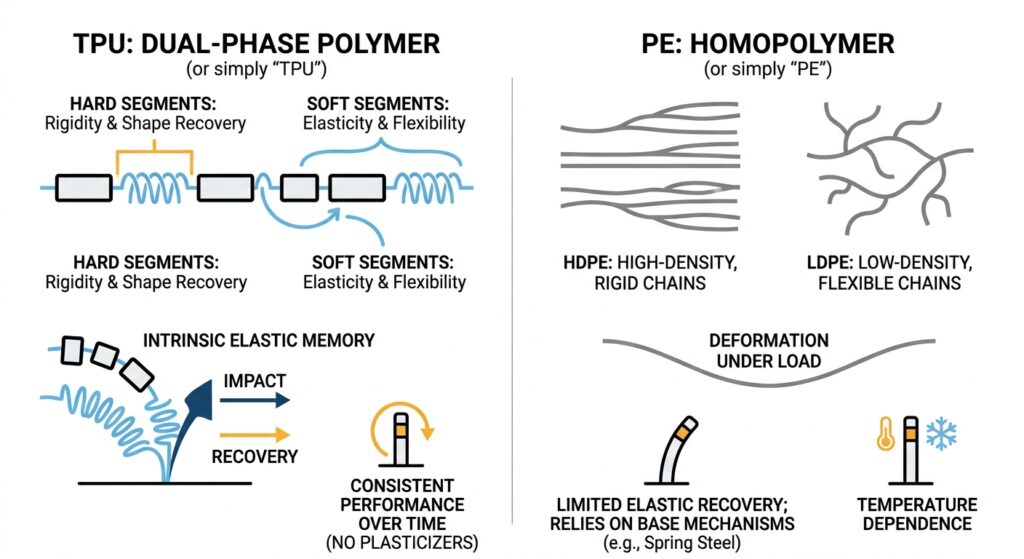
Thermoplastic polyurethane is a segmented block copolymer formed through the reaction of diisocyanates with polyols, producing a polymer chain that alternates between hard segments, which provide structural rigidity and load-bearing capacity, and soft segments, which provide elasticity and flexibility. This dual-phase molecular architecture is the source of TPU’s most commercially significant property for delineator post applications: it behaves simultaneously like a rigid structural material and a flexible elastomer, without the need for external plasticizer additives to achieve that combination.
The hard segments in TPU create physical crosslinks within the polymer matrix that hold the post’s shape under load and drive the recovery force that returns it to upright after impact. The soft segments provide the elastic memory that makes that recovery consistent across thousands of impact cycles without progressive deformation or fatigue. Because the flexibility and recovery performance of TPU are intrinsic to its molecular structure rather than dependent on plasticizer content, they do not degrade over time through chemical migration the way plasticizer-dependent flexible materials do. A TPU delineator post that has been in service for three years performs the same impact-and-recovery cycle as it did on the day of installation, with no measurable loss in recovery force or cycle count capacity attributable to material aging alone.
2. What PE Is and How It Differs Structurally From TPU
Polyethylene is a homopolymer consisting of repeating ethylene monomer units arranged in chains of varying length and branching density depending on the grade. High-density polyethylene, HDPE, has tightly packed, minimally branched chains that produce a relatively rigid material with good tensile strength. Low-density polyethylene, LDPE, has more branching that interrupts chain packing, producing a softer, more flexible material. For flexible delineator post applications, HDPE is the most commonly used PE grade, often combined with a spring steel or polyurethane spring mechanism in the post base to provide the return-to-upright function that the PE material body alone does not deliver with the same elasticity as TPU.
PE is a thermoplastic, meaning it softens and deforms under heat and stiffens under cold, but it does not have the dual-phase elastic architecture of TPU. The flexibility of a PE delineator post body is a function of the material’s inherent stiffness at the operational temperature, not of a designed elastic recovery mechanism built into the polymer chain. This distinction has direct consequences for performance at temperature extremes and under repeated high-frequency impact loading, as discussed in the sections that follow.
Impact Recovery Performance: The Critical Operational Comparison
1. TPU Recovery Behavior Under Single and Repeated Impact
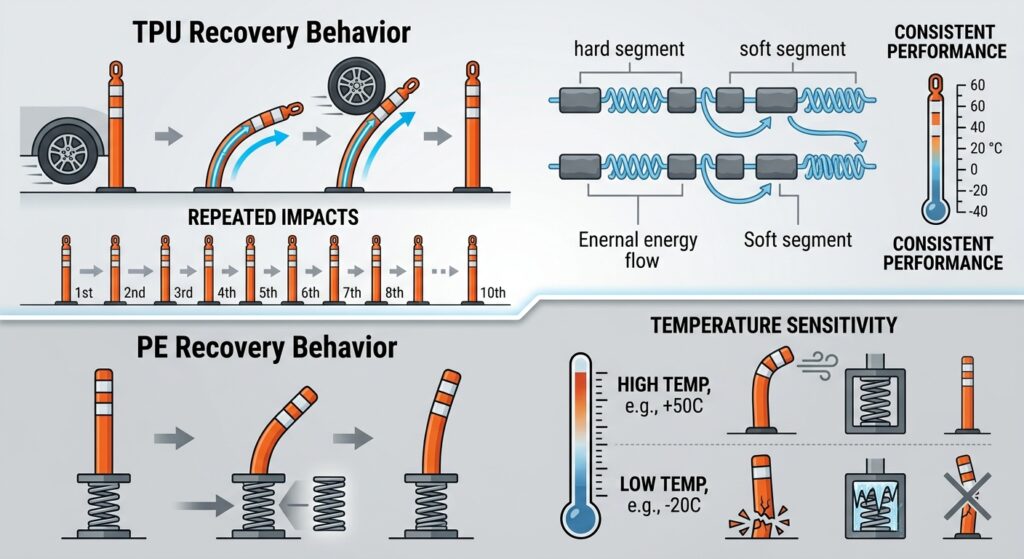
When a vehicle wheel or bumper contacts a TPU delineator post, the post deflects under the applied force, bending toward or past horizontal depending on impact energy, and then recovers fully to its original vertical position as the contact force is removed. The elastic recovery force is generated by the TPU material’s internal elastic memory, which stores energy during deflection and releases it as the post returns upright. This process occurs in a fraction of a second and produces no measurable permanent deformation in the post body across thousands of impact cycles.
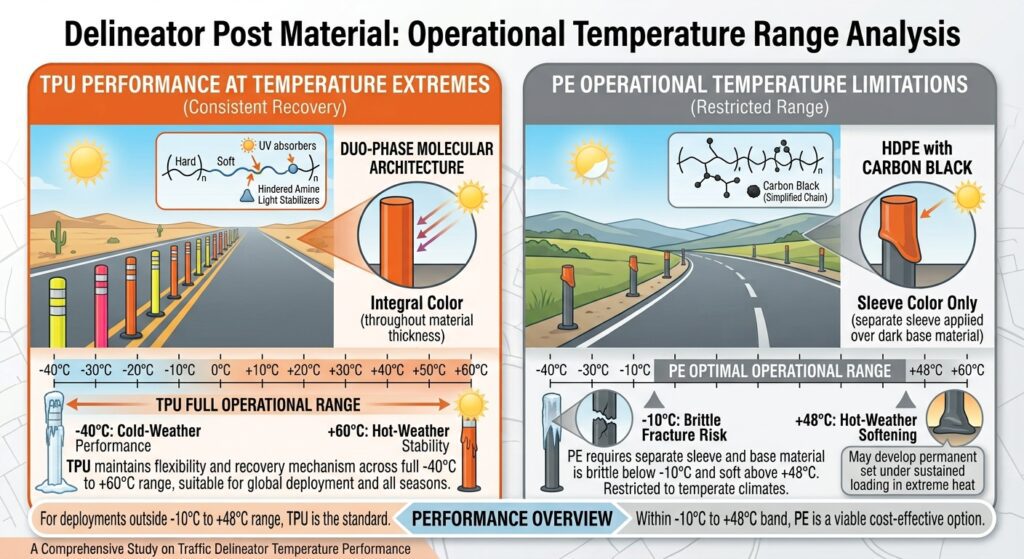
The recovery force of a TPU post is consistent across a wide temperature range, from approximately minus 40 degrees Celsius at the cold extreme to plus 60 degrees Celsius at the hot extreme, because the soft segment mobility in the TPU molecular architecture maintains its elastic behavior across this full range without phase transitions or stiffness discontinuities. A TPU post struck by a vehicle in a sub-zero winter environment recovers with essentially the same force and speed as the same post struck in a hot summer environment, which is the performance consistency that highway and high-traffic deployment environments demand.
2. PE Recovery Behavior and Its Temperature Dependence
A PE delineator post with a spring base mechanism recovers to upright after impact through the mechanical spring force of the base rather than through the elastic recovery of the post body material itself. The post body deflects, the spring base compresses, and the spring returns the post to vertical as the contact force is removed. This mechanism works reliably under standard temperature conditions but is sensitive to temperature extremes in ways that the TPU elastic recovery mechanism is not.
At low temperatures below approximately minus 10 degrees Celsius, HDPE stiffens significantly. A PE post body that deflects adequately under impact at 20 degrees Celsius may crack or fracture at impact in the same contact scenario at minus 15 degrees Celsius, because the reduced polymer chain mobility at low temperature converts what would be a flexible deflection event into a brittle fracture event. The spring base mechanism itself may also lose performance at very low temperatures if the spring steel component is not rated for the operational temperature range or if ice formation in the base housing interferes with spring travel.
At high temperatures above approximately 40 to 50 degrees Celsius, HDPE softens measurably, which can cause PE post bodies to develop a permanent set under sustained lateral loading from vehicle draft pressure or wind load, reducing the post’s effective height and visual prominence over time in hot climate deployments.
Durability and Service Life in High-Impact Environments
1. TPU Abrasion and Surface Wear Resistance
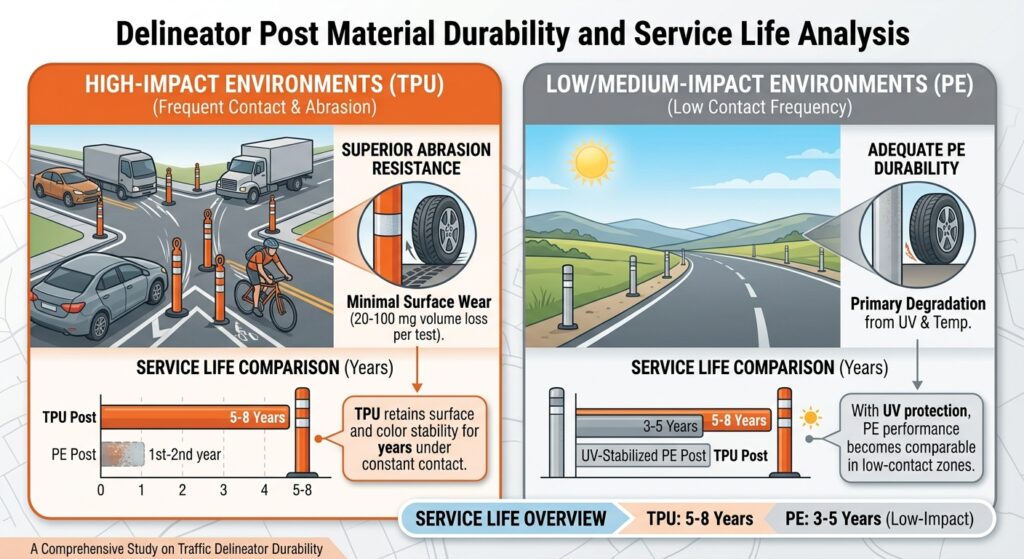
TPU is one of the most abrasion-resistant materials in the thermoplastics family. Its abrasion resistance index, measured by the DIN 53516 abrasion test, is typically between 20 and 100 milligrams of volume loss per test cycle depending on the specific TPU grade, which is substantially lower than HDPE and most other thermoplastic materials used in traffic safety product manufacturing. In practical delineator post terms, this means that the repeated scraping contact from vehicle tires, road debris, and maintenance equipment that progressively degrades the surface of a PE post body has significantly less effect on the surface condition and structural integrity of a TPU post body over the same exposure period.
The surface abrasion resistance of TPU is particularly relevant in high-frequency contact environments such as highway lane separators, bicycle lane delineators on roads with high cycling traffic, and parking facility posts adjacent to vehicle maneuvering zones where repeated low-speed tire contact is part of the normal operational condition rather than an occasional impact event. In these environments, a PE post may show significant surface wear, crazing, and loss of color within the first year of service, while a TPU post of equivalent specification retains its surface integrity and color stability into its second or third year under the same contact frequency.
2. PE Durability Under Low and Medium Impact Frequency
In deployment environments where contact frequency is low to moderate, such as highway shoulder delineators on roads with low traffic volume, construction zone markers on access roads with limited vehicle movements, and parking lot perimeter delineators in facilities with light vehicle turnover, the durability gap between TPU and PE narrows considerably. PE posts in these environments do not accumulate the repeated impact fatigue and surface abrasion that expose the material’s durability limitations in high-frequency contact deployments. Service life in low-impact environments is driven primarily by UV degradation and temperature cycling rather than mechanical fatigue, and in this context PE with adequate UV stabilizer content performs more comparably to TPU across a reasonable operational period.
The service life of a UV-stabilized HDPE delineator post in a low-impact outdoor environment is typically between three and five years before replacement is warranted by color fading, surface crazing, or base mechanism fatigue. A TPU post in the same environment typically reaches five to eight years of service before equivalent degradation is observed, reflecting TPU’s superior UV stability and elastic recovery retention. The cost implication of this service life difference is addressed in the procurement cost comparison section below.
UV Stability and Weathering Performance
1. TPU UV Resistance Across Extended Outdoor Exposure
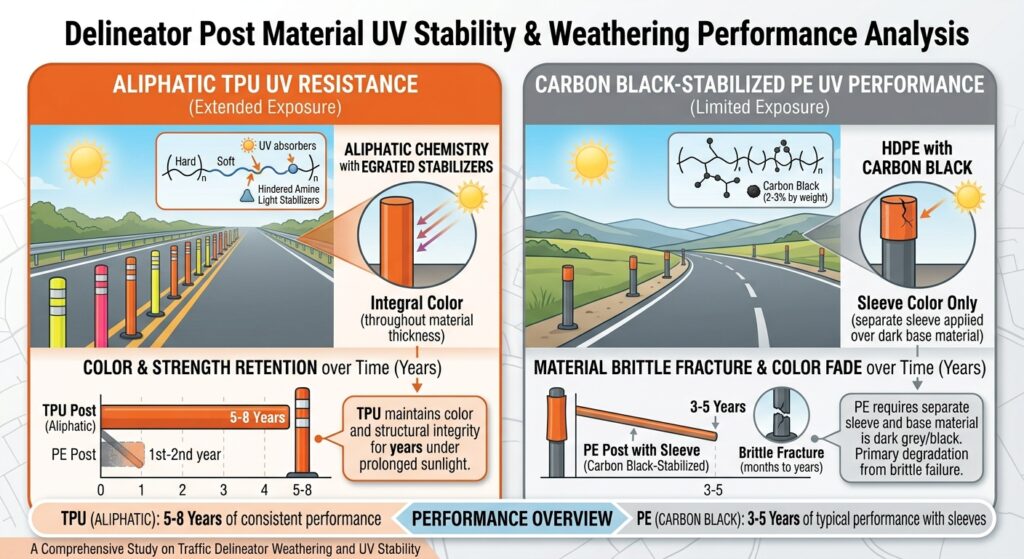
TPU formulations with aliphatic diisocyanate chemistry and integrated UV stabilizer packages maintain their color, surface condition, and mechanical properties across extended outdoor UV exposure periods that exceed the performance of standard HDPE compounds. The UV stability of TPU is a function of both the base polymer chemistry and the stabilizer package used in the formulation. Aliphatic TPU grades are inherently more UV-stable than aromatic grades because the aliphatic urethane linkages do not undergo the photooxidation reaction that yellows and embrittles aromatic formulations under prolonged sunlight exposure. For outdoor delineator post applications, aliphatic TPU with added UV absorbers and hindered amine light stabilizers is the correct material specification and is the standard grade used in quality commercial delineator posts for highway and outdoor permanent installation.
2. PE UV Performance and the Role of Carbon Black Stabilization
Standard HDPE without UV stabilization degrades rapidly under prolonged outdoor UV exposure, becoming brittle and losing mechanical properties within months of outdoor installation. UV-stabilized HDPE for outdoor traffic safety applications is typically compounded with carbon black at two to three percent by weight, which is the most cost-effective UV stabilization approach for PE and produces a material that maintains adequate outdoor UV resistance for three to five years in typical temperate climate outdoor conditions. The practical consequence of carbon black stabilization is that UV-stabilized PE delineator posts are black or dark grey in their base material color, with fluorescent yellow or orange sleeves or applied reflective collars providing the high-visibility color required for traffic safety applications.
TPU delineator posts can be produced in fluorescent yellow, orange, and other high-visibility colors throughout the full material thickness, eliminating the requirement for a separate color sleeve and producing a post whose color is integral to the material rather than applied to the surface. For procurement specifications that require consistent color appearance throughout the post service life, and in applications where sleeve condition and attachment integrity are operational concerns, an integrally colored TPU post is technically advantaged over a carbon-black stabilized PE post with a separate color sleeve.
Temperature Performance Range: The Climate Consideration
1. TPU Performance at Temperature Extremes
The operational temperature range of standard commercial TPU delineator posts extends from approximately minus 40 degrees Celsius to plus 60 degrees Celsius while maintaining flexible behavior and impact recovery performance throughout. This range covers virtually all outdoor deployment environments globally, from subarctic road conditions to equatorial desert highway surfaces. Within this range, TPU maintains its elastic recovery mechanism without the phase transitions or stiffness discontinuities that affect PE at temperature extremes. For procurement specifications covering deployments in climate zones with significant seasonal temperature variation, TPU’s consistent performance across the full temperature range eliminates the cold-weather brittleness and hot-weather softening failures that affect PE posts in the same conditions.
2. PE Operational Temperature Limitations
Standard HDPE delineator posts perform adequately within an operational temperature range of approximately minus 10 degrees Celsius to plus 48 degrees Celsius. Below minus 10 degrees Celsius, HDPE stiffness increases significantly and impact brittleness becomes a realistic failure mode in contact with moving vehicles, particularly at highway approach speeds where impact energy is high. Above 48 degrees Celsius, HDPE softens and may develop permanent set under sustained loading. For deployment environments within this temperature band, PE posts are a viable and cost-effective specification. For environments that regularly fall outside this range in either direction, TPU is the material that maintains rated performance across the full operational temperature envelope.
Cost Comparison and Procurement Economics
1. Unit Cost Differential at Wholesale Volume
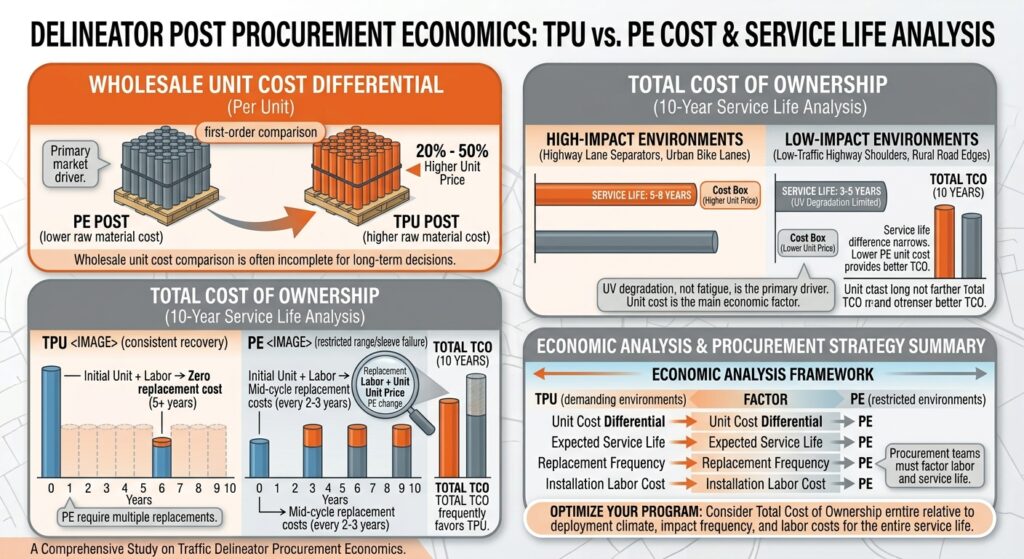
At equivalent diameters and heights, TPU delineator posts carry a higher unit cost than PE delineator posts at wholesale volume, reflecting the higher raw material cost of TPU compound relative to HDPE. The magnitude of this premium varies by supplier, order volume, and market, but typically ranges from 20 to 50 percent per unit at comparable specifications and quantities. At first-order unit cost comparison, PE posts are the lower-cost option and this is the primary reason PE remains a significant share of the delineator post market despite the material performance advantages of TPU in demanding environments.
The unit cost comparison is, however, an incomplete basis for a procurement economics decision in any deployment environment where service life, replacement frequency, and installation labor cost are factors. A TPU post with a service life of six years in a high-impact deployment environment compared to a PE post with a service life of three years in the same environment has a per-year-of-service cost that may be lower than the PE post despite the higher unit price, once the replacement cost and the labor cost of the mid-cycle replacement are factored into the total cost of ownership calculation.
2. Total Cost of Ownership Across the Deployment Life
For procurement teams managing delineator post programmes across large highway networks, urban cycling infrastructure, or multi-site commercial facility portfolios, the total cost of ownership calculation that compares TPU and PE posts should include the unit purchase price, the expected service life at the specific deployment environment’s impact frequency and temperature exposure, the cost of replacement units at the end of each service life cycle, and the labor cost of each replacement installation cycle. In high-impact environments such as highway lane separators, urban bike lane delineators, and busy parking facility posts, where PE posts require replacement in two to three years and TPU posts reach five to seven years before equivalent degradation, the total cost of ownership over a ten-year deployment period frequently favors TPU despite the higher unit purchase price.
In low-impact environments such as low-traffic highway shoulders, rural road edge delineators, and low-turnover parking facilities, where contact frequency is insufficient to expose TPU’s mechanical fatigue advantage and where UV degradation rather than impact fatigue drives the replacement cycle, the service life difference between PE and TPU narrows and the unit cost advantage of PE produces a more favourable total cost of ownership comparison for the lower-cost material.
Deployment Environment Specification Guide
1. Where TPU Is the Correct Specification
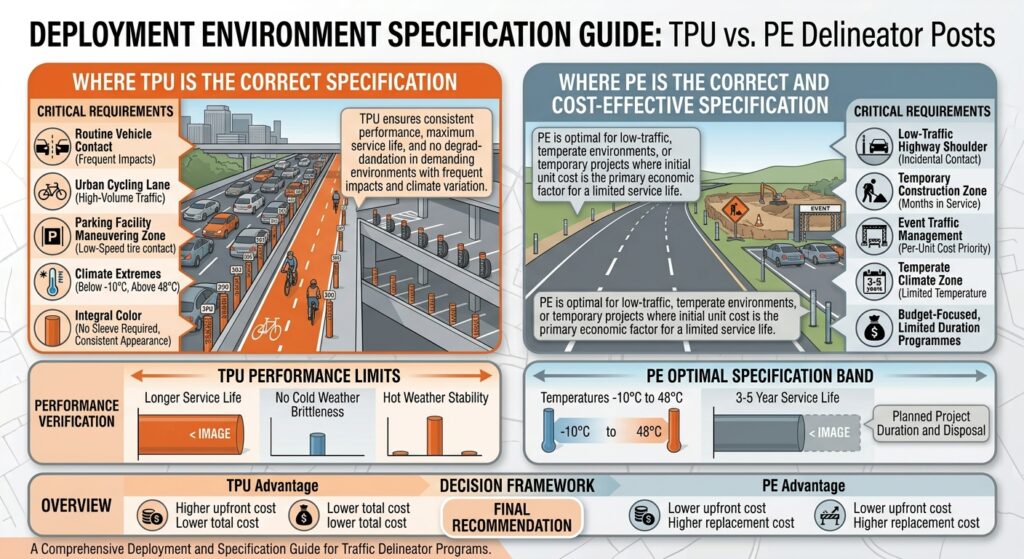
TPU delineator posts are the correct specification for all highway and motorway lane separator applications where vehicle contact is a routine operational condition rather than an occasional event, for urban cycling lane delineators on roads with high cycling and vehicle traffic where contact frequency is high and service life consistency is a maintenance programme priority, for parking facility posts adjacent to vehicle maneuvering zones where repeated low-speed tire contact accumulates rapidly, for any deployment in climate zones where temperatures regularly fall below minus 10 degrees Celsius or regularly exceed 48 degrees Celsius, and for any application where the procurement specification requires consistent color throughout the post body without a separate sleeve or applied finish.
2. Where PE Is the Correct and Cost-Effective Specification
PE delineator posts are the correct and cost-effective specification for low-traffic highway shoulder delineation in temperate climate zones where impact frequency is low and temperature extremes within the PE operational range, for temporary construction zone delineation where posts will be in service for months rather than years and end-of-project disposal is planned regardless of post condition, for event and temporary traffic management applications where posts are deployed and retrieved on a per-event basis and per-unit cost is the dominant procurement consideration, and for any application in a temperate climate zone where vehicle contact is incidental rather than routine and where three-to-five year service life is adequate for the programme.
Compliance and Standards Considerations
1. MUTCD and EN 1463 Compliance Across Both Materials
Both TPU and PE delineator posts can be manufactured to meet the retroreflective performance and dimensional requirements of the primary regulatory frameworks governing flexible delineator post specification in major markets. In the United States, MUTCD Part 3 governs delineator retroreflective requirements and post dimensions for highway applications. In European markets, EN 1463 covers retroreflective road studs and related products including delineator posts. Neither standard mandates a specific material for the post body, meaning that a TPU post and a PE post of equivalent dimensions and retroreflective collar specification are both compliant products for the same application, with material selection driven by performance and cost considerations rather than regulatory mandate.
Procurement teams should confirm that posts of either material from their selected supplier are accompanied by third-party test reports demonstrating compliance with the applicable standard for the specific market and road type involved, as self-certification by the manufacturer without independent testing is not an adequate compliance basis for public road procurement in most regulated markets.
Conclusion: Material Selection Follows Deployment Reality
The TPU versus PE delineator post decision is not a universal judgment about which material is better. It is a deployment-specific assessment of which material’s performance profile matches the operational demands and economic constraints of the specific application. TPU is the correct material for high-impact, wide-temperature-range, long-service-life deployments where its superior elastic recovery, abrasion resistance, and temperature stability translate directly into fewer replacements, lower total cost of ownership, and more consistent performance over the programme life. PE is the correct material for low-impact, temperate-climate, cost-sensitive, or temporary applications where its lower unit cost delivers adequate performance for the service life required without the premium that TPU’s advanced material properties command.
For procurement teams managing programmes that span both high-demand and low-demand deployment environments within the same portfolio, a split specification approach that uses TPU in identified high-impact locations and PE in identified low-impact locations achieves the optimal balance of performance and cost across the full programme without either overpaying for TPU performance in locations that do not need it or accepting PE’s limitations in locations where those limitations produce failure costs that exceed the unit price saving.
The right delineator post material is determined by what happens to it after installation. Know the impact frequency, know the temperature range, then select the material.
Looking for a manufacturer supplying both TPU and PE flexible delineator posts to highway and commercial specification with flexible MOQ and consistent lead times for volume road safety procurement? At JessuBond, we produce the full range of flexible delineator post configurations in both materials with transparent per-unit pricing at volume. Contact us here.