
Airport ground operations sit at the intersection of extreme operational pressure and unforgiving consequence. Aprons, taxiways, service roads, and gate areas handle simultaneous aircraft movement, ground support equipment traffic, fueling operations, baggage handling, and maintenance activity within a confined physical space where the margin for error is measured in metres and the cost of equipment failure can mean aircraft damage, personnel injury, or a runway incursion. Every piece of safety equipment deployed in this environment, including traffic cones, must meet a standard that has no equivalent in standard road or industrial applications.
Rubber traffic cones for airport ground operations are a distinct product category, not a variant of the standard orange PVC cone used in road construction. The material, weight, base design, reflectivity specification, and FOD compatibility of an airside traffic cone are all driven by the specific hazards and regulatory requirements of the aviation environment. For airport operations managers, ground handling procurement teams, and safety equipment distributors supplying the aviation sector, understanding these specifications before sourcing is the difference between compliant deployment and equipment that creates the very hazards it was placed to prevent.
Why Standard Road Cones Are Unsuitable for Airside Use
The most important starting point for any airport ground operations procurement discussion is understanding precisely why standard road traffic cones are not appropriate for airside deployment, even when they appear physically similar to aviation-grade alternatives.
The FOD Problem
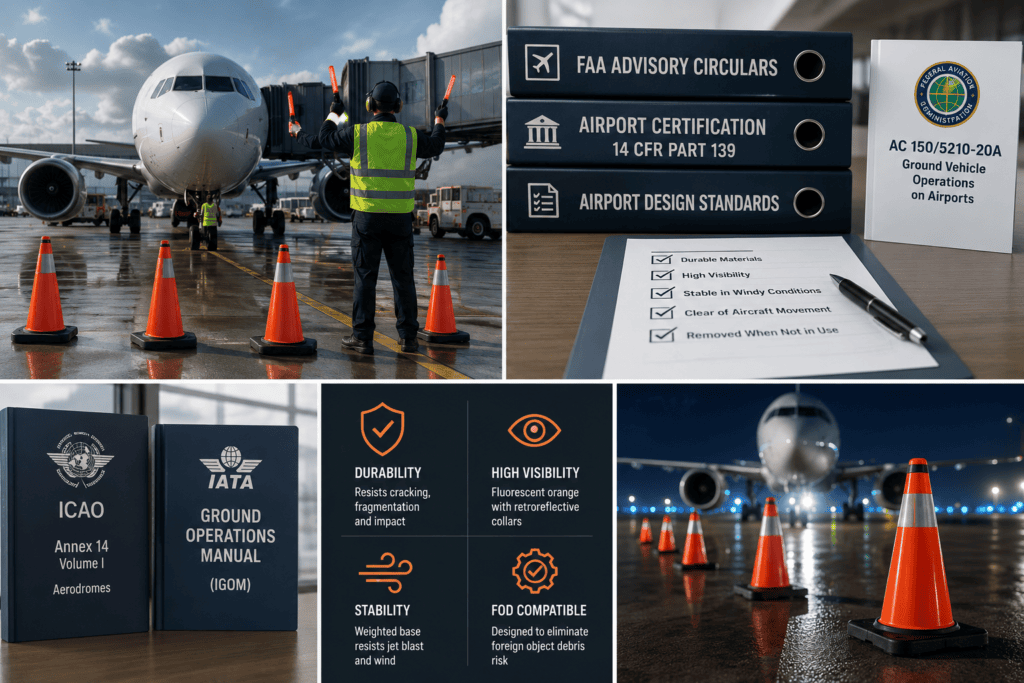
Foreign Object Debris (FOD) is defined by the FAA in Advisory Circular AC 150/5210-24A as any object located in an inappropriate location in the airport environment that has the capacity to injure airport or airline personnel and damage aircraft. The FAA’s FOD management framework is extensive and reaches into every aspect of airside equipment specification, including temporary delineation equipment such as traffic cones. ICAO Annex 14 requires that all paved runways, taxiways, and aprons be maintained free of any defect or debris that could adversely affect the safe operation of aircraft, and loose or fragmented materials from safety equipment constitute a direct violation of that requirement.
Standard road cones, particularly lower-grade PVC formulations, are prone to cracking, chipping, and fragmenting when subjected to the impact stresses of airside environments: vehicle contact, repeated jet blast exposure, and thermal cycling across the full temperature range experienced on open apron surfaces. Any fragment detached from a standard cone in an airside location becomes FOD with the potential to be ingested by a jet engine, damage aircraft tyres, or injure apron personnel. Rubber cones address this failure mode directly. The material properties of quality rubber allow the cone to deform under impact and return to its original shape rather than fracturing or fragmenting, eliminating the FOD risk that brittle or low-quality PVC creates.
Jet Blast Resistance
Jet blast from commercial aircraft engines generates sustained wind velocities far beyond anything encountered in a road work zone. Behind the engines of a narrowbody aircraft during pushback or taxi operations, jet blast can exceed 100 knots at close range. A standard road cone weighing 1.5 to 3 kilograms with a narrow base will be displaced or overturned consistently in these conditions, entering the operational area as an uncontrolled hazard. Rubber traffic cones specified for airside use are weighted significantly more heavily, with the majority of mass concentrated in a wide, flat base that lowers the centre of gravity and resists overturning moment from lateral and angled wind loading.

Regulatory Framework Governing Airside Cone Specifications
Airport traffic cone specifications are governed by a layered regulatory framework that combines international standards, national regulatory guidance, and airport-specific operational requirements. Understanding this framework is essential for procurement teams sourcing cones for airside deployment.
FAA Advisory Circulars and Part 139
In the United States, the primary regulatory reference for airport ground operations equipment is FAA Advisory Circular AC 150/5210-20A, Ground Vehicle Operations on Airports, which establishes guidance for all vehicle and equipment operations on airport movement areas. For airport apron equipment including traffic cones, the FAA’s Airport Design standards require that cones used in apron areas be made of durable, high-visibility material, designed to be stable in windy conditions, placed so as not to obstruct aircraft movement or access to emergency equipment, and removed promptly once their purpose has been served. Airports certified under 14 CFR Part 139 are subject to self-inspection programs under Section 139.327 that include daily inspection for FOD and equipment condition on all movement areas.
These requirements translate into practical cone specifications that procurement managers must meet. Durability means resistance to fragmentation and cracking across the full range of airside temperatures and impact conditions. High visibility means fluorescent orange colour that maintains its intensity under UV exposure, with retroreflective collars for operations that continue into low-visibility or night conditions. Stability in windy conditions means base weight and geometry adequate to resist jet blast displacement within the deployment zones applicable to the specific location on the apron.
ICAO Standards and IATA Ground Operations Manual
For international airports and those operating under ICAO standards, the applicable framework is ICAO Annex 14, Volume I, which governs aerodrome design and operations. The IATA Ground Operations Manual (IGOM) supplements ICAO standards with operational guidance for airline ground handling operations, including the deployment of temporary delineation equipment on apron areas.
Under both ICAO and IGOM frameworks, the specific acceptance criteria for traffic cones are defined at the airport authority level rather than through a single universal product specification. This means that while international standards establish the principles, such as visibility, stability, and FOD compatibility, each airport authority sets its own specific product approval criteria based on those principles interpreted against the operational characteristics of their facility. Procurement teams sourcing rubber cones for airports operating under ICAO standards must verify the specific cone acceptance criteria of the relevant airport authority before finalizing their specification.
Core Specifications for Rubber Traffic Cones in Airport Ground Operations
Within the regulatory framework above, the following specifications define what a rubber traffic cone suitable for airport ground operations must deliver across the key performance dimensions.
Height and Visibility
The cone height specification for airside use is driven by the viewing distance requirements of the specific deployment location. For gate area and apron delineation visible primarily to ground personnel and GSE operators at close range, 70 centimetre cones are widely deployed and accepted by most airport authorities. For locations that must also be visible to taxiing aircraft flight crews or to approaching vehicles at distance, 90 centimetre cones are the standard specification in many airport operational procedures.
Visibility is not determined by height alone. The fluorescent orange colour must be UV-stabilized to maintain its high-visibility characteristics across years of outdoor airside deployment. Unstabilized pigment will fade to a dull, low-contrast orange within one to two seasons of direct apron UV exposure, producing a cone that is technically present but operationally ineffective as a high-visibility delineation device. Quality rubber cones for airside use specify colour retention as a performance parameter, not just as an initial production characteristic.
Retroreflective collars are mandatory for any cone deployed in airside locations during night operations or low-visibility conditions. The standard configuration for airport apron cones is dual retroreflective collars: a 150mm upper band and a 100mm lower band in white retroreflective material. High-Intensity Prismatic (HIP) grade retroreflective tape is preferred over standard engineer grade for airside applications because it delivers a brighter and more directional return under the mixed lighting conditions of a working apron at night.
Base Weight and Stability
Base weight is the most operationally critical specification for rubber traffic cones used in jet blast-exposed locations on airport aprons. The minimum base weight for cones deployed within jet blast influence zones of commercial jet aircraft is widely accepted at 4.5 kilograms, with 5 to 5.5 kilograms specified for locations with direct exposure to engine exhaust from widebody aircraft. The weight must be concentrated in the base rather than distributed across the cone body, which is why rubber as a dense material is particularly well-suited to this application. A rubber base achieves the required mass in a compact, low-profile geometry that keeps the centre of gravity as close to the apron surface as possible.
For cone placement outside direct jet blast exposure zones, such as service road edges, terminal kerb areas, and passenger airbridge approaches, the base weight requirement is less extreme and 3 to 4.5 kilogram rubber-base cones are appropriate for most airport authority specifications in these locations.
Material Properties and FOD Compliance
The rubber compound used in aviation-grade traffic cone bases and bodies must meet specific material performance requirements beyond simple weight. Recovery from deformation is critical: when struck by a ground support equipment vehicle or subjected to the pressure of an aircraft tyre rolling over a displaced cone, the material must return to its original shape without fragmenting, cracking, or leaving residual rubber debris on the apron surface. The rubber formulation must remain flexible and non-brittle across the full temperature range experienced at the deployment airport. For tropical airport environments, this means resistance to surface tack and deformation at sustained temperatures above 50 degrees Celsius on dark apron surfaces. For airports in cold climate regions, it means maintaining flexibility and impact recovery at temperatures below minus 20 degrees Celsius where rigid materials become brittle.
Dark-coloured cone components, including black rubber bases, require particular attention in FOD management terms. FAA FOD research indicates that dark-coloured debris items make up a disproportionate share of collected FOD because they are harder to detect during visual inspections of apron surfaces. Procurement managers sourcing black rubber-base cones for airside use should confirm that the rubber base material is a single homogeneous compound rather than a multi-layer construction, which reduces the risk of delamination and fragment separation.

Deployment Zones and Location-Specific Requirements
The apron environment is not uniform, and cone specifications appropriate for one deployment zone may be inadequate or excessive for another. Understanding the location-specific requirements within an airport ground operations context allows procurement teams to build a tiered specification that optimizes both safety compliance and procurement cost.
Active Apron and Gate Areas
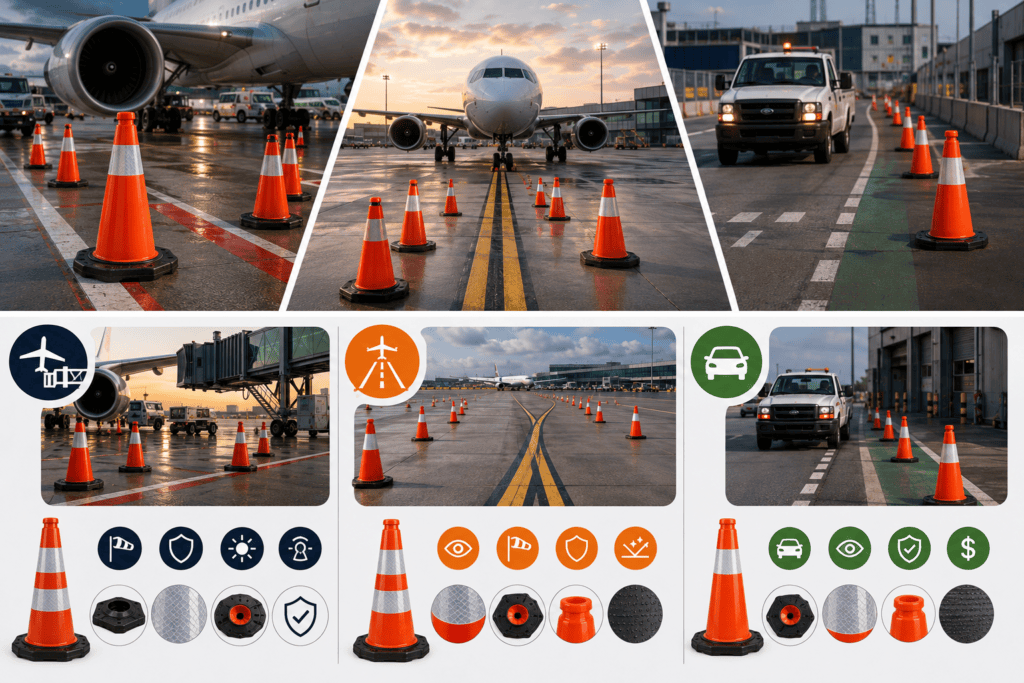
The highest-specification rubber cones are required in active gate areas where jet blast exposure from taxiing and pushing back aircraft is most direct and most frequent. In these locations, the combination of maximum base weight, UV-stabilized high-visibility orange body, dual HIP retroreflective collars, and fragmentation-resistant rubber compound is the full specification required by most airport authorities. These cones delineate aircraft parking positions, equipment exclusion zones around jet engine hazard areas, and safety boundaries around fueling operations.
Taxiway and Apron Edge Delineation
Temporary taxiway and apron edge delineation during maintenance or resurfacing operations requires cones that are visible to taxiing aircraft as well as to ground vehicles. In these locations, the 90 centimetre height is generally specified to ensure adequate visibility from the elevated cockpit positions of large commercial aircraft. Base weight requirements remain at the higher end of the range due to the exposure to aircraft wake turbulence and crosswind conditions on open apron areas.
Service Roads and Vehicle-Only Areas
On airport service roads and in areas restricted to ground vehicles rather than aircraft, the specification demands are somewhat lower. The jet blast exposure risk is reduced or absent, and the primary visibility requirement is for ground personnel and vehicle operators rather than flight crews. In these locations, 70 centimetre rubber cones with 3 to 4.5 kilogram bases and standard retroreflective collars satisfy most airport authority requirements at a meaningfully lower unit cost than the maximum-specification cones required in active apron zones.
Sourcing Rubber Traffic Cones for Airport Applications
Finding the right supplier for airport-grade rubber traffic cones requires evaluating sources against a set of criteria that differs from standard road safety equipment sourcing in important ways.
Documentation and Airport Authority Acceptance
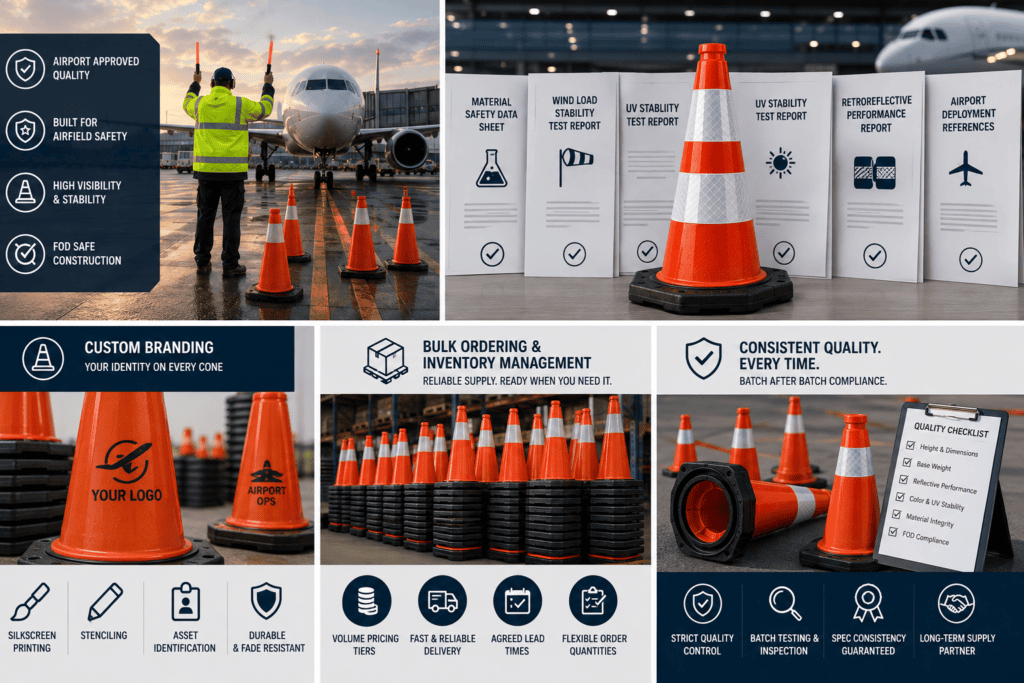
The most important sourcing criterion for airport rubber traffic cones is the supplier’s ability to provide the documentation that airport authorities require before approving a product for airside use. This typically includes the material safety data sheet for the rubber compound confirming that it meets FOD safety requirements, test reports for cone stability under defined wind load conditions, UV stability test results for cone body colour retention, retroreflective sleeve performance data from an accredited test laboratory, and references from other airport deployments where the product is in active operational use.
Suppliers who cannot provide this documentation package are not appropriate sources for airside traffic cones regardless of their pricing. The airport authority approval process requires this evidence, and a product that cannot be approved cannot be deployed, making its purchase cost a total loss.
Custom Branding and Airport Identification
Many airport authorities and ground handling companies require traffic cones deployed on their apron to carry identification marking that confirms ownership and aids in accountability during daily FOD inspection and equipment recovery. Quality rubber cone suppliers for the airport market offer silkscreen printing and stencilling services for company logos, airline identifiers, and equipment registration numbers directly onto the cone body or base. This custom branding capability is a standard offering among specialist aviation safety equipment suppliers and is worth confirming before engaging a supplier for an airport program.
Bulk Ordering and Inventory Management
Airport ground operations consume traffic cones at a higher replacement rate than most other deployment environments, driven by the combination of vehicle contact damage, jet blast displacement cycles, and the strict removal requirements applied during FOD inspection programs. Procurement managers for large airports and ground handling companies should negotiate framework agreements with their rubber cone supplier that specify pricing tiers for annual volume commitments, guaranteed delivery lead times for replenishment orders, and quality consistency requirements across multiple production batches.
A supplier who delivers a compliant first batch but allows specification drift in subsequent orders creates a compliance management problem that is disproportionately costly to resolve in an airport environment. Consistent batch-to-batch quality is not a preference in aviation safety equipment procurement. It is an operational requirement that belongs explicitly in the supply agreement.
Building the Right Specification for Your Airport
The rubber traffic cone specification appropriate for any given airport ground operations program must be built from the specific deployment zones, wind exposure conditions, operational hours, and airport authority requirements of the facility in question. The specifications discussed in this guide represent the established parameters within which airport-grade cone procurement operates, not a rigid single specification applicable to all airports equally.
Start with the airport authority’s own equipment acceptance criteria, which will define the non-negotiable compliance parameters for your facility. Build from those parameters outward through the material, weight, visibility, and FOD compatibility requirements that the deployment zones within your operation demand. Source from suppliers who understand the aviation safety equipment market, can provide the documentation that airport approval processes require, and have a demonstrable track record of supplying compliant products into operational airside environments.
The traffic cone is a simple product. In airport ground operations, specifying and sourcing it correctly is not.
Looking for a Custom Traffic Cones Manufacturer or Supplier? Struggling to find the right factory to bring your vision to life? We’ve got you covered! At our place, we craft top-quality traffic cones with precision and care. Big or small, your needs are our mission. Let’s launch your cones project and take your product line to the next level! Click here to contact