
For road safety equipment distributors, the transition from reselling branded convex mirrors to operating a private label program is one of the most significant strategic decisions available. It changes the commercial relationship with customers, shifts margin structure in the distributor’s favour, and builds a defensible brand identity in a product category where most competitors are selling identical products under someone else’s name.
But private label convex mirror programs are not simply a matter of printing a logo on an existing product and increasing the price. Done correctly, a private label program requires thoughtful preparation, the right manufacturing partner, clearly defined product specifications, and a realistic understanding of the commercial commitments involved. Distributors who enter a private label program without that preparation tend to encounter the same set of problems: MOQ commitments that strain cash flow, inconsistent product quality that damages the brand they are trying to build, and packaging that does not meet the professional standard their customers expect.
This guide covers everything a distributor needs to understand before placing a first private label convex mirror order, from how to evaluate whether a program is right for your business through to the specific preparation steps that separate successful private label launches from expensive learning exercises.
What a Private Label Convex Mirror Program Actually Involves
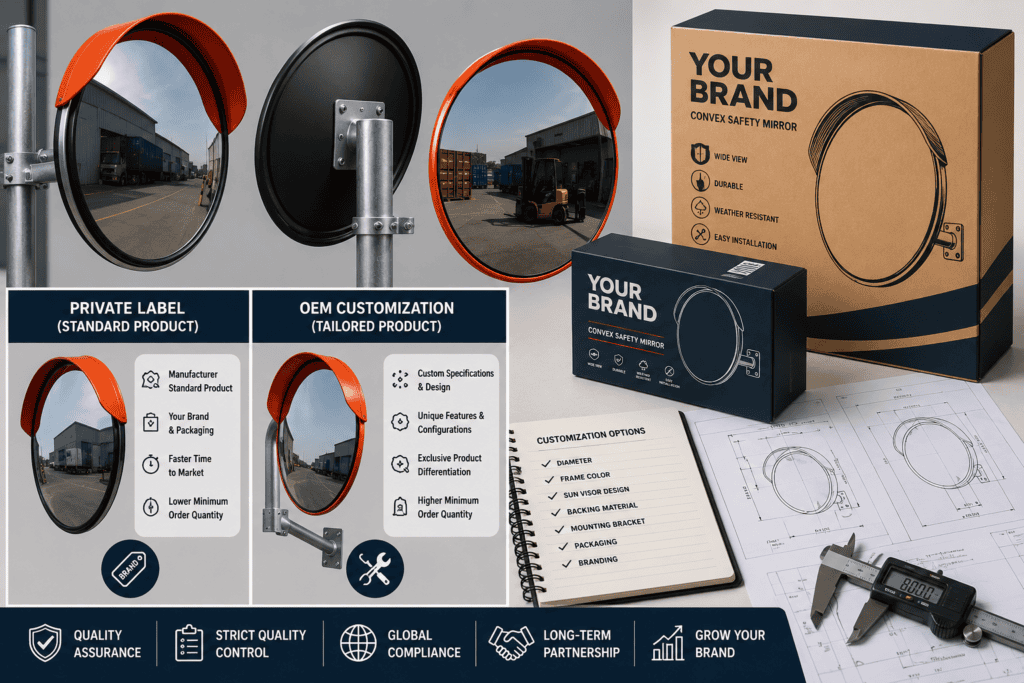
The term private label is used loosely across the road safety products industry, and it covers a meaningful spectrum of arrangements that distributors should understand clearly before engaging with any manufacturer.
At its most basic level, a private label convex mirror program means that a manufacturer produces a standard convex mirror product and applies the distributor’s brand name, logo, and packaging design instead of their own. The product specification itself does not change. The distributor gains the ability to present the product as their own brand to end customers, without developing or manufacturing the product themselves.
A more involved arrangement, often called OEM (Original Equipment Manufacturer) customization, goes further. In an OEM convex mirror program, the distributor works with the manufacturer to develop a product specification that differs from the manufacturer’s standard range. This might mean specifying a particular lens diameter that the manufacturer does not normally produce, a specific frame colour or material combination, a custom sun visor design, or a mounting bracket configuration tailored to a particular market application. OEM customization gives the distributor a product that competitors cannot easily replicate, because the specification is proprietary rather than drawn from a standard catalogue.
Most distributors entering a private label program for the first time start with the simpler arrangement, branding an existing product, and progress to OEM customization as their volume and market knowledge grow. Understanding which level you are entering is essential before any commercial discussion begins.
Why Distributors Choose Private Label Over Branded Resale
The commercial logic of a private label convex mirror program is straightforward, but it is worth examining clearly because the benefits are sometimes overstated by manufacturers eager to secure volume commitments.
Margin Control and Price Insulation
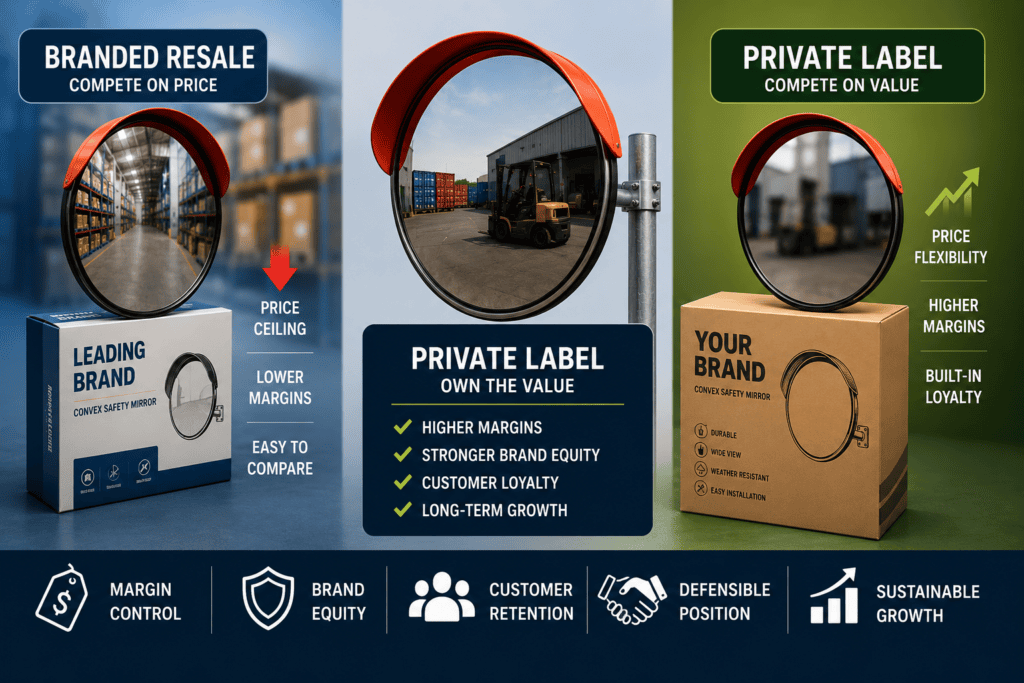
When a distributor resells a branded convex mirror, the manufacturer’s retail pricing sets a ceiling on how much the distributor can charge. If the manufacturer’s product is available through multiple channels at a known market price, the distributor is competing on service and availability rather than on product value. Margin compression in branded resale is structural and tends to worsen as the market matures.
A private label convex mirror removes that ceiling. Because the product carries the distributor’s brand and is not directly comparable to a manufacturer’s publicly listed product, pricing is based on the distributor’s perceived value rather than a market reference price. Distributors operating private label programs consistently report gross margins 15 to 25 percentage points higher than those achievable through branded resale of equivalent products.
Brand Equity and Customer Retention
Every sale of a branded manufacturer’s convex mirror builds recognition for that manufacturer’s name among the distributor’s customers. If those customers later source directly from the manufacturer or through a competing distributor, the brand relationship does not transfer. A private label program inverts this dynamic entirely. Each sale builds recognition for the distributor’s brand, and repeat purchases are tied to the distributor’s relationship with the customer rather than to a product name that any competing channel can supply.
For distributors operating in specific geographic markets or vertical sectors such as municipal procurement, industrial facility management, or construction supply, a recognized private label brand in convex mirrors creates a defensible market position that is significantly harder for competitors to displace than a resale business built on price and availability alone.
Evaluating Whether Your Business Is Ready
Not every distributor is positioned to benefit from a private label convex mirror program at any given point in their business development. Several conditions need to be in place before the investment makes commercial sense.
Volume Threshold
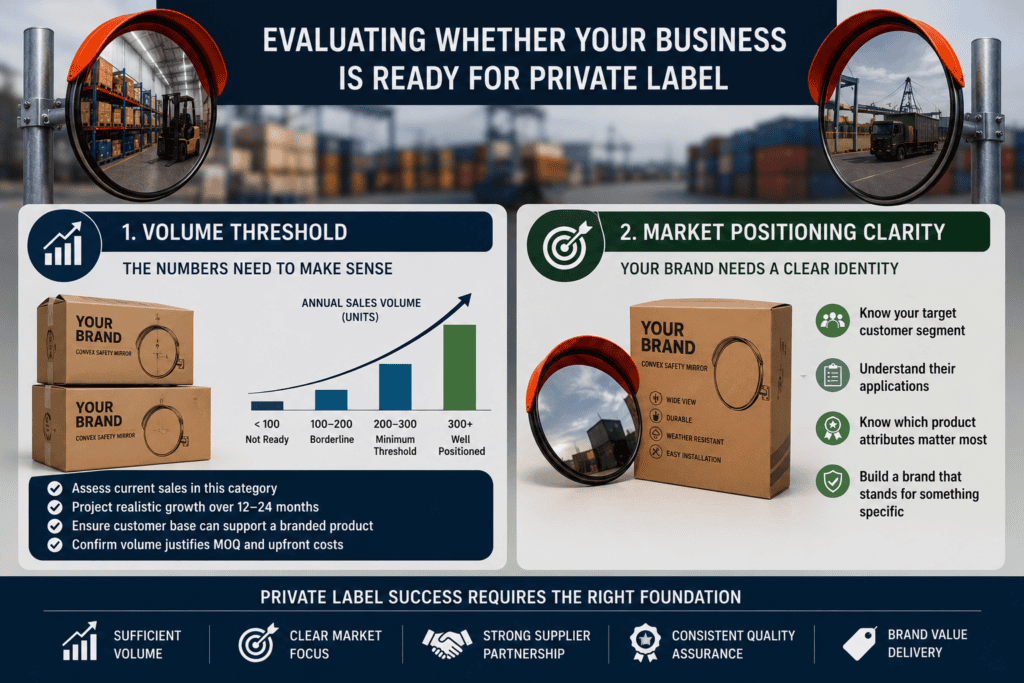
Private label programs involve fixed costs that do not exist in standard product resale. Custom packaging design, logo artwork preparation, sample production and approval, and the minimum order quantities required by most manufacturers all represent upfront commitments that need to be recovered across a sufficient sales volume. Distributors selling fewer than 200 to 300 convex mirror units per year in a given product category are unlikely to generate enough volume to make private label economics work at standard MOQ levels.
A realistic volume assessment should look at current sales in the specific product category being considered for private labelling, the realistic growth trajectory over the following twelve to twenty-four months, and whether the distributor’s customer base is concentrated enough to support a branded product identity or too fragmented to build recognition.
Market Positioning Clarity
A private label convex mirror brand needs to stand for something specific in the market it serves. Distributors who have a clear understanding of their target customer segment, the applications their customers prioritize, and the product attributes those customers value most are well-positioned to build a private label brand around those attributes. Distributors who serve a diffuse mix of customers across multiple sectors without a dominant positioning tend to find that a private label brand does not resonate strongly enough with any particular segment to justify the investment.
Choosing the Right Manufacturing Partner
The manufacturer behind a private label convex mirror program is the most consequential decision in the entire process. The distributor’s brand reputation is directly tied to the quality of the products the manufacturer produces.
Factory vs. Trading Company
The first distinction to establish is whether a prospective partner is an actual manufacturer with their own production facility or a trading company sourcing from third-party factories. Both can offer private label programs, but they offer them in different ways and at different risk levels.
A direct manufacturer offers tighter quality control, direct access to technical expertise on materials and specifications, and typically better pricing at equivalent volumes because there is no intermediary margin built into the unit cost. A trading company offers access to a broader product range and sometimes more flexible MOQ arrangements, but quality consistency depends on which factory they are sourcing from for a given order, and the distributor has less visibility into that relationship.
For a private label program where consistent product quality is essential to brand integrity, a direct manufacturer with a documented quality management system and verifiable production capacity is the preferred partner.
Quality Management and Certification
The manufacturer behind a private label convex mirror program should hold ISO 9001 certification as a baseline requirement. This confirms that they operate documented quality management processes, that production batches are traceable, and that there is a formal system for identifying and handling non-conforming products. For distributors targeting markets where CE marking or other certification is required, the manufacturer must be capable of producing products that meet those certification requirements and providing the documentation to prove it.
Ask to review the manufacturer’s quality control process for convex mirror production specifically. Key checkpoints should include incoming raw material inspection for polycarbonate or acrylic sheet quality, in-process inspection of lens curvature consistency, optical clarity testing of finished mirrors, and final inspection of packaging before shipment.
Sample Approval Process
Before committing to a private label order, a thorough sample approval process is essential. Request production samples, not showroom units or pre-production prototypes. Production samples must be drawn from the same materials, tooling, and process that will be used for the actual order. Review samples against every specification parameter: lens clarity, curvature uniformity, frame finish and sealing, hardware quality, and packaging presentation. Any deviation identified at the sample stage is infinitely less expensive to address than a deviation discovered after a full production run has been completed.

MOQ, Pricing, and Lead Time Realities
Distributors entering private label discussions for the first time often discover that the commercial realities are different from their initial expectations. Understanding these realities before the first conversation with a manufacturer prevents misaligned expectations and wasted negotiation time.
Minimum Order Quantities for Private Label Convex Mirrors
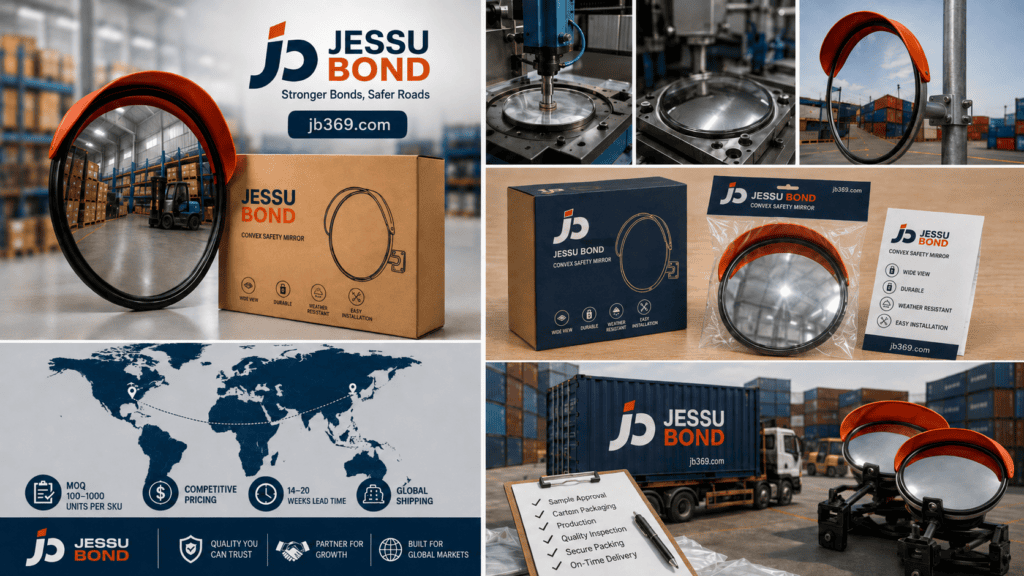
Standard private label MOQs for convex mirrors from Chinese manufacturers typically range from 100 to 500 units per SKU for basic logo and packaging customization on an existing product specification. OEM customization involving modifications to the product itself, such as a non-standard mirror diameter, custom frame colour, or proprietary mounting bracket design, typically requires higher MOQs of 300 to 1,000 units per SKU because the manufacturer must set up dedicated tooling or modify a production line to accommodate the custom specification.
For distributors launching a private label range across multiple SKUs, covering different mirror sizes and configurations, the total MOQ commitment across the range can be substantial. A phased launch approach, starting with the two or three highest-volume SKUs and adding additional products once the program is generating consistent sales, is a more manageable approach than attempting to launch a full range simultaneously.
Packaging Customization and Lead Times
Custom packaging is where many private label programs encounter their first unexpected complexity. A printed carton, a branded polybag, or a custom insert card each involves a separate artwork approval process, print run MOQ, and lead time that sits alongside the mirror production lead time. Packaging print runs for custom cartons typically require a minimum of 500 to 1,000 units to be economically viable with offset printing, though digital printing options allow shorter runs at higher per-unit cost.
Total lead time from order confirmation to delivery for a first-time private label convex mirror order, including sample approval, packaging production, mirror production, and international shipping, is typically fourteen to twenty weeks. Distributors who plan their inventory based on the lead times of their current branded resale suppliers, which are often drawing from existing stock, will need to build significantly more planning lead time into a private label supply chain.
Protecting Your Brand Through Contract Clarity
The commercial agreement governing a private label convex mirror program must be specific enough to protect the distributor’s brand investment across the full duration of the relationship.
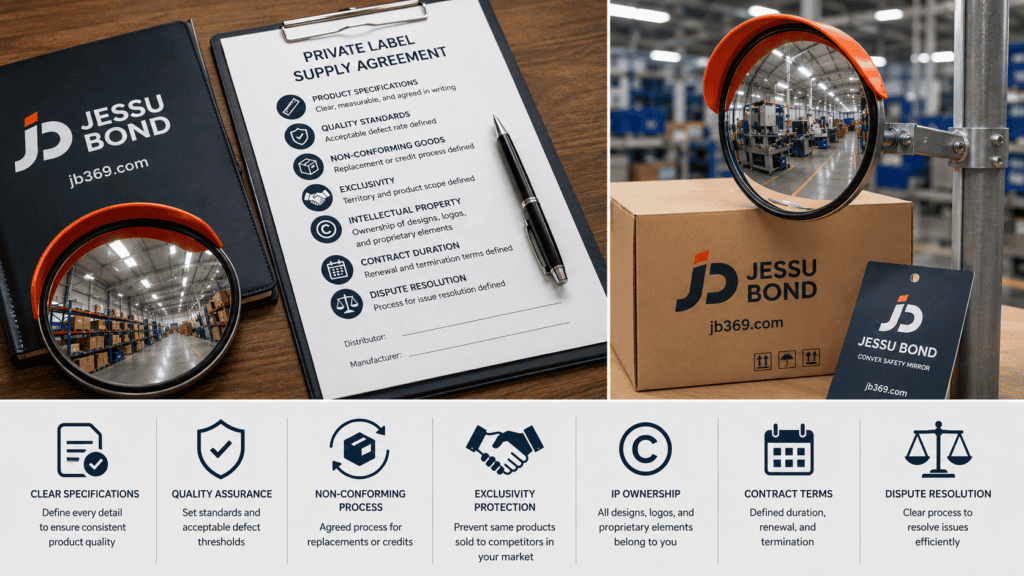
The agreement should specify product specifications in measurable technical terms so that there is an objective standard against which delivered products can be assessed. It should define the acceptable defect rate per shipment and the process for handling non-conforming units, including whether replacement units or credit will be provided and within what timeframe. Exclusivity terms, if the distributor intends to prevent the manufacturer from supplying the same product configuration under a different brand in the same geographic market, must be explicitly stated and agreed.
Intellectual property ownership of the packaging design, logo application, and any proprietary product elements developed in collaboration with the manufacturer must vest clearly in the distributor. Without this, a manufacturer could legitimately use design elements developed for the distributor’s program with other customers once the commercial relationship ends.
Building the Program for Long-Term Success
The distributors who build the most successful private label convex mirror programs treat them as brand-building exercises rather than procurement arrangements. They invest in professional packaging design that communicates the product’s quality and application. They select specifications that reflect the genuine performance requirements of their target customers rather than simply choosing the lowest-cost option available at the required MOQ. They build marketing materials and product documentation that support their sales teams and give end customers the information needed to specify the right product for their application.
A private label convex mirror program built on that foundation creates compounding returns over time. Each sale strengthens brand recognition, each repeat order builds the manufacturing relationship and improves pricing leverage, and each new customer acquired under the brand adds to a customer base that is tied to the distributor rather than to a product name that any competitor can supply.
The preparation required before the first order is the investment that determines whether the program delivers those returns or becomes an expensive inventory management problem. Get the preparation right, and the commercial case for private label in convex mirrors is compelling.
Looking for a custom convex mirror manufacturer or supplier? Struggling to find the right factory to bring your vision to life? We’ve got you covered! At our place, we craft top-quality convex mirrors with precision and care. Big or small, your needs are our mission. Let’s launch your mirror project and take your product line to the next level! Click here to contact