
Ports and shipping terminals operate at a scale and pace that most industrial environments never approach. At any given hour across a working terminal, container trucks move through gate entry corridors, reach stackers and empty handlers navigate yard lanes between towering stacks, forklifts cross pedestrian walkways at loading bays, and third-party haulage vehicles manoeuvre through areas designed with cargo movement as the primary priority and worker safety as the secondary consideration. The result is one of the most hazardous working environments in global industry.
The numbers reflect this reality without ambiguity. US marine terminal and water-transport support workers died at a rate of 15.9 per 100,000 full-time equivalents per year between 2011 and 2017, roughly five times the all-industry fatality rate over the same period. Struck-by-vehicle incidents, collisions at blind intersections, and pedestrian-vehicle conflicts in confined yard spaces account for a disproportionate share of those fatalities and serious injuries.
Against this backdrop, the convex safety mirror is not a peripheral safety accessory. In port and shipping terminal environments, a properly specified and strategically deployed convex mirror network is a foundational element of site safety infrastructure. This article explains why, and what procurement and safety managers need to understand when sourcing convex mirrors for maritime and terminal operations.
The Unique Hazard Profile of Port and Terminal Environments
Understanding why convex mirrors matter so much in terminal environments requires understanding what makes those environments categorically different from standard industrial or logistics facilities.
Vehicle Scale and Blind Spot Severity
The vehicles operating in container terminals are not warehouse forklifts or delivery vans. Reach stackers, rubber-tyred gantry cranes, straddle carriers, and heavy articulated trucks all share yard space with pedestrian workers, smaller internal transfer vehicles, and third-party haulage operators who may be unfamiliar with the terminal layout. <cite index=”19-1″>Manual straddle carriers have inevitable blind spots, and while monitoring technologies are available to support mechanical performance and operator behaviour, collisions and overturns remain very common across the sector.</cite>
These blind spots are not minor. A fully loaded reach stacker or straddle carrier has forward, lateral, and rear blind zones that can entirely conceal a pedestrian worker or a smaller vehicle at close range. At a yard intersection where two vehicle routes cross without a clear line of sight, the consequence of a missed visual cue is not a minor incident. It is a fatality or a serious crush injury.
Layout Complexity and Intersection Density
Port and terminal layouts are defined by operational logic, not safety geometry. Lanes are positioned to maximize container storage density and cargo throughput, which means intersections, blind corners, gate bottlenecks, and crossing points between vehicle routes and pedestrian access paths proliferate across the site. <cite index=”19-1″>Smaller vehicles, including internal transfer vehicles, third-party trucks, and all other vehicles on the terminal require good traffic management procedures and enforcement, yet collisions and overturns remain very common.</cite>
At each of these intersection and crossing points, a convex mirror mounted at the correct height and angle provides both approaching vehicle operators and pedestrians with a reflected view of what is coming from the direction they cannot directly see. That reflected view, delivered in real time with no power supply, no connectivity dependency, and no maintenance requirement beyond occasional cleaning, is the most cost-effective safety intervention available at those locations.
Shift Operations and Fatigue
Terminals operate around the clock. Vessel berthing schedules do not respect standard working hours, and peak cargo throughput periods often coincide with night shifts, early morning operations, and periods of operator fatigue. Visibility infrastructure that functions independently of operator alertness levels is therefore critical. A convex mirror delivers its safety function regardless of whether the approaching driver is fully alert or working through their third consecutive night shift. A safety protocol that depends on human vigilance alone will fail under those conditions with statistical regularity.
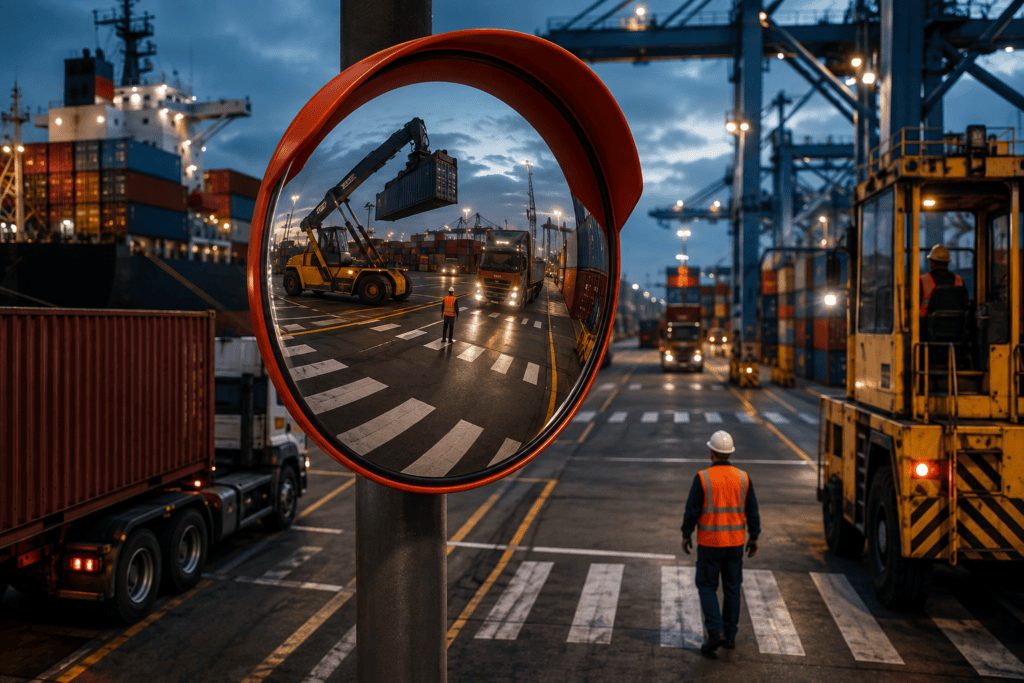
Where Convex Mirrors Must Be Deployed in Terminal Environments
Strategic placement is what transforms a collection of convex mirrors into an effective safety network. In a port or shipping terminal, there are specific locations where convex mirrors are not merely useful but genuinely non-negotiable.
Gate Entry and Exit Corridors
Terminal gate areas concentrate the highest density of mixed traffic in any port environment. Outbound trucks, inbound haulage vehicles, terminal staff vehicles, and pedestrians moving between gatehouse facilities all converge in a confined space with multiple crossing points and limited sight lines. Convex mirrors mounted at each decision point within the gate corridor give drivers a clear view of crossing pedestrian paths and intersecting vehicle lanes before they commit to a movement they cannot safely reverse.
Yard Lane Intersections
The internal yard of a container terminal is a grid of lanes between container stacks, and every intersection in that grid is a potential collision point. At full container stack height, the visual barrier between approaching vehicles at a yard intersection is absolute. Neither driver has any indication that a vehicle is approaching from the perpendicular direction until that vehicle enters the intersection itself. A convex mirror mounted at the correct height at each yard intersection, angled to reflect both approaching directions, provides a critical advance warning that allows approaching operators to slow or stop before entering the conflict zone.
Loading Bay and Dock Approach Zones
Loading bays present a specific and well-documented blind spot hazard. <cite index=”23-1″>When forklift drivers exit a truck, they are coming out blind into a zone behind the trailer where pedestrians cannot see them, creating a two-way blind spot where neither party has a clear view of the other.</cite> At terminal loading bays where multiple dock doors are being serviced simultaneously, this hazard multiplies with each active bay. Convex mirrors positioned at the approach to each bay and at the edges of the dock staging area give both forklift operators and pedestrians the sight line they need to identify conflicting movements before entering the danger zone.
Pedestrian Crossing Points
Where designated pedestrian routes cross vehicle lanes, convex mirrors serve a dual function. They give approaching vehicle operators a view of the pedestrian crossing ahead, and they give pedestrians a view of approaching vehicles from directions that a direct line of sight cannot cover. At high-traffic crossing points, the mirror must be sized and positioned to be useful to both audiences simultaneously, which typically means a larger diameter mirror mounted at a height accessible to both seated vehicle operators and standing workers.
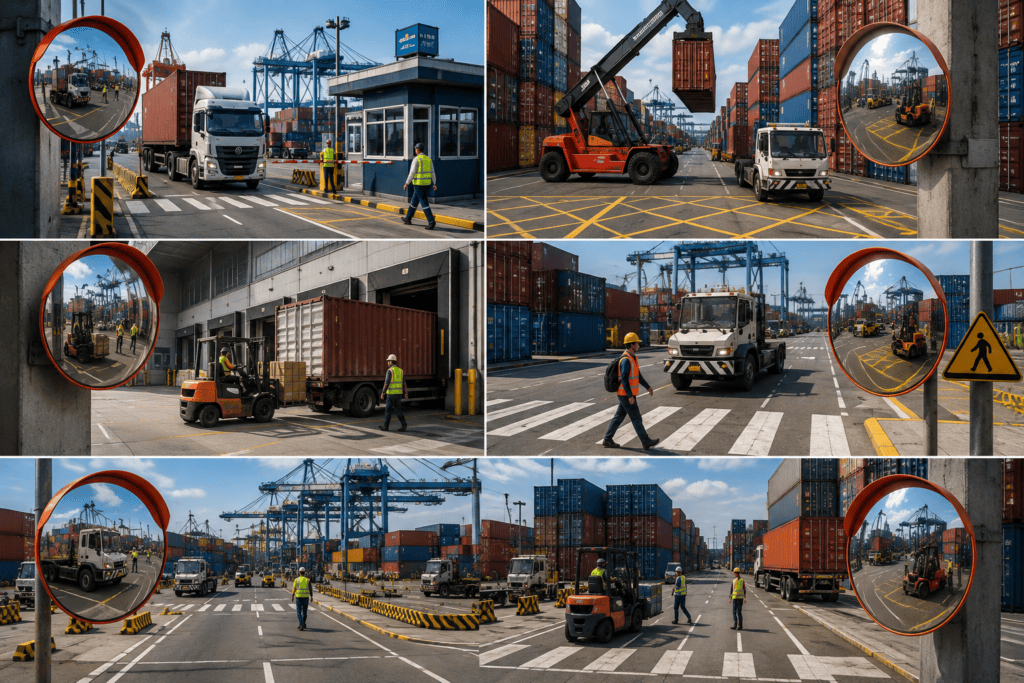
Why Standard Industrial Mirrors Are Not Sufficient
Not every convex mirror on the market is suitable for port and terminal deployment. The environmental conditions at coastal maritime facilities impose demands on safety mirror specifications that standard indoor-rated or light-duty outdoor mirrors cannot meet.
Salt Air and Coastal Corrosion
The single most significant material challenge for convex mirrors in port environments is salt-laden air. Marine terminals located on or near coastlines subject every piece of exposed equipment and infrastructure to continuous salt spray exposure. For convex mirrors, this creates two distinct failure risks. First, frame and backing materials that are not specifically rated for coastal or marine exposure will corrode, which compromises the structural integrity of the mounting and can lead to mirror failure. Second, mounting hardware that uses standard carbon steel fasteners will rust rapidly in salt air, with bracket failure as the eventual outcome.
The correct specification for convex mirrors deployed in coastal port environments is a stainless steel Grade 304 or Grade 316 frame and backing, with stainless steel fasteners throughout the mounting assembly. Grade 316 stainless steel is preferred for the most exposed locations due to its higher molybdenum content, which provides superior resistance to chloride-driven corrosion compared to Grade 304. For buyers seeking a polymer alternative, HDPE-backed mirrors with stainless steel hardware represent an appropriate specification for moderately exposed terminal locations.
Wind Load at Open Port Sites
Container terminal yards are open, exposed environments with minimal wind shelter. Wind loading on pole-mounted convex mirrors at an open terminal site is significantly higher than at an urban road intersection or a covered warehouse facility. A mirror mounting system that is adequate for an urban installation may fail structurally within months at an exposed terminal location.
Wind load resistance must be specified explicitly for terminal convex mirrors. For most coastal terminal environments, a minimum wind load resistance equivalent to Beaufort Scale Level 10, representing sustained wind speeds of 89 to 102 kilometres per hour, is the appropriate benchmark. The pole clamp bracket, the mirror-to-bracket connection, and the mounting pole itself must all be rated to this load, not just the mirror housing.
Optical Performance Under Variable Lighting
Port operations continue through night hours, dawn and dusk transitions, and the challenging low-angle lighting conditions that accompany early morning and late afternoon operations. A convex mirror serving a terminal yard intersection must deliver a usable reflected image across this full range of lighting conditions.
UV-stabilized polycarbonate lenses with vacuum-deposited aluminium reflective coatings deliver the optical performance required across variable lighting conditions. Mirrors with yellowed or hazed lenses, common in products that lack adequate UV stabilization, fail precisely in the low-light conditions where their performance is most needed.
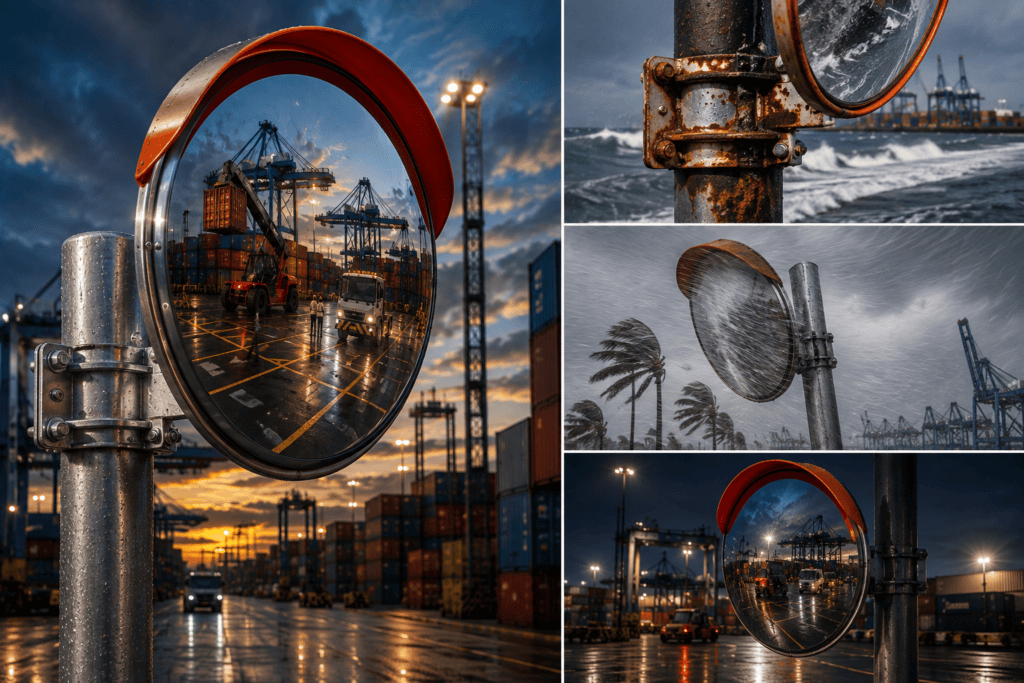
Specifying Convex Mirrors for Port and Terminal Procurement
When procurement and safety managers source convex mirrors for port and shipping terminal deployment, the specification must address the unique demands of the environment rather than defaulting to a generic outdoor mirror specification.
Size Selection for Terminal Viewing Distances
Terminal yard intersections typically require viewing distances of fifteen to twenty-five metres or more. At those distances, a 600mm diameter convex mirror delivers marginal utility. The standard specification for open yard intersection mirrors in terminal environments is 800mm to 1000mm diameter, which provides a reflected image large enough for a vehicle operator to identify crossing hazards from a distance sufficient to stop or slow before entering the intersection.
For gate corridor and loading bay applications where viewing distances are shorter and the primary audience includes pedestrians as well as vehicle operators, 600mm to 800mm mirrors are appropriate depending on the specific geometry of the installation point.
Material Specification Summary
For coastal and marine-adjacent terminal environments, the material specification should state: polycarbonate lens with Grade 8 UV stability rating, stainless steel Grade 316 frame and backing for exposed locations, galvanized steel or stainless steel Grade 304 for moderately sheltered locations, stainless steel fasteners throughout, IP65 minimum weatherproof rating for the mirror housing, and wind load resistance rated to a minimum of Level 10 Beaufort.
For terminal locations that are partially sheltered by structures or within covered loading facilities, a polycarbonate-lens mirror with HDPE backing and galvanized steel mounting hardware represents an appropriate and more cost-effective specification.
Maintenance and Inspection Intervals
Convex mirrors in terminal environments should be included in the site’s formal safety infrastructure inspection schedule. Quarterly inspection of mounting hardware integrity, lens clarity, and bracket adjustment is a reasonable minimum frequency for exposed coastal locations. Any mirror showing lens hazing, frame corrosion, or bracket movement should be replaced rather than deferred, as a degraded mirror is operationally unreliable and creates a false sense of coverage at the location it serves.
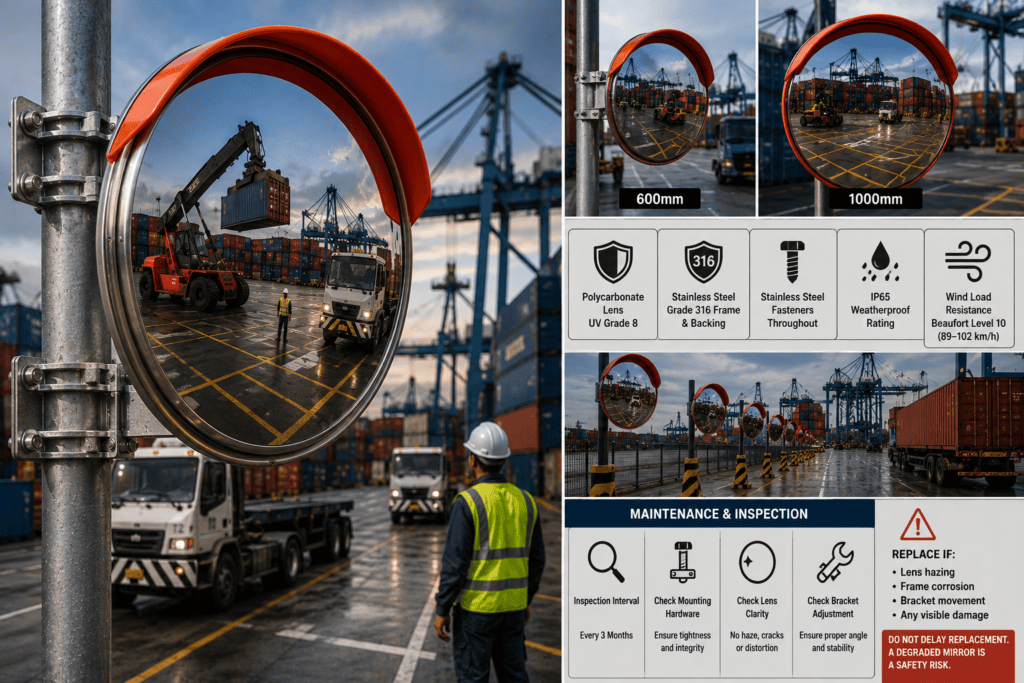
The Cost Argument for Investing Correctly
Safety managers presenting the case for a properly specified convex mirror network in a port or terminal environment often face cost pressure from procurement stakeholders who view mirror specification as a detail rather than a strategic decision. The cost argument is straightforward.
A correctly specified stainless steel or marine-grade polycarbonate convex mirror installed in a coastal terminal environment will maintain its structural integrity and optical performance for five to ten years with routine cleaning and annual hardware inspection. An undersized or incorrectly specified mirror that degrades within eighteen months, requires replacement hardware after two years due to corrosion failure, or simply fails to provide adequate coverage at the distances required in the terminal layout represents a total lifecycle cost that is multiple times higher than the upfront investment in correct specification.
Beyond lifecycle cost, the liability exposure created by a safety infrastructure gap at a known blind spot in a high-hazard environment is a cost of a different order entirely. A single struck-by-vehicle incident at a yard intersection that lacked adequate mirror coverage, in an environment where management had identified the intersection as a hazard point, creates regulatory, legal, and reputational consequences that no procurement saving could justify.
Convex mirrors in port and shipping terminal environments are not a cost to be minimized. They are a foundational safety investment to be specified correctly and maintained consistently.
Looking for a custom convex mirror manufacturer or supplier? Struggling to find the right factory to bring your vision to life? We’ve got you covered! At our place, we craft top-quality convex mirrors with precision and care. Big or small, your needs are our mission. Let’s launch your mirror project and take your product line to the next level! Click here to contact