
Convex mirrors are one of the most widely deployed safety tools across commercial and industrial environments. Yet one of the most common and costly mistakes B2B buyers make is treating indoor and outdoor convex mirrors as interchangeable products. They are not. The differences between an indoor convex safety mirror and an outdoor convex traffic mirror go far beyond where each one is mounted. They differ in materials, construction, size, mounting hardware, optical performance requirements, and total cost of ownership.
For procurement managers, facility operators, safety distributors, and infrastructure contractors sourcing convex mirrors at volume, understanding these distinctions is not optional. Ordering the wrong type for the wrong environment results in premature product failure, safety gaps, non-compliance with site regulations, and the added cost of replacement orders that could have been avoided from the start.
This article breaks down every key difference between indoor and outdoor convex mirrors so that B2B buyers can source the right product for each application with confidence.
The Fundamental Difference: Environment Determines Everything
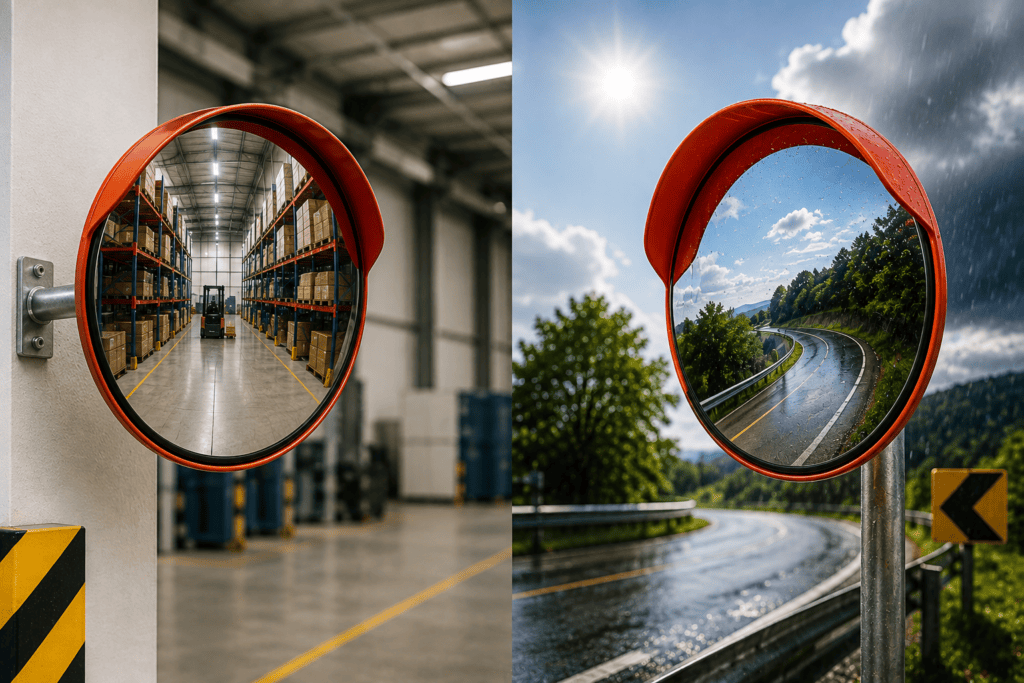
The core reason indoor and outdoor convex mirrors differ so significantly comes down to the environment each one must perform in. Indoor environments are controlled. Temperature fluctuations are moderate, humidity is managed, and the mirror is protected from direct sunlight, rain, frost, and wind. The demands placed on an indoor convex safety mirror are relatively predictable.
Outdoor environments are the opposite. A convex traffic mirror mounted on a roadside pole or at a construction site entrance faces direct UV exposure for hours every day, temperature swings that can span 40 degrees Celsius or more across seasons, rainfall, humidity, road debris impact, and in coastal or industrial zones, constant exposure to corrosive elements. A mirror that performs perfectly in a warehouse aisle will begin degrading within months if deployed outdoors without the specifications to match that environment.
This environmental reality drives every downstream difference in materials, sizing, mounting, and cost.
Materials: Where the Differences Begin
Lens Material
The reflective lens is the most performance-critical component of any convex mirror, and the choice of lens material differs significantly between indoor and outdoor applications.
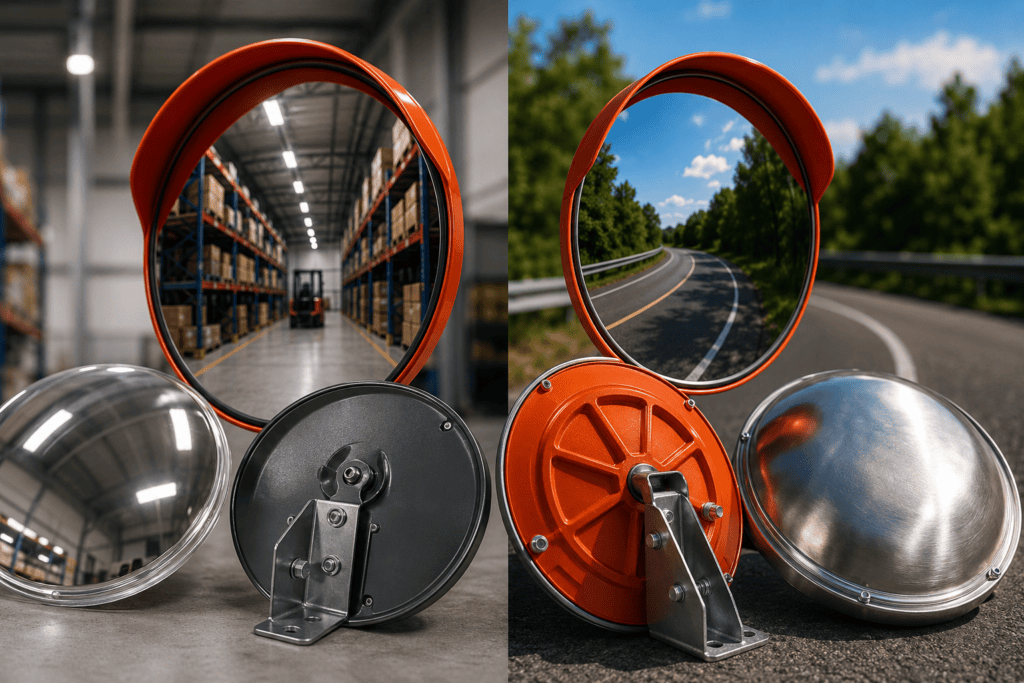
For indoor convex mirrors, PMMA acrylic is the standard lens material. Acrylic delivers excellent optical clarity, is lightweight, easy to handle during installation, and cost-effective for large-scale indoor deployments across retail chains, warehouses, hospitals, and office facilities. In a controlled indoor environment, acrylic performs reliably over its intended service life. The material’s primary limitation is its sensitivity to prolonged UV exposure and impact, which makes it unsuitable for outdoor use in most professional applications.
Outdoor convex mirrors, by contrast, are most commonly specified with polycarbonate (PC) lenses. Polycarbonate is significantly more impact-resistant than acrylic, handles UV degradation far better when properly treated, and maintains dimensional stability across wide temperature ranges. For traffic mirrors deployed on public roads or in industrial outdoor environments, polycarbonate is the professional standard. Some high-specification outdoor applications, particularly in areas prone to vandalism or heavy industrial activity, use stainless steel reflective surfaces instead of polymer lenses entirely.
Frame and Backing Materials
The frame and backing of a convex mirror are what protect the lens and anchor the entire assembly to its mounting point. For indoor mirrors, ABS plastic or lightweight polypropylene frames are standard. These materials are adequate for the controlled stresses of an indoor environment and keep the overall unit weight low.
Outdoor convex mirrors require significantly more robust frame and backing materials. UV-stabilized ABS, high-density polyethylene (HDPE), galvanized steel, and powder-coated aluminum are all common in outdoor mirror construction. The backing must resist water ingress, prevent the lens seal from failing over years of thermal cycling, and maintain structural integrity under wind load. Outdoor mirrors destined for coastal, humid, or corrosive industrial environments should be specified with stainless steel or fully sealed HDPE-backed frames to prevent corrosion-driven failure.
Size and Viewing Distance Requirements
Indoor Sizing Guidelines
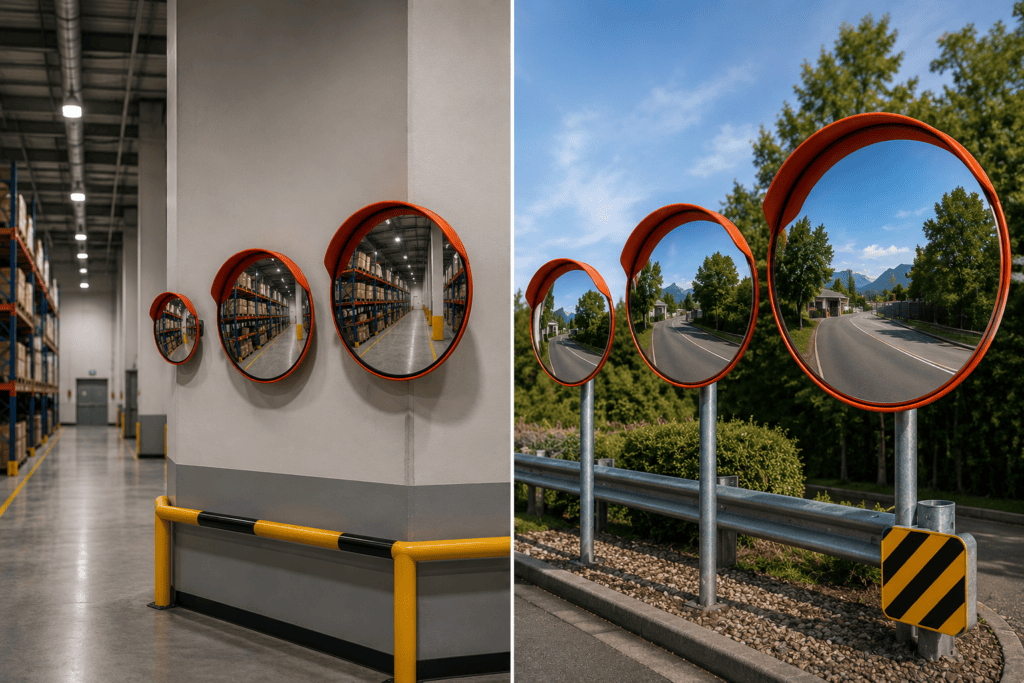
Indoor convex mirrors are sized based on the viewing distance required within the specific installation environment. As a general rule, indoor mirrors in retail corridors and office spaces with viewing distances of two to five metres are typically specified at 300mm to 450mm in diameter. Warehouse aisle intersections operating at five to ten metres of viewing distance generally require 450mm to 600mm mirrors. Larger indoor spaces with central observation points at ten to fifteen metres of distance may require mirrors up to 800mm.
The relatively shorter viewing distances of most indoor applications mean that smaller mirrors can deliver adequate field of view coverage. This keeps unit costs manageable for large-scale indoor deployments involving dozens or hundreds of units across a facility network.
Outdoor Sizing Requirements
Outdoor convex traffic mirrors are almost always larger than their indoor equivalents, and for good reason. Road intersections, driveway exits, industrial gate entrances, and construction site perimeters all involve vehicles approaching at speed from distances of ten to twenty-five metres or more. At those distances, a mirror needs sufficient diameter to produce a reflected image that a driver can interpret quickly and accurately.
Standard outdoor traffic mirrors for public road applications typically start at 600mm and commonly reach 800mm to 1000mm in diameter for high-speed or high-traffic environments. A procurement decision that attempts to save cost by specifying an undersized outdoor mirror will produce a mirror that is functionally inadequate, because drivers will not be able to identify hazards from the distances at which the mirror needs to be effective.
Mounting Hardware and Installation Requirements
Indoor Mounting
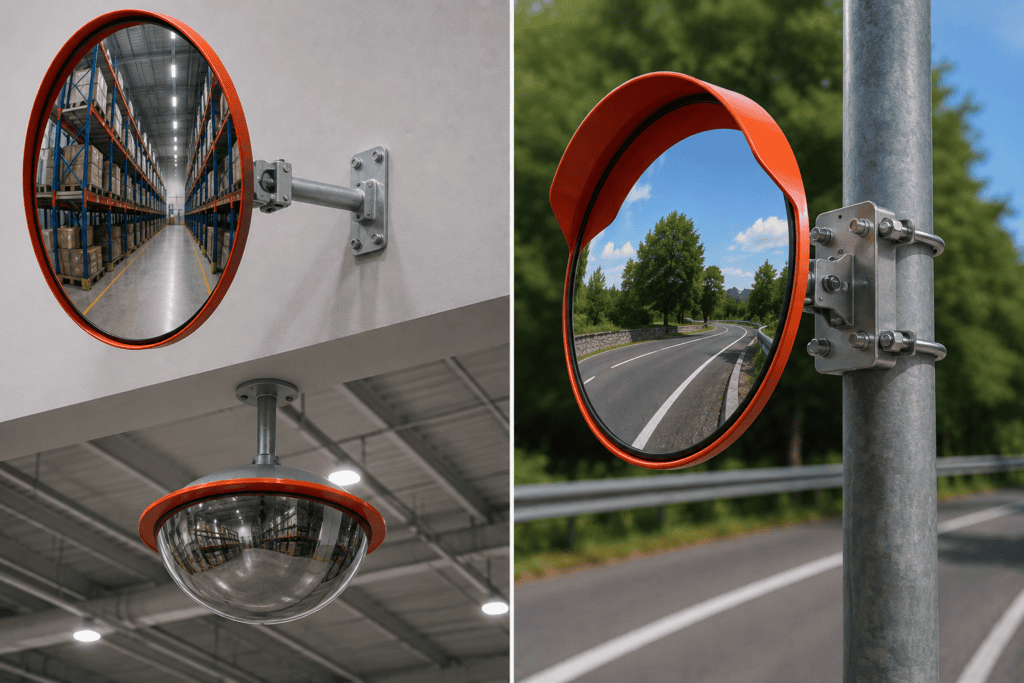
Indoor convex mirrors are typically wall-mounted or ceiling-hung. Wall mounting uses simple adjustable bracket assemblies that allow the mirror angle to be set during installation and left in position. Ceiling-hung dome mirrors, which are a variant of the convex mirror family, are common in retail and large warehouse environments where a single central overhead position can cover a wide area below.
For most indoor installations, the mounting hardware requirements are straightforward. The loads involved are modest, the surfaces are stable, and the absence of wind or weather means that simple fixed-angle or adjustable brackets perform reliably over the mirror’s service life.
Outdoor Mounting
Outdoor convex mirror mounting is a meaningfully different engineering challenge. Pole-mounted traffic mirrors must resist wind loading across years of service, which means the pole clamp bracket, the mirror-to-bracket connection, and the pole itself all need to be specified with structural adequacy in mind. Standard outdoor convex traffic mirrors use galvanized steel pole clamp brackets designed to fit poles of 50mm, 60mm, or 76mm diameter, with stainless steel fasteners to prevent corrosion-driven bracket failure.
For mirrors in locations subject to high winds, the mounting angle must also be set carefully to minimize the surface area presented to prevailing wind directions without compromising the mirror’s field of view coverage. Many professional-grade outdoor convex mirrors include an integrated sun visor above the reflective surface. This visor serves two purposes: it reduces direct solar glare that can wash out the mirror’s reflected image during certain times of day, and it provides some physical protection from rain and debris that would otherwise accumulate on the mirror surface.
Weather Resistance and Protective Coatings
This is the area where indoor and outdoor convex mirrors diverge most dramatically in specification and cost.
What Outdoor Mirrors Must Withstand
A professionally specified outdoor convex mirror is expected to maintain optical performance and structural integrity through years of continuous exposure to rain, frost, direct sunlight, airborne particulates, and in many environments, road salt spray or coastal humidity. To meet these demands, outdoor mirrors are manufactured with a suite of protective features that indoor mirrors do not require.
UV-stabilized lens material is non-negotiable for outdoor applications. Without UV stabilization, polycarbonate and acrylic lenses will begin yellowing and hazing within one to two years of outdoor deployment, progressively degrading the optical clarity of the mirror until it no longer provides a usable reflected image. Professional-grade outdoor mirrors specify UV resistance rated to Grade 8 or equivalent standards, meaning the lens material will maintain its clarity and structural properties across many years of direct UV exposure.
Weatherproof sealing between the lens and frame prevents water ingress that would allow frost expansion damage in cold climates or mold and algal growth in humid environments. IP65 weatherproof rating is a commonly specified benchmark for professional outdoor convex traffic mirrors, indicating that the mirror housing is dust-tight and protected against water projected from any direction.
Anti-fog coatings and hydrophobic surface treatments are additional options for outdoor mirrors deployed in high-humidity environments or locations subject to rapid temperature changes that would otherwise cause condensation on the reflective surface.
Indoor Mirror Protective Specifications
Indoor convex mirrors are not subject to any of these environmental demands in standard operating conditions. The lens material does not require UV stabilization, the frame does not require weatherproof sealing, and mounting hardware does not need to be corrosion-resistant beyond what normal indoor humidity levels require. This difference in protective specification is a primary reason why outdoor convex mirrors carry a higher unit cost than indoor equivalents of similar diameter.
-1024x683.png)
Cost Implications for B2B Procurement
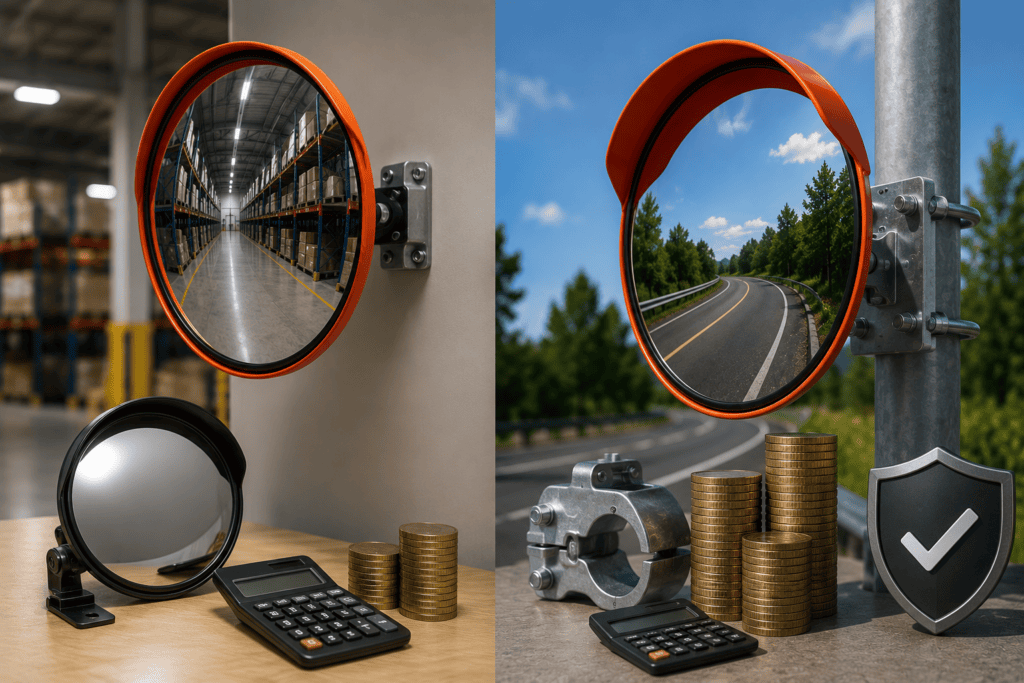
Understanding the cost difference between indoor and outdoor convex mirrors matters enormously at bulk order scale. An outdoor polycarbonate convex traffic mirror with a galvanized steel bracket, UV-stabilized lens, IP65-rated housing, and stainless steel fasteners will cost meaningfully more per unit than an indoor acrylic convex mirror with a lightweight ABS frame and a simple adjustable wall bracket.
For B2B buyers procuring both indoor and outdoor mirrors for a large facility or multi-site rollout, the temptation to standardize on the lower-cost indoor specification across all applications is understandable but counterproductive. Indoor mirrors deployed outdoors will require replacement in a fraction of the time a properly specified outdoor mirror would last, eliminating the upfront unit cost saving and then some when replacement logistics, downtime, and safety risk during the gap period are factored in.
The correct procurement approach is to specify each mirror precisely to its deployment environment, purchase indoor and outdoor units through separate line items with appropriate specifications for each, and evaluate total cost of ownership over a five-year horizon rather than unit cost alone.
Choosing the Right Type for Each Application
The decision between an indoor convex safety mirror and an outdoor convex traffic mirror is straightforward once the deployment environment is clearly defined. For any location with direct weather exposure, use a polycarbonate-lens outdoor mirror with UV stabilization, weatherproof sealing, and galvanized or stainless steel mounting hardware. For controlled indoor environments, an acrylic-lens mirror with lightweight ABS frame and simple wall or ceiling mounting is the appropriate and cost-effective choice.
Where the installation environment is transitional, such as a covered loading dock, a partially exposed parking structure entrance, or an industrial building overhang, specify to the harsher of the two conditions. A mirror rated for outdoor use will always perform in a transitional environment. An indoor-rated mirror in a transitional environment is a calculated risk that will typically cost more over the long run than the premium for outdoor specification.
B2B buyers who take the time to match mirror specification to environment will build safer facilities, deliver more reliable safety outcomes, and spend less on replacements over the life of their safety infrastructure investment.
Looking for a custom convex mirror manufacturer or supplier? Struggling to find the right factory to bring your vision to life? We’ve got you covered! At our place, we craft top-quality convex mirrors with precision and care. Big or small, your needs are our mission. Let’s launch your mirror project and take your product line to the next level! Click here to contact