
Winning an international tender for convex mirror supply does not begin with the lowest price. It begins with the specification sheet. A well-written convex mirror specification sheet tells the issuing authority exactly what they will receive, in measurable and verifiable terms, and demonstrates that the supplier understands the technical, regulatory, and environmental demands of the project. A poorly written or generic specification sheet, on the other hand, signals inexperience and invites disqualification before evaluation even begins.
For manufacturers, distributors, and road safety equipment exporters supplying convex mirrors to government bodies, infrastructure agencies, municipalities, and international organizations, the ability to produce a precise, compliant, and professionally structured specification sheet is a core commercial skill. This guide covers every component of a convex mirror specification sheet written for international tender submission, from product identification through to certification documentation and revision control.
Why the Specification Sheet Is the Most Important Tender Document
In any international procurement process, the specification is the foundation on which the entire tender is evaluated. It is the document that defines what success looks like, what failure looks like, and what the issuing authority will use to assess whether a submitted product actually meets their requirements. For physical products like convex mirrors, the specification sheet must describe the product in terms that are measurable, testable, and unambiguous.
International procurement bodies, including United Nations agencies, World Bank-funded infrastructure programs, and national government departments, have become significantly more rigorous in their specification requirements over the past decade. Vague language such as “high quality” or “suitable for outdoor use” is no longer acceptable in formal tender documents. Buyers need numbers, standards references, and test methodologies. Suppliers who provide those details clearly and completely move to the top of the evaluation pile.
Section 1: Product Identification and Scope
Every convex mirror specification sheet must open with a clear product identification section that establishes exactly what is being supplied. This section should include the product name in full, the intended application category, the quantity being specified, and a brief functional description.
Product Name and Application Statement
The product name should be written in full without abbreviation and should specify the mirror type. For example: “Outdoor Polycarbonate Convex Traffic Safety Mirror, Pole-Mounted, for Road Intersection and Driveway Hazard Management.” This level of specificity immediately communicates to the evaluating authority that the supplier understands the application environment and is not simply submitting a generic product.
The application statement should identify the intended deployment context: whether the mirrors are for public road intersections, industrial facility perimeters, parking structure entrances, construction site safety zones, or other specific environments. Each context carries different performance requirements, and naming the context upfront frames the technical content that follows.
Scope and Exclusions
Clearly state what the specification covers and, where relevant, what it does not cover. If the specification applies to a single mirror size and configuration, state that. If it covers a range of sizes within a product family, define the range. Exclusions prevent disputes later in the procurement process when a buyer attempts to apply a specification to a variant that was never intended to fall within its scope.

Section 2: Physical and Dimensional Specifications
The physical specification section is where most evaluation happens for convex mirror tenders. Every dimension, material, and construction detail should be stated in precise, measurable terms.
Mirror Diameter and Curvature
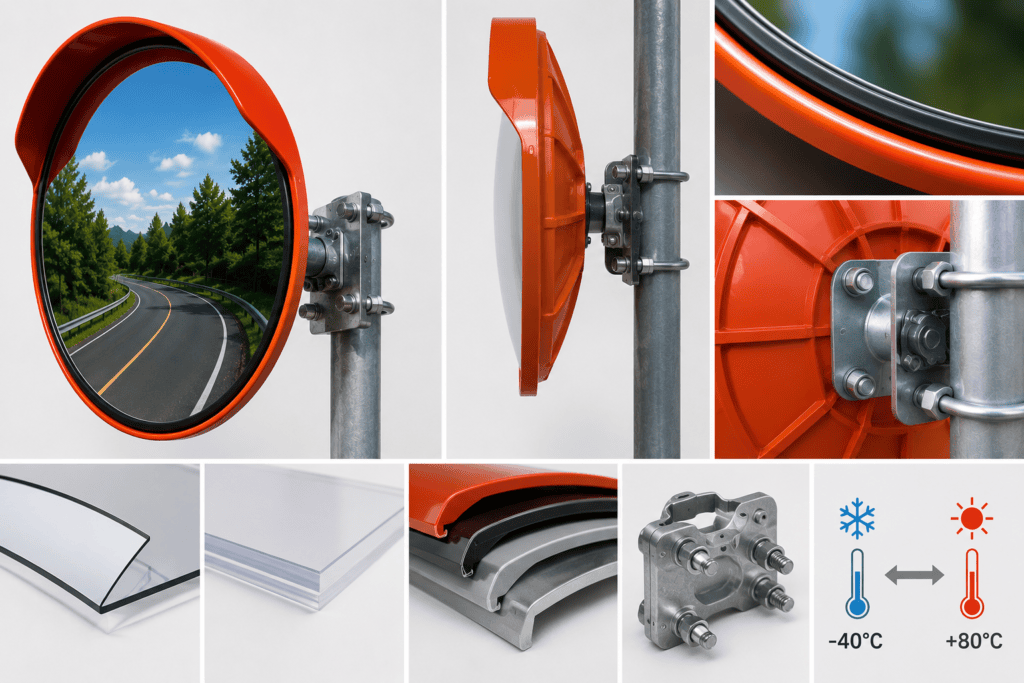
State the mirror diameter in millimetres. Standard sizes for outdoor convex traffic mirrors used in international tenders range from 600mm for secondary road and driveway applications up to 1000mm for high-speed highway and industrial perimeter installations. For indoor safety mirrors, the range is typically 300mm to 600mm depending on the viewing distance requirement.
Curvature specification is less commonly included in basic tender documents but is a meaningful differentiator for technically sophisticated buyers. Mirror curvature is expressed as the radius of curvature in millimetres or inches. A tighter curvature produces a wider field of view at the cost of image size reduction; a shallower curvature produces a larger reflected image over a narrower viewing angle. Where the tender specifies a minimum field of view angle, the curvature must be specified to deliver that angle at the installation distance stated in the project brief.
Lens Material
Specify the lens material by type and grade. For outdoor convex traffic mirrors, polycarbonate (PC) is the professional standard. The specification should state: lens material as impact-resistant polycarbonate, minimum thickness in millimetres, and UV stabilization rating. A UV stability rating of Grade 8 per ISO 4892 or equivalent international standard is the benchmark for professional outdoor convex mirror applications.
If the specification permits acrylic (PMMA) as an alternative for indoor applications, state the acceptable grade and the specific conditions under which acrylic is permitted. Do not leave the material choice open-ended, as this creates ambiguity that suppliers will interpret in the most cost-effective direction, which may not align with the buyer’s performance expectations.
Frame and Backing Construction
The frame and backing specifications must address both material and construction method. For outdoor convex mirrors, acceptable frame materials include UV-stabilized ABS, high-density polyethylene (HDPE), powder-coated galvanized steel, and stainless steel Grade 304 or 316 for corrosive environments. State the required material explicitly and do not use generic descriptors like “durable plastic” or “metal frame.”
Specify the sealing requirement between lens and frame. For outdoor applications, state that the lens-to-frame seal must be weatherproof and maintained across a defined temperature cycling range, typically minus 40 degrees Celsius to plus 80 degrees Celsius for international specifications covering both cold and tropical climates.
Section 3: Performance Standards and Testing Requirements
This is the section that separates a professional specification sheet from a generic one. Every performance claim in a convex mirror specification must be tied to a measurable standard and a recognized test methodology.
Weatherproof Rating
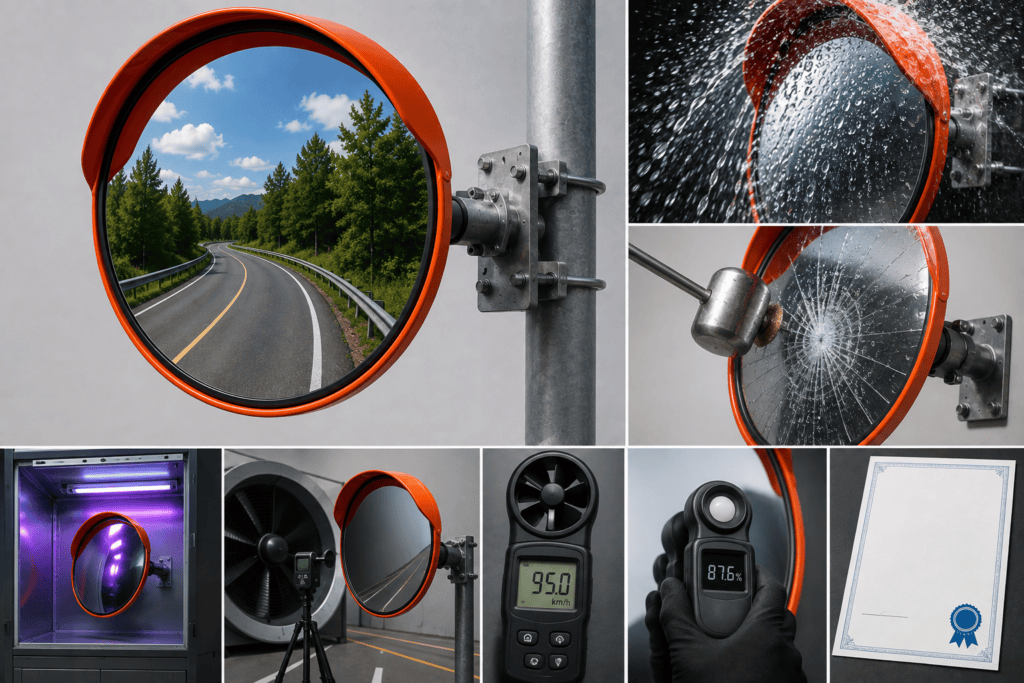
For outdoor convex mirrors, state the required IP (Ingress Protection) rating per IEC 60529. IP65 is the appropriate minimum standard for most outdoor traffic mirror applications, indicating dust-tight construction and protection against water projected from any direction. For mirrors in exceptionally exposed coastal or marine-adjacent locations, IP66 may be warranted.
Impact Resistance
Specify the impact resistance requirement in terms of the test standard rather than subjective descriptors. For polycarbonate convex mirrors in public road or industrial applications, reference IK rating per IEC 62262, which quantifies impact resistance in joules. IK08 (five joules) is a common minimum for public infrastructure convex mirrors; IK10 (twenty joules) is specified for high-vandalism-risk environments.
UV Stability
State the UV stability requirement as a rating per ISO 4892 or equivalent, with the minimum acceptable grade and the test duration. Grade 8 per ISO 4892 after 2000 hours of accelerated weathering testing is the standard most credible international tenders apply to outdoor polycarbonate convex mirrors.
Wind Load Resistance
For pole-mounted outdoor convex traffic mirrors, wind load resistance is a critical structural specification. State the required wind speed resistance in kilometres per hour or metres per second, and reference the applicable structural standard. Many international infrastructure tenders specify a minimum wind load resistance equivalent to Level 10 on the Beaufort scale, representing sustained wind speeds of 89 to 102 kilometres per hour.
Optical Clarity
The reflective surface must maintain a minimum reflectance value across the mirror’s service life. Specify minimum initial reflectance as a percentage, and if possible, the minimum acceptable reflectance after the UV stability test period. Vacuum-deposited aluminium reflective coatings typically deliver initial reflectance values of 85 to 90 percent.
Section 4: Mounting Hardware Specifications
A convex mirror specification sheet that omits mounting hardware detail is incomplete. The mirror and its mounting system function together as a single safety installation, and hardware failures are as damaging to the buyer as lens or frame failures.
Pole Clamp Bracket
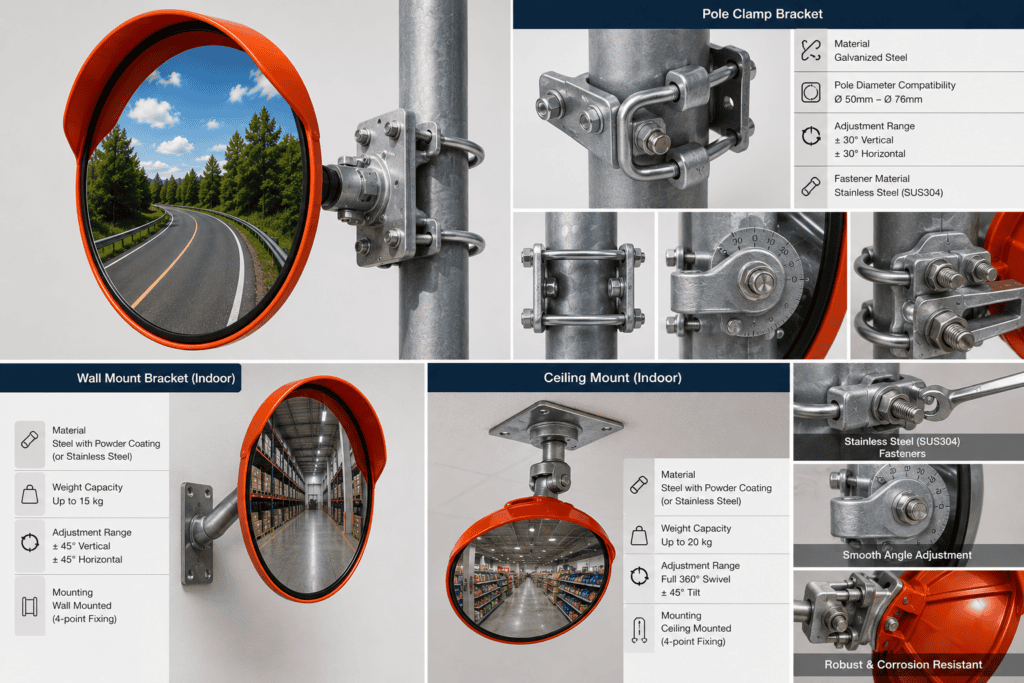
For pole-mounted outdoor convex traffic mirrors, specify the bracket material, the pole diameter compatibility range in millimetres, the bracket adjustment range in degrees, and the fastener material. Galvanized steel brackets with stainless steel Grade 304 fasteners are the standard specification for outdoor road safety applications. State the torque specification for fasteners if the tender authority has specific installation standards.
Wall and Ceiling Mounting Hardware
For indoor convex mirrors, specify the wall bracket type, material, and the maximum weight the bracket must support. Adjustable swivel brackets are preferred for most indoor safety mirror installations because they allow the mirror angle to be optimized after mounting. State the adjustment range in degrees both horizontally and vertically.
Section 5: Certification and Compliance Documentation
For international tenders, product compliance documentation is not supporting material. It is core evidence. The specification sheet should explicitly state which certifications and documents must be submitted with the tender response, and it should distinguish between mandatory certifications and preferred ones.
Mandatory Certifications
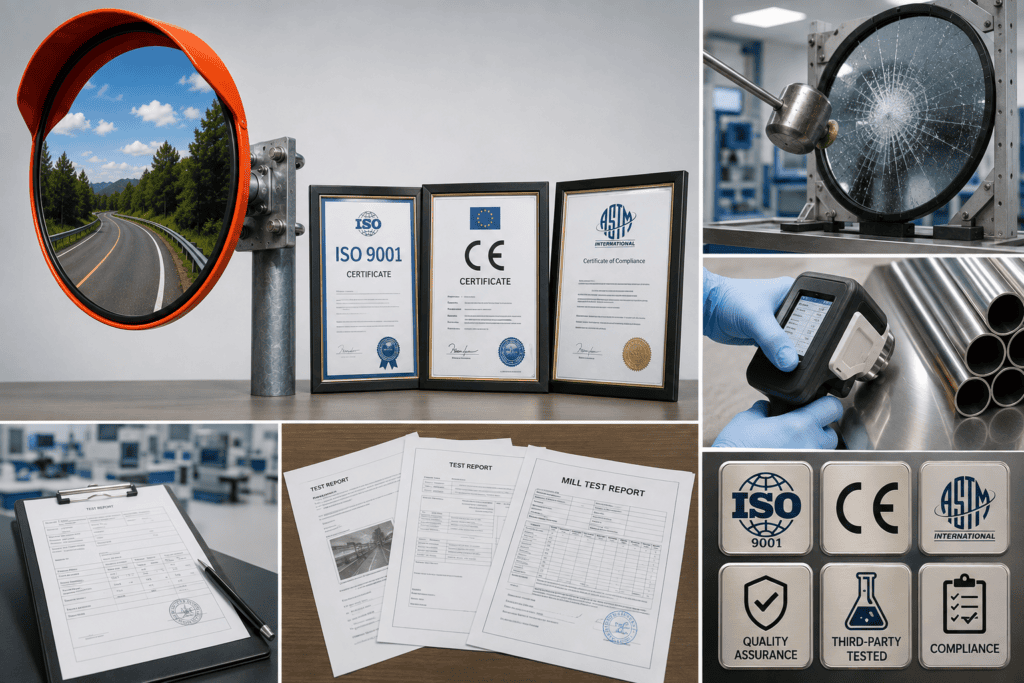
ISO 9001 certification for the manufacturing facility is the baseline mandatory requirement for virtually all international convex mirror tenders. This certification confirms that the supplier operates a documented quality management system and is not simply a trading company reselling unverified products.
For tenders covering supply to European Union member states or EU-funded projects, CE marking is mandatory. CE marking confirms that the product meets the applicable EU directives for safety, health, and environmental protection relevant to its product category.
For tenders covering North American markets or World Bank-funded projects with US procurement standards, ASTM compliance for relevant material and performance standards may be required. State the specific ASTM standards applicable to the product category in the specification.
Test Reports and Material Certificates
Beyond certification marks, professional international tenders for convex mirrors increasingly require actual test reports from accredited third-party laboratories. The specification sheet should state which tests must be evidenced by laboratory reports, from which accredited laboratory type, and how recent the test reports must be. Reports dated within three years of the tender submission date are commonly accepted; some municipal authorities require reports dated within twelve months.
For stainless steel-backed outdoor mirrors, mill test reports (MTRs) confirming the actual steel grade composition may be required by technically sophisticated buying authorities. Include this requirement explicitly if it applies.
Section 6: Packaging, Labelling, and Delivery Requirements
International tender specification sheets for physical products must address packaging and delivery in enough detail to prevent damage during transit and ensure that delivered products can be verified against the specification on arrival.
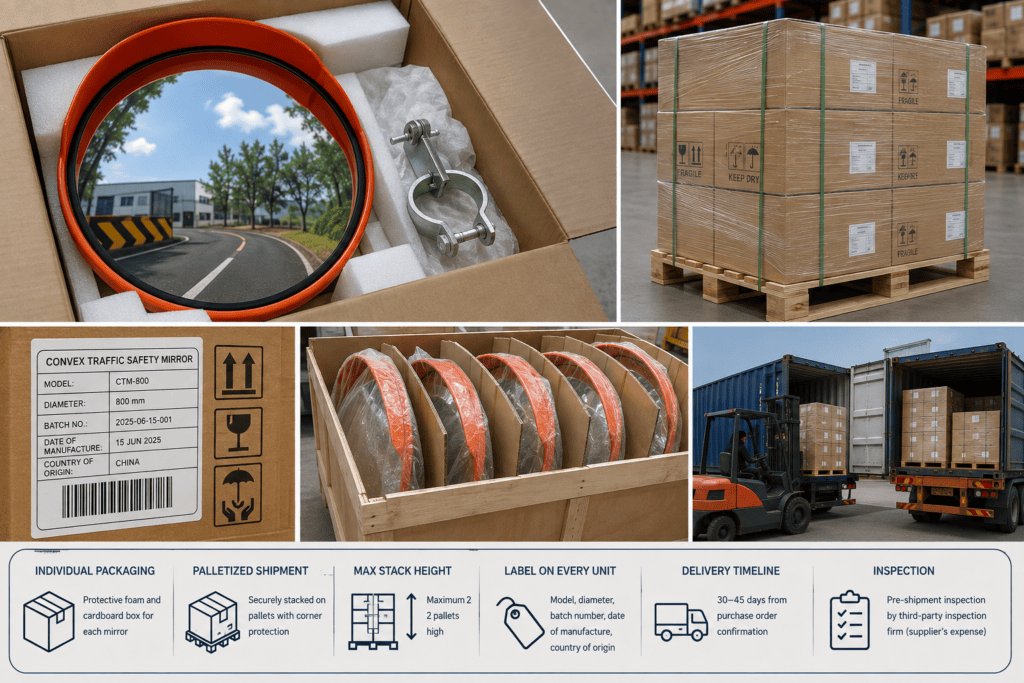
State the required individual unit packaging type, the maximum stack height for palletized shipment, and any special handling instructions for large-diameter mirrors. Each unit should be individually identified with a label stating the product model, diameter, batch or lot number, date of manufacture, and the country of origin.
Delivery requirements should state the required delivery timeline from purchase order confirmation, the acceptable delivery schedule for phased shipments, and the inspection process the buying authority will apply upon delivery. For international shipments, state whether pre-shipment inspection by a third-party inspection firm will be required at the supplier’s expense, and which inspection standards apply.
Section 7: Warranty and Revision Control
Warranty Statement
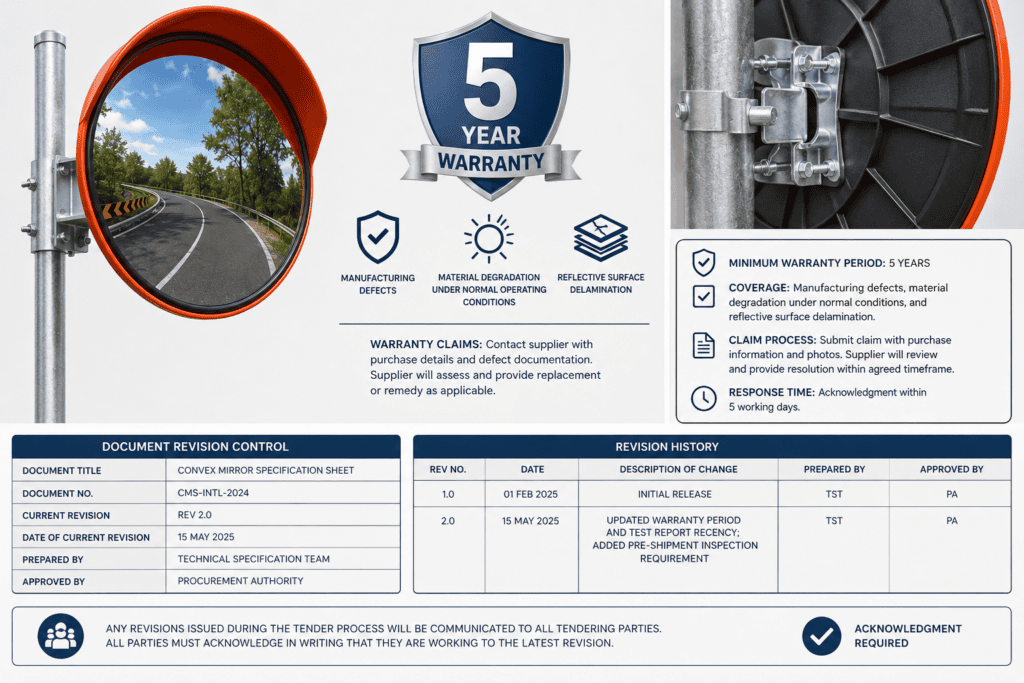
The specification sheet should state the minimum warranty period the supplier must provide, the scope of warranty coverage, and the process for warranty claims. For professional-grade outdoor convex traffic mirrors, a minimum warranty of three years against manufacturing defects, material degradation under normal operating conditions, and reflective surface delamination is a reasonable standard. Five-year warranty coverage is increasingly common in international infrastructure tenders for high-traffic road safety applications.
Document Revision Control
A professionally prepared specification sheet includes a document control section at the front or footer of the document. This section records the document title, the current revision number, the date of the current revision, the author, and the approving authority. Revision control ensures that both the buying authority and all tendering suppliers are working from the same version of the specification at any point in the tender process.
Any mid-tender revision to the specification must be issued as a formal document with an incremented revision number, communicated to all tendering parties simultaneously, and acknowledged in writing by each party before the tender closes.
Writing the Specification Sheet: Practical Standards to Follow
The language used throughout a convex mirror specification sheet for international tender submission should be directive, precise, and free of subjective descriptors. Use phrases such as “the product shall comply with,” “the supplier shall provide,” and “the mirror shall achieve a minimum reflectance of.” Avoid language like “good quality,” “weather-resistant where necessary,” or “appropriate materials.”
Where international standards are referenced, cite the full standard number and edition. Where a performance requirement is stated as a minimum threshold, ensure that the threshold is verifiable through a defined test method. Every requirement in the specification sheet should answer the question: how will the buying authority verify that this requirement has been met?
A convex mirror specification sheet written to these standards does more than satisfy a tender requirement. It builds the supplier’s credibility, reduces the risk of post-delivery disputes, and creates a documented basis for the product’s performance expectations that protects both parties throughout the contract period.
Looking for a custom convex mirror manufacturer or supplier? Struggling to find the right factory to bring your vision to life? We’ve got you covered! At our place, we craft top-quality convex mirrors with precision and care. Big or small, your needs are our mission. Let’s launch your mirror project and take your product line to the next level! Click here to contact