
Sourcing convex mirrors in bulk is not simply a matter of finding the lowest price per unit. For procurement managers, facility operators, road safety distributors, and infrastructure contractors, a bulk purchase agreement represents a significant financial and operational commitment. The wrong supplier can deliver products that degrade within months, fail compliance audits, or arrive so inconsistently that your project timelines collapse.
This guide walks through every critical factor B2B buyers must evaluate before committing to a convex mirror supplier at volume. Whether you are sourcing outdoor convex traffic mirrors for municipal road projects, polycarbonate safety mirrors for warehouse networks, or stainless steel convex mirrors for coastal installations, the evaluation process follows the same core principles.
Why Supplier Evaluation Matters More Than Price in Bulk Convex Mirror Procurement
When buyers search for a convex mirror supplier, the first filter is almost always price. And while unit cost is an important variable, it is rarely the deciding factor in a successful long-term procurement relationship. A convex mirror that costs 15% less but requires replacement after 18 months instead of 5 years will cost your organization significantly more over its lifecycle.
Bulk purchase agreements for convex mirrors typically involve quantities ranging from 100 units on the low end to tens of thousands of units for large infrastructure rollouts. At that scale, every weakness in the supplier relationship is multiplied across every unit delivered.
1. The Real Cost of a Poor Supplier Relationship
Quality failures in convex mirror procurement tend to cluster around a few consistent problems: mirror surfaces that yellow or cloud under UV exposure within the first year, mounting hardware that corrodes in outdoor conditions, reflective coatings that delaminate in high-humidity environments, and curvature inconsistencies that compromise the wide-angle field of view the mirror is supposed to provide.
Each of these failures creates downstream costs that dwarf the initial savings from choosing a cheaper wholesale convex mirror supplier. Replacement logistics, project downtime, warranty disputes, and potential liability exposure from safety-related incidents all factor into the true procurement cost.
2. Why B2B Buyers Need a Structured Evaluation Framework
Most procurement teams evaluate suppliers through informal processes: browsing product listings, requesting a quotation, reviewing a few sample photos, and making a decision. This approach works for low-stakes purchases. For bulk convex mirror orders, it leaves too much to chance.
A structured evaluation framework ensures that every supplier is assessed against the same criteria, that no critical factor is overlooked under time pressure, and that the final agreement protects your organization if the supplier underperforms.
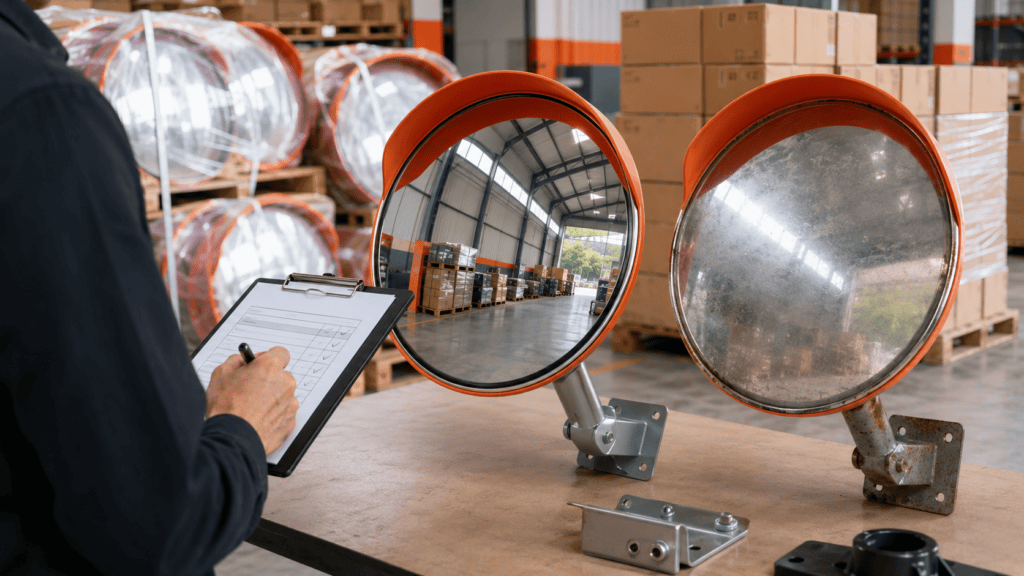
Manufacturing Capability and Production Capacity
Before evaluating product quality, you need to understand whether the convex mirror manufacturer you are considering can actually handle your order volume reliably and on schedule.
3. Factory Verification and On-Site Audits
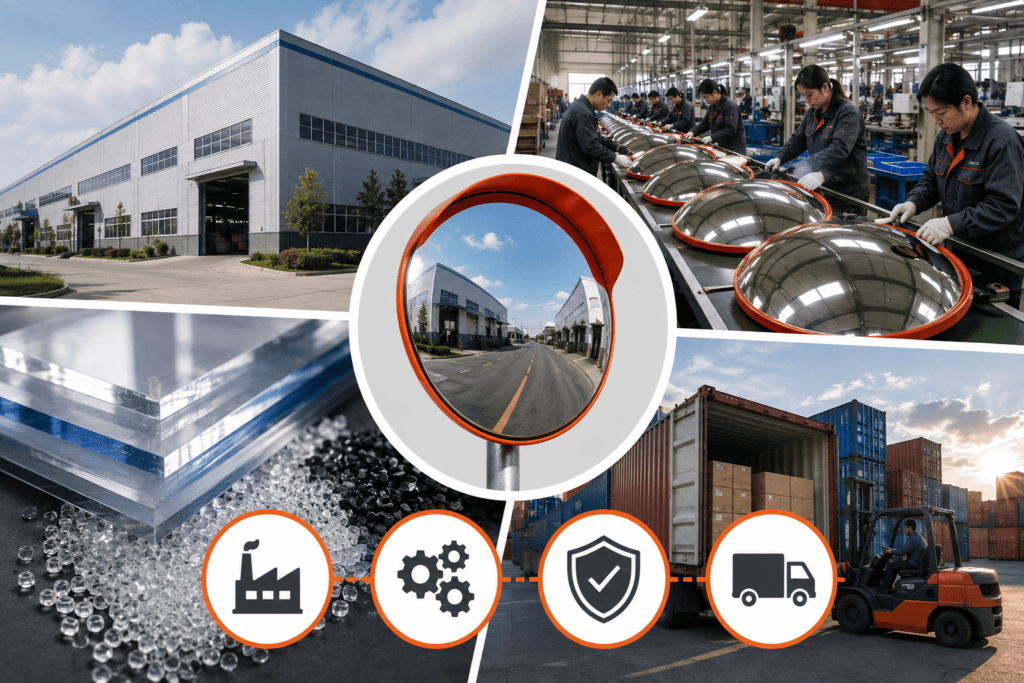
Legitimate convex mirror manufacturers will welcome factory audits, either in person or through a third-party inspection firm. A factory audit for a convex mirror supplier should cover production line capacity, raw material sourcing and storage practices, quality control checkpoints during manufacturing, and how defective units are identified and handled.
For buyers sourcing from convex mirror manufacturers in China, third-party audit firms operating in major manufacturing hubs such as Shanghai, Zhejiang, and Guangdong can conduct thorough facility assessments at reasonable cost. This step is non-negotiable for any bulk order exceeding 500 units.
4. Monthly Production Capacity vs. Your Order Timeline
One of the most common problems in bulk convex mirror procurement is a mismatch between the supplier’s stated production capacity and their actual throughput. Ask for documented monthly output figures, not verbal assurances. A supplier claiming a monthly production capacity of 30,000 units should be able to provide verifiable export records or production logs to support that claim.
Cross-reference the supplier’s capacity against your delivery schedule. If you need 10,000 outdoor convex traffic mirrors delivered across three shipments over four months, confirm that the supplier can fulfill each shipment without deprioritizing your order in favor of a larger client.
5. Raw Material Supply Chain Stability
The quality of a convex mirror is directly tied to the quality of its raw materials. Polycarbonate (PC) and PMMA acrylic are the two dominant lens materials in the market. Both are subject to commodity price fluctuations and supply chain disruptions. Ask your prospective convex mirror supplier where they source their PC or acrylic sheet material, whether they maintain buffer stock, and how they handle raw material shortages mid-production.
A supplier that sources materials exclusively from a single domestic provider is more vulnerable to supply disruptions than one with diversified procurement relationships.
Product Quality Standards and Certification Requirements
Quality in convex mirror manufacturing is measurable. There are established standards and testable specifications that separate professional-grade products from commodity imports.
6. ISO Certification and Quality Management Systems
ISO 9001 certification is the baseline quality management standard you should require from any convex mirror manufacturer you consider for a bulk purchase agreement. ISO 9001 certification means the supplier has documented processes for quality control, traceability, and continuous improvement.
Beyond ISO 9001, look for product-specific certifications relevant to your target market. CE marking is required for products sold within the European Union. Products destined for North American markets may need to comply with ASTM standards for impact resistance and UV stability. Municipal procurement in many countries requires suppliers to provide certified test reports, not just compliance claims.
7. Material and Optical Performance Testing
A convex safety mirror is only as effective as its optical clarity and curvature precision. Before finalizing a bulk purchase agreement, request documented results from the following tests:
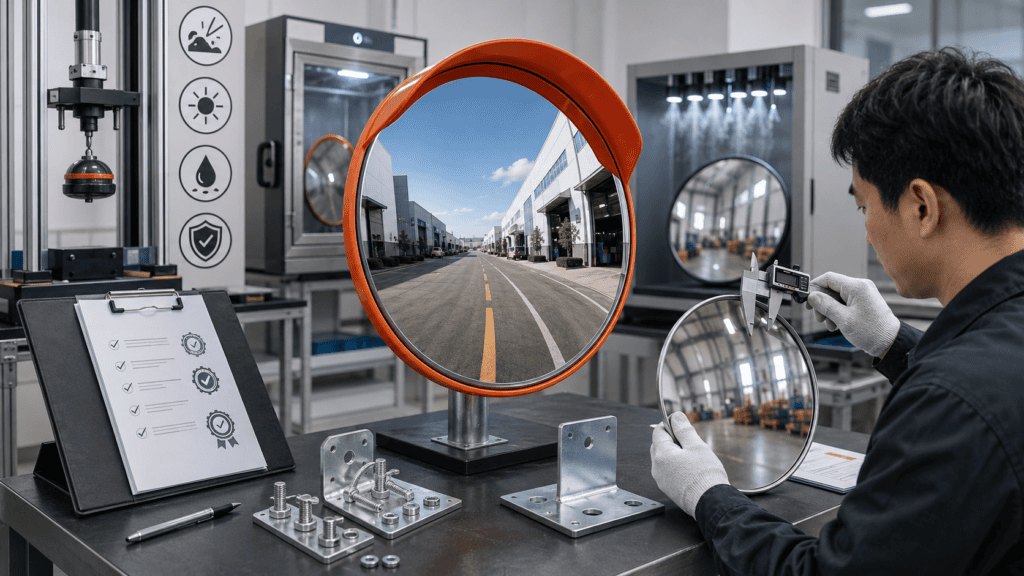
Impact resistance testing confirms that the mirror lens can withstand the mechanical stress of outdoor installation and incidental contact without shattering into dangerous fragments. UV stability testing confirms that the reflective surface and lens material will not yellow, cloud, or degrade under prolonged sun exposure. Weatherproof rating testing confirms that the mirror housing and backing can withstand rain, humidity, and temperature cycling without warping, cracking, or allowing water ingress.
A reputable ISO certified convex mirror manufacturer will have these test results on file and will share them without hesitation. Suppliers who provide vague responses or redirect to marketing materials rather than actual test documentation are a red flag.
8. Sample Inspection Before Bulk Commitment
No evaluation process is complete without a physical sample inspection. Request production samples, not pre-made showroom units. Production samples are drawn from the same manufacturing process and materials that will produce your bulk order. Showroom units may use higher-grade materials or receive additional finishing that your order will not.
Inspect samples for optical clarity across the entire reflective surface, uniformity of mirror curvature, quality of edge finishing and sealing, bracket and mounting hardware durability, and the security of the connection between lens and backing frame.
Minimum Order Quantities, Pricing Structure, and Contract Terms
Understanding the commercial framework of a bulk convex mirror agreement is as important as understanding the product specifications.
9. Evaluating Minimum Order Quantity Requirements
Minimum order quantity (MOQ) requirements vary significantly among convex mirror suppliers. Some manufacturers set MOQs as low as 50 to 100 units for standard sizes, while others require 500 or more units per SKU before they will accept an order. For B2B buyers placing a first-time bulk order with a new supplier, starting at or near the MOQ allows you to validate product quality and supplier reliability before committing to a full-scale volume order.
Be cautious of suppliers that aggressively push you toward the largest possible order quantity on the first engagement. A reputable wholesale convex mirror supplier understands the value of building a long-term relationship and will accommodate a phased approach.
10. Price Tiering and Long-Term Agreement Discounts
Most convex mirror manufacturers offer tiered pricing based on order volume. The unit price typically decreases meaningfully between 100-unit, 500-unit, and 1,000-unit thresholds. Before signing a bulk purchase agreement, understand the full pricing structure and negotiate price protection clauses for future orders.
If you anticipate recurring orders, a framework agreement or blanket purchase order can lock in pricing for a defined period, protecting your procurement budget from raw material price increases.
11. Contract Terms: What Must Be Specified Before Signing
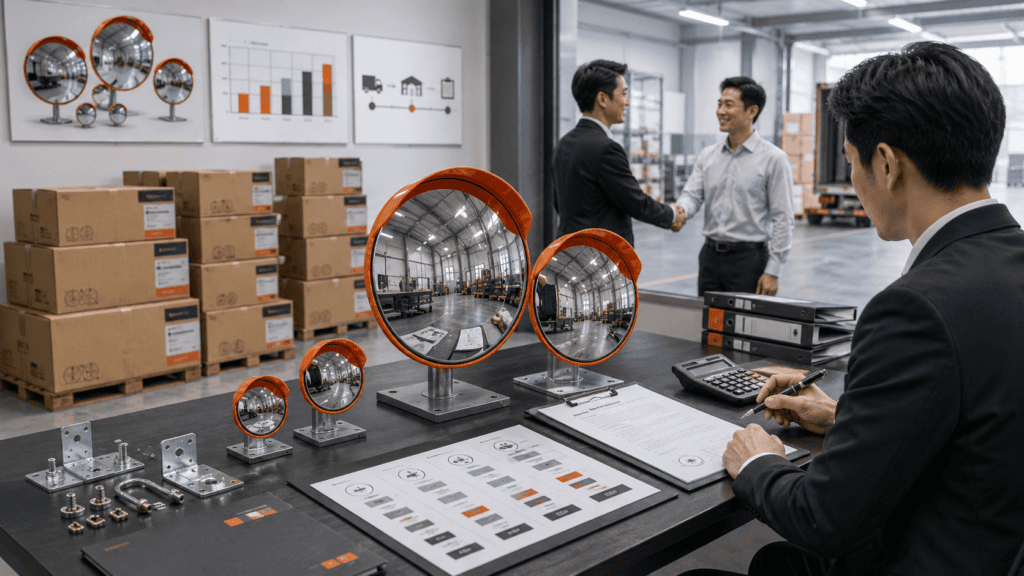
A bulk purchase agreement for convex mirrors should specify product specifications in precise technical terms, including mirror diameter, lens material, reflective surface type, UV resistance rating, and mounting hardware configuration. The agreement must also define acceptable defect rates and the process for handling non-conforming units, delivery timelines and penalties for late shipment, warranty coverage including duration and replacement procedures, and the jurisdiction and process for dispute resolution.
Vague contract language around product specifications is one of the most common sources of disputes in international convex mirror procurement. If the agreement refers to product quality in subjective terms without measurable benchmarks, insist on revision before signing.
After-Sales Support and Long-Term Supplier Reliability
A supplier relationship does not end at delivery. The strongest bulk purchasing agreements are built on suppliers who provide ongoing support across the lifecycle of the product.
12. Warranty Terms and Replacement Logistics
Standard warranty coverage for outdoor convex mirrors from reputable manufacturers ranges from two to five years depending on the product category and operating environment. Confirm that the warranty covers manufacturing defects, material degradation under normal use conditions, and surface delamination. Understand whether warranty claims require you to return defective units at your cost or whether the supplier covers replacement logistics.
13. Technical Support and Application Guidance
For buyers deploying convex mirrors across complex environments such as multi-level parking structures, industrial facilities, or public road infrastructure, supplier technical support is a genuine value-add. A knowledgeable supplier should be able to advise on appropriate mirror sizes for specific viewing distances, optimal mounting heights and angles for different applications, and material selection for challenging environmental conditions.
14. Assessing Supplier Communication and Responsiveness
Responsiveness before the order is a reliable indicator of responsiveness after it. During the supplier evaluation phase, note how quickly inquiries are answered, how complete and accurate the responses are, and whether technical questions receive substantive answers or generic deflections. Suppliers who respond to sample requests, certification queries, and contract questions within 24 hours and with specificity are demonstrating the operational culture that will support your account after the purchase agreement is signed.
Making the Final Decision
Evaluating convex mirror suppliers before signing a bulk purchase agreement requires discipline, preparation, and a willingness to walk away from a supplier who cannot meet your standards, regardless of their pricing. The goal is not simply to find a convex mirror supplier. The goal is to find a convex mirror manufacturer capable of delivering consistent, certified, durable products at the agreed volume, timeline, and price, and backing those products with warranty and support.
Build your evaluation around verified manufacturing capacity, certified product quality, transparent commercial terms, and demonstrated after-sales commitment. Those four pillars will consistently identify the suppliers worth trusting with a long-term bulk purchase agreement, and protect your organization from the costly mistakes that come from skipping the evaluation process.
Looking for a custom convex mirror manufacturer or supplier? Struggling to find the right factory to bring your vision to life? We’ve got you covered! At our place, we craft top-quality convex mirrors with precision and care. Big or small, your needs are our mission. Let’s launch your mirror project and take your product line to the next level! Click here to contact