
Blind spots cost businesses money. In some cases, they cost lives. For facility managers, safety compliance officers, logistics operators, and procurement teams, a pole-mounted safety mirror is one of the most practical, immediately deployable tools available for eliminating dangerous sightline obstructions across commercial and industrial environments.
But choosing the wrong mirror on a pole, whether it is undersized for the viewing distance, made from the wrong material for the environment, mounted at the wrong height, or paired with inadequate pole hardware, means the mirror fails to deliver the safety outcome it was purchased to provide. At best that is a wasted procurement budget. At worst it is a gap in safety coverage that leads to an incident.
This guide is written for B2B buyers, facilities contractors, safety equipment distributors, and EHS managers who need a structured, practical framework for selecting the right pole-mounted convex safety mirror for every application. From mirror size and material to pole specification, mounting height, bracket type, and compliance requirements, every key variable is covered here.
“Sizing the hazard, the viewing distance, and the mounting condition before focusing on part numbers is the correct sequence for any pole-mounted safety mirror procurement decision.”
What Is a Mirror on a Pole and Where Is It Used
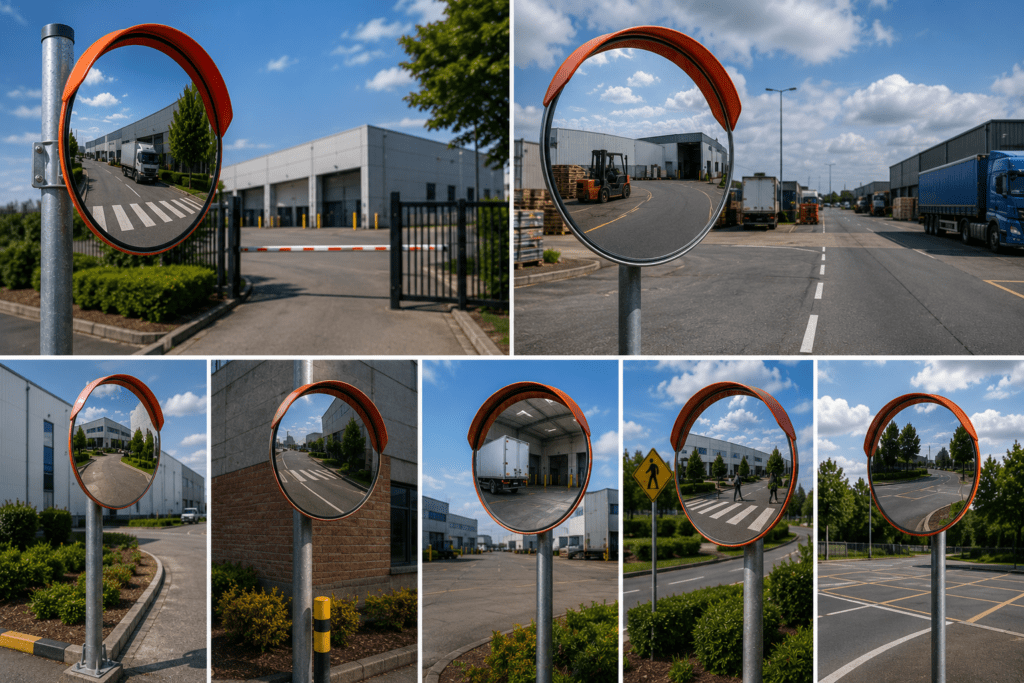
A mirror on a pole, more formally known as a pole-mounted convex traffic mirror or post-mounted road safety mirror, is a wide-angle reflective mirror fixed to a vertical post installed at a location where sightlines are obstructed and natural visibility is insufficient for safe vehicle or pedestrian movement.
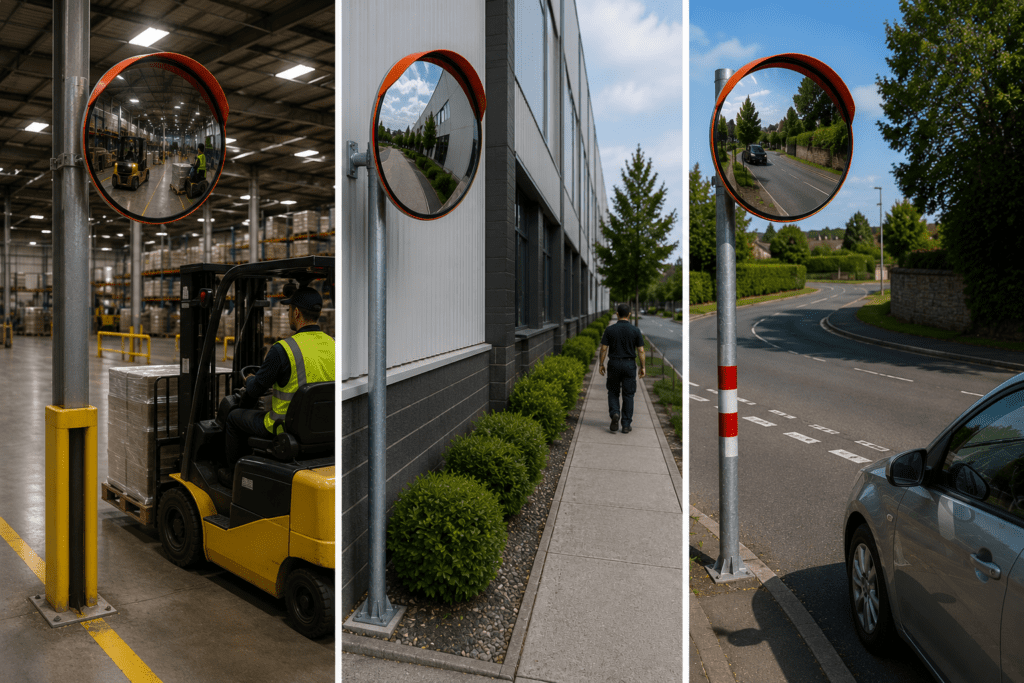
Pole mounting is the preferred installation method when there is no suitable wall, building face, or fence structure close enough to the required mirror position to allow wall-bracket mounting. It is also the standard configuration for roadside traffic mirror installations, driveway exit mirrors on open boundaries, and internal facility junction mirrors where the mirror needs to be positioned in open space rather than against a surface.
Common applications for pole-mounted convex safety mirrors in B2B environments include:
- Driveway exit mirrors at commercial and industrial facility entrances onto public roads
- Internal road junction mirrors within logistics yards, manufacturing campuses, and industrial estates
- Blind corner mirrors at building perimeter corners where vehicles turn onto site roadways
- Loading dock approach mirrors positioned in open yard areas
- Pedestrian crossing point mirrors at internal facility road intersections
- Public road junction mirrors installed by local authorities and municipal contractors
Key Selection Factors for Pole-Mounted Safety Mirrors
Selecting the right pole-mounted safety mirror for a commercial or industrial application requires a structured assessment across six key variables. Working through each of these in sequence before engaging with product catalogues or supplier quotations ensures the specification is driven by the hazard and the environment rather than by product availability or default purchasing habits.
The Six Key Selection Factors
1. Mirror Size and Viewing Distance
The single most common procurement error in pole-mounted safety mirror selection is choosing a mirror that is too small for the required viewing distance. A mirror that does not provide adequate image size at the distance from which it will be viewed fails to deliver the safety benefit it was installed to provide.
a. The Viewing Distance Rule
The viewing distance is the distance between the mirror and the position from which drivers or pedestrians will be looking at it. This is not the distance between the mirror and the hazard it is reflecting. It is the distance between the mirror and the viewer.
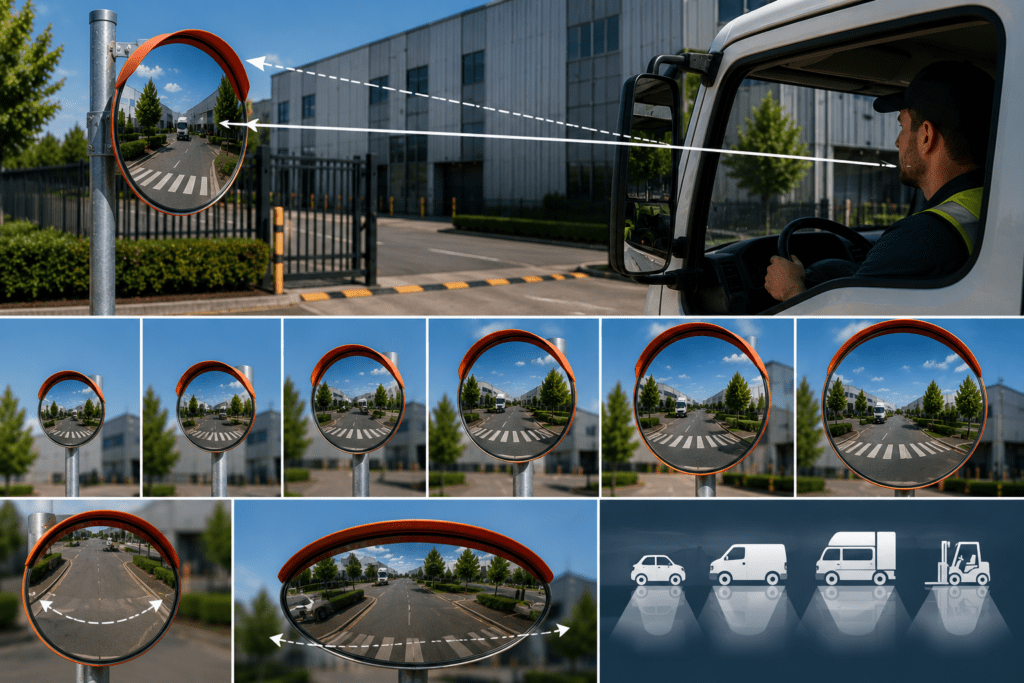
The standard sizing guide for pole-mounted convex road safety mirrors maps mirror diameter to effective viewing distance as follows:
- 12-inch pole-mounted convex mirror: effective up to approximately 18 feet of viewing distance
- 18-inch pole-mounted safety mirror: effective up to approximately 27 feet
- 24-inch outdoor pole-mounted traffic mirror: effective up to approximately 36 feet
- 30-inch pole-mounted convex mirror for commercial driveways: effective up to approximately 45 feet
- 36-inch pole-mounted road safety mirror: effective up to approximately 55 feet
- 48-inch large pole-mounted convex mirror for industrial sites: effective for viewing distances of 65 feet or more
b. Commercial and Industrial Size Recommendations
For most commercial facility driveway exits and internal road junction applications, 30-inch to 36-inch pole-mounted convex mirrors are the standard specification. Smaller mirrors are frequently under-specified for commercial viewing distances and provide an inadequate reflected image for drivers of larger vehicles including trucks, vans, and forklifts.
For public road junction mirrors and larger industrial site applications where viewing distances exceed 50 feet, 36-inch to 48-inch pole-mounted outdoor safety mirrors are the appropriate starting point for specification.
c. Wide-Angle Field of View Requirements
Standard convex pole-mounted safety mirrors provide a field of view of approximately 130 to 160 degrees depending on the curvature of the lens. For T-intersection driveway exits where drivers need to check traffic in both directions, a two-way pole-mounted driveway mirror providing 180-degree coverage is more effective than a single standard convex mirror covering only one direction.
2. Mirror Material for the Installation Environment
The installation environment determines the correct mirror material. For pole-mounted outdoor safety mirrors, which by definition are exposed to outdoor conditions, material selection significantly affects service life, maintenance requirements, and total cost of ownership.
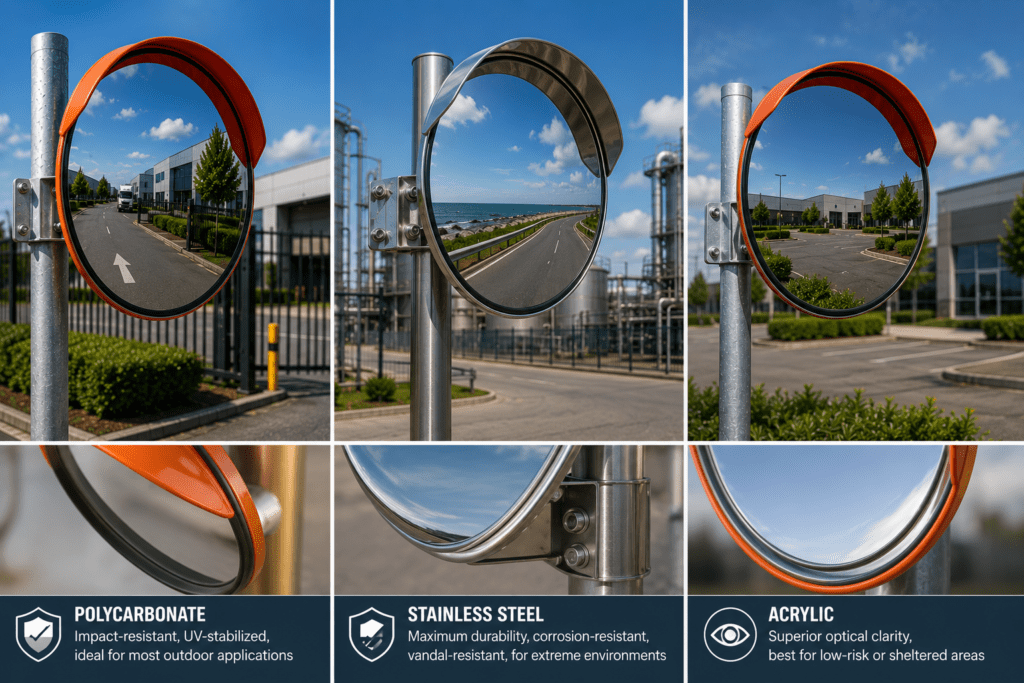
a. Polycarbonate Pole-Mounted Mirrors
UV-stabilized polycarbonate is the standard material specification for most commercial and industrial pole-mounted outdoor convex safety mirrors. It delivers a service life of 8 to 10 years in standard outdoor environments, provides adequate impact resistance for most commercial applications, and represents the best balance of performance and cost for the majority of non-extreme outdoor installations.
Polycarbonate pole-mounted traffic mirrors are the correct specification for commercial property driveway exits, logistics facility road junctions, retail park safety mirrors, school zone driveway mirrors, and standard municipal road junction installations.
b. Stainless Steel Pole-Mounted Mirrors
Grade 304 or grade 316 stainless steel pole-mounted convex mirrors are the correct specification for demanding environments where polycarbonate would degrade prematurely or be subject to vandalism damage. Stainless steel delivers service lives of fifteen or more years, is inherently UV-resistant, and provides exceptional resistance to vandalism, corrosion, and physical impact.
Grade 316 stainless steel pole-mounted outdoor traffic mirrors should be specified for coastal locations, salt-spray environments, chemical processing facility access roads, food manufacturing site driveways, and any high-vandalism location where plastic lens mirrors would be at risk of defacement or damage.
c. Acrylic Pole-Mounted Mirrors
Acrylic pole-mounted safety mirrors offer the highest optical clarity of the available material options but are less impact-resistant than polycarbonate and more susceptible to UV degradation without proper stabilization treatment. They are appropriate for lower-risk, sheltered, or moderate-exposure outdoor pole-mounted applications where image clarity is prioritized and environmental stressors are not severe.
3. Pole Specification and Hardware
The pole itself is a critical component of any pole-mounted safety mirror installation. An under-specified pole creates structural failure risk under wind load, creates a safety hazard of its own, and may void any compliance certification that applies to the installation.
a. Pole Diameter and Material
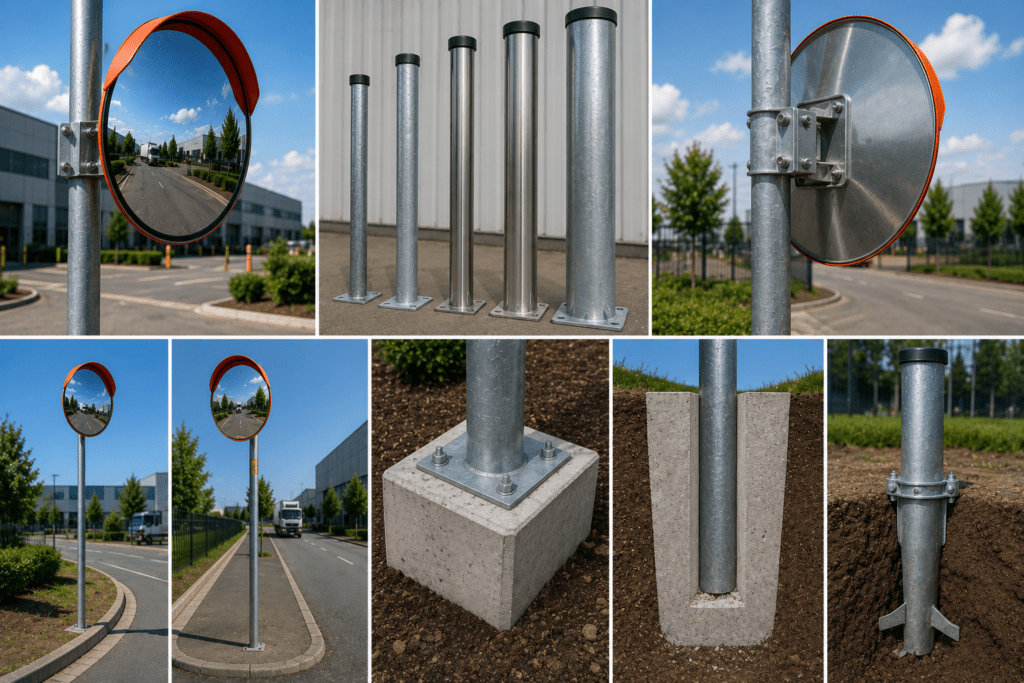
Pole-mounted convex safety mirrors are most commonly installed on round galvanized steel poles with diameters ranging from 48mm to 76mm depending on the size and weight of the mirror and the wind exposure of the installation location. Galvanized steel is the standard pole material for outdoor traffic mirror installations because it combines structural rigidity with corrosion resistance at a cost-effective price point.
For coastal environments and chemical processing facility installations, stainless steel or hot-dip galvanized poles are the preferred specification to match the corrosion resistance of grade 316 stainless steel mirror units.
b. Pole Height
The mounting height of a pole-mounted safety mirror directly affects its effectiveness. A mirror mounted too low is ineffective for drivers of larger vehicles and may be obscured by vegetation or parked vehicles. A mirror mounted too high reduces the quality of the reflected image and may create viewing angle problems.
The generally recommended mounting height for pole-mounted outdoor convex road safety mirrors is between 2 and 3 metres from ground level to the centre of the mirror. For sites where heavy goods vehicles are the primary user, mounting heights at the upper end of this range or slightly above are advisable to ensure adequate sightline for truck cab driver eye levels.
c. Pole Foundation and Ground Fixing
For permanent pole-mounted safety mirror installations, the pole foundation is a critical structural element. Standard practice for galvanized steel poles supporting outdoor convex mirrors involves either a concrete ground socket installation or a ground-driven anchor post system depending on ground conditions.
Concrete socket installation involves setting a steel ground socket in a concrete footing poured to a depth appropriate for the soil conditions and wind load requirements of the location. The mirror pole then inserts into and bolts through the socket. This method provides the most robust and permanent foundation for pole-mounted safety mirrors in high-traffic or high-wind locations.
Ground-driven anchor posts are a faster and lower-cost installation option suitable for lower wind exposure locations and softer soil conditions. They are not appropriate for hard-standing, paved, or concrete surfaces or for locations with significant wind load exposure.
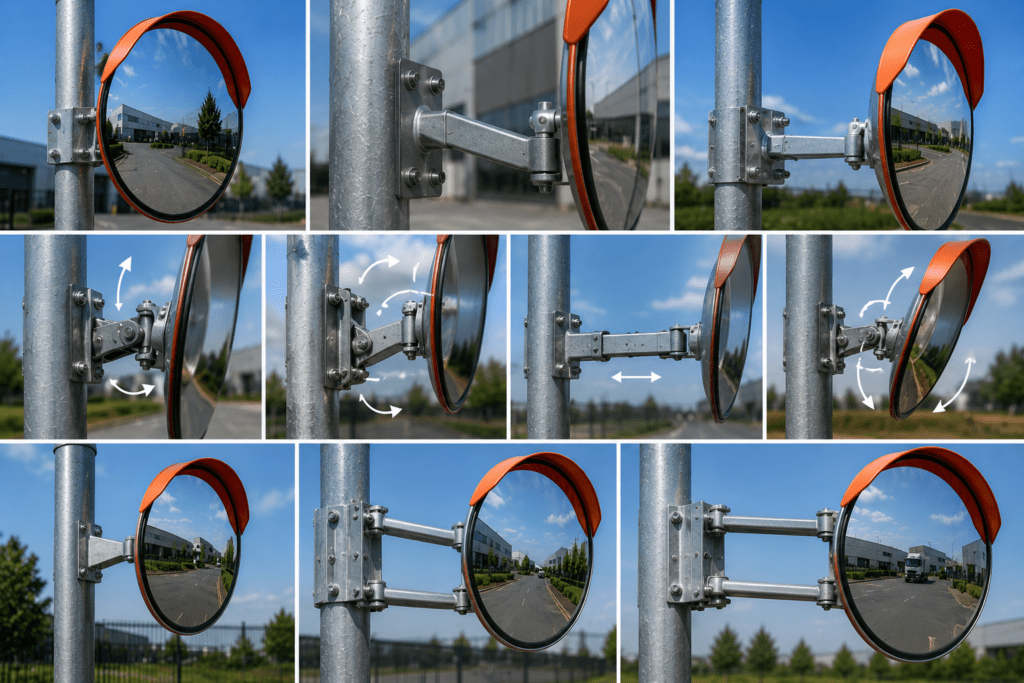
4. Bracket Type and Adjustability
The bracket connecting the mirror to the pole is the component that determines the mirror’s final viewing angle and, in the case of adjustable brackets, the ability to optimize that angle after installation.
a. Fixed Bracket Pole-Mounted Mirrors
Fixed bracket configurations provide a set mounting angle between the mirror face and the pole. These are appropriate for installations where the required viewing angle is clearly defined and unlikely to need adjustment after installation. Fixed bracket pole-mounted safety mirrors are simpler, lower in cost, and less susceptible to loosening or misalignment over time than adjustable alternatives.
b. Adjustable Bracket Pole-Mounted Mirrors
Adjustable bracket pole-mounted convex safety mirrors allow the mirror angle to be modified after installation. This is particularly valuable for:
- Sites where the precise required viewing angle is difficult to determine before installation
- Locations where seasonal vegetation growth may require mirror angle adjustment
- Facilities with changing traffic patterns or new hazard zones that affect required mirror coverage
- Multi-site safety programs where standardized mirror units are installed across varied site layouts
Telescoping adjustable bracket systems that extend the mirror reach away from the pole as well as adjusting the vertical and horizontal angle provide the maximum installation flexibility. These are the preferred bracket specification for pole-mounted safety mirror programs covering multiple varied site configurations.
c. Single-Arm Versus Double-Arm Brackets
Single-arm brackets extend the mirror from one side of the pole and are appropriate for most standard pole-mounted convex mirror installations. Double-arm brackets, which support the mirror from two bracket arms rather than one, provide additional structural stability and are specified for larger, heavier mirrors (36-inch and above) and high-wind exposure locations where single-arm bracket structural integrity may be a concern under load.
5. Positioning and Placement
The physical position of the pole and mirror within the installation environment is as important as the product specification itself. A correctly specified mirror positioned in the wrong location delivers poor safety outcomes regardless of its quality.
a. Mirror Placement Relative to the Hazard
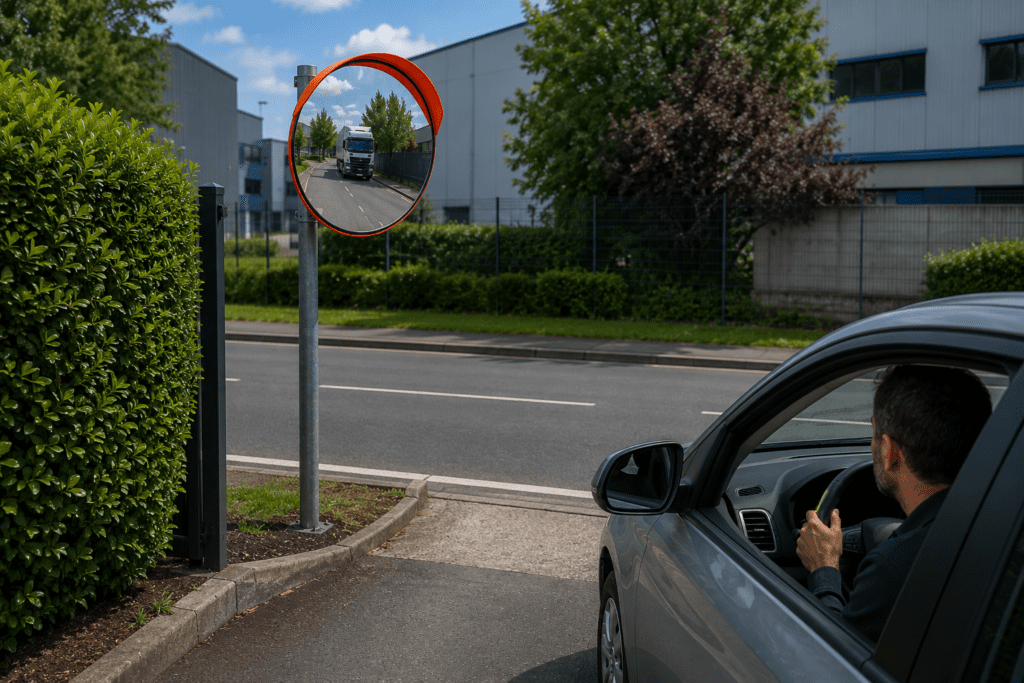
For driveway exit mirrors, the pole-mounted safety mirror should be positioned on the opposite side of the road or traffic lane from the exit point, angled back toward the exit so that a driver approaching the exit point can see the reflected image of approaching traffic in the mirror before reaching the give-way or stop line.
The mirror should be positioned far enough from the exit point that a driver waiting at the give-way line can see the full required field of reflected view. If the mirror is too close to the exit, drivers have to move partially into the traffic lane to see the reflection, defeating the safety purpose of the installation.
b. Viewing Angle Optimization
The mirror face should be angled so that the centre of the reflected image covers the primary hazard zone, with the wide-angle field of view capturing the broader surrounding area. For a driveway exit mirror, the centre of the reflected image should show the road in the direction of approaching traffic at the typical viewing distance of a vehicle waiting at the give-way line.
c. Avoiding Obstruction of the Mirror Itself
Pole-mounted safety mirrors installed in outdoor environments need clear sightlines from the viewer position to the mirror face. Vegetation, signage, parked vehicles, and site furniture can all obstruct either the driver’s view of the mirror or the mirror’s reflection of the hazard area. Site assessment before finalizing pole position should include checking for existing and potential future obstructions across all seasons, including summer vegetation growth that may not be present at the time of installation.
6. Compliance and Safety Standards
For B2B procurement managers and EHS officers, compliance with relevant safety standards is a non-negotiable element of any pole-mounted safety mirror specification.
a. OSHA Requirements for Workplace Pole-Mounted Mirrors
In warehouse, logistics, and manufacturing environments, OSHA’s General Duty Clause requires employers to implement engineering controls to eliminate recognized hazards. Pole-mounted convex safety mirrors at internal road junctions and pedestrian crossing points qualify as engineering controls for vehicle-pedestrian collision hazard mitigation. OSHA-compliant pole-mounted safety mirrors for industrial facilities should be sized appropriately for the viewing distance, positioned to cover the specific hazard zone identified in the site risk assessment, and maintained in serviceable condition with periodic inspection.
b. ADA Protruding Object Provisions
For pole-mounted safety mirrors installed in locations that intersect with pedestrian circulation routes, the ADA protruding object provisions require that objects mounted between 27 inches and 80 inches above walking surfaces must not project more than 4 inches into circulation paths. Pole-mounted mirror brackets that extend the mirror significantly beyond the pole footprint in pedestrian areas should be evaluated against this requirement.
c. MUTCD Visibility Principles for Road Junction Mirrors
For pole-mounted traffic mirrors at public road junctions, the Manual on Uniform Traffic Control Devices provides a compliance framework covering conspicuity, retroreflectivity, size adequacy for the viewing distance, and maintenance obligations. Mirrors serving public road traffic control functions should feature high-visibility mounting hardware, reflective striping where required, and maintenance programs ensuring continued optical clarity throughout the service life.
Bulk Procurement Considerations for Pole-Mounted Safety Mirror Programs
For safety equipment distributors, facilities management contractors, and procurement managers sourcing pole-mounted convex safety mirrors at scale across multiple sites, several supply chain factors significantly affect total program value.
Standardizing on a limited range of mirror sizes and materials across a multi-site program simplifies procurement, reduces inventory complexity, and enables volume pricing from wholesale pole-mounted traffic mirror suppliers. For most commercial and industrial multi-site programs, standardizing on 30-inch and 36-inch UV-stabilized polycarbonate pole-mounted convex mirrors with galvanized steel pole hardware covers the majority of installation requirements.
Suppliers offering complete pole-mounted mirror kits including mirror, pole, bracket, and ground fixing hardware as a packaged product reduce site-level procurement complexity and ensure hardware compatibility across all components. For large-scale pole-mounted safety mirror deployment programs, this system supply approach is significantly more efficient than sourcing mirror, pole, and hardware components separately from different suppliers.
Conclusion: A Structured Approach to Pole-Mounted Safety Mirror Selection
Choosing the right mirror on a pole for safety purposes is not a single product decision. It is a structured specification exercise that starts with understanding the hazard, the viewing distance, and the installation environment, and works through mirror size, material, pole hardware, bracket configuration, positioning, and compliance requirements before arriving at a product specification.
For B2B procurement teams and EHS managers, working through each of the six key selection factors covered in this guide transforms what can appear to be a simple purchasing decision into a repeatable, defensible specification process that delivers consistent safety outcomes across facilities of any size and complexity.
Get the specification right, and a pole-mounted convex safety mirror delivers years of reliable blind spot elimination at a total cost of ownership that makes it one of the most efficient safety investments available to commercial and industrial facility operators.
Looking for a custom convex mirror manufacturer or supplier? Struggling to find the right factory to bring your vision to life? We’ve got you covered! At our place, we craft top-quality convex mirrors with precision and care. Big or small, your needs are our mission. Let’s launch your mirror project and take your product line to the next level! Click here to contact