
Winning a municipal traffic cone contract is not the same as winning a commercial sale. The evaluation process that a city, county, or public works department applies to traffic cone suppliers operates under a completely different logic than a private sector purchasing decision. Price matters, but it operates within a framework of compliance requirements, documentation standards, vendor qualification criteria, and accountability mechanisms that have no equivalent in commercial procurement.
For traffic cone manufacturers and distributors seeking to supply public sector clients, understanding how municipalities evaluate and approve suppliers is not optional background knowledge. It is the foundational competence that determines whether a supplier can participate in the process at all, let alone win the contract. This article explains the municipal procurement process for traffic safety equipment from the supplier’s perspective, covering how evaluation criteria are structured, what compliance documentation is required, how vendor qualification works, and what separates suppliers who consistently win public contracts from those who consistently do not.
How Municipal Procurement Differs From Commercial Purchasing
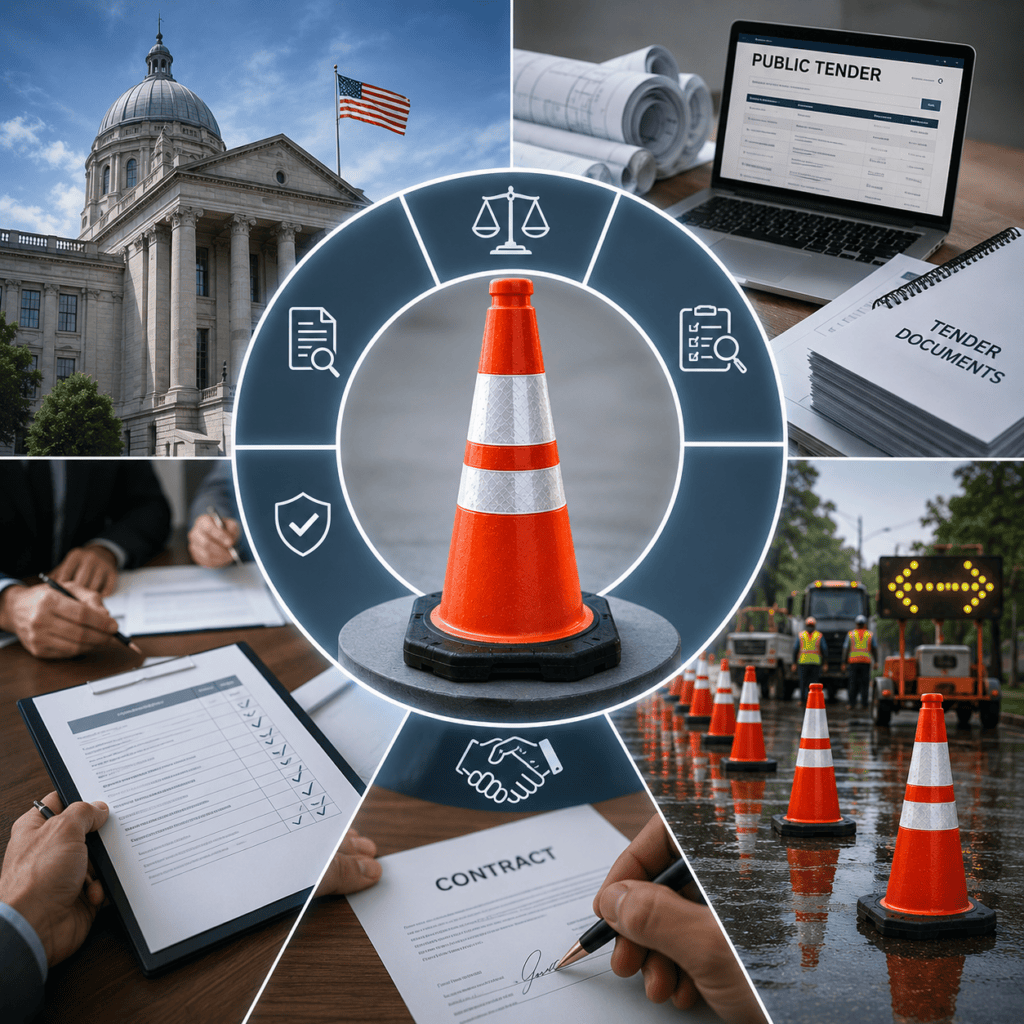
The most important thing a traffic cone supplier entering the municipal market for the first time needs to understand is that public procurement is governed by law, not preference. Every stage of the process, from how the requirement is defined and published to how bids are evaluated and how the contract is awarded, must comply with the statutory procurement framework of the relevant jurisdiction. In the United States, this means compliance with state procurement codes, city or county purchasing ordinances, and federal requirements for any project receiving federal highway funding. In the European Union, it means compliance with the EU Public Procurement Directives transposed into national law. In other markets, equivalent national or regional frameworks apply.
This legal foundation has two practical consequences for traffic cone suppliers. First, the evaluation criteria applied to supplier bids must be defined in advance, applied consistently to all bidders, and documented in a way that can withstand scrutiny from unsuccessful bidders and oversight bodies. A procurement officer cannot simply choose the supplier they prefer. They must award the contract to the bidder who scores highest against the pre-defined criteria, or justify any departure from that outcome in documented terms. Second, suppliers who do not meet the mandatory minimum requirements defined in the tender documents are disqualified before evaluation begins, regardless of their pricing or relationships. Compliance documentation is not a formality. It is the gate through which a supplier must pass before their bid is considered on its merits.
The Pre-Qualification Stage: What Municipalities Screen For First
Most municipal procurement processes for traffic safety equipment, including traffic cones, involve a pre-qualification or mandatory minimum requirements stage before competitive evaluation begins. Some municipalities conduct this as a formal pre-qualification exercise ahead of the tender, building an approved vendor list from which all future traffic cone orders are placed. Others embed mandatory minimum requirements within individual tender documents, disqualifying bids that do not satisfy all mandatory criteria before scoring the remaining submissions.
Business Registration and Financial Standing
The baseline pre-qualification requirement for any public contract supplier is proof of legitimate business registration in the relevant jurisdiction, or evidence of the right to do business there as a foreign entity. For traffic cone suppliers based outside the municipality’s country, this may require registration with the relevant trade or commerce authority, proof of an established business entity rather than a trading arrangement, and in some jurisdictions, a local agent or representative with formal standing to bind the supplier contractually.
Financial standing requirements are applied to filter out suppliers whose financial position creates a risk of contract non-performance. Municipal procurement bodies typically require audited financial statements for the most recent two to three financial years, evidence of adequate credit lines or bonding capacity to finance the order through production and delivery, and in some cases a minimum annual revenue threshold relative to the contract value being tendered.
Safety Record and Past Performance
Many municipalities require traffic cone suppliers to provide a documented safety record and verifiable references from comparable public sector contracts. This is particularly common in jurisdictions where the purchasing authority has previously experienced delivery failures, product non-conformance, or safety incidents attributed to substandard equipment. A supplier with no public sector track record is not automatically disqualified, but they must typically provide alternative evidence of organizational capability, such as references from large private sector clients, third-party quality audit results, or independent certification of their manufacturing and quality management processes.
Product Compliance: The Non-Negotiable Foundation
Before any commercial evaluation begins, the traffic cones being offered must meet the applicable product compliance standards for the jurisdiction in which they will be deployed. This is the area where the largest proportion of supplier disqualifications occur in municipal traffic cone procurement, and it is the area where preparation and documentation are most critical.
MUTCD Compliance in the United States
In the United States, the Manual on Uniform Traffic Control Devices (MUTCD), published by the Federal Highway Administration, is the governing standard for traffic control devices used on any road open to public travel. The 11th Edition of the MUTCD, released in December 2023, must be adopted by all states as their legal standard, with state supplements permitted where additional local requirements apply.
For traffic cones, MUTCD compliance covers minimum height requirements by road speed category, retroreflective sleeve specifications for nighttime and low-visibility use, and colour requirements. Specifically, cones used in work zones on roads with speeds above 70 kilometres per hour must be at least 70 centimetres tall. Nighttime use on roads above 70 kilometres per hour requires retroreflective collars meeting defined minimum dimensions and reflectivity values. Municipal procurement documents for traffic cones used in road work applications will specify MUTCD compliance as a mandatory requirement, and suppliers must provide evidence that their products meet the applicable edition of the MUTCD, including any state-specific supplements relevant to the purchasing jurisdiction.
NCHRP-350 and MASH Crashworthiness Standards
Beyond MUTCD dimensional and reflectivity compliance, traffic cones used in federally funded highway work zones in the United States must meet crashworthiness standards established by the National Cooperative Highway Research Program (NCHRP-350) or its successor standard, the Manual for Assessing Safety Hardware (MASH). These standards govern how traffic control devices perform when struck by vehicles, ensuring that cones do not create secondary hazards to vehicle occupants or road workers when impacted.
Suppliers seeking to supply traffic cones for federally funded municipal road projects must be able to demonstrate that their products carry NCHRP-350 or MASH crashworthiness approval from an accredited testing laboratory. This approval is product-specific, meaning that approval for one cone model does not extend to variants or size configurations that have not been independently tested and approved. Municipal procurement documents for highway and arterial road applications will list crashworthiness approval as a mandatory compliance requirement, and bids without supporting documentation will be disqualified.
EN 13422 and European Market Standards
For municipalities in European Union member states and associated countries, the applicable standard for traffic cones is EN 13422, which specifies requirements for temporary road traffic signs, including cones used for traffic management and temporary hazard delineation. EN 13422 covers cone dimensions, base weight requirements, retroreflection performance, and resistance to mechanical damage.
CE marking is the conformity declaration mechanism for products sold within the EU single market. Traffic cone suppliers bidding on municipal contracts in EU member states must be able to provide CE marking documentation confirming compliance with the applicable EU directives and the EN 13422 standard. Suppliers from outside the EU must work with an EU-based authorized representative to complete the conformity assessment process and affix CE marking before their products can legally be sold on the EU market.

The Competitive Evaluation Framework
Once mandatory compliance requirements have been verified and non-compliant submissions disqualified, the remaining bids are evaluated against a scoring framework that municipal procurement bodies must define and publish in advance. The specific weighting of evaluation criteria varies by jurisdiction and procurement type, but the factors that consistently appear in municipal traffic cone tender evaluations follow a recognizable pattern.
Price Within Compliance
Price is evaluated only among compliant bids. A traffic cone supplier who bids below the compliance threshold, either by omitting mandatory certification, proposing products that do not meet the specified standards, or offering a delivery timeline that does not meet the project requirement, does not compete on price. Price evaluation is conducted within the pool of technically compliant bids, and the weighting given to price relative to quality and other factors varies. Some municipal procurement frameworks operate on a lowest-compliant-bid basis, where the contract goes to the cheapest fully compliant submission. Increasingly, municipalities apply a best-value framework where price accounts for 40 to 60 percent of the total evaluation score and quality, delivery, and sustainability criteria account for the remainder.
Quality Evidence and Technical Evaluation
For municipalities operating a best-value evaluation framework, technical quality evidence contributes meaningfully to the evaluation score. The quality factors most commonly assessed in traffic cone tenders include the quality management system of the manufacturer, typically ISO 9001 certification, independent laboratory test reports for the specific products being offered, product sample assessment by the procurement authority’s technical team, and evidence of warranty coverage and the supplier’s capacity to honour warranty claims across the contract period.
Suppliers who submit comprehensive, organized, and evidenced technical documentation consistently score better in this component than suppliers who provide marketing materials, unsupported claims, or references to generic certifications that do not specifically cover the products being offered.
Delivery Capability and Supply Chain Resilience
Municipal traffic cone contracts often require delivery across defined project timelines that cannot accommodate supply chain failures. A road resurfacing programme that requires traffic cones on site by a specific date has no flexibility to absorb a six-week production delay from a supplier who accepted the contract without confirming their production schedule. Procurement evaluations for significant municipal contracts increasingly include an assessment of delivery capability, covering documented production capacity relative to the contract volume, the supplier’s inventory position for the required products, logistics arrangements for delivery to multiple sites if required, and evidence of supply chain resilience from prior contract performance.
Sustainability and Environmental Criteria
An increasing number of municipal procurement frameworks incorporate sustainability criteria into traffic cone evaluations. These criteria assess the proportion of recycled content in cone materials, the carbon footprint of production and delivery, end-of-life recyclability of the product, and the supplier’s broader environmental management practices. While sustainability criteria rarely account for more than 10 to 15 percent of total evaluation weighting in most current municipal tender frameworks, their presence in evaluation criteria is growing and suppliers who can document strong performance in these areas gain a meaningful edge in competitive evaluations where other criteria are closely matched.

Approved Vendor Lists and Framework Agreements
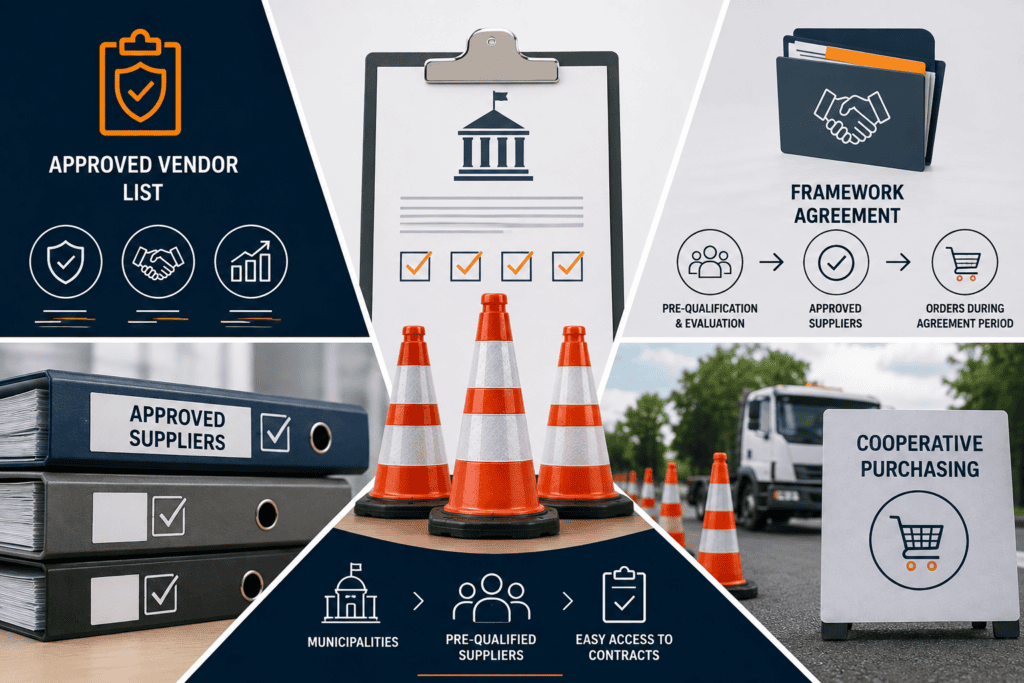
Many municipalities manage their traffic cone procurement not through individual tenders for each purchase but through approved vendor lists or framework agreements that pre-qualify a panel of suppliers for a defined period, typically two to four years. Under a framework agreement, the municipality conducts one comprehensive evaluation to establish the approved panel, and individual orders during the framework period are placed directly with approved suppliers, sometimes through a secondary mini-competition among panel members.
For traffic cone suppliers, getting onto a municipal approved vendor list or framework agreement is often more valuable than winning any single contract, because it creates a stream of order opportunities over the framework period without the overhead of responding to a full tender for each purchase. The pre-qualification evaluation for an approved vendor list is typically more comprehensive than a single-contract tender, covering all the compliance, quality, delivery, and financial criteria discussed above in depth.
Suppliers who have not yet established a track record with a particular municipality can use cooperative purchasing agreements as an entry point. Cooperative purchasing programmes, such as those operated by county or state level purchasing cooperatives in the United States, pre-negotiate contracts with approved suppliers that participating municipalities can access without conducting their own full tender process. A supplier who is already approved on a cooperative purchasing agreement can be accessed by member municipalities with significantly lower procurement overhead, which makes the cooperative route an effective first step into the municipal market for suppliers without an existing approved vendor relationship.
What Separates Suppliers Who Win Municipal Contracts
The traffic cone suppliers who consistently win and retain municipal contracts share a set of characteristics that go beyond product quality and price competitiveness. They maintain their compliance documentation in a current and organized state so that it can be submitted accurately and completely in response to any tender requirement without a rushed preparation process. They understand the specific compliance standards applicable to the markets they are targeting and have their products tested and certified to those standards before the tender opportunity arises. They invest in the quality management infrastructure, ISO 9001 certification, documented production processes, and third-party audit capability, that municipal evaluation frameworks reward.
Most importantly, they treat municipal procurement as a long-term relationship rather than a transactional sale. A supplier who performs consistently on a first municipal contract, delivers on time, meets specification, responds to warranty claims promptly, and communicates proactively when issues arise, builds the performance record that strengthens their position in every subsequent tender that municipality issues. That performance record is the most durable competitive advantage available in the municipal traffic cone market, and it is built one contract at a time.
Looking for a Custom Traffic Cones Manufacturer or Supplier? Struggling to find the right factory to bring your vision to life? We’ve got you covered! At our place, we craft top-quality traffic cones with precision and care. Big or small, your needs are our mission. Let’s launch your cones project and take your product line to the next level! Click here to contact