
For procurement officers, road safety distributors, construction contractors, and facilities managers sourcing traffic cones in volume, the unit price on a wholesale quote is rarely the whole story. Two variables consistently account for the widest price variation within the traffic cone category: whether the order includes custom logo printing, and which reflective collar classification the cones are specified to meet. Understanding exactly how each of these variables affects the factory cost, the compliance value, and the total procurement cost of a traffic cone order is essential for making sourcing decisions that balance budget discipline with safety and branding requirements.
This article breaks down both variables in detail, explains the reflective collar classification systems used in the major regulatory frameworks, and gives procurement teams a clear framework for evaluating traffic cone wholesale quotes that include logo customization and reflective specification components.
Why Traffic Cone Wholesale Pricing Varies More Than Most Buyers Expect
1. The Base Cone Price Is Just the Starting Point
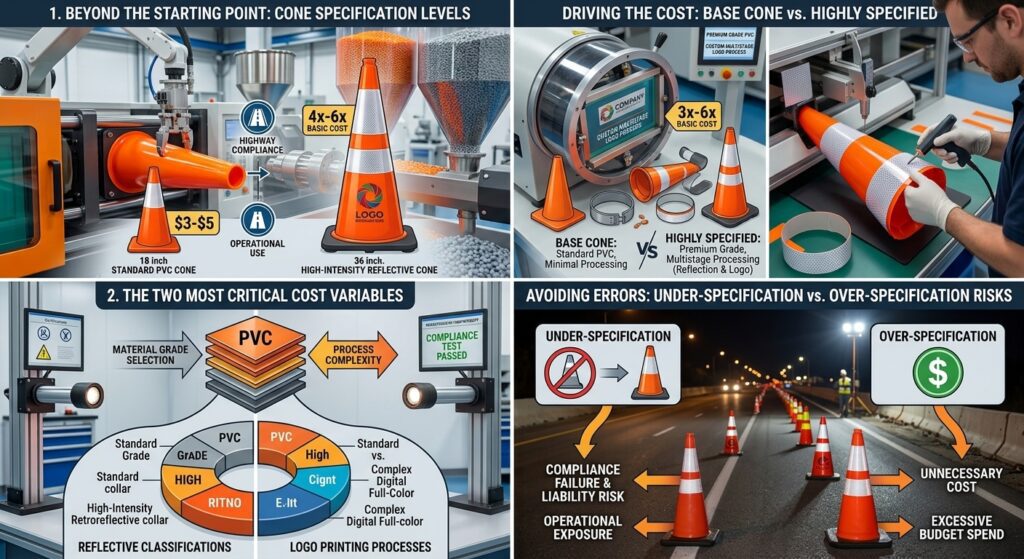
A standard non-reflective, non-printed PVC traffic cone at the 18-inch height from a wholesale manufacturer can cost as little as three to five dollars per unit at high volume. A fully specified 36-inch cone with a high-intensity retroreflective collar, a custom logo printed on the collar, and compliance certification for highway night use can cost four to six times that figure from the same manufacturer. Both are described as traffic cones in supplier catalogues, but they are fundamentally different products serving different regulatory environments and operational purposes.
The buyers who consistently pay more than necessary for traffic cones at wholesale are those who specify reflective and customization requirements without understanding what drives the cost of each, and those who under-specify and then face compliance or liability exposure when their cones fail to meet the standards required by the contract or the regulatory authority overseeing their work zone. Both errors are avoidable with a clear understanding of how reflective classifications and logo printing each contribute to the final unit cost.
2. The Two Variables That Move the Price Most
Of all the factors that determine traffic cone wholesale prices, material type, height, base weight, color, and quantity all play a role, but reflective collar specification and logo customization are the two that require the most deliberate decision-making at the procurement stage. They involve choices between different grades of material and different manufacturing processes that cannot be easily reversed after an order is placed, and they interact with compliance requirements in ways that make under-specification a legal and operational risk rather than simply a cost saving.
Reflective Collar Classifications and Their Effect on Wholesale Price
1. What Reflective Collars Actually Do
A reflective collar on a traffic cone is a band of retroreflective sheeting applied around the upper body of the cone. Its function is to return vehicle headlight beams back toward the driver, making the cone visible at night and in low-visibility conditions from distances that an orange PVC body alone cannot achieve. Without a retroreflective collar, a traffic cone placed in an unlit work zone at night becomes effectively invisible to a driver approaching at speed until it is too late to take evasive action. This is not a theoretical risk. It is the operational reality that retroreflective collar requirements in road safety standards exist to address.
The retroreflective performance of a collar is determined by the grade of sheeting used and is measured as a coefficient of retroreflection, expressed in candelas per lux per square metre. Higher-grade sheeting returns more light per unit area, is visible at greater distances and wider angles, and retains its performance for longer across its service life. It also costs more to manufacture and more to purchase at wholesale.
2. MUTCD Reflective Collar Requirements and Their Pricing Implications
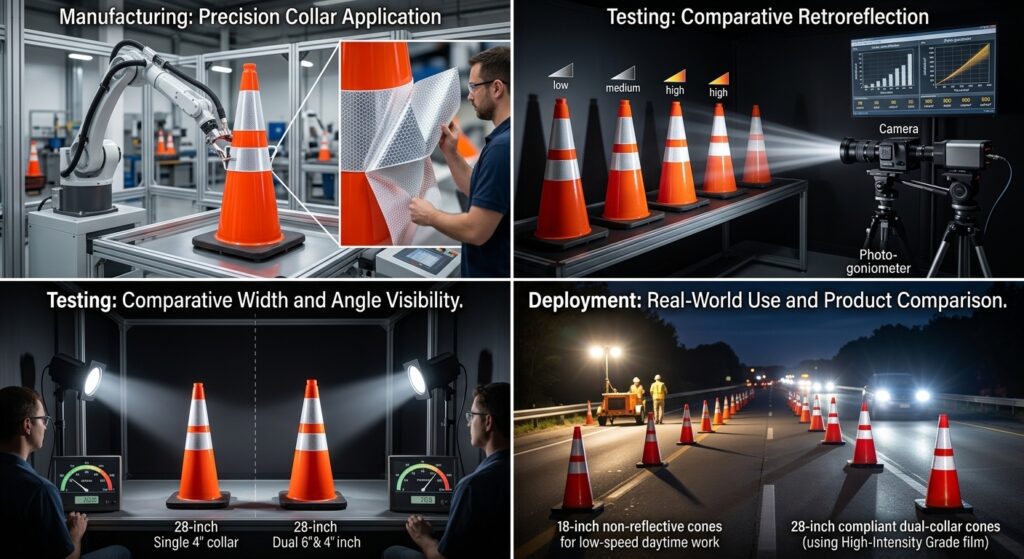
In the United States, the Manual on Uniform Traffic Control Devices sets the national standard for traffic cone retroreflective requirements. Under MUTCD Part 6 in its current 11th edition, traffic cones used on freeways, high-speed highways, or in nighttime work zones on any highway must be a minimum of 28 inches in height and must be equipped with two white retroreflective collar bands. The upper band must be 6 inches wide, positioned 3 to 4 inches from the top of the cone. The lower band must be 4 inches wide, positioned approximately 2 inches below the upper band.
For daytime-only, low-speed applications at or below 40 miles per hour, 18-inch cones without reflective collars are permitted. The cost difference between a compliant non-reflective 18-inch cone and a fully compliant 28-inch nighttime highway cone with dual retroreflective collars is substantial at wholesale. The reflective sheeting itself contributes a meaningful per-unit material cost, the application process adds labor, and the larger body of the 28-inch cone increases raw material consumption. Together these factors typically add between three and eight dollars per unit to the wholesale cost compared to a non-reflective base cone of equivalent material quality.
The grade of retroreflective sheeting specified also affects the price within the MUTCD-compliant category. Engineer Grade sheeting meets the minimum retroreflective performance threshold and is the lowest-cost option. High-Intensity Grade sheeting, which uses a more efficient prismatic or enclosed lens structure to return significantly more light per unit area, costs more per linear meter of sheeting and adds correspondingly to the cone wholesale price. Diamond Grade sheeting, the highest performance retroreflective material available for traffic cone applications, is used in premium highway and motorway cone specifications where maximum visibility distance is required and commands the highest material cost.
3. EN 13422 Reflective Classifications and European Market Pricing
For buyers sourcing traffic cones for European markets or for projects governed by European standards, the relevant classification framework is EN 13422. Under this standard, traffic cones are classified by retroreflective performance into three grades: R1, R2, and R3, with R3 representing the highest retroreflective performance. An additional suffix, A, indicates that the cone also meets the optional measurement at a two-degree observation angle, which is relevant for visibility from high-cab vehicles at close range.
The R1 classification represents the minimum retroreflective performance threshold and corresponds broadly to Engineer Grade sheeting in MUTCD terminology. R2 is the minimum specification recommended for nighttime use on fast roads and motorways, and uses high-intensity prismatic film that returns substantially more light than R1 material. R3 is the highest classification and is appropriate for motorway night operations where maximum approach visibility is critical.
The wholesale price difference between R1 and R2 cones of the same body specification is driven primarily by the sheeting cost, which for prismatic high-intensity film is significantly higher than for standard enclosed-lens sheeting. At volume orders of several thousand units, the per-unit cost difference between R1 and R2 specification cones from the same manufacturer typically ranges from one to three dollars depending on collar width and cone height. The R3 specification adds a further premium on top of the R2 price. Buyers sourcing for European distribution or for projects under EN 13422 should confirm the exact R classification required by the contract or the relevant road authority before submitting a specification to a manufacturer, as ordering R1 cones for an R2-required project creates a compliance liability that cannot be resolved without replacing the entire order.
4. Collar Width, Number of Bands, and Their Cost Contribution
Beyond the grade of sheeting, the physical dimensions of the reflective collar also affect wholesale pricing. A single 4-inch collar uses less sheeting material than a dual-band configuration with a 6-inch upper band and a 4-inch lower band. Wider collars and dual-band configurations are more visible and are required for highway and motorway compliance, but they use proportionally more retroreflective material and add accordingly to the unit cost.
For buyers whose application is entirely within private property, parking lots, or low-speed indoor venues where retroreflective compliance is not mandated, a single narrow collar in standard grade sheeting may be adequate and represents a meaningful cost saving per unit at volume. For any application that touches public roads, even temporarily, the MUTCD or EN 13422 specification for the relevant use case should be confirmed before narrowing the collar specification to save cost, as the liability exposure from a non-compliant cone in a work zone substantially outweighs any per-unit saving achieved.
Custom Logo Printing on Traffic Cones and Its Effect on Wholesale Prices
1. Why Buyers Request Logo-Printed Traffic Cones
The demand for custom logo printing on traffic cones comes from several distinct buyer categories, each with different motivations and different price sensitivity profiles. Road construction contractors and utilities companies print their company name or logo on cones to identify their equipment on site, reduce losses through theft or mix-up when multiple contractors are working adjacent areas, and reinforce brand visibility at road-level in public-facing work zones. Municipalities and local authorities print cones with civic branding, department identification, or regulatory markings that distinguish their equipment from contractor-owned cones on shared worksites.
Event management companies, stadium operators, hotel groups, and parking operators use logo-printed traffic cones as a branded traffic management tool in customer-facing environments, where a plain orange cone is visually acceptable but a cone carrying the venue or company logo adds a layer of professional presentation that aligns with the overall environment. For this buyer category, the branding value of the printing is the primary justification for the additional cost.
2. The Printing Methods Used and How Each Affects Cost
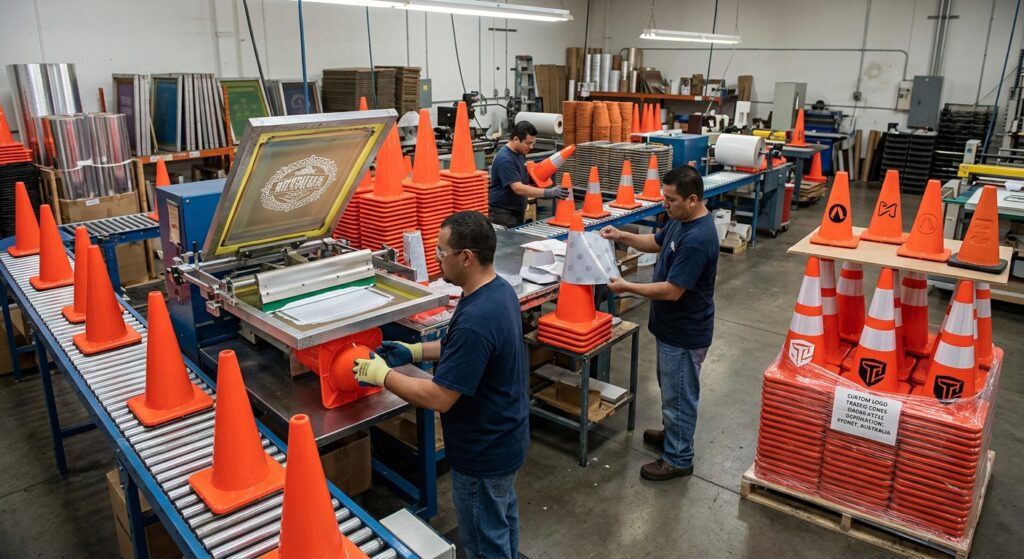
Traffic cone logo printing at the wholesale manufacturing level is achieved through three primary methods: screen printing directly onto the cone body, hot stamping or debossing into the cone body or base, and printing onto the reflective collar sheeting before it is applied to the cone.
Screen printing onto the cone body is the most common and cost-effective method for single-color or simple two-color logos at volume. The setup cost for screen printing is relatively low, and the per-unit cost addition for a single-color screen print on a standard traffic cone body at orders above 500 units is typically in the range of 0.20 to 0.50 dollars per unit. Multi-color screen prints require a separate screen for each color, increasing both setup cost and per-unit printing cost proportionally. Full-color photographic or complex multi-color logos on cone bodies are not well-suited to screen printing and are better achieved through digital printing methods that carry a higher per-unit cost.
Printing onto the reflective collar is a more technically demanding process that requires the logo artwork to be applied to the retroreflective sheeting before the sheeting is cut and applied to the cone body. The retroreflective surface requires specialized inks and printing processes to achieve adequate adhesion and color fastness without degrading the reflective performance of the collar. Logo printing on reflective collars adds more to the wholesale unit cost than body-only printing, with typical cost additions at volume in the range of 0.30 to 0.80 dollars per unit for a single-color logo on a standard dual-band collar.
Debossing, which presses the logo into the cone body or base material as a physical impression rather than an applied ink print, is a permanent and highly durable branding method that requires a custom mold or debossing tool. The tooling cost for debossing is a one-time setup charge that is typically amortized across the initial order and is only cost-effective for buyers committing to ongoing repeat orders of the same product. At the per-unit level, debossed logos add less ongoing cost than printed logos once the tooling cost has been absorbed, making it the preferred method for large ongoing programmes where branding consistency over multiple orders is a priority.
3. Minimum Order Quantities and Setup Charges for Printed Cones
The pricing structure for logo-printed traffic cones at wholesale differs from standard stock cones in that it involves both per-unit costs and order-level setup charges that do not scale linearly with quantity. A typical manufacturer or wholesale supplier will charge a screen setup fee per color per cone location, a minimum order quantity for printed cones that is higher than for stock cones, and a per-unit price that decreases as order quantity increases but remains above the equivalent non-printed cone price at all quantities.
At the minimum order quantity for printed cones, which typically ranges from 100 to 500 units depending on the supplier and the printing method, the effective per-unit cost including setup charges amortized across the order can be significantly higher than the nominal per-unit quote suggests. Buyers evaluating the cost of logo customization should request a full cost breakdown that includes all setup charges and calculates the all-in per-unit cost at their specific order quantity, rather than comparing only the stated unit prices on different supplier quotes.
How Logo Printing and Reflective Classification Interact in a Single Order
1. The Compound Effect on Wholesale Pricing
When a single traffic cone order specifies both a reflective collar classification above the base standard and custom logo printing on the collar, the two cost drivers compound rather than add simply. A high-intensity R2 or MUTCD-grade collar costs more per unit than a standard collar. Printing on that collar requires a more specialized process than printing on a plain PVC surface. The combination of premium sheeting and logo printing on the collar therefore adds more to the wholesale price than either variable would contribute independently.
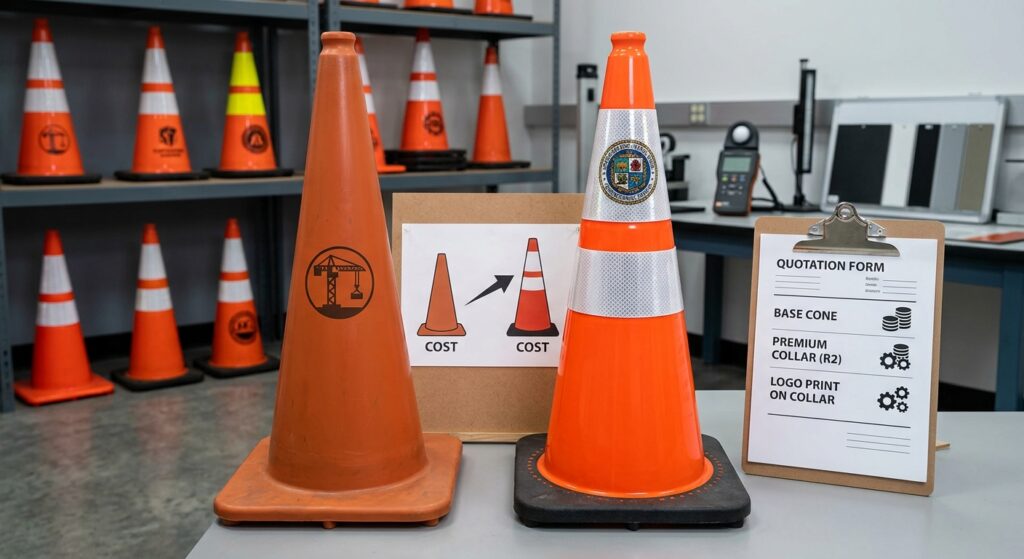
Buyers specifying logo-printed, high-reflectivity cones for highway or motorway use should request quotes that separately itemize the base cone cost, the collar upgrade cost for the specified reflective grade, and the printing cost for the logo on that collar. This breakdown allows the procurement team to evaluate whether the logo printing on the reflective collar is cost-justified relative to an alternative such as printing the logo on the cone body only while retaining the premium collar without printing, which maintains compliance and reduces the per-unit cost of the branded order.
2. Matching Specification to Application to Avoid Overpaying
The most common overpayment error in traffic cone wholesale procurement is specifying a premium reflective grade for an application that does not require it, driven by the assumption that higher specification is always better. For cones deployed exclusively in daytime, low-speed, private property environments such as parking lots, warehouse yards, and indoor event spaces, an R1 or Engineer Grade collar provides adequate visibility and costs less than an R2 or High-Intensity specification that delivers performance the application will never need.
Similarly, logo printing on the reflective collar is only cost-justified when the cone will be used in conditions where the collar is visible and the branding on it will be read. For cones used primarily in nighttime highway work zones where the collar’s retroreflective function is critical and driver attention is on the road ahead rather than on cone branding, logo printing on the collar may contribute cost without delivering meaningful branding value. In that application, printing on the cone body or base at a lower per-unit cost achieves the identification and branding function adequately.
Building a Procurement Brief That Controls Both Variables
What to Define Before Requesting Wholesale Quotes
A traffic cone wholesale procurement brief that effectively controls both reflective collar cost and logo printing cost should specify the following clearly before quotes are requested: the intended use environment for each cone type in the order, daytime or nighttime, public road or private property, and the applicable regulatory standard; the reflective collar grade required by that standard or by contract specification; whether logo printing is required and if so on which surface of the cone; the printing method preferred and the number of colors in the logo; the order quantity for each cone type; and whether repeat orders at the same specification are anticipated, which affects the cost-effectiveness of debossing tooling investment.
Providing this information upfront to a manufacturer or wholesale supplier eliminates the ambiguity that results in quotes that are not comparable, where one supplier quotes a base cone price without reflective upgrade costs and another quotes an all-in price with setup charges already included.
Conclusion: Specification Drives Price More Than Negotiation Does
In traffic cone wholesale procurement, the two variables of reflective collar classification and logo printing customization account for more price variation between otherwise comparable quotes than any other single factor including supplier margin negotiation. Buyers who understand what each variable costs and why are in a stronger position to specify exactly what their application requires, reject over-specified or under-specified alternatives, and evaluate wholesale quotes on a genuinely comparable basis.
The reflective collar grade should be determined by the regulatory requirement and the operational environment, not by assumption or by default to the highest available specification. Logo printing should be evaluated on the basis of method, location on the cone, and order volume economics before committing to a specification that compounds printing cost with premium collar cost in applications where a simpler approach would achieve the same result.
The cheapest cone in a wholesale catalogue is not the lowest-cost cone for every application. The lowest-cost cone is the one correctly specified for the job it will actually do.
Looking for a manufacturer that supports custom reflective Collar Grades, Logo Printing on Collar and body, and flexible MOQ for wholesale traffic cone programmes? At JessuBond, we produce MUTCD and EN 13422 compliant traffic cones with full customization support and transparent per-unit pricing at volume. Contact us here.