
Dome mirrors are among the most misspecified products in commercial safety procurement. The three main configurations, full dome, half dome, and quarter dome, look superficially similar in product catalogues and are often selected on the basis of price or diameter alone, without reference to the coverage angle each type provides, the mounting geometry it requires, or the specific traffic pattern at the location it needs to serve. The result is a mirror that is physically installed but functionally inadequate: a quarter dome mounted at a four-way intersection leaves two full approach directions unmonitored, and a full dome suspended in a corner position wastes half its reflective surface against a wall while leaving the real coverage requirement underserved.
For safety managers, facilities procurement teams, warehouse operators, retail loss prevention coordinators, and anyone responsible for specifying dome mirrors across a commercial or industrial environment, the selection decision starts with the geometry of the space and the number of approach directions that need to be visible from a single mounting point. Everything else, size, material, suspension method, follows from that. This article covers all three dome mirror configurations in technical and operational detail, maps each to the specific work zone types where it is the correct specification, and addresses the most common selection mistakes that produce installations that look compliant but do not perform as required.
The Geometry Behind Dome Mirror Coverage: What the Fractions Mean
1. How Dome Mirror Coverage Angles Are Defined
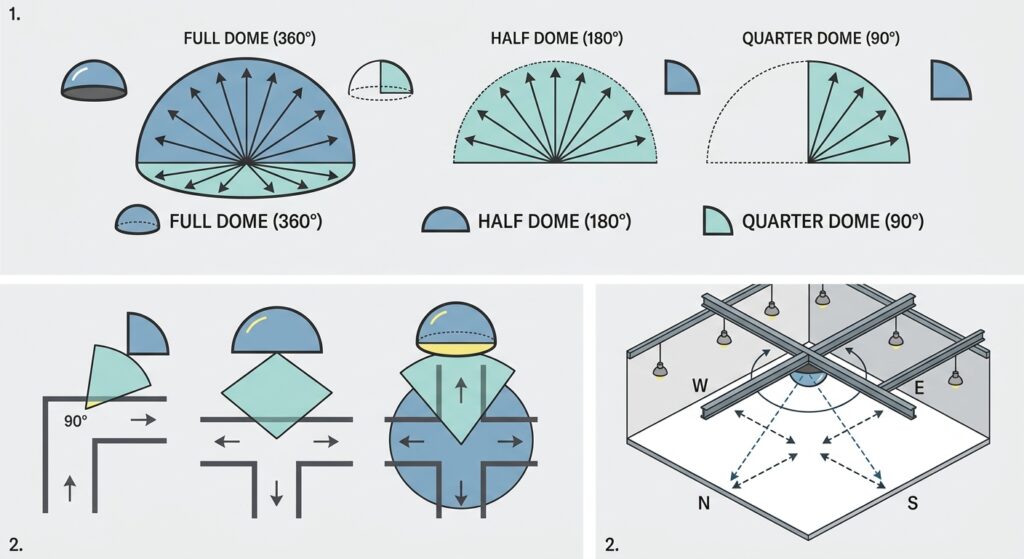
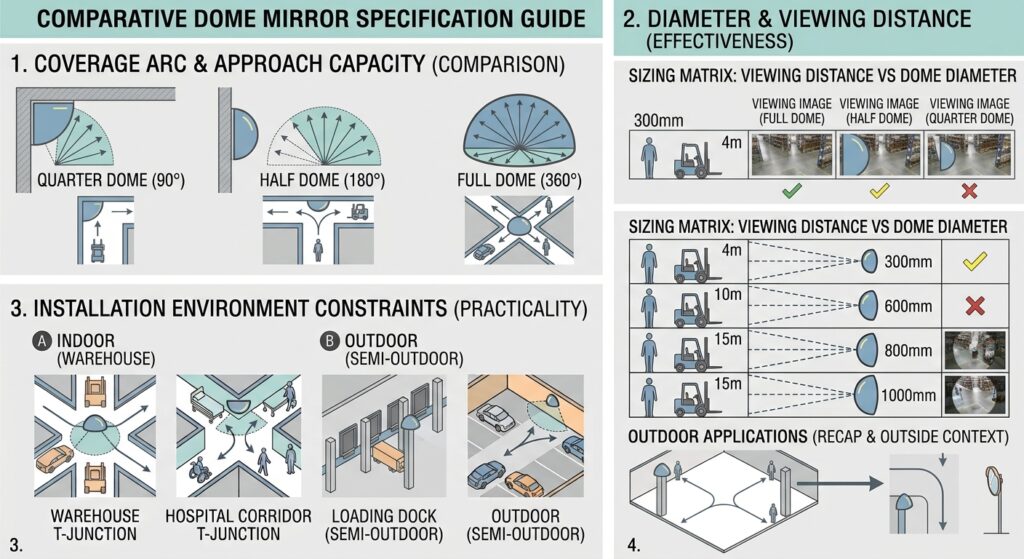
A dome mirror is a hemispherical or partial-hemispherical reflective surface. A full dome covers a complete hemisphere, meaning it reflects in all directions simultaneously across a 360-degree horizontal arc. A half dome covers exactly half of that hemisphere, providing 180 degrees of horizontal coverage. A quarter dome covers one quarter of the hemisphere, providing 90 degrees of horizontal coverage. These coverage angles are not approximate marketing descriptions. They are the physical consequence of the reflective surface geometry and they define exactly which approach directions will and will not be visible to an observer using the mirror from any given position.
The coverage angle of a dome mirror determines two things that together define whether it is the right product for a given location: how many approach directions it can simultaneously serve, and where it can physically be mounted to achieve that coverage without wasting reflective surface against a structural element. A full dome mounted at the center of an open four-way intersection ceiling serves all four approach directions equally. The same full dome mounted in a corner position has one quarter of its reflective surface facing the wall behind it, delivering 75 percent of its potential coverage while the remaining 25 percent reflects the wall to no useful purpose.
2. Matching Coverage Angle to Approach Direction Count
The primary selection criterion for any dome mirror installation is the number of approach directions that converge at the location being served. A location where two directions converge, a corner where one aisle meets another, requires 90 degrees of coverage and is the natural application for a quarter dome. A location where three directions converge, a T-junction at the end of a corridor where traffic approaches from left, right, and straight ahead, requires 180 degrees of coverage and is the natural application for a half dome. A location where four directions converge, a cross-aisle intersection in a warehouse or retail floor where traffic approaches from all four compass points, requires 360 degrees of coverage and is the natural application for a full dome.
This one-criterion decision tree eliminates most dome mirror selection errors before they reach the product specification stage. Count the approach directions at the location. Match the approach direction count to the coverage angle. Select the dome type that provides that coverage angle. Everything else is a secondary specification decision.
Quarter-Dome Mirrors: Selection, Mounting, and Work Zone Applications
1. Coverage Geometry and Physical Profile of Quarter-Dome Mirrors
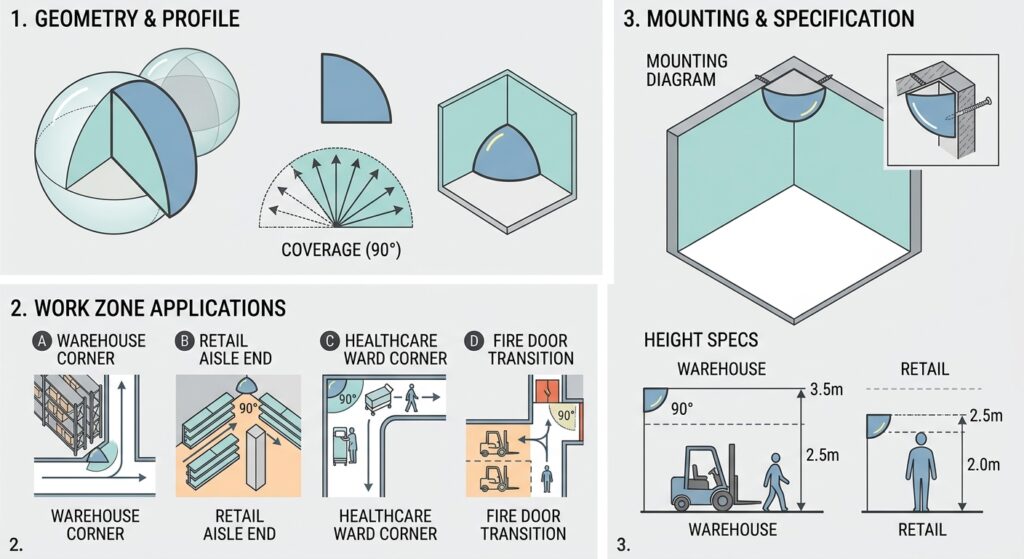
A quarter-dome mirror covers 90 degrees of horizontal arc, representing one quarter of the full hemispherical coverage that a full dome provides. The physical profile of the mirror reflects this: it is not a complete bowl shape but rather a rounded wedge, like a segment cut from a sphere along two perpendicular vertical planes. This profile is what allows the quarter dome to sit flush into a wall corner, with one flat edge against each of the two meeting walls and the curved reflective surface facing outward into the approach zone.
The quarter dome is the correct specification for any location where exactly two approach directions converge at an outside corner, where traffic or pedestrians approach from two perpendicular directions and neither party can see the other until they reach the corner itself. The reflective surface simultaneously shows both approach directions to any observer looking at the mirror from either side, providing the advance warning that makes the corner safe to navigate at normal operating pace without requiring vehicles or pedestrians to stop and check before proceeding.
2. Work Zones Where Quarter-Dome Mirrors Are the Correct Specification
In warehouse environments, the correct locations for quarter-dome mirrors are outside corners of racking aisles where the aisle terminates at a perpendicular cross-aisle or wall-running service route, column corners in open warehouse areas where structural posts create blind angles at two-direction approach points, and the corners of fire door openings where a corridor turns 90 degrees and forklifts or pallet trucks approach from both sides of the turn without a direct sightline through the corner.
In retail environments, quarter-dome mirrors are the correct specification at aisle-end corners where two shelf runs meet at a right angle, at the corners of stock room doorways opening onto the retail floor, and at the corner transitions between different areas of a store layout where the direction of customer and staff traffic changes by 90 degrees. In healthcare facilities, quarter-dome mirrors serve the corners of ward corridor junctions, the corners of medication room doorways, and any 90-degree corner in a staff or patient circulation route where bed frames, wheelchair footrests, or equipment trolleys present a collision risk to pedestrians approaching from the other direction.
3. Mounting Requirements for Quarter-Dome Mirrors
Quarter-dome mirrors mount at the junction of two walls meeting at a 90-degree corner, typically at ceiling height to maximise the viewing angle of the reflective surface from the approach directions on both sides. The two flat edges of the mirror profile sit flush against the two wall surfaces, and the mirror is secured with screws through the flat edges into the wall substrate. Most quarter-dome mirrors are supplied with a wall-mounting bracket or fixing plate that simplifies the installation and allows minor angle adjustment after the initial fixing to optimise the coverage zone.
The correct mounting height for a quarter-dome mirror in a warehouse or industrial environment is typically between 2.5 and 3.5 metres from the floor level, high enough to provide a clear line of sight from the approach distance and low enough that the reflective surface is within the useful viewing angle of a forklift operator or standing pedestrian. In retail environments where ceiling heights are lower and the primary users are standing pedestrians, a mounting height of 2.0 to 2.5 metres is more typical.
Half-Dome Mirrors: Selection, Mounting, and Work Zone Applications
1. Coverage Geometry and Physical Profile of Half-Dome Mirrors
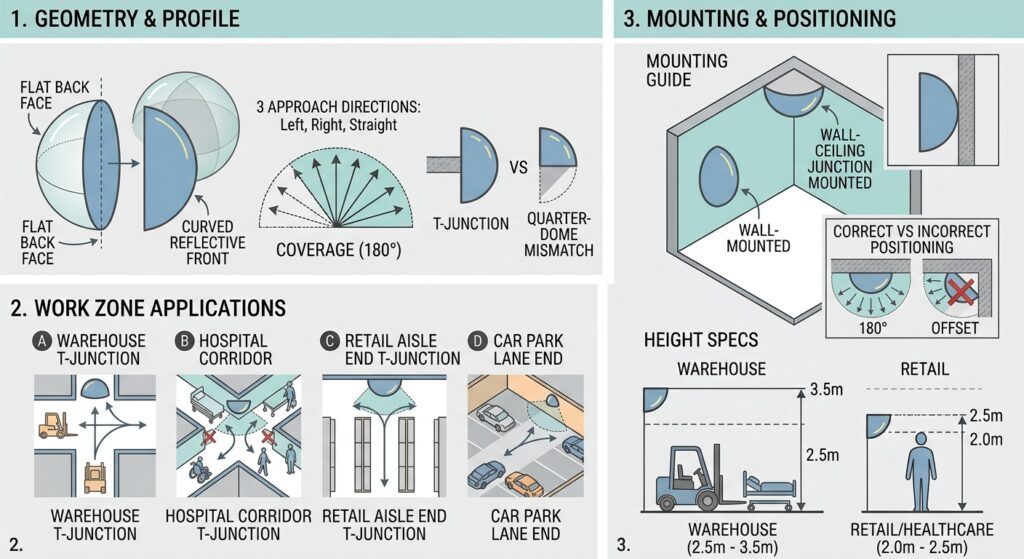
A half-dome mirror covers 180 degrees of horizontal arc, representing exactly half of the full hemispherical coverage. The physical profile is a hemisphere split along a single vertical plane, producing a flat back face and a curved reflective front face. This flat back allows the half dome to mount flush against a wall or at the wall-ceiling junction, with the curved surface facing outward to cover the full 180-degree arc of the approach zone in front of the wall.
The half dome is the correct specification for any location where three approach directions converge: the classic T-junction geometry where traffic or pedestrians approach from left, right, and straight ahead. From any of the three approach directions, the curved reflective surface of a correctly positioned half dome shows all three zones simultaneously, giving every user advance visibility of what is approaching from the other two directions before they reach the junction point. A quarter dome at the same location would cover only two of the three approach directions, leaving the third as a residual blind zone that the mirror does not address.
2. Work Zones Where Half-Dome Mirrors Are the Correct Specification
In warehouse environments, half-dome mirrors are the correct specification at T-junctions where a primary forklift aisle meets a cross-aisle or pedestrian walkway from one side only, at the end of a racking aisle that opens onto a wider circulation area where traffic approaches from left, right, and out of the aisle itself, and at the internal wall of loading dock approach corridors where vehicles can enter from two directions along the dock face while pedestrians approach from the interior of the building.
In hospital and healthcare facilities, half-dome mirrors are the standard specification for T-junction corridor configurations where bed traffic, wheelchair users, and walking staff all converge at a three-direction meeting point. The 180-degree coverage of a correctly positioned half dome serves all three approach directions from a single ceiling or high-wall mounting point, replacing what would otherwise require two or three standard convex mirrors to achieve equivalent coverage. In retail environments, half-dome mirrors serve T-junction aisle configurations at the ends of shelf runs that open onto a main circulation aisle, providing staff and customers with advance visibility of approaching traffic from the aisle and from both directions along the main circulation route.
In car parks and parking structures, half-dome mirrors mounted at the wall of a T-junction where two parking lanes meet serve both the approach from the lane and the two directions along the cross lane, which is the most common junction geometry in structured parking layouts where full four-way intersections are less frequent than T-junctions created by the parking bay layout.
3. Mounting Requirements for Half-Dome Mirrors
Half-dome mirrors mount at the wall surface or at the wall-ceiling junction of the wall that faces the three-way junction they are serving. The flat back face of the mirror sits flush against the wall, with the curved reflective surface facing outward into the junction zone. Fixings pass through the flat back plate into the wall substrate or into the ceiling structure at the wall junction. The mirror must be positioned at the center of the wall section facing the three-way junction, not offset to one side, as an offset position skews the 180-degree coverage arc and leaves one of the three approach directions only partially covered.
Unlike quarter-dome mirrors, which must be positioned in a physical corner to function correctly, half-dome mirrors can be mounted at any flat wall surface at the appropriate height, which gives more installation flexibility in environments where the exact corner of a T-junction is inaccessible or structurally unsuitable for fixing. The optimum mounting height follows the same general principle as quarter-dome mirrors: high enough for a clear sightline from the approach distance, within the working viewing angle of the primary users at the location.
Full-Dome Mirrors: Selection, Mounting, and Work Zone Applications
1. Coverage Geometry and Physical Profile of Full-Dome Mirrors
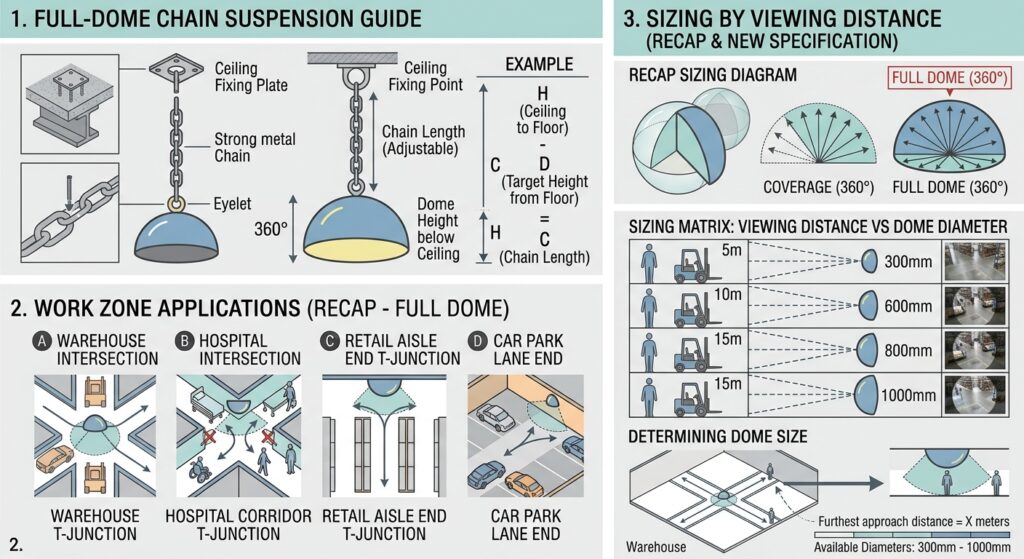
A full-dome mirror covers the complete 360-degree horizontal arc, providing simultaneous visibility of all approach directions from a single suspended or ceiling-mounted position. The physical profile is a complete hemisphere, a bowl-shaped reflective surface with no flat back face, which means the full dome cannot be wall-mounted or corner-mounted: it requires a ceiling suspension point positioned over the center of the intersection it is serving. Most full-dome mirrors are supplied with a chain suspension kit that allows them to be hung from ceiling structure at a height appropriate for the space.
The full dome is the correct specification for any location where four approach directions converge at an open intersection, typically the most common junction geometry in warehouse racking aisle layouts, large open-plan retail floors, food service preparation areas, and any environment where a grid of circulation routes creates four-way intersections at regular intervals throughout the space. At a correctly positioned and sized full dome, any observer approaching from any of the four directions can see all four zones of the intersection simultaneously in a single glance at the mirror.
2. Work Zones Where Full-Dome Mirrors Are the Correct Specification
In warehouse environments, full-dome mirrors are the primary specification for all four-way aisle intersections in racking layouts where forklift and pallet truck traffic approaches from all four directions and no wall or structural element naturally closes off one of the four approach zones. A full dome suspended at the ceiling center of each four-way intersection in a warehouse racking grid provides simultaneous 360-degree visibility to all users approaching from any direction, and a single correctly sized full dome replaces what would otherwise require four standard convex mirrors positioned at each corner of the intersection to achieve equivalent coverage.
In retail environments, full-dome mirrors suspended at ceiling height over the intersections of major circulation aisles provide loss prevention coverage and pedestrian safety awareness across the four-direction traffic flow typical of large format retail and supermarket layouts. The 360-degree coverage allows staff monitoring from a single mirror position to observe approaching activity from all four directions without requiring multiple standard mirrors or repeated repositioning of observation angles.
In food production and processing facilities where ceiling-mounted mirrors are common for hygiene zone monitoring and pedestrian safety in equipment-heavy environments, full-dome mirrors at four-way intersections in the production floor layout provide the coverage required without introducing wall-mounted hardware that complicates cleaning protocols in regulated food contact zones.
3. Suspension and Ceiling Mounting Requirements for Full-Dome Mirrors
The suspension requirement of the full dome is the most operationally significant constraint on its use, and it is the most common reason that a half-dome or multiple quarter-dome configuration is specified instead of a full dome even at a four-way intersection. A full dome must be suspended from a structural ceiling element directly above the center of the intersection, at a height that keeps the bottom of the dome within the useful viewing angle for users approaching from the maximum expected distance. In warehouse environments with high racking and correspondingly high ceilings, this can require a custom drop-rod or chain extension that positions the dome at a practical height well below the structural ceiling level.
Where a ceiling suspension point is not available at the intersection center, such as in open mezzanine structures, external canopy areas, or covered outdoor loading bays without a solid ceiling, full-dome mirrors cannot be installed in their standard configuration. In these cases, four quarter-dome mirrors positioned at the four corners of the intersection, or two half-dome mirrors positioned on opposing walls, achieve equivalent coverage from wall and corner mounting points without requiring a ceiling suspension structure that the space does not provide.
Full-dome mirrors are supplied with chain suspension kits as standard, and the chain length should be calculated to position the dome at the target height below the ceiling fixing point before ordering. Most commercial full-dome mirrors are available in standard diameters from 300mm to 1000mm, with the appropriate size determined by the viewing distance from the furthest approach direction to the mirror center.
Comparing All Three Configurations Across Key Selection Variables
1. Coverage Arc and Approach Direction Capacity
The coverage arc of each dome type determines its maximum approach direction capacity without repositioning or supplementary mirrors. A quarter dome covers 90 degrees and serves two perpendicular approach directions from a single corner mounting. A half dome covers 180 degrees and serves three approach directions converging at a T-junction from a single wall mounting. A full dome covers 360 degrees and serves all four approach directions at a cross-junction from a single ceiling suspension point.
No dome type can substitute for a higher-coverage type without leaving approach directions uncovered. A quarter dome cannot serve a T-junction. A half dome cannot serve a full four-way intersection without supplementary coverage from a second mirror. These are geometric constraints, not performance quality differences, and they cannot be compensated by selecting a larger diameter product of the lower coverage type.
2. Viewing Distance and Diameter Selection
For all three dome configurations, the correct diameter is determined by the viewing distance from the furthest approach direction to the mirror center. Larger diameters provide a larger reflective image that is visible and readable from greater distances. Smaller diameters are appropriate for shorter viewing distances in confined spaces. The relationship between diameter and effective viewing distance is consistent across dome types: a 300mm dome is appropriate for viewing distances up to approximately 3 to 4 metres, a 600mm dome for distances up to 8 to 10 metres, and a 1000mm dome for distances up to 15 metres in typical indoor conditions.
However, full-dome mirrors of equivalent diameter to a quarter-dome or half-dome provide greater effective viewing distance for the same diameter, because the full hemispherical surface area concentrates the reflective image differently from a partial hemisphere. A 12-inch full dome provides useful coverage at viewing distances that a 12-inch quarter dome cannot match, which means that where full-dome coverage is appropriate, a smaller diameter full dome can sometimes replace a larger diameter partial dome without reducing effective detection distance.
3. Installation Environment Constraints
The mounting requirement of each dome type creates distinct installation constraints that may determine which type is practical at a given location regardless of the coverage angle calculation. Quarter-dome mirrors require a physical 90-degree corner formed by two meeting walls. If the corner is not available or is structurally unsuitable for fixing, the quarter dome cannot be installed in its intended configuration. Half-dome mirrors require a flat wall surface at the appropriate position relative to the T-junction they serve. Full-dome mirrors require a ceiling suspension point above the intersection center, which may not exist in all facility types.
In outdoor or semi-outdoor work zones, covered loading areas, external vehicle circulation routes, and similar environments where ceiling structures are either absent or at impractical heights, full-dome mirrors are generally not the viable specification. Quarter-dome and half-dome configurations mounted on structural columns, external wall corners, and gate posts are more commonly used in these environments, with flat convex mirrors supplementing coverage at locations where no corner or wall position is available within the appropriate viewing distance.
Common Selection Mistakes and How to Avoid Them
1. Selecting by Price Rather Than Coverage Requirement
The most consistent selection error across dome mirror procurement is choosing the smallest or cheapest product that physically fits the location rather than the product that provides the coverage angle the location requires. A quarter-dome mirror costs less than a half-dome and substantially less than a full dome of the same diameter. At a T-junction where a half dome is the correct specification, installing a quarter dome saves money at the procurement stage and creates a permanent blind zone that the mirror will never resolve regardless of repositioning or size upgrade within the same product type.
2. Installing Full Domes in Corner Positions
Installing a full dome in a physical corner position is a procurement and installation error that wastes a significant portion of the mirror’s coverage capacity. In a corner installation, approximately one quarter of the full dome’s reflective surface faces the wall behind it rather than the approach zone in front of it. The mirror delivers 270 degrees of useful coverage where 360 degrees was paid for, and a three-quarter dome or a correctly sized half dome would have served the location more efficiently at lower cost. For corner positions, the correct product is always a quarter dome or, where three directions converge at a corner-adjacent junction, a half dome mounted on the wall adjacent to the corner.
Conclusion: The Correct Dome Type Is the One That Matches the Junction Geometry
Dome mirror selection is simpler than the product category’s variety sometimes suggests. The junction geometry at the installation location determines the coverage angle required. The coverage angle required determines the dome type. The dome type determines the mounting configuration. The mounting configuration determines whether the location can physically support the correct product or whether a supplementary approach is needed. Following this sequence from location geometry to product specification eliminates the most common errors in dome mirror procurement and produces installations that deliver the safety and surveillance coverage they were designed to provide.
For procurement teams specifying dome mirrors across large facilities or multi-site portfolios, a systematic site survey that maps each installation location by its junction type, approach direction count, ceiling height, and available mounting surfaces gives the specification data needed to select the correct dome type and diameter for every location before the first order is placed.
A dome mirror that covers the wrong directions is not a safety tool. It is a fixture. Count the approaches first, then select the mirror.
Looking for a manufacturer supplying full-dome, half-dome, and quarter-dome safety mirrors for warehouse, retail, healthcare, and industrial facility programmes? At JessuBond, we produce the complete range of dome mirror configurations in acrylic and polycarbonate with flexible MOQ and consistent lead times for volume procurement. Contact us here.