
Facility security and safety depend heavily on eliminating blind spots that create vulnerabilities for theft, accidents, and operational inefficiencies. While comprehensive security programs often emphasize electronic surveillance systems and access control technologies, convex security mirrors represent a cost-effective, reliable solution for addressing visibility challenges that cameras alone cannot adequately resolve. Understanding the specific facility locations where convex security mirror installations deliver maximum value enables security directors, facility managers, and operations leaders to implement strategic visibility solutions that protect assets, enhance worker safety, and improve overall operational awareness without the ongoing costs and maintenance requirements that electronic systems demand.
Location One: Warehouse Aisle Intersections and Blind Corners
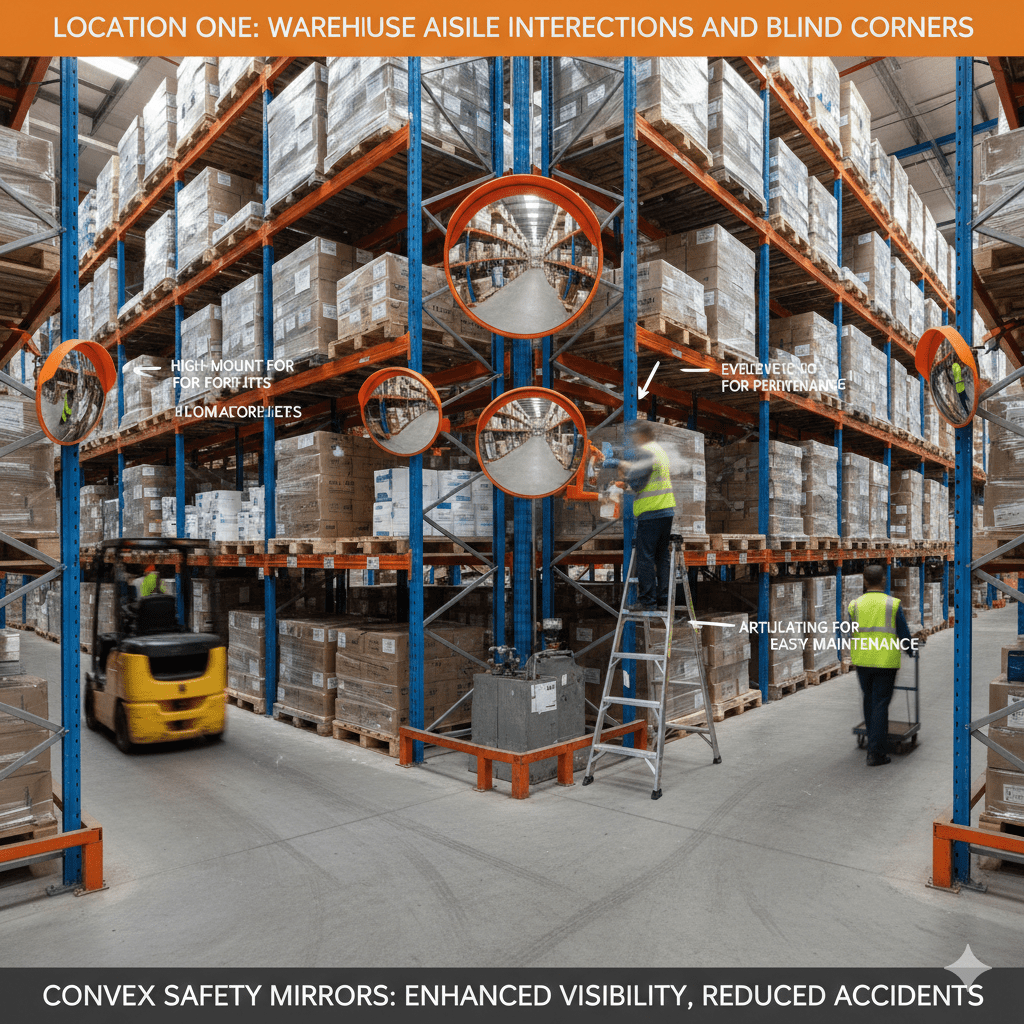
Warehouse environments present some of the most dangerous blind spot scenarios in commercial facilities, with forklift operators, pedestrian workers, and material handling equipment converging at intersection points where structural racking systems completely obstruct sight lines. These intersections represent collision hotspots where the inability to see approaching traffic from perpendicular aisles creates constant near-miss situations and frequent accidents resulting in equipment damage, product loss, and worker injuries. The installation of convex safety mirrors at these strategic intersection points transforms dangerous blind intersections into monitored zones where operators receive advance warning of approaching traffic before committing to crossing paths.
The specific positioning of convex mirrors at warehouse intersections requires careful consideration of typical operator sight lines and the varying heights of different equipment types. Forklift operators seated 6-8 feet above floor level need mirror placement at heights providing clear visibility without requiring operators to look significantly upward or downward from their natural sight line. Meanwhile, pedestrian workers moving through warehouses at ground level benefit from mirrors positioned within their natural field of view, typically 5-7 feet height for standing adults. Quality installations often include mirrors at multiple heights serving both equipment operators and pedestrian workers, ensuring comprehensive visibility for all warehouse traffic types.
The size selection for warehouse intersection mirrors depends on the viewing distances involved and the width of aisles requiring coverage. Narrow aisles with viewing distances under 30 feet may adequately serve with 18-inch convex mirrors, while wider facilities with longer sight lines benefit from 24-inch or even 30-inch large convex mirror installations ensuring operators can clearly discern approaching traffic from required distances. The investment in appropriately sized mirrors proves trivial compared to the costs of even a single forklift collision, making proper sizing specifications essential rather than optional considerations driven by budget minimization.
Maintenance accessibility represents another critical consideration for warehouse mirror installations. Mirrors positioned in high-traffic areas accumulate dust, dirt, and debris from material handling operations, requiring regular cleaning to maintain optical clarity. Installations should consider cleaning access, potentially incorporating articulating mounts allowing mirrors to be temporarily repositioned for cleaning without requiring ladders or lifts. Some facilities establish weekly cleaning schedules for warehouse mirrors, recognizing that dirty mirrors providing degraded visibility prove nearly as dangerous as having no mirrors at all.
Location Two: Loading Dock Areas and Vehicle Approach Zones
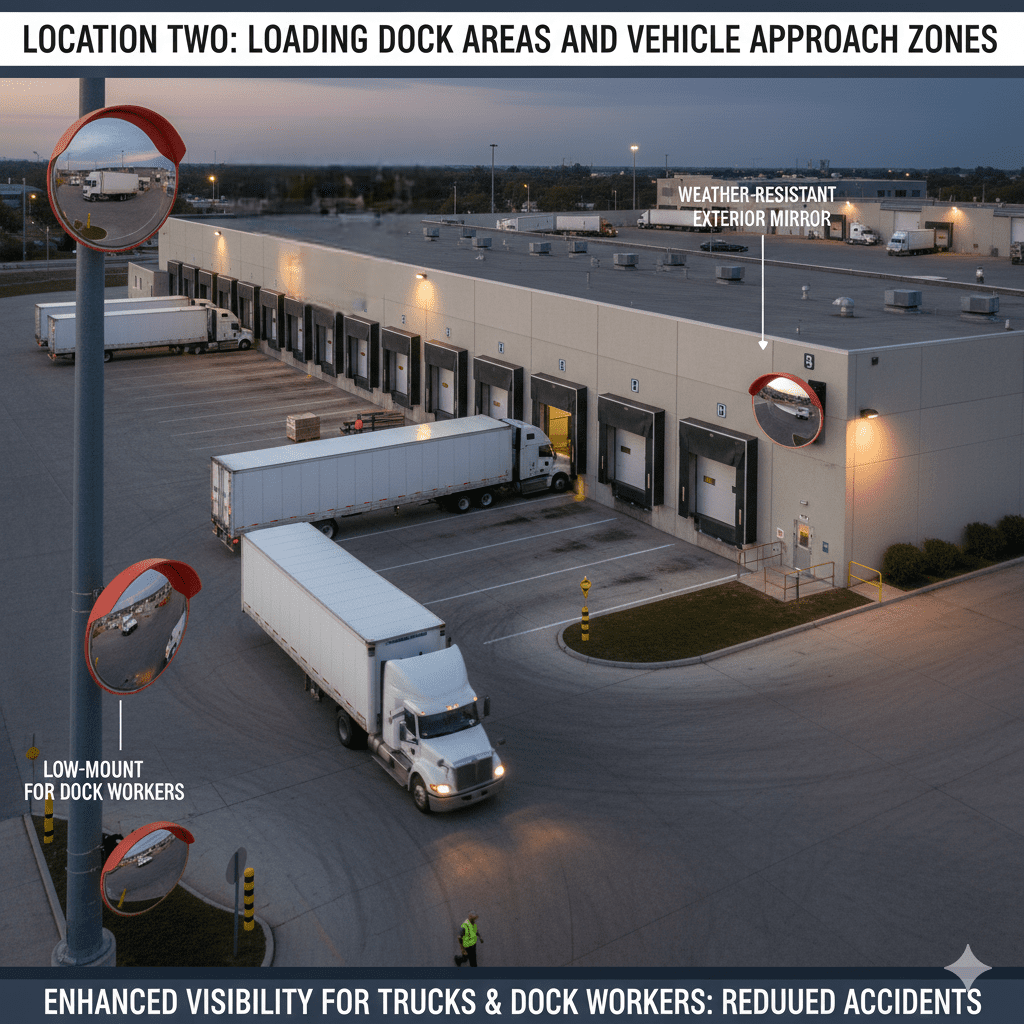
Loading docks represent critical facility interfaces where internal operations meet external transportation, creating complex safety challenges as trucks maneuver in confined spaces while dock workers conduct loading and unloading operations. The blind spots inherent in these environments prove particularly dangerous given the mass and momentum of commercial trucks operating in close proximity to workers on foot. Convex traffic safety mirrors positioned strategically around loading dock areas provide truck drivers with visibility of dock workers, pedestrians, and obstacles that would otherwise remain invisible in mirrors and camera systems integrated into truck cabs.
Interior dock positions benefit from convex security mirror installations allowing dock workers to monitor approaching trucks and adjacent dock positions without leaving their work areas. When multiple docks operate simultaneously, workers need awareness of activity at neighboring positions to coordinate movement of equipment and personnel safely. A dock worker operating a pallet jack needs to know when trucks are backing into adjacent positions before entering travel paths that might intersect with vehicle movements. Convex mirrors positioned to provide this peripheral awareness create the situational knowledge necessary for safe coordination of complex dock operations.
Exterior approach areas where trucks navigate from public roadways into dock yards require mirror coverage at entry points, curve approaches, and anywhere sight lines become obstructed by buildings, equipment, or landscape features. Drivers unfamiliar with facility layouts rely heavily on visibility aids to safely navigate tight quarters, and outdoor convex safety mirror installations positioned at critical decision points provide the visual information drivers need for confident maneuvering. These exterior mirrors must withstand weather exposure, requiring robust construction with UV-resistant materials and weather sealing protecting against precipitation and temperature extremes.
The substantial size of commercial trucks creates unique mirror positioning requirements, as drivers’ elevated cab positions and limited downward visibility create different sight line challenges than passenger vehicles present. Convex mirrors serving truck traffic should be positioned accounting for typical semi-truck cab heights of 10-12 feet, placing mirrors within the natural downward viewing angle that truck drivers can easily monitor without extreme head or eye movements. Some facilities install multiple mirrors at different heights serving both truck drivers and ground-level dock workers, ensuring comprehensive visibility for all personnel operating in dock environments.
Location Three: Retail Store Corners and High-Value Merchandise Areas
Retail environments face the dual challenge of preventing theft while maintaining welcoming atmospheres that encourage customer shopping behaviors. Traditional anti-theft measures such as prominent security cameras or intrusive employee monitoring can create uncomfortable shopping experiences that negatively impact sales, making convex security mirrors attractive alternatives providing theft deterrence through visibility without the oppressive atmosphere that obvious surveillance might create. Strategic mirror placement in retail environments serves both security and operational functions, simultaneously reducing theft opportunity and helping staff monitor customer service needs across the sales floor.
Store corners where merchandise displays create visual barriers represent primary theft vulnerability points requiring mirror coverage. Shoplifters actively seek locations where they can examine merchandise without direct staff observation, making corners and areas behind tall displays preferred operating locations. Convex security mirror installations positioned to provide staff sight lines into these hidden areas significantly reduce theft opportunity by eliminating the privacy that shoplifters require for concealing merchandise. The mere presence of mirrors serves deterrent functions even when staff aren’t actively monitoring them, as potential shoplifters cannot determine whether mirrors are under observation and must assume their actions remain visible.
High-value merchandise departments including electronics, jewelry, cosmetics, and designer apparel warrant particular attention for convex mirror deployment given the disproportionate financial impact of theft from these areas. While these departments typically receive more intensive staffing and surveillance than general merchandise areas, convex mirrors provide supplementary visibility that staff can monitor without requiring continuous direct observation of all high-value areas. This visibility flexibility allows staff to maintain customer service engagement while retaining peripheral awareness of potential theft activity through periodic mirror checks.
Dressing room approaches and exits represent another critical retail location requiring mirror coverage, as these areas experience high theft incidence due to the privacy they provide for removing security tags and concealing merchandise. While privacy concerns prevent direct observation of dressing room interiors, convex security mirrors monitoring approach corridors and exits allow staff to observe customers entering with merchandise and verify they exit with the same items. Unusual behaviors such as entering with multiple items but exiting with empty hands trigger intervention before losses occur rather than discovering theft during post-incident inventory reconciliation.
Backroom and storage area access points benefit from convex mirror installations allowing front-of-house staff to monitor who enters restricted areas without requiring direct visual contact with every entry event. Employee theft represents a significant source of retail losses, often exceeding external shoplifting in total financial impact. Mirrors providing visibility of restricted area access create passive monitoring discouraging opportunistic employee theft while supporting investigation efforts if losses occur and access patterns become relevant for identifying potential suspects.

Location Four: Parking Garage Exits and Blind Curve Approaches
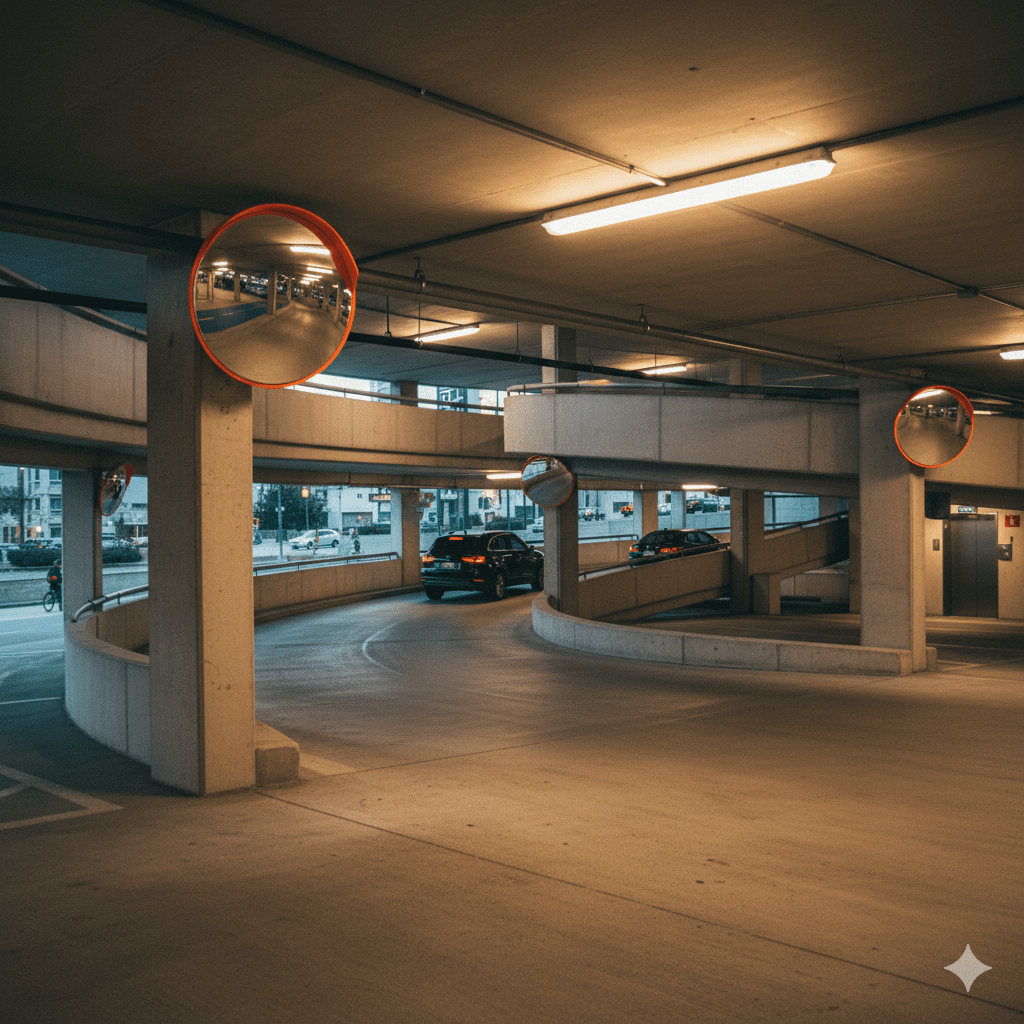
Parking structures present unique visibility challenges created by tight curve radii, limited lighting, concrete columns obstructing sight lines, and the interaction between exiting vehicles and pedestrian traffic. These conditions create frequent near-miss situations and periodic collisions that generate insurance claims, customer complaints, and liability exposure for facility operators. The strategic deployment of convex mirror for road safety applications within parking structures addresses these visibility challenges, providing drivers with advance warning of approaching vehicles, pedestrians, and obstacles that structural geometry keeps hidden until collision becomes unavoidable without intervention.
Exit ramps where vehicles transition from parking structure interiors to public streets or parking lots represent the highest-priority location for convex traffic mirrors in these facilities. Drivers exiting structures must merge with external traffic while navigating downgrade ramps that limit forward visibility, creating scenarios where mirrors become essential safety devices rather than optional enhancements. Large convex mirror installations at exit points show drivers approaching street traffic, pedestrians using adjacent sidewalks, and bicyclists that might be traveling in bike lanes adjacent to parking structure exits. The advance warning these mirrors provide allows drivers to time their exits safely rather than blindly entering traffic and hoping for safe gaps.
Interior ramp curves connecting different parking levels create blind approach scenarios where vehicles traveling in opposite directions on the same ramp cannot see each other until reaching the curve apex, creating head-on collision potential in facilities where ramp widths don’t accommodate simultaneous bidirectional travel. Convex mirrors positioned at curve approaches provide drivers visibility around curves before committing to entry, allowing them to yield if oncoming traffic occupies the curve. These mirrors prove particularly critical during peak usage periods when parking structure traffic density increases collision probability despite slower travel speeds.
Aisle intersections within parking levels where main circulation routes cross perpendicular parking aisles require mirror coverage similar to warehouse intersections, though the specific hazards differ. Rather than forklift-pedestrian conflicts, parking structures face vehicle-vehicle and vehicle-pedestrian conflicts as drivers search for spaces while pedestrians walk between vehicles toward building access points. Convex traffic safety mirrors at these intersections provide drivers searching for parking with awareness of crossing traffic and pedestrians, reducing conflicts that create both collision damage and customer frustration with facility safety.
Pedestrian stairwell and elevator exits opening directly onto parking levels create vulnerable points where people emerge into vehicle travel paths without ability to see approaching traffic. While signage and marked crosswalks address these hazards, convex mirrors positioned to show drivers approaching pedestrian exit points provide redundant protection ensuring drivers receive visual warning of potential pedestrian conflicts. This layered approach combining multiple safety measures proves more effective than relying solely on any single intervention, recognizing that distracted or inattentive drivers require multiple cues to ensure appropriate awareness and response.
Location Five: Industrial Production Floor Equipment Zones and Material Flow Paths
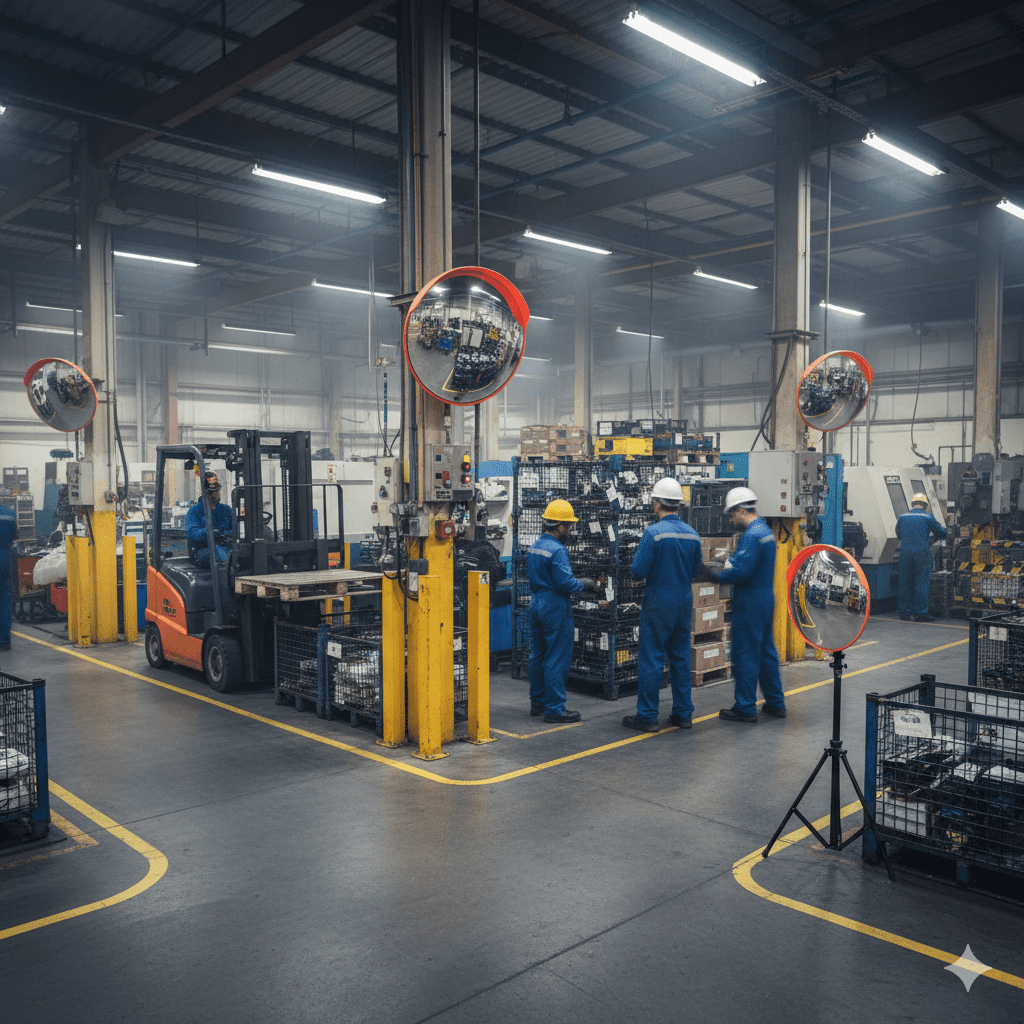
Manufacturing and industrial facilities feature equipment layouts, material storage configurations, and workflow patterns that create numerous blind spots where equipment operators, workers on foot, and material handling equipment converge without clear mutual visibility. These industrial environments prove particularly hazardous given the mass and power of production equipment, the focused attention workers direct toward their immediate tasks, and the noise levels that prevent workers from hearing approaching equipment or vehicles. Convex safety mirrors deployed strategically throughout production floors address these visibility challenges, creating awareness that helps prevent the crushing injuries, collisions, and near-misses that characterize poorly managed industrial traffic environments.
Production equipment corners where machines, assembly stations, or processing equipment create visual barriers require convex mirror coverage allowing workers to see around equipment before stepping into travel paths or equipment swing zones. Large industrial equipment often creates blind zones extending 10-20 feet or more, sufficient to completely hide approaching forklifts, workers, or other hazards from view. Mirrors positioned to show these blind zones transform them into monitored areas where workers can make informed decisions about when it’s safe to enter rather than taking unnecessary risks by stepping blindly into spaces where hazards might exist.
Material staging areas where raw materials, work-in-process inventory, or finished goods accumulate before transport to next production stages or shipping areas create congested zones with frequent equipment and worker movements. The combination of stacked materials restricting visibility and concentrated activity creates ideal conditions for collisions between equipment and workers or between multiple pieces of equipment converging on the same location. Convex blind spot mirror installations around staging areas provide operators and workers with expanded situational awareness, reducing conflicts through earlier detection of potential problems allowing proactive avoidance rather than reactive emergency responses.
Corridor intersections where main production floor circulation routes cross equipment access paths or connect different production zones require mirror coverage ensuring personnel and equipment traveling different routes can detect conflicts before entering intersection zones. Industrial facilities often develop informal traffic patterns as workers and operators identify preferred routes between frequently visited locations, and these organic patterns don’t always align with originally planned traffic flows. Regular observation of actual facility usage patterns helps identify intersection points requiring mirror coverage even if original facility layouts didn’t anticipate these locations becoming high-traffic convergence points.
Maintenance areas where equipment receives service, repairs, or adjustments create temporary blind spots that might not exist during normal production operations. When equipment access panels open, guards remove, or components detach for maintenance, they create visual barriers that weren’t present during equipment design or original facility layout. Portable convex mirrors that maintenance crews can temporarily deploy during service operations provide flexible visibility solutions addressing these transient blind spots without requiring permanent installations at locations that only occasionally need coverage.
Implementation Strategy and Success Factors
Successful implementation of convex security mirror programs requires systematic facility assessment identifying all significant blind spots, appropriate product selection matching mirrors to specific applications, professional installation ensuring optimal positioning and secure mounting, and ongoing maintenance preserving mirror effectiveness throughout service life. Organizations should begin with comprehensive facility walkthroughs involving operations personnel, safety staff, and potentially external consultants who bring fresh perspectives unburdened by familiarity that can cause permanent employees to overlook hazards they’ve learned to unconsciously navigate.
The assessment process should document each identified blind spot with photographs, measurements of viewing distances and coverage requirements, notes on traffic types using each location, and observations about lighting conditions that might affect mirror visibility. This documentation creates the foundation for appropriate product specifications and provides baseline information supporting future program expansion as facilities evolve or as additional blind spots become apparent through operational experience. Some organizations create facility maps marking all mirror installations with unique identifiers linking to detailed specification and maintenance records, creating systematic program management that prevents gaps and ensures consistent coverage.
Product selection should consider the specific requirements of each installation location rather than attempting to standardize on single mirror types for all applications. Outdoor installations requiring weather resistance need different specifications than indoor applications in climate-controlled environments. High-traffic areas experiencing frequent physical contact require more robust construction than protected locations where impact damage proves unlikely. Matching product specifications to actual operational requirements ensures installations deliver expected performance and longevity rather than experiencing premature failure from specifications inadequate for actual conditions.
Professional installation pays dividends through optimal positioning that maximizes coverage effectiveness and secure mounting that prevents displacement or position drift from vibration, impact, or environmental effects. While some organizations attempt to economize through internal installation using maintenance staff, the specialized knowledge that professional installers develop through extensive experience often results in superior outcomes justifying incremental costs. Professional installers understand subtleties about sight line optimization, mounting technique variations for different substrate types, and common installation errors that internal teams without specialized expertise might overlook.
Ongoing maintenance programs should include regular cleaning schedules, periodic inspection verifying mounting integrity and mirror condition, and prompt replacement of damaged or degraded mirrors ensuring continuous program effectiveness. Organizations should assign clear responsibility for mirror maintenance rather than assuming someone will naturally attend to it, as diffused accountability reliably results in neglect regardless of initial intentions. Some facilities incorporate mirror inspection into broader facility inspection protocols conducted by safety personnel or facility maintenance teams, ensuring systematic attention rather than reactive responses only when obvious problems emerge.
Measuring Return on Investment and Program Success
The value proposition for convex security mirror investments extends beyond simple cost-benefit calculations to encompass accident prevention, theft deterrence, insurance premium reduction, and operational efficiency improvements that prove difficult to precisely quantify but represent genuine economic benefits justifying program investments. Organizations can measure program success through multiple metrics including accident frequency reduction, security incident decreases, insurance claim costs, and qualitative feedback from workers and customers about perceived safety improvements.
Before-and-after accident tracking provides quantifiable evidence of mirror program effectiveness, comparing incident rates during periods before mirror installation with rates following implementation. While various factors beyond mirrors might influence accident trends, significant reductions following mirror deployment strongly suggest program effectiveness that justifies continued investment and potential expansion. Organizations should maintain detailed incident records including locations, circumstances, and contributing factors allowing analysis of whether mirror installations addressed specific hazard types and locations or whether residual hazards require additional interventions.
Loss prevention metrics in retail environments provide another quantifiable success measure, comparing shrinkage rates and theft incident frequencies before and after convex security mirror deployment in critical areas. While mirrors alone never eliminate retail theft, measurable shrinkage reduction following strategic mirror installation demonstrates program value and identifies whether expansion to additional locations might further improve results. Some retailers conduct formal studies installing mirrors in test stores while maintaining control stores without mirrors, allowing direct comparison of theft rates under otherwise similar conditions to isolate mirror effectiveness from other variables affecting shrinkage.
Insurance premium negotiations may benefit from documented convex mirror programs demonstrating proactive risk management that justifies rate reductions or prevents increases that might otherwise apply. While insurers rarely provide explicit premium discounts for specific security measures, comprehensive risk management programs incorporating multiple measures including strategic mirror deployment create negotiating leverage that may yield rate benefits. Organizations should document mirror programs through photographs, specifications, and maintenance records providing evidence of systematic risk management supporting insurance negotiations and defending against potential coverage disputes if claims occur.
The strategic deployment of convex security mirrors at these five critical facility locations represents cost-effective risk management that enhances safety, reduces theft, and improves operational efficiency through better situational awareness. Organizations approaching mirror deployment systematically, with thorough facility assessment, appropriate product selection, professional installation, and ongoing maintenance commitment, consistently realize substantial returns on relatively modest investments while creating safer, more secure environments protecting their most valuable assets, their people, their customers, and their property.
Looking for a custom convex mirror manufacturer or supplier? Struggling to find the right factory to bring your vision to life? We’ve got you covered! At our place, we craft top-quality convex mirrors with precision and care. Big or small, your needs are our mission. Let’s launch your mirror project and take your product line to the next level! Click here to contact