
Industrial facilities, commercial warehouses, and transportation infrastructure in seismic zones face unique challenges when implementing safety equipment. Convex mirrors, essential for blind spot elimination and traffic management in business operations, require specialized mounting solutions to maintain functionality during seismic events. B2B procurement teams and facility managers must understand the critical specifications and compliance requirements for mounting hardware in earthquake-prone regions to protect their infrastructure investments and ensure continuous operational safety.
Understanding Seismic Zone Classifications and Business Implications
Seismic zones are geographical areas classified by their earthquake risk levels, ranging from Zone 0 (minimal risk) to Zone 4 (highest risk) according to international building codes. For B2B buyers sourcing convex mirror systems, understanding your facility’s seismic classification directly impacts hardware selection, compliance obligations, and long-term total cost of ownership. Businesses operating in high-risk zones including California, Alaska, portions of the Pacific Northwest, and numerous international markets must prioritize seismic-rated mounting hardware to avoid equipment failure, liability exposure, and operational disruptions.
The International Building Code and local regulations mandate that non-structural components, including safety mirrors, must be adequately anchored to resist seismic forces. Corporate risk management teams increasingly recognize that inadequate mounting hardware can transform essential safety equipment into hazardous projectiles during seismic events, creating liability concerns and potential worker compensation claims. Forward-thinking procurement departments now include seismic performance specifications in their vendor qualification processes and RFP requirements.
Critical Hardware Components for Seismic Applications
Mounting hardware for convex mirrors in seismic zones consists of several interconnected components, each requiring careful specification to meet performance standards. B2B suppliers must evaluate base plates, pole mounting systems, wall brackets, and fastening assemblies as integrated systems rather than individual components.
Base Plate Engineering and Load Distribution
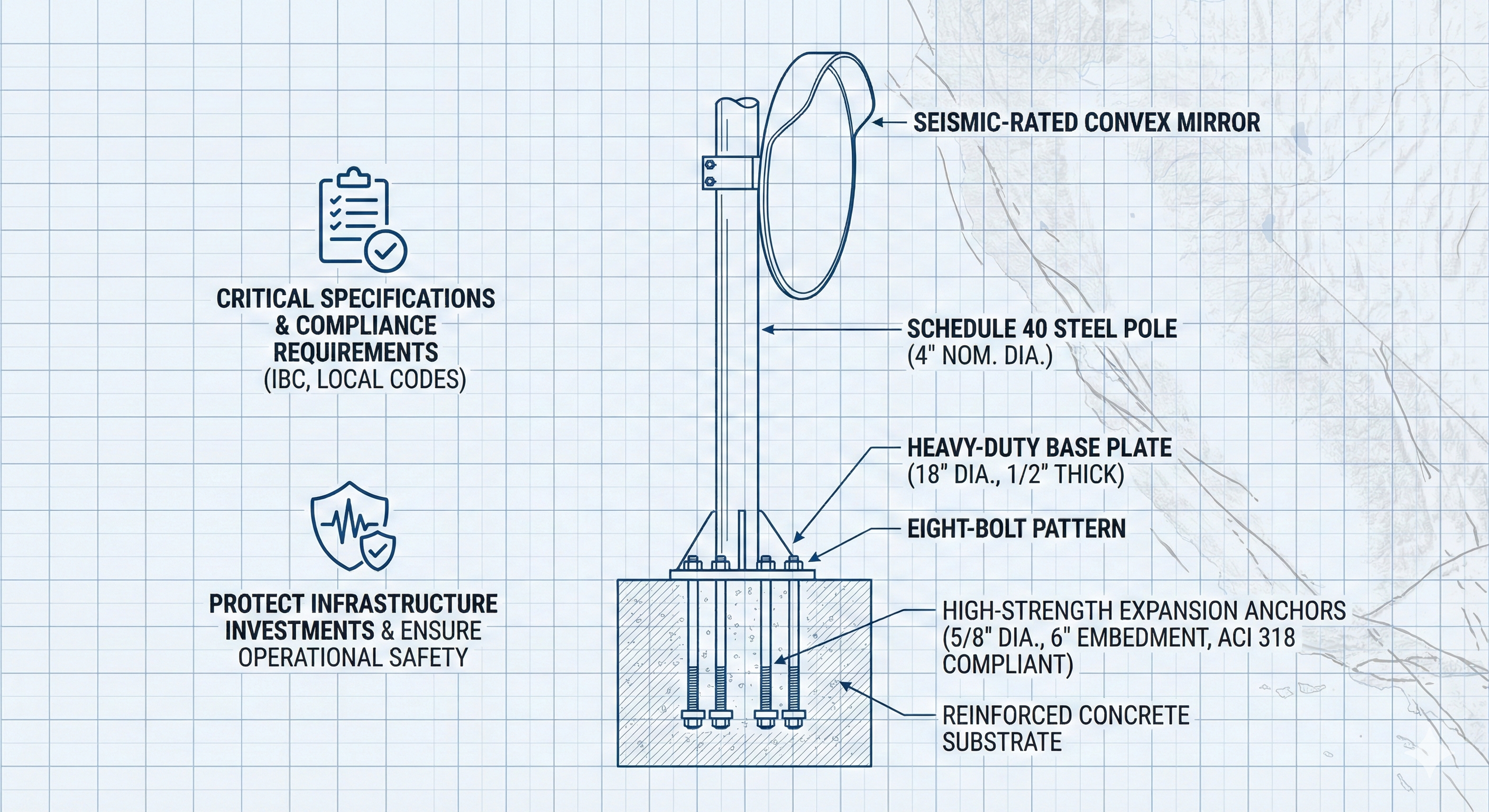
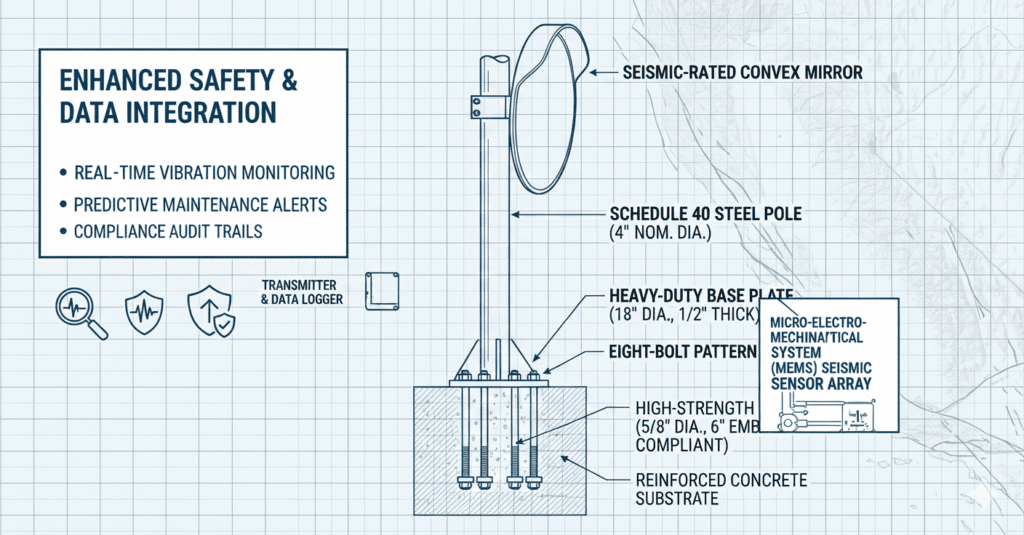
The foundation of any pole-mounted convex mirror system begins with the base plate, which must distribute seismic loads across a sufficient surface area to prevent concrete failure or asphalt degradation. Industrial-grade base plates for seismic applications typically feature reinforced steel construction with minimum thickness specifications of 3/8 inch for standard commercial applications and up to 1/2 inch for heavy industrial environments. The base plate diameter should provide adequate moment resistance, with most seismic-rated installations requiring plates between 12 to 18 inches in diameter depending on mirror size and expected wind loads.
B2B buyers should specify base plates with pre-drilled mounting holes arranged in patterns that optimize load transfer. Four-bolt patterns represent the minimum acceptable configuration, while six or eight-bolt arrangements provide superior performance in high seismic zones. The bolt circle diameter must be maximized within the plate dimensions to create longer moment arms that resist overturning forces during ground motion.
Anchor Bolt Specifications and Embedment Requirements
The connection between mounting hardware and the structural substrate represents the most critical failure point in seismic applications. Procurement specifications must address anchor bolt material grades, embedment depths, edge distances, and spacing requirements that comply with both ACI 318 concrete design standards and local seismic codes.
For concrete substrates, expansion anchors or epoxy-set threaded rods provide reliable performance when properly specified. High-strength steel with minimum yield strengths of 55,000 PSI ensures the fasteners themselves won’t fail before the concrete substrate. Embedment depth calculations must account for both tension and shear loads, with typical installations in seismic zones requiring depths of 4 to 6 inches for 1/2-inch diameter anchors and proportionally deeper for larger fasteners.
Chemical adhesive anchors offer superior performance in cracked concrete conditions common in seismic zones, providing consistent holding strength even when substrate integrity has been compromised by previous seismic activity. B2B buyers should specify adhesive systems that have been tested according to ICC-ES AC308 protocols, which specifically address performance in cracked concrete under seismic loading conditions.
Pole Mount Design and Flexibility Considerations
The vertical support pole connecting the base plate to the mirror housing must balance rigidity with controlled flexibility. Rigid poles transmit higher forces to the foundation, potentially causing anchor failure, while excessively flexible poles create excessive deflection that compromises mirror effectiveness. Industrial convex mirror suppliers serving the B2B market typically offer poles in schedule 40 steel pipe ranging from 2-inch to 4-inch nominal diameter.
Seismic design principles favor poles with controlled flexibility achieved through proper material selection and cross-sectional properties. Procurement teams should specify poles with continuous welded construction rather than sectional assemblies that create potential failure points at joints. The connection between pole and base plate must utilize full-penetration welds or heavy-duty mechanical fasteners that exceed the structural capacity of the pole itself, ensuring failure occurs in a predictable, ductile manner rather than through sudden brittle fracture.
Wall-Mounted Systems and Structural Attachment
Wall-mounted convex mirrors present different engineering challenges in seismic zones, requiring hardware that accounts for both vertical seismic forces and the amplification effects that occur in upper building levels. B2B facility managers must coordinate with structural engineers to identify appropriate mounting locations and evaluate the adequacy of existing structural elements to support mirror assemblies under seismic loading.
Bracket Design and Load Path Engineering
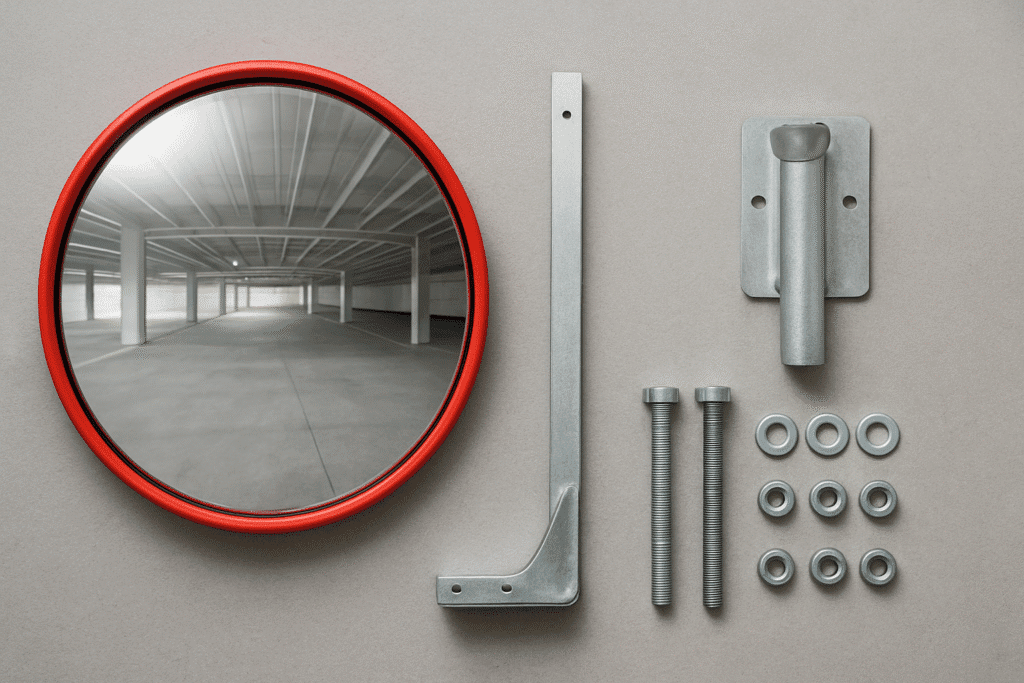
Wall brackets for seismic applications must create a clear load path from the mirror assembly through the bracket structure into the building’s lateral force-resisting system. Cast aluminum brackets common in standard commercial applications may not provide adequate strength for seismic zones, making fabricated steel brackets the preferred specification for B2B procurement in high-risk areas.
The bracket arm length affects the overturning moment applied to wall fasteners, with longer arms creating proportionally higher demands. Procurement specifications should limit bracket projections to 18 inches unless engineering calculations demonstrate adequate capacity. The bracket-to-mirror connection should utilize vibration-resistant hardware including lock washers, nylon-insert locknuts, or mechanically deformed threads that maintain pre-load under cyclic loading.
Structural Substrate Evaluation and Fastener Selection
The adequacy of wall-mounted mirror systems depends critically on the structural substrate and fastener compatibility. Concrete and concrete masonry unit walls provide reliable substrates when proper anchors are specified, while hollow metal studs and wood framing require specialized fasteners and potential reinforcement to achieve seismic performance.
For CMU walls, specifications should require fastening into grouted cells with through-bolt installations that engage both faces of the wall assembly. This configuration prevents the localized crushing that can occur with expansion anchors in the face shells. B2B buyers should verify that contractors have identified grouted cells through non-destructive testing methods before drilling, as anchor performance in ungrouted cells is inadequate for seismic applications.
Steel stud walls present particular challenges for mounting heavy convex mirrors, as the thin material gauge and wide spacing limit load capacity. Remedial solutions include installing steel plate reinforcement behind mounting locations, specifying backup structural members at mirror locations during initial construction, or utilizing specialty toggle bolts rated for seismic applications. Corporate purchasing departments should engage structural engineers early in the specification process when wall-mounted mirrors are planned for steel stud construction.
Material Selection and Corrosion Resistance
Seismic zones frequently coincide with coastal environments or industrial facilities where corrosive conditions accelerate hardware deterioration. B2B procurement strategies must balance initial costs against lifecycle performance, recognizing that hardware failure due to corrosion creates the same safety hazards as inadequate seismic design.
Hot-dip galvanized steel provides economical corrosion protection suitable for most commercial environments, with typical coating thicknesses of 3.0 mils offering 20 to 30 years of service life in moderate exposure conditions. For harsh industrial environments or coastal installations within three miles of saltwater, stainless steel hardware becomes cost-effective when total lifecycle costs are considered. Type 304 stainless steel serves most applications adequately, while Type 316 with molybdenum content provides superior resistance in chloride-rich environments.
Fastener material specifications must match or exceed the corrosion resistance of visible hardware components. Galvanic corrosion occurs when dissimilar metals contact in the presence of an electrolyte, accelerating degradation of the more anodic material. B2B buyers should specify consistent material systems, using stainless steel fasteners with stainless brackets and galvanized fasteners with galvanized poles to prevent accelerated corrosion at critical connections.
Compliance Documentation and Quality Assurance
Corporate procurement departments face increasing pressure to demonstrate due diligence in equipment selection, particularly for safety-critical applications in seismic zones. Comprehensive documentation of hardware specifications, engineering calculations, and compliance with applicable codes creates defensible procurement records while facilitating facility audits and insurance reviews.
B2B suppliers should provide technical submittals that include material certifications, engineering calculations demonstrating code compliance, and installation instructions specific to seismic applications. Third-party testing reports from accredited laboratories add credibility to performance claims and provide objective evidence of seismic adequacy. Procurement contracts should include language requiring suppliers to maintain professional liability insurance and provide sealed engineering calculations when requested by the purchasing organization or their consultants.
Installation quality assurance represents the final critical element ensuring that properly specified hardware performs as intended. Facility managers should implement inspection protocols verifying anchor embedment depths, torque values on fastener assemblies, and proper installation sequences for chemical adhesive systems. Photographic documentation of installations creates valuable records for future reference and demonstrates organizational commitment to safety compliance.
Vendor Qualification and Supply Chain Considerations
Selecting qualified suppliers for seismic-rated convex mirror mounting hardware requires evaluation beyond traditional price and delivery criteria. B2B procurement teams should assess vendors’ technical capabilities, quality management systems, and experience with seismic applications when developing approved supplier lists.
Vendor engineering support capabilities become particularly important for custom applications or challenging installation conditions. Suppliers with in-house engineering resources can provide application-specific calculations, review existing structural conditions, and recommend modifications to standard products that optimize performance while controlling costs. This technical partnership approach creates value beyond commodity pricing competition, making it an important consideration in vendor selection matrices.
Supply chain resilience for critical safety components deserves attention in procurement planning. Sole-source dependencies create vulnerability to supply disruptions that could delay facility openings or leave existing installations incomplete. B2B buyers should maintain relationships with multiple qualified suppliers and specify standard product configurations when possible to maximize sourcing flexibility without compromising seismic performance requirements.
Conclusion *Strategic Procurement for Seismic Safety*
Convex mirror mounting hardware selection for seismic zones represents a complex procurement challenge requiring technical knowledge, regulatory awareness, and lifecycle cost analysis. B2B organizations that invest in proper hardware specifications, qualified supplier partnerships, and rigorous installation quality assurance create safer facilities while managing liability exposure and protecting their infrastructure investments.
The incremental cost of seismic-rated mounting hardware represents a small fraction of total facility development costs while providing substantial risk mitigation value. Forward-thinking procurement professionals recognize that comprehensive hardware specifications tailored to local seismic conditions create competitive advantages through reduced maintenance costs, extended equipment service life, and enhanced organizational safety culture. As seismic building codes continue to evolve and enforcement becomes more stringent, organizations with established expertise in seismic-rated equipment procurement will be better positioned to execute facility projects efficiently while maintaining full regulatory compliance.
Looking for a custom convex mirror manufacturer or supplier? Struggling to find the right factory to bring your vision to life? We’ve got you covered! At our place, we craft top-quality convex mirrors with precision and care. Big or small, your needs are our mission. Let’s launch your mirror project and take your product line to the next level! Click here to contact