
One of the most consistent mistakes in convex mirror procurement is treating the purchase price as the total cost of the decision. It is not. The unit price at the point of order is only the first line in a cost equation that plays out across years of service, maintenance intervals, inspection cycles, and eventual replacement. Procurement managers who budget exclusively on the basis of unit price tend to discover the full cost of their decision somewhere between twelve and thirty-six months after the mirrors go into service, when degraded lenses, corroded brackets, or structural failures begin generating unplanned replacement orders.
Understanding convex mirror lifespan expectations, and what drives those lifespans up or down across different product grades and deployment environments, gives procurement managers the information they need to build a realistic total cost of ownership model rather than a purchase price comparison. This article breaks down what to expect from convex mirrors across product categories, environments, and quality tiers, and what that means for multi-year procurement budgeting.
Why Lifespan Varies So Dramatically Between Products
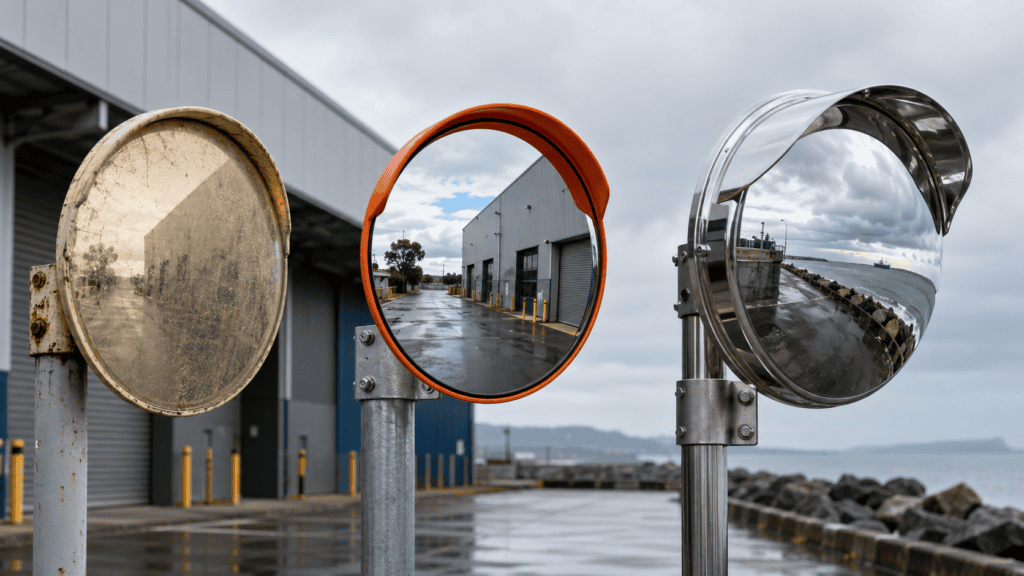
The convex mirror market spans an enormous range of product quality, and that quality range translates directly into a correspondingly large range of service life outcomes. A premium-grade outdoor polycarbonate convex mirror, correctly specified for its deployment environment and properly installed, can deliver eight to ten years of reliable optical performance before replacement is warranted. A budget-grade mirror deployed in the same environment may require replacement within eighteen to thirty months.
That difference is not marginal. It changes the entire cost structure of a multi-site procurement program. Premium mirrors typically last eight to ten years outdoors, while cheaper mirrors are typically replaced two to four times over the same period, making their total lifecycle cost equal to or higher than the premium product despite the lower unit price. The drivers of that performance gap are consistent and well understood: lens material and thickness, UV stabilization quality, backing and frame construction, sealing integrity, and mounting hardware specification.
Lens Material as the Primary Lifespan Driver
The reflective lens is where convex mirror lifespan is most directly determined, and the choice of lens material is the single most important specification decision a procurement manager can make for outdoor applications.
Acrylic (PMMA) lenses deliver excellent optical clarity and are well-suited to indoor and covered environments where UV exposure is minimal. In fully exposed outdoor conditions, however, acrylic without UV stabilization will begin yellowing and hazing under prolonged sun exposure, with visible optical degradation typically appearing within two to four years in high-UV environments. Even UV-stabilized acrylic performs better indoors than out, and most technical specifications place its outdoor UV durability at three to five years under direct sunlight.
Polycarbonate (PC) lenses, when manufactured with proper UV stabilization, deliver five to seven years of outdoor UV durability as a standard specification. Premium polycarbonate mirrors with Grade 8 UV stabilization per ISO 4892 can extend that further, and the material’s significantly higher impact resistance compared to acrylic means that physical damage from debris, vehicle contact, or vandalism is far less likely to cause premature failure.
Stainless steel reflective surfaces represent the top of the durability range. Stainless steel dome mirrors and convex mirrors with electro-polished stainless steel reflective faces can last fifteen years or more in outdoor environments, including coastal and marine-adjacent locations where polymer lenses face additional degradation challenges from salt air exposure. The trade-off is a higher unit price and somewhat lower optical clarity than a premium polycarbonate lens, but for applications demanding maximum service life with minimal maintenance, stainless steel is the specification to reach for.
Lifespan Expectations by Deployment Environment
Product grade alone does not determine convex mirror lifespan. The deployment environment exerts an equally powerful influence on how quickly a given product reaches the end of its useful service life.
Controlled Indoor Environments
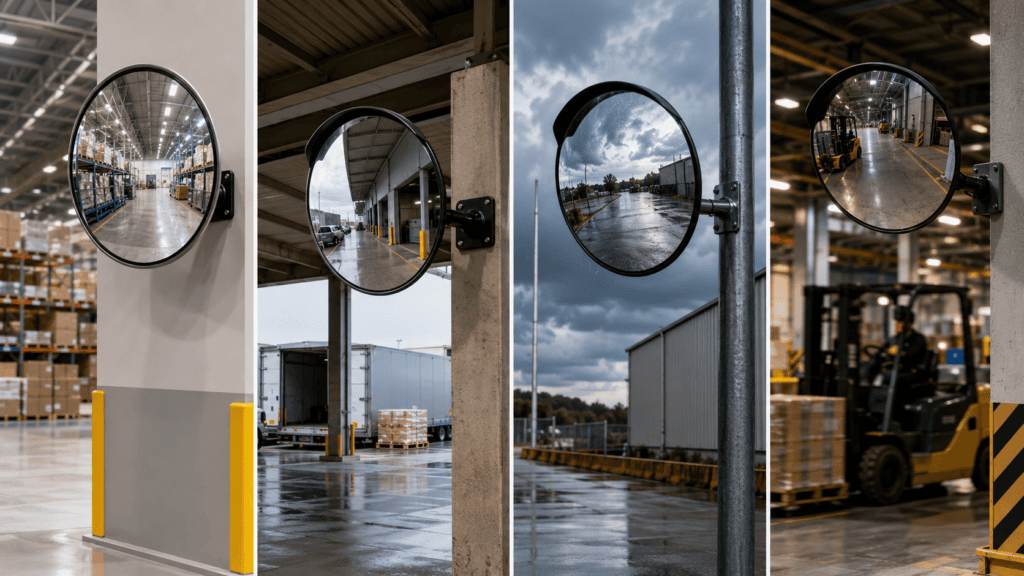
Indoor convex mirrors deployed in warehouses, retail facilities, hospitals, office buildings, and similar controlled environments face the most benign set of operating conditions. Without UV exposure, temperature extremes, or weather, the primary drivers of indoor mirror degradation are physical contact and cleaning practices. A good-quality acrylic indoor convex mirror in a well-managed facility with appropriate cleaning protocols can remain in service for ten years or more without meaningful optical degradation.
For budgeting purposes, procurement managers responsible for large indoor mirror networks across multi-site retail or logistics operations should plan on an average service life of eight to twelve years for standard-grade acrylic mirrors, with earlier replacement at high-traffic locations where physical contact is more frequent.
Covered Outdoor and Transitional Environments
Locations that are outdoors but partially sheltered, such as covered loading docks, parking structure interior levels, or building overhang zones, occupy a middle category. These environments expose mirrors to higher humidity and temperature cycling than fully indoor locations, but direct UV exposure and rainfall are limited or absent.
In these transitional environments, a UV-stabilized polycarbonate mirror will typically deliver a service life of seven to ten years. An acrylic mirror in the same location, without the UV stabilization that polycarbonate provides, will perform adequately given the reduced UV exposure, and a service life of five to eight years is a reasonable budget assumption for procurement planning.
Fully Exposed Outdoor Environments
This is where lifespan budgeting becomes most critical and where the gap between product grades is most consequential. Fully exposed outdoor locations subject convex mirrors to direct UV radiation, rainfall, frost and freeze-thaw cycling, wind loading, and in many environments, road salt spray, industrial atmospheric pollutants, or coastal humidity.
A premium-grade UV-stabilized polycarbonate convex mirror with a sealed ABS or HDPE backing and galvanized steel or stainless steel mounting hardware should be budgeted at a service life of seven to ten years in a standard outdoor environment. Budget-grade products in the same conditions should be planned at two to four years, based on consistent field performance data from installers and facility managers across the industry.
For coastal and marine-adjacent outdoor locations, even premium polycarbonate mirrors may experience accelerated frame corrosion if the backing and hardware are not specified with marine-grade materials. Stainless steel Grade 316 framed mirrors in coastal environments can be budgeted at ten to fifteen years of service life, which is the most cost-effective specification for high-exposure maritime locations when total lifecycle cost is the evaluation metric rather than unit price.
High-Impact Industrial Environments
Warehouses with active forklift operations, container terminals, construction sites, and manufacturing facilities with heavy vehicle movement present a different degradation challenge. In these environments, physical impact damage is the primary cause of premature mirror failure rather than material degradation. A lens that survives ten years of UV exposure in a standard outdoor location may be damaged by a single forklift mirror strike at a busy warehouse intersection.
For high-impact industrial environments, polycarbonate lenses are non-negotiable. The significantly higher impact resistance of polycarbonate compared to acrylic, roughly fifteen times stronger under impact, dramatically reduces the frequency of impact-driven replacement. Procurement managers budgeting for industrial facility convex mirrors should plan on a baseline service life of five to eight years for polycarbonate mirrors in high-traffic locations, with individual unit replacement rates of five to ten percent per year driven by impact damage rather than material degradation.
What Drives Early Failure: The Cost of Specification Errors
Understanding where convex mirrors fail prematurely is as important as understanding average lifespan expectations, because premature failure is almost always driven by a specification or installation error rather than by a product reaching its natural end of life.
Undersized Mounting Hardware
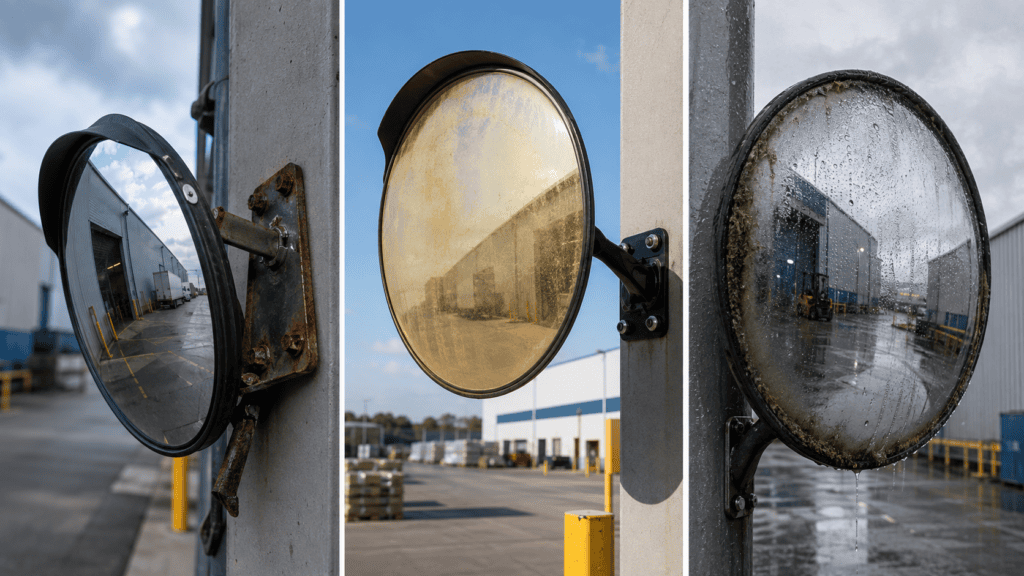
One of the most common sources of premature convex mirror failure is not the mirror itself but the bracket and mounting hardware. Light-gauge pressed steel brackets that flex under wind loading, carbon steel fasteners that rust through within two to three years of outdoor exposure, and pole clamp brackets that are not rated for the mirror diameter they are carrying all generate failures long before the mirror lens or frame would have reached the end of their service life. When a mounting failure occurs, the mirror itself is often undamaged and would have continued performing for years. The cost of the incident, including the replacement hardware, the labour to reinstall, and any safety gap during the period the mirror was not functional, is entirely avoidable with correct hardware specification from the outset.
Wrong Material for the Environment
Deploying an indoor-rated acrylic mirror in an outdoor location is the most straightforward specification error, and it is more common than it should be in large-scale procurement programs where category management teams are sourcing mirrors across diverse facility types without distinguishing between deployment environments. The lens degradation timeline in this scenario is predictable and well-documented: visible yellowing within one to two years, significant hazing within three years, and optical performance below any useful functional threshold by year four in high-UV climates.
Similarly, deploying a standard-grade polycarbonate mirror with a galvanized steel backing in a coastal location, where the steel backing will begin corroding from salt air within two to three years, is a specification error that produces unnecessary early replacement costs.
Inadequate Sealing
The seal between lens and frame is a detail that rarely appears in procurement specifications but has a disproportionate impact on outdoor mirror service life. When the lens-to-frame seal fails, water ingress follows. In cold climates, water trapped between lens and frame expands on freezing and progressively breaks the lens-to-frame bond, leading to structural failure of the mirror assembly. In humid climates, water ingress creates conditions for algal and mould growth on the reflective surface, permanently degrading optical clarity. A properly sealed outdoor convex mirror specified to IP65 or better avoids this failure mode entirely.
Building a Realistic Procurement Budget
Translating lifespan expectations into a procurement budget requires a straightforward total cost of ownership model rather than a unit price comparison. The model should include the initial purchase price per unit, the installation cost per unit, the expected service life in years for the specified product in the specific deployment environment, annual maintenance cost including cleaning and inspection, and the replacement unit cost and installation cost at end of service life.
When that model is applied across a multi-site network with a mix of indoor, covered outdoor, and fully exposed outdoor locations, the cost difference between correctly specifying each location and defaulting to a single product grade across all locations becomes visible. Networks that apply outdoor-grade specification to indoor locations pay a premium they do not need. Networks that apply indoor-grade or budget-grade products to outdoor locations pay far more in replacement costs over five to ten years than the upfront saving on unit price would suggest.
For large-scale procurement programs covering hundreds or thousands of convex mirror installations across diverse facility types, the investment in a detailed specification review before the purchase order is placed consistently delivers a lower total cost of ownership than any unit price negotiation can achieve on its own.

Maintenance Intervals and Inspection Planning
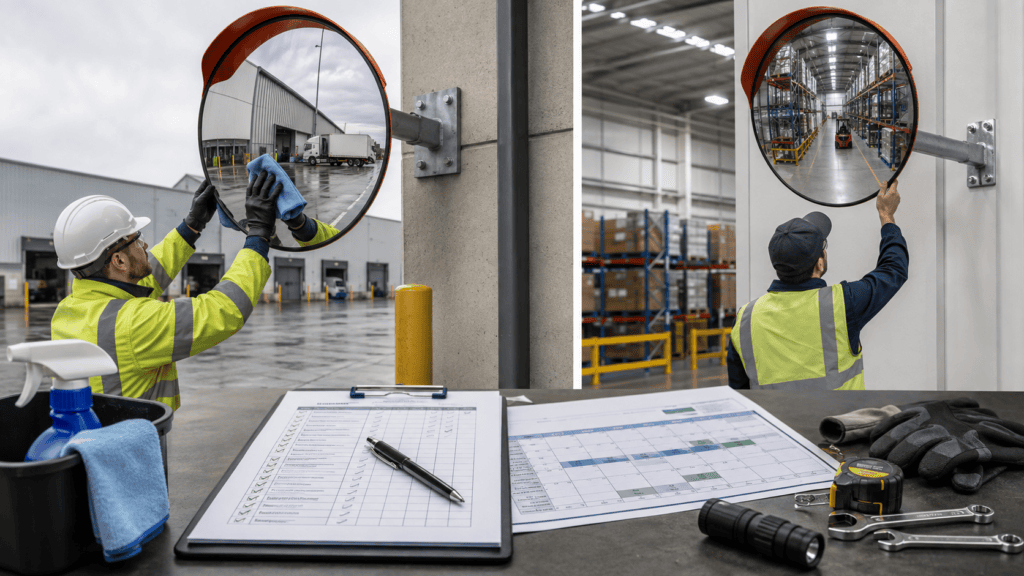
Even the highest-quality convex mirrors require periodic maintenance to perform reliably across their full service life. Procurement budgets that account for purchase and installation but not for maintenance tend to produce facilities where mirrors are cleaned reactively rather than on schedule, where hardware degradation goes unnoticed until a structural failure occurs, and where optical performance declines gradually below functional thresholds without triggering replacement until the degradation is severe.
A realistic maintenance budget for an outdoor convex mirror network should include quarterly lens cleaning at exposed locations, annual hardware inspection covering bracket integrity, fastener condition, and mounting pole stability, and a planned replacement allowance of five to eight percent of the total mirror count per year to cover impact damage, installation failures, and end-of-life units identified during annual inspection.
For indoor mirror networks in clean, controlled environments, semi-annual cleaning and biennial hardware inspection is a more appropriate maintenance cadence, with a planned replacement allowance of two to three percent per year.
These maintenance cost inputs, when built into the total procurement budget from the outset, produce a realistic and defensible multi-year cost model that finance and operations stakeholders can plan against without being surprised by unplanned replacement expenditure.
The Budget Case for Getting Specification Right
The commercial argument for investing in correct specification rather than lowest unit price is not complicated. A premium-grade outdoor convex mirror that costs more per unit at purchase but delivers eight to ten years of service before replacement produces a lower annualized cost than a budget product that delivers two to three years of service before it needs to be replaced, even before installation labour costs are factored into each replacement cycle.
Procurement managers who present a total cost of ownership model rather than a unit price comparison to their budget approval process consistently find that the case for correct specification is straightforward to make on financial grounds. The challenge is rarely convincing the approving authority that quality matters. The challenge is having the lifespan data, replacement cost assumptions, and maintenance cost inputs in hand to build the model. This article provides that foundation. The specification decisions that follow from it will determine whether a convex mirror procurement program delivers reliable safety performance at a predictable total cost, or generates a cycle of premature replacements that costs more than anyone budgeted for.
Looking for a custom convex mirror manufacturer or supplier? Struggling to find the right factory to bring your vision to life? We’ve got you covered! At our place, we craft top-quality convex mirrors with precision and care. Big or small, your needs are our mission. Let’s launch your mirror project and take your product line to the next level! Click here to contact