
Property managers and facility directors evaluating speed control solutions face fundamental decisions about materials that significantly impact installation costs, long-term maintenance requirements, and total ownership expenses over multi-decade planning horizons. The choice between concrete speed bumps and plastic speed bumps represents more than simple material preference, encompassing installation complexity, durability expectations, environmental suitability, and lifecycle cost considerations that collectively determine which option delivers superior value for specific applications. Understanding the comprehensive investment implications of each material enables informed decision-making that optimizes both immediate budget allocation and long-term financial performance while ensuring effective speed control throughout equipment service lives.
Initial Cost Analysis and Installation Expense Comparison
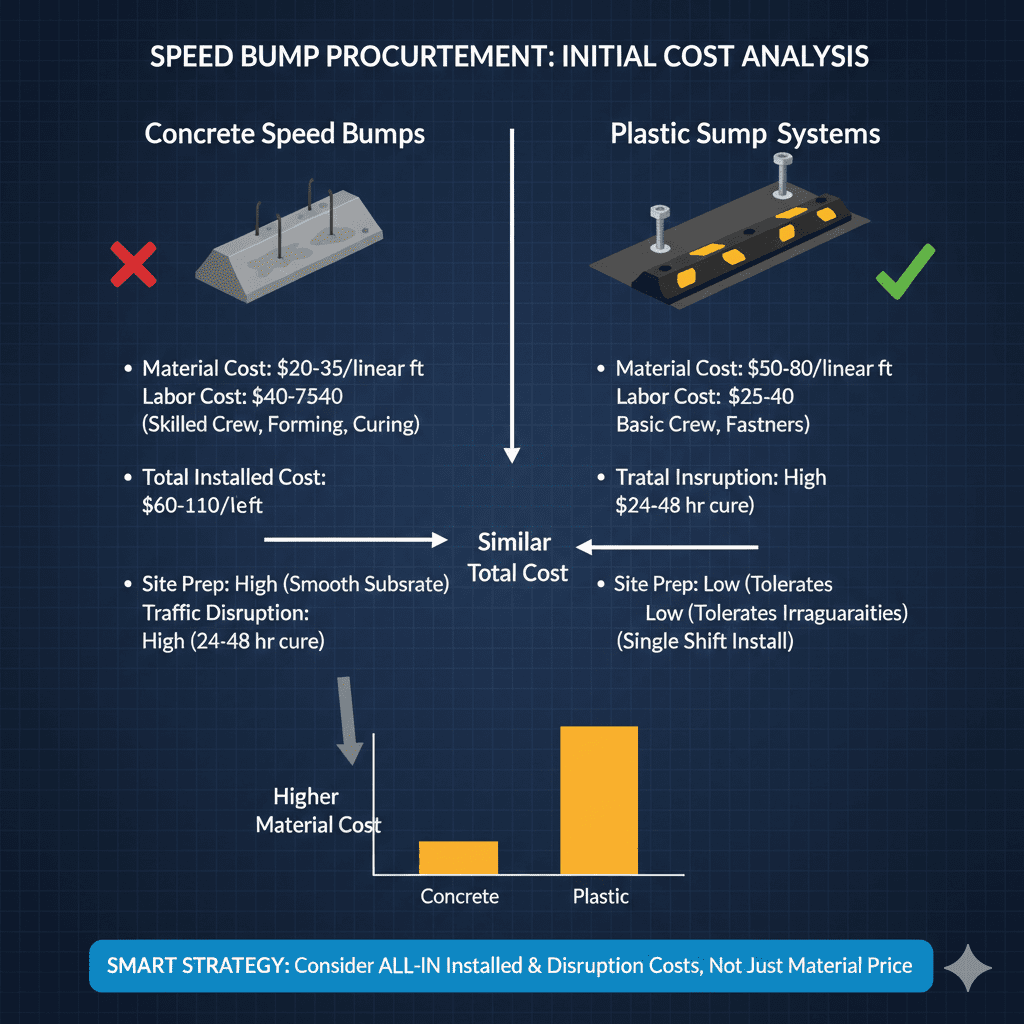
Concrete speed bumps carry lower material costs per linear foot than quality plastic alternatives, with raw concrete typically costing $20-35 per foot of coverage versus $50-80 per foot for durable plastic speed bump systems. This substantial material cost advantage initially suggests concrete represents the economical choice, though comprehensive cost analysis must extend beyond material pricing to encompass installation labor, equipment requirements, and site preparation demands that differ dramatically between materials. Professional concrete installation requires skilled crews, specialized equipment, substrate preparation, curing time, and often significant traffic disruption during multi-day installation processes.
Installation labor for concrete speed bumps typically ranges $40-75 per linear foot depending on site conditions, access constraints, and regional labor rates, bringing total installed costs to $60-110 per foot when materials and labor combine. Plastic systems installed by competent crews generally require $25-40 per foot for labor given simpler mounting procedures that avoid concrete mixing, forming, pouring, and curing processes. Despite higher material costs, plastic speed bump total installation expenses often approximate $75-120 per foot, remarkably similar to concrete installations when all costs are properly accounted despite the seemingly dramatic material cost differentials that superficial comparisons highlight.
Site preparation requirements differ substantially, with concrete installations demanding smooth, clean substrates that may necessitate asphalt repairs, grinding, or cleaning beyond what plastic mounting requires. Plastic systems utilize mechanical fasteners penetrating existing pavement, accommodating minor substrate irregularities that would compromise concrete adhesion or create unacceptable finished appearance. Organizations facing substrate condition issues should evaluate whether concrete installations require supplementary repairs that plastic systems avoid, potentially offsetting material cost advantages through higher preparation expenses that project estimates sometimes overlook.
Traffic disruption costs during installation represent hidden expenses that concrete and plastic options impose differently. Concrete installations requiring 24-48 hours for curing force extended closures that interrupt facility operations, inconvenience customers, or necessitate expensive traffic accommodation measures routing vehicles through alternative pathways. Plastic installations completed in single work shifts minimize operational disruption, creating productivity benefits that formal cost analysis should recognize even when difficult to quantify precisely. Facilities operating 24/7 or serving time-sensitive operations should particularly value installation speed that plastic systems provide.
Durability Expectations and Replacement Cycle Economics
Concrete speed bumps properly installed in suitable environments deliver exceptional longevity, often providing 15-25 years of service before deterioration necessitates replacement or major repairs. This extended service life results from concrete’s inherent durability, resistance to UV degradation, and ability to withstand heavy traffic loads without structural failure. However, concrete’s brittleness creates vulnerability to cracking from freeze-thaw cycles, substrate movement, or impact damage from snowplows, potentially requiring repairs or premature replacement in challenging environments despite material’s theoretical longevity.
Plastic speed bumps utilizing quality materials and robust construction typically deliver 10-15 years of service in appropriate applications, somewhat shorter than concrete but still representing substantial lifecycles justifying initial investments. Modern plastic formulations incorporate UV inhibitors, impact-resistant compounds, and weather-resistant additives that dramatically improved performance beyond early-generation plastic products that degraded rapidly in outdoor environments. Organizations evaluating plastic options should specify premium materials rather than economy grades that sacrifice durability for lower initial costs, as material quality significantly influences actual service life and lifecycle cost-effectiveness.
The calculation of annualized ownership costs accounting for different replacement cycles reveals that material longevity differences prove less decisive than initial cost comparisons suggest. Concrete installations costing $85 per foot and lasting 20 years represent $4.25 annual equivalent cost, while plastic systems costing $95 per foot with 12-year service life yield $7.92 annual cost. While concrete shows advantage in this comparison, the differential of $3.67 per foot annually proves quite modest relative to total facility operating budgets, suggesting that other factors beyond simple longevity economics should inform material selection decisions.
Repair and partial replacement economics also differ, with concrete repairs often requiring removing and replacing substantial sections even when damage remains localized due to monolithic construction making targeted repairs impractical. Plastic modular systems allow replacing individual damaged sections without disturbing adjacent units, potentially extending overall system life through progressive replacement of worn sections while preserving functional components. This repair flexibility provides practical advantages that lifecycle models focusing solely on complete replacement cycles may not adequately capture.
Environmental Suitability and Performance Under Challenging Conditions
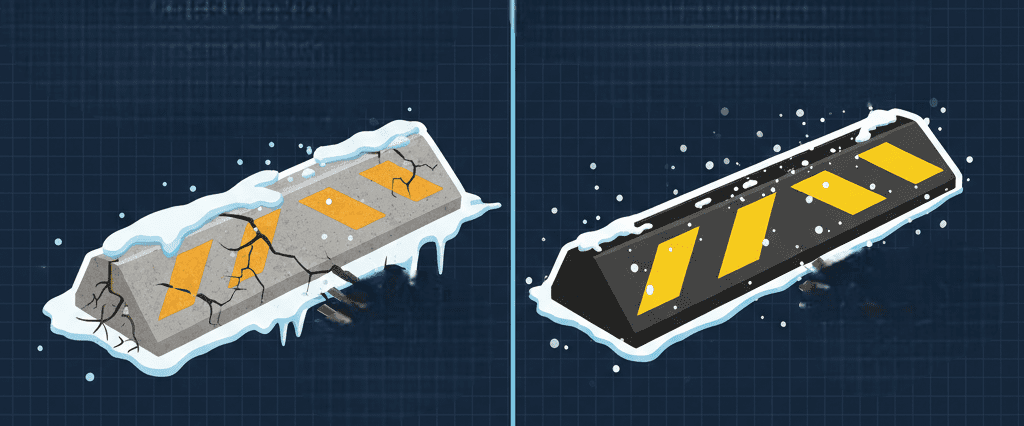
Climate conditions profoundly affect material performance, with concrete and plastic exhibiting different vulnerabilities to environmental stresses. Concrete speed bumps in freeze-thaw climates experience progressive deterioration as water infiltrates microscopic cracks, freezes, expands, and gradually enlarges damage until structural integrity fails. Properly installed concrete with adequate air entrainment and sealing can resist freeze-thaw damage, but poor installation or deferred maintenance allows moisture infiltration that accelerates deterioration. Organizations in northern climates should carefully evaluate concrete specifications and installation quality rather than assuming all concrete installations deliver equivalent cold-weather performance.
Plastic speed bumps avoid freeze-thaw vulnerability since polymers don’t absorb water and remain flexible across temperature ranges rather than experiencing the brittle failure that concrete sustains during freezing. However, extreme cold can reduce plastic flexibility, making materials more susceptible to impact damage from snowplow contact or vehicle strikes during winter months when brittle plastics crack rather than flexing. UV exposure in high-sun environments creates gradual degradation that quality plastics resist through UV inhibitors but that can eventually cause brittleness, fading, and structural weakness if inferior materials were specified or if service life extends beyond design parameters.
Chemical exposure from road salt, de-icing compounds, oil, and fuel creates material challenges that concrete and plastic address differently. Concrete proves vulnerable to salt infiltration causing rebar corrosion and concrete spalling, though plastic systems avoid this failure mode entirely. Conversely, certain chemicals degrade specific plastic formulations while leaving concrete unaffected, making material selection dependent on anticipated exposure conditions. Facilities near industrial operations using aggressive chemicals should consult with suppliers about chemical resistance rather than assuming either material universally resists all potential exposures.
Snowplow damage represents a significant consideration for facilities in snow-prone regions, as plow blade strikes can destroy both concrete and plastic speed bumps if equipment operators fail to exercise adequate caution. Concrete typically shatters catastrophically when struck, often requiring complete replacement of damaged sections. Plastic systems may survive moderate impacts through material flexibility, though severe strikes still cause breakage requiring repair. Some organizations in heavy-snow regions install seasonal temporary speed bumps removed before winter, avoiding permanent installation damage regardless of material selection.
Maintenance Requirements and Long-Term Care Costs
Concrete speed bumps require minimal routine maintenance beyond periodic cleaning and occasional sealing to prevent moisture infiltration that accelerates deterioration. Annual maintenance costs typically approximate $1-3 per linear foot for basic care, though major repairs addressing cracking, spalling, or structural damage can substantially increase expenses in particular years. Organizations should budget for potential repair needs rather than assuming maintenance-free operation throughout equipment lifecycles, as deferred maintenance that seems economical short-term often accelerates deterioration requiring expensive premature replacement.
Plastic speed bump maintenance involves similar cleaning requirements plus periodic inspection verifying that mounting hardware remains secure and that material degradation hasn’t compromised structural integrity. Annual maintenance expenses typically range $2-4 per foot including fastener retightening and replacement of damaged reflective striping, modestly higher than concrete maintenance but still representing minor expenses relative to total ownership costs. The ease of plastic component replacement when damage occurs may partially offset higher routine maintenance costs by avoiding the major repair expenses that concrete damage sometimes necessitates.
Appearance maintenance proves easier with plastic systems, as cleaning restores original appearance without the gradual staining, discoloration, and surface deterioration that concrete experiences over time. Organizations prioritizing aesthetic appearance, such as retail properties, institutional campuses, or upscale residential communities, may find that plastic systems maintain more attractive appearance throughout service lives despite concrete’s superior structural longevity. The subjective value of appearance proves difficult to quantify but represents genuine consideration for properties where curb appeal affects property values or customer perceptions.
Reflectivity maintenance for nighttime visibility requires attention regardless of material choice, as both concrete and plastic systems utilize reflective striping or markers that degrade from UV exposure, weather, and vehicle contact. Facilities should budget for periodic reflective material replacement every 3-5 years ensuring adequate nighttime visibility throughout equipment service lives. This maintenance requirement affects both materials similarly, creating parity rather than advantage for either option.
Application-Specific Suitability and Selection Criteria
The optimal material choice depends heavily on specific application characteristics including traffic volumes, vehicle types, climate conditions, aesthetic priorities, budget constraints, and long-term facility plans. Concrete speed bumps excel in permanent installations at high-traffic locations with heavy vehicle loads, particularly in mild climates where freeze-thaw vulnerability proves minimal. Parking lots, internal roadways at industrial facilities, and university campuses with stable long-term configurations all represent applications where concrete durability justifies selection despite installation complexity and higher initial costs.
Plastic speed bumps prove superior for situations requiring installation flexibility, rapid deployment, environments where removal for seasonal or operational reasons provides value, or locations where substrate conditions make concrete attachment problematic. Facilities anticipating layout changes, properties with compromised pavement requiring speed control before comprehensive repaving projects, and seasonal applications such as summer recreational facilities all favor plastic systems despite somewhat higher lifecycle costs that flexibility advantages justify.
Budget considerations sometimes dictate material selection despite technical factors favoring alternatives, as immediate capital availability constraints may force plastic selection for projects where concrete would prove optimal if funding permitted or vice versa. Organizations should resist selecting materials solely on initial cost grounds without thorough lifecycle analysis, but must acknowledge that budget realities sometimes override technical optimization. When budget constraints drive material selection, organizations should at minimum specify quality products within chosen material categories rather than compounding suboptimal material selection with inferior product specifications that prove false economy through premature failure.
Regulatory or specification requirements occasionally mandate specific materials for particular applications, removing discretion from decision-makers regardless of preferences or local conditions. Organizations working under such constraints should focus on optimizing specifications within required material categories rather than debating material selection that regulations predetermine. Professional consultation with engineers and architects can sometimes identify specification flexibility that initial requirement readings suggest doesn’t exist, creating opportunities for material optimization when comprehensive analysis reveals that alternative materials satisfy underlying performance requirements despite prescriptive specifications suggesting otherwise.
The concrete versus plastic speed bump investment comparison reveals that neither material provides universal superiority, with optimal selection depending on facility-specific conditions, operational requirements, and financial circumstances that vary substantially across applications. Organizations conducting thorough analysis addressing installation costs, lifecycle expenses, environmental suitability, and aesthetic priorities consistently make superior material selections compared to those relying on incomplete cost comparisons or unexamined assumptions about material advantages that specific circumstances may not validate.
Looking for a Custom Speed Bumps Manufacturer or Supplier? Struggling to find the right factory to bring your vision to life? We’ve got you covered! At our place, we craft top-quality Speed Bumps with precision and care. Big or small, your needs are our mission. Let’s launch your Speed Bumps project and take your product line to the next level! Click here to contact