
When a traffic cone is placed in a live work zone after dark, the fluorescent orange PVC body that makes it visible during daylight hours becomes essentially irrelevant. At night, the cone is only as visible as its retroreflective collar allows it to be. A collar that returns insufficient light to an approaching driver’s eyes at the detection distance required for safe braking is not a minor specification shortfall. It is a safety failure at the moment the cone’s function is most critical.
For procurement managers, road safety contractors, municipal authorities, and site safety officers sourcing traffic cones in volume for nighttime or mixed day-night deployment, the distinction between Class 1 and Class 2 reflective collar specifications is the most consequential technical decision in the procurement process. It determines whether the cones on site meet the regulatory standard for the road type and operating environment they are deployed on, and it determines whether a driver approaching a work zone at night has adequate warning distance to reduce speed before reaching the hazard. This article covers both questions in full: what the classification system means technically, what the nighttime visibility difference between Class 1 and Class 2 actually looks like in practice, and which compliance frameworks require each class for which deployment environments.
Understanding the Retroreflective Classification System
1. What Retroreflectivity Means and How It Is Measured
Retroreflectivity is the property of a material that causes it to return light back toward its source rather than scattering it diffusely in all directions. On a traffic cone, the collar’s retroreflective sheeting returns vehicle headlight beams back toward the driver, making the collar appear to glow brightly in the driver’s field of view at night even when no ambient lighting is present. The intensity of this return is measured as a coefficient of retroreflection, expressed in candelas per lux per square metre, which quantifies how much luminous intensity the material returns to the observer per unit of incident illumination per unit of surface area.
The higher this coefficient, the more light the collar returns to the driver, and the brighter and more visible the cone appears at a given distance under a given headlight intensity. The coefficient of retroreflection is not a fixed single value for a given material. It varies with the angle at which the headlight beam strikes the collar surface and the angle at which the returned light reaches the driver’s eyes, both of which change as the vehicle approaches the cone. Traffic cone collar classification systems define minimum retroreflection coefficients at specified observation and entrance angles that represent the real-world geometry of an approaching vehicle and driver, so that a classified collar is guaranteed to meet a minimum visibility threshold under those conditions.
2. The EN 13422 Classification Framework: R1, R2, and R3
The principal European standard governing traffic cone retroreflective performance is EN 13422, which was fully revised in 2019 and now represents the current compliance framework for traffic cones in European Union markets, the United Kingdom under Chapter 8 of the Traffic Signs Manual, and a growing number of markets globally that reference European standards in their road safety procurement specifications.
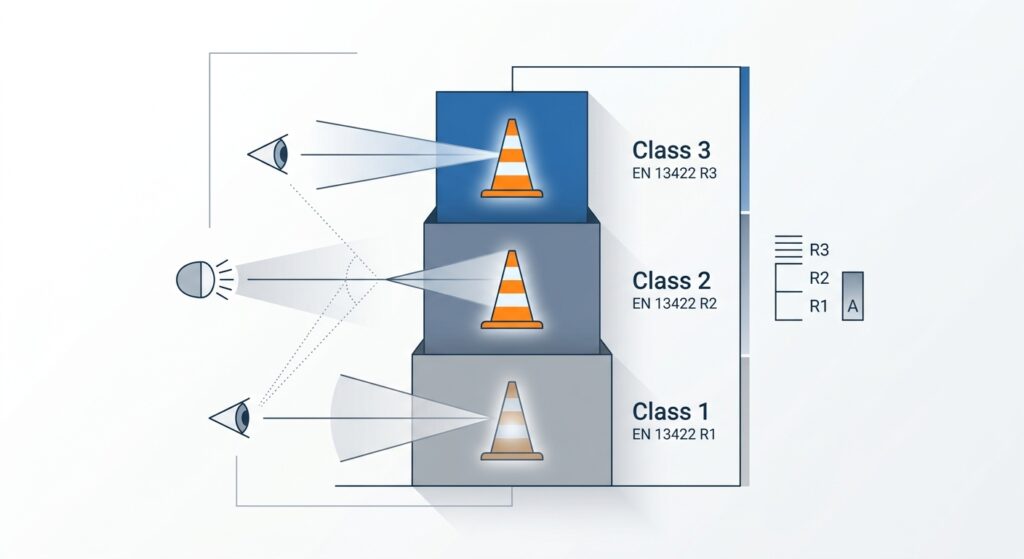
Under EN 13422, traffic cone collars are classified into three retroreflective performance grades: R1, R2, and R3. R1 is the baseline classification representing the minimum retroreflective performance for a cone to be considered retroreflective at all. R2 represents significantly higher retroreflective performance, achieved through the use of high-intensity prismatic sheeting rather than the enclosed lens or standard engineer-grade sheeting used in R1 products. R3 represents the highest performance grade available under the standard and is used in the most demanding motorway and high-speed road applications.
An additional suffix designation, the letter A appended after the class designation to give R1A, R2A, or R3A, indicates that the cone meets an optional supplementary requirement measured at a two-degree observation angle. This two-degree measurement represents the viewing geometry of a driver in a high-cab vehicle such as a truck or bus who is at close range to the cone. A cone that meets the A suffix requirement maintains adequate retroreflective performance at this narrower observation angle, which is relevant for procurement specifications covering mixed car and heavy vehicle traffic routes.
3. How Class 1 and Class 2 Map Onto the EN 13422 Framework
The terms Class 1 and Class 2 as applied to traffic cone reflective collars appear across procurement specifications, product catalogues, and contractor documentation in markets including the UK, Australia, and several Asian markets that use classification language derived from or parallel to the EN 13422 framework. In the UK Chapter 8 context, the operative classifications are R1B and R2, where R1B represents a standard reflectivity collar rated for lit urban roads with speed limits at or below 40 miles per hour, and R2 represents the higher-intensity collar required for high-speed roads, motorways, and unlit rural environments.
For the purposes of this article and the procurement decisions it addresses, Class 1 refers to the lower-performance retroreflective collar category corresponding broadly to R1 and R1B in the EN 13422 and Chapter 8 frameworks, and Class 2 refers to the higher-performance category corresponding to R2 and above. This framing aligns with how the distinction is most commonly communicated in B2B procurement contexts across the markets where these products are sourced and deployed.
Nighttime Visibility: What the Performance Difference Actually Means
1. Detection Distance at Night Under Standard Headlight Illumination
The practical significance of the gap between Class 1 and Class 2 retroreflective collar performance is most clearly understood through detection distance: the distance at which an approaching driver can reliably identify a cone as a traffic control device and begin to respond to it. Detection distance is a function of the collar’s retroreflective coefficient, the vehicle’s headlight output, the driver’s visual acuity, and the background light conditions at the deployment location.
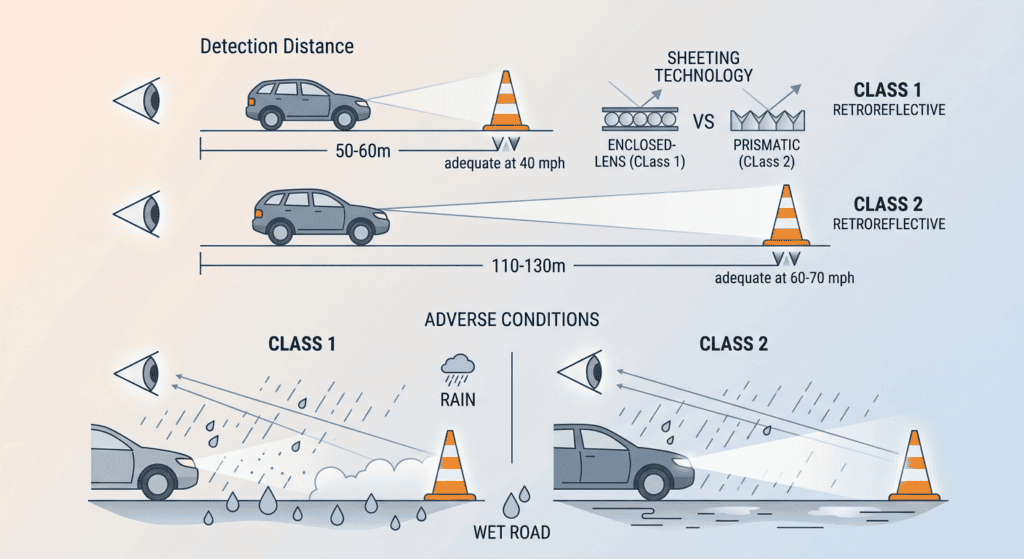
Under standard low-beam headlight illumination on an unlit road with no background lighting interference, a Class 1 retroreflective collar provides adequate detection distance for approach speeds at or below approximately 40 miles per hour. At this speed, a driver needs a minimum detection distance of approximately 50 to 60 metres to perceive the cone, process the information, and begin braking before reaching it. A Class 1 collar on a standard 750mm traffic cone under low-beam illumination on an unlit road can typically achieve this detection threshold at approach speeds in this range.
At approach speeds above 40 miles per hour, the required detection distance increases substantially. At 60 miles per hour, the minimum detection distance for a driver to perceive and respond to a traffic cone before reaching it is approximately 90 to 110 metres. At 70 miles per hour, it approaches 130 metres under adverse conditions. At these distances and approach speeds, a Class 1 collar does not reliably return sufficient light to meet the detection threshold under standard low-beam headlight illumination on an unlit road. A Class 2 high-intensity prismatic collar, which returns between three and five times more light per unit area than a Class 1 enclosed-lens collar at the same geometry, achieves this detection distance reliably under the same lighting conditions and is the minimum specification for any cone deployment on roads where approach speeds exceed 40 miles per hour.
2. The Role of Sheeting Technology in the Performance Gap
The performance difference between Class 1 and Class 2 collars is not a matter of collar width or the number of collar bands. It is a fundamental difference in the retroreflective sheeting technology used to manufacture the collar. Class 1 collars are typically manufactured using enclosed-lens sheeting, also referred to as engineer-grade sheeting, in which glass microspheres are embedded in a binder layer beneath a transparent protective film. Light striking the sheeting surface passes through the film, enters the glass microspheres, reflects from a metallic backing behind each sphere, and returns approximately back toward its source. The retroreflective efficiency of this system is adequate at short detection distances and moderate approach speeds but falls off relatively quickly as the observation geometry becomes less favourable at longer distances.
Class 2 collars are manufactured using high-intensity prismatic sheeting, in which an array of precisely engineered microprism elements replaces the glass microsphere system. Each microprism element reflects incident light with significantly greater efficiency and across a wider range of observation angles than a glass microsphere can achieve. The result is a retroreflective coefficient that is substantially higher than enclosed-lens sheeting across all measurement geometries, and that maintains its performance advantage more consistently as observation distance increases. For a driver approaching a work zone at motorway speed, the practical visibility difference between a Class 1 and a Class 2 cone collar is not marginal. It is the difference between detecting the cone with adequate reaction distance and detecting it too late.
3. Visibility in Adverse Conditions: Rain, Fog, and Wet Roads
The performance gap between Class 1 and Class 2 collars widens further under adverse weather conditions. Rain, spray, surface water, and fog all reduce the effective light return from retroreflective sheeting by interrupting the incident light path before it reaches the sheeting surface and by dispersing the returned light before it reaches the driver’s eyes. Class 1 enclosed-lens sheeting loses a significant proportion of its retroreflective performance in heavy rain or wet conditions because water film forming over the sheeting surface effectively fills the spaces between the microspheres and disrupts the reflection geometry.
High-intensity prismatic sheeting used in Class 2 collars is significantly more resistant to wet-weather performance degradation because the microprism geometry is less susceptible to the water film effect. The structured air spaces within the prism array maintain their reflective geometry under wet surface conditions more effectively than the microsphere-binder system, and Class 2 collars retain a substantially higher proportion of their dry-weather retroreflective performance in rain and spray. For any cone deployment on roads where rain, surface water, or spray from passing vehicles is a routine condition, specifying Class 2 collars rather than Class 1 is a directly measurable safety improvement regardless of the speed environment.
Compliance Requirements by Deployment Environment
1. EN 13422 and UK Chapter 8 Compliance Requirements
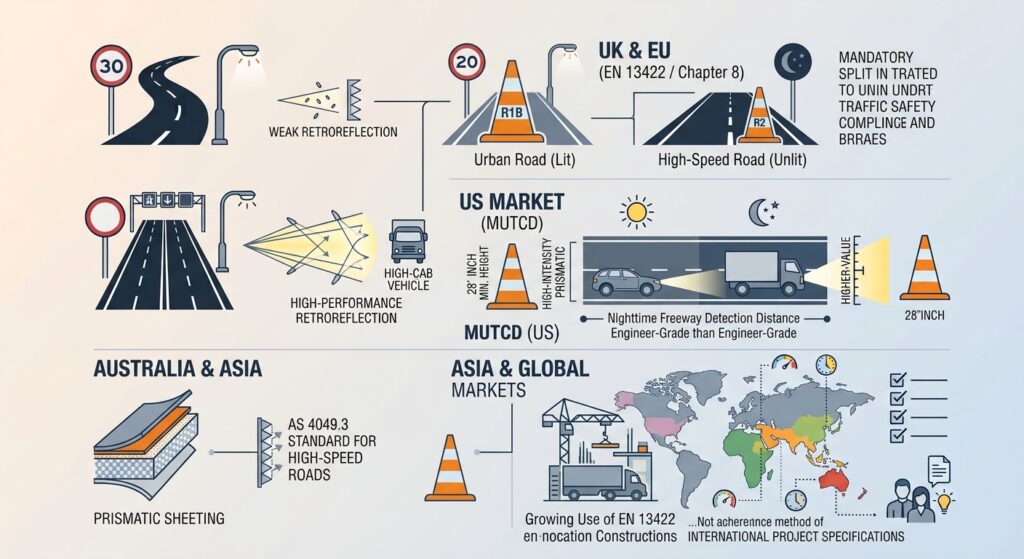
Under the current EN 13422 standard, the R1 classification is the minimum for any cone described as retroreflective, but it is not the minimum for nighttime deployment on roads with approach speeds above 40 miles per hour. The UK Chapter 8 Traffic Signs Manual, which governs temporary traffic management on UK roads, specifies Class R1B collars as the minimum for lit urban environments with speed limits at or below 40 miles per hour, and Class R2 as the mandatory minimum for all other deployments, including unlit roads at any speed, roads with speed limits above 40 miles per hour, and all motorway and dual carriageway deployments regardless of lighting conditions.
For procurement managers sourcing traffic cones for UK road work contracts, specifying Class 1 cones for a motorway or high-speed road deployment is not a cost optimisation. It is a compliance failure that exposes the contracting organisation to liability for any incident that occurs in the work zone, on the basis that the traffic control devices deployed did not meet the mandatory specification for the road type and operating condition. The compliance documentation required for UK Highways England contracts and local authority road work licences requires the contractor to confirm that deployed cones meet the Chapter 8 retroreflective specification for the road type, and Class 1 cones cannot satisfy this requirement on any road where Class R2 is mandated.
2. MUTCD Requirements for the US Market
In the United States, the Manual on Uniform Traffic Control Devices 11th Edition governs retroreflective requirements for traffic cones on public roads. MUTCD Part 6 requires that cones used on freeways or expressways, or in nighttime operations on any highway, must be a minimum of 28 inches in height and must carry retroreflective collars meeting the standard’s visibility requirements. The MUTCD does not use the R1, R2, R3 classification language of EN 13422, but the underlying performance requirements for nighttime freeway and highway cone deployment correspond broadly to the Class 2 performance level when compared against the EN 13422 framework.
Engineer-grade enclosed-lens sheeting, which corresponds to the Class 1 performance level, meets the MUTCD daytime visibility requirement but does not reliably meet the nighttime freeway detection distance requirement at approach speeds above 55 miles per hour. High-intensity prismatic sheeting, corresponding to Class 2 performance, is the recommended specification for MUTCD-compliant nighttime freeway cone deployment and is the specification that major US highway contractors and state departments of transportation require in their procurement standards for nighttime work zone cones.
3. Markets Using Australian and Asian Standards
In Australia, the relevant standard for traffic cone retroreflective performance is AS 4049.3, which establishes retroreflective performance requirements for temporary traffic management devices including cones. The Australian standard’s performance requirements for nighttime deployment on high-speed roads are broadly consistent with the Class 2 performance level and require prismatic high-intensity sheeting for cone collars deployed on roads with operating speeds above 60 kilometres per hour in nighttime conditions.
In markets across Southeast Asia, the Middle East, and parts of Africa where national road safety standards are less prescriptive or where international project specifications govern procurement, the EN 13422 framework is increasingly used as the reference standard in tender documents for road construction, infrastructure maintenance, and public event traffic management contracts. Procurement teams working on internationally tendered projects in these markets should confirm whether the project specification references EN 13422 or another specific standard, and which retroreflective classification is mandated for nighttime deployment at the operating speeds of the specific road type involved, before finalising a collar specification.
The Procurement Decision: When Each Class Is the Right Choice
1. When Class 1 Is the Correct and Sufficient Specification
Class 1 retroreflective collars are the appropriate and compliant specification for traffic cone deployments in lit urban environments with operating speeds at or below 40 miles per hour, where the combination of ambient street lighting and Class 1 retroreflective performance provides adequate driver detection distance for the approach speeds involved. Parking lots, private roads, indoor facilities, pedestrian zones, and low-speed access roads where speed is not an independent risk factor are all environments where Class 1 cones are compliant, adequate, and represent the correct cost point for the application.
Specifying Class 2 cones for a parking lot or a lit urban low-speed deployment does not improve safety in any measurable way for the application, because the detection distance provided by Class 1 performance already exceeds the detection distance required at 20 to 30 miles per hour approach speeds by a substantial margin. It adds cost without adding safety outcome, which is the procurement error equivalent of specifying Class 1 cones for a motorway nighttime deployment: in both cases the specification does not match the application requirement, and in both cases the organisation is paying for either more or less than the application needs.
2. When Class 2 Is the Mandatory Minimum
Class 2 retroreflective collars are the mandatory minimum specification for all traffic cone deployments on roads with operating speeds above 40 miles per hour, for all nighttime deployments on unlit roads at any speed, for all motorway and dual carriageway deployments regardless of lighting conditions, and for any deployment in adverse weather environments where rain, spray, or fog regularly reduces ambient visibility. These are not situations where Class 2 is a premium upgrade over an adequate Class 1 specification. They are situations where Class 1 performance is demonstrably insufficient for the detection distance required and where regulatory compliance mandates a higher performance threshold.
Procurement teams sourcing cones for contractors or authorities operating across a mixed portfolio of road types and speed environments should strongly consider standardising their procurement on Class 2 cones across the entire fleet rather than attempting to manage a split specification between Class 1 and Class 2 stock. The unit cost premium of Class 2 over Class 1 is real but modest at volume, and the operational risk of Class 1 cones being deployed on Class 2-required routes through logistical error is a compliance and liability exposure that the cost saving from mixed specification procurement does not justify.
3. Collar Width, Band Count, and Their Interaction With Class
Within both the Class 1 and Class 2 categories, collar configuration, meaning the width of each band and the number of bands applied to the cone, affects both visibility and compliance. A single narrow collar band of Class 2 sheeting provides less total retroreflective area than a dual-band configuration of the same sheeting grade, and at long detection distances the total retroreflective area visible to the driver matters alongside the per-unit-area retroreflective coefficient.
The standard dual-band configuration for a 750mm nighttime highway cone, a 150mm upper band and a 100mm lower band of Class 2 sheeting, provides the combination of total retroreflective area and high-intensity coefficient that regulatory standards for high-speed nighttime cone deployment are written around. Single-band configurations or narrower bands of Class 2 sheeting may meet the minimum retroreflective coefficient requirement per unit area while falling short of the total area requirement that some regulatory specifications impose alongside the sheeting grade requirement. Before finalising a collar specification for a regulatory compliance application, procurement teams should confirm both the sheeting grade requirement and the collar width and band count requirement in the applicable standard.
Conclusion: Reflective Class Is a Safety Decision, Not a Cost Decision
The choice between Class 1 and Class 2 retroreflective collars for traffic cones is not a cost optimisation decision with an acceptable middle ground. It is a safety specification decision with a correct answer for each deployment environment, defined by the approach speed of traffic at the site, the ambient lighting conditions, the weather environment, and the applicable regulatory standard. Getting it right means correctly identifying which environments require Class 2 performance and specifying accordingly, and correctly identifying which environments are adequately and compliantly served by Class 1 performance without paying the Class 2 premium unnecessarily.
For procurement teams managing cone fleets across diverse deployment environments, the simplest route to consistent compliance is to understand the boundary conditions that trigger the Class 2 requirement: approach speeds above 40 miles per hour, unlit roads at any speed, motorway and dual carriageway routes, and nighttime deployment in adverse weather. Any cone deployment that meets one or more of these conditions requires Class 2. Everything below that threshold is adequately served by Class 1, and no amount of specification upgrade above Class 2 improves the safety outcome at those lower-risk sites.
In a nighttime work zone, the collar is the cone. Everything else is just orange plastic.
Looking for a manufacturer supplying EN 13422 compliant Class 1 and Class 2 retroreflective collar traffic cones for nighttime road work, highway deployment, and volume procurement programmes? At JessuBond, we produce traffic cones to full international specification with flexible MOQ and consistent lead times for B2B buyers. Contact us here.