
Selecting the appropriate convex mirror size for commercial applications requires careful consideration of viewing distances, coverage requirements, and environmental conditions. While the wide-angle visibility provided by convex safety mirrors makes them ideal for business premises and parking facilities, improper sizing can compromise their effectiveness and fail to deliver the safety benefits that justified the investment. Understanding the relationship between mirror diameter, viewing distance, and coverage area enables facility managers to specify mirror solutions that genuinely enhance safety while optimizing budget allocation.
Understanding Mirror Size and Viewing Distance Relationships
The fundamental principle governing convex mirror sizing centers on the relationship between mirror diameter and effective viewing distance. As viewing distance increases, larger mirror diameters become necessary to maintain clear visibility of reflected objects and provide operators with actionable visual information. A mirror that performs perfectly at 15 feet may become nearly useless at 50 feet if the diameter is insufficient for the extended range.
Professional-grade convex safety mirror manufacturers typically provide sizing guidelines based on maximum viewing distances. A 12-inch diameter mirror generally serves viewing distances up to 15 feet effectively, while 18-inch models extend useful range to approximately 25 feet. For longer sightlines common in parking facilities and warehouse aisles, 24-inch and 30-inch mirrors provide clear visibility at distances reaching 40-60 feet respectively. These guidelines represent starting points rather than absolute rules, as factors like lighting conditions, reflective surface quality, and observer visual acuity influence real-world performance.
The consequences of undersizing mirrors extend beyond reduced visibility. Workers who struggle to see clear images in undersized mirrors may ignore them entirely, defeating the purpose of the installation and creating false confidence in safety measures that don’t actually function effectively. Conversely, oversized mirrors waste budget resources and may create installation challenges without delivering proportional safety benefits. The goal is identifying the optimal size that provides clear, actionable visibility at required viewing distances.
Parking Area Sizing Considerations
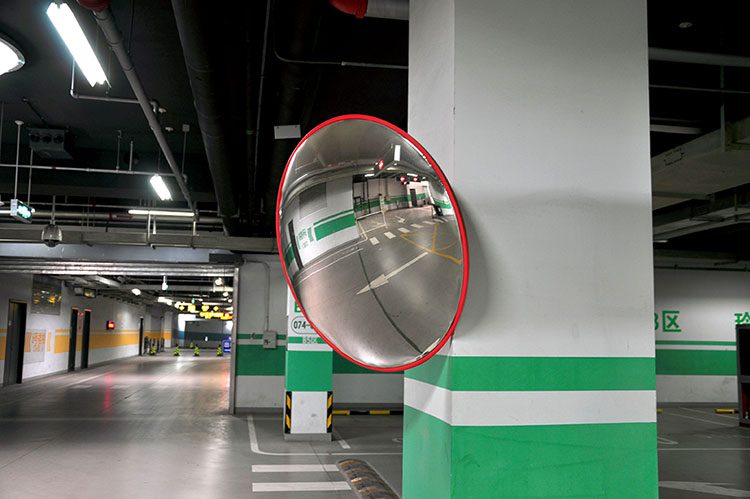
Parking facilities present unique mirror sizing challenges due to variable viewing distances, multiple approach angles, and diverse user populations with different visual capabilities. A convex mirror for road safety applications in parking structures must account for drivers approaching at various speeds, from multiple directions, often while simultaneously managing complex maneuvering tasks.
Entry and exit points typically require larger mirrors to provide adequate warning distances. When vehicles approach parking garage exits at 10-15 mph, drivers need sufficient advance notice to react appropriately to cross-traffic or pedestrians. A large convex mirror positioned to monitor both approach directions might require 30-inch or even 36-inch diameter to ensure visibility from the required distance while drivers are still far enough away to safely stop or yield.
Interior parking aisle intersections may accommodate smaller mirrors since viewing distances are compressed and vehicle speeds are lower. An 18-inch or 24-inch convex security mirror can effectively monitor perpendicular aisles where drivers approach at walking speeds and travel distances between parking spaces and intersection points remain relatively short. The key consideration is ensuring that drivers navigating the main aisle can clearly see approaching vehicles from side aisles early enough to prevent collisions.
Multi-level parking structures require special attention to sight lines and viewing angles. Ramp areas where vehicles transition between levels often feature blind curves that necessitate larger mirrors positioned to provide maximum advance warning. A 30-inch convex traffic safety mirror mounted at the optimal height and angle can show drivers what’s approaching around curves where direct sight lines don’t exist, preventing head-on collisions in narrow ramp sections.
Business Premises Interior Applications
Indoor business environments typically feature shorter viewing distances and more controlled conditions than outdoor parking areas, but mirror sizing remains critical for effectiveness. Warehouse aisles, manufacturing floor intersections, and loading dock approaches each present distinct requirements that influence appropriate mirror sizing.
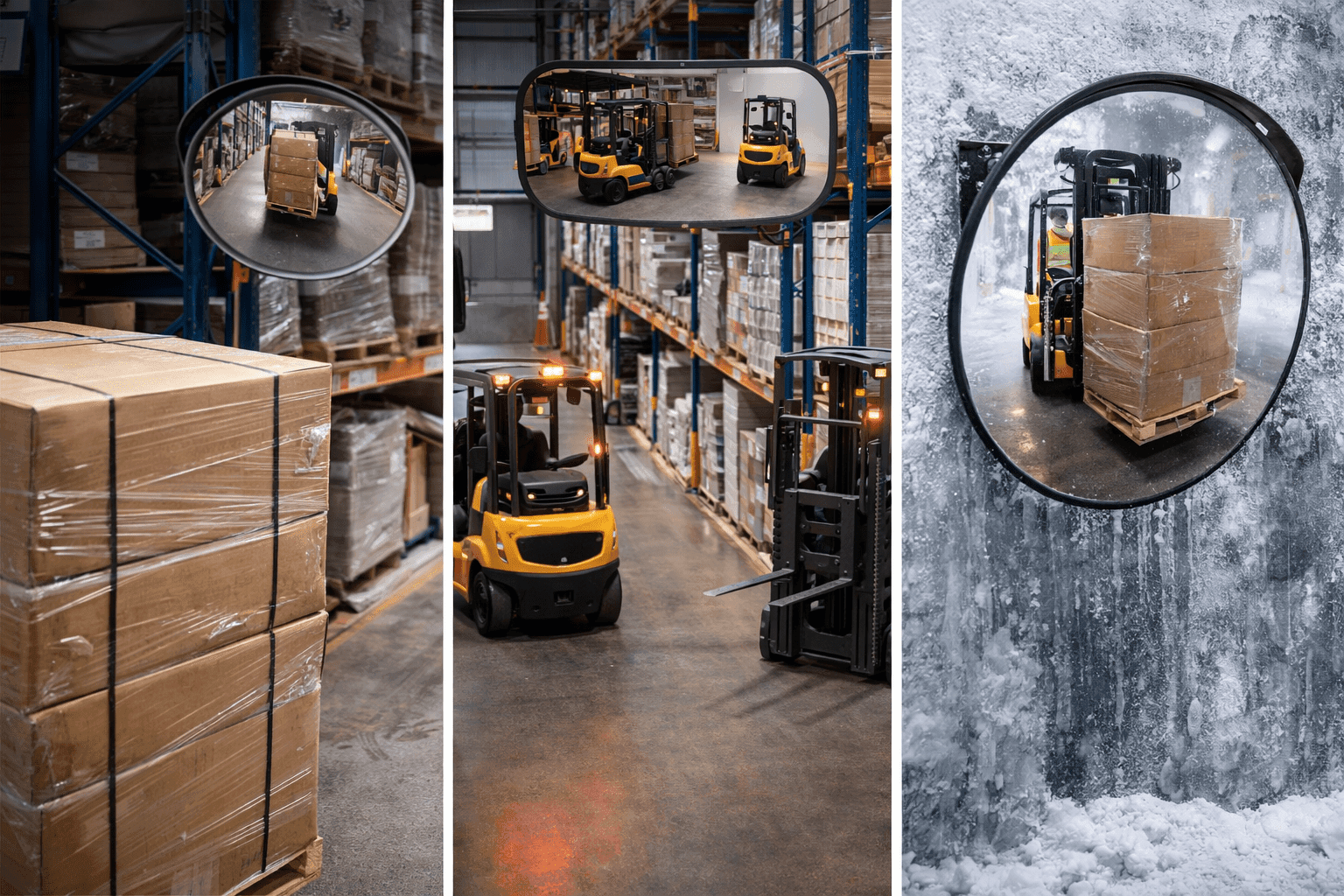
Warehouse operations with narrow aisles and frequent forklift traffic benefit from precisely sized mirrors that provide comprehensive coverage without creating visual clutter. A typical warehouse aisle intersection might require a 12-inch to 18-inch mirror positioned to show operators approaching traffic from perpendicular aisles. The shorter viewing distances in confined warehouse spaces mean that smaller mirrors often suffice, though aisle length and lighting conditions may necessitate larger sizes.
Manufacturing facilities with complex floor layouts and multiple traffic patterns may require varied mirror sizes throughout the facility. High-traffic intersections near production equipment might warrant 24-inch convex traffic mirrors to ensure operators can clearly see approaching vehicles and pedestrians from extended distances. Less critical areas with lower traffic volumes and shorter sight lines can utilize smaller 12-inch or 15-inch mirrors that provide adequate coverage without excessive cost.
Loading dock areas present their own sizing requirements. Indoor docks where trucks back into bays under low-speed, controlled conditions may need 18-inch mirrors to help dock workers monitor vehicle positioning and surrounding pedestrian traffic. Outdoor loading areas with longer approach distances and variable lighting conditions often require 24-inch or larger mirrors to maintain visibility across the extended ranges involved in truck maneuvering operations.
Outdoor Visibility and Environmental Factors
Outdoor convex safety mirror applications must account for environmental conditions that don’t affect indoor installations. Sunlight, precipitation, temperature extremes, and varying ambient light levels all influence the effective viewing range of mirrors, often necessitating larger sizes than comparable indoor applications would require.
Direct sunlight can create glare that reduces mirror visibility during certain times of day. Facility managers should consider solar angles when positioning mirrors and may need to upsize mirror diameter to ensure reflected images remain visible even when glare affects portions of the reflective surface. A mirror that would suffice indoors might prove inadequate outdoors where glare, precipitation, or dirt accumulation reduces optical clarity.
Weather resistance also influences sizing decisions. Larger mirrors typically feature more robust construction with enhanced weather sealing and protective housings that extend service life in challenging environments. While a basic 12-inch mirror might meet minimum visibility requirements, upgrading to an 18-inch model constructed specifically for outdoor use provides both improved visibility and superior durability that justifies the incremental cost through extended service life.
Seasonal considerations affect outdoor mirror performance as well. Winter conditions with snow, ice, and fog can significantly reduce visibility range, suggesting that outdoor installations should incorporate some sizing buffer beyond minimum requirements calculated for optimal conditions. An outdoor convex safety mirror that provides barely adequate visibility in summer may prove nearly useless during winter weather events, compromising safety during conditions when enhanced visibility becomes most critical.
Calculating Coverage Areas and Dead Zones
Effective mirror sizing requires understanding coverage area requirements beyond just viewing distance. Convex mirrors provide wide-angle views, but the viewing angle varies with mirror diameter, curvature, and mounting position. Facility managers should map coverage requirements before specifying mirror sizes to ensure installations provide comprehensive visibility.
Coverage mapping begins with identifying conflict points where vehicles, equipment, or pedestrians might intersect. By measuring viewing distances and angles from typical observer positions to potential hazard zones, facilities can determine minimum mirror sizes that provide adequate coverage.
Dead zones where mirrors don’t provide coverage represent critical safety gaps. These occur when undersized mirrors lack sufficient viewing angle to show all approach vectors, or when viewing distances exceed the effective range of installed mirrors. Identifying these gaps during planning allows facilities to specify appropriately sized mirrors to eliminate blind spots.

Budget Optimization and Value Engineering
Mirror sizing decisions involve budget considerations, but focusing solely on initial purchase price often leads to poor outcomes. The cost difference between a 12-inch mirror and an 18-inch mirror might be modest, but if the larger size prevents even a single accident, the return on investment becomes immediately apparent.
Value engineering should evaluate total cost of ownership rather than unit prices. A higher-quality convex safety mirror outdoor model with superior weather resistance might cost more initially but deliver 10-12 years of reliable service versus 3-4 years for cheaper alternatives. When amortized over actual service life, premium products often prove more economical.
Bulk purchasing strategies can reduce per-unit costs for facilities requiring multiple mirrors. Many suppliers offer volume discounts for orders of ten or more units, making it feasible to specify appropriately sized mirrors throughout a facility. The key is treating mirror procurement as a comprehensive safety program investment.
Professional Assessment and Installation Planning
While general sizing guidelines provide useful starting points, professional assessment of specific site conditions yields optimal results. Many commercial mirror suppliers offer site evaluation services that analyze viewing requirements, environmental conditions, and traffic patterns to recommend precise mirror sizes for each location.
These assessments involve measuring viewing distances, evaluating lighting conditions, analyzing traffic flow patterns, and identifying specific hazards that mirrors must address. The resulting recommendations specify mirror sizes along with optimal mounting heights and positions.
Installation planning should coordinate mirror sizing with mounting hardware selection. Larger mirrors require more robust mounting systems capable of supporting increased weight while maintaining precise positioning. Outdoor installations particularly demand heavy-duty mounting brackets and anchoring systems that prevent mirror movement.
Verification and Adjustment After Installation
Even carefully planned mirror installations benefit from post-installation verification. After mirrors are mounted, operators should conduct visibility tests from typical positions to confirm that mirrors provide clear views of all required coverage areas. This verification process may reveal opportunities for adjustments that significantly improve effectiveness.
Lighting conditions change throughout the day and across seasons, so verification should occur at multiple times to ensure mirrors function effectively under all operational conditions. Identifying limitations allows facilities to adjust mirror positions or add supplementary mirrors that maintain consistent visibility.
User feedback provides valuable input for assessing mirror sizing effectiveness. Operators who regularly use mirrors offer practical insights into whether mirrors provide adequate visibility or if sizing adjustments would improve safety. Establishing feedback mechanisms demonstrates organizational commitment to continuous improvement.
Making Informed Sizing Decisions
Selecting appropriate convex mirror sizes for business premises and parking areas requires balancing multiple factors including viewing distances, coverage requirements, environmental conditions, budget constraints, and operational needs. While general guidelines provide starting points, optimal outcomes result from thoughtful analysis of specific site conditions and genuine understanding of how mirror size affects visibility and safety.
The investment in properly sized convex traffic safety mirrors pays dividends through reduced accidents, improved operational efficiency, and enhanced safety culture. Undersized mirrors that save a few dollars per unit but fail to provide adequate visibility represent false economies that ultimately cost more through preventable accidents and compromised safety. Conversely, thoughtfully specified mirrors sized appropriately for their intended applications deliver reliable performance that protects workers, visitors, and assets while supporting efficient operations in demanding commercial environments.
Facility managers who approach mirror sizing as a component of comprehensive safety planning rather than isolated purchasing decisions consistently achieve superior outcomes. By understanding the relationships between size, viewing distance, and coverage requirements, and by leveraging professional expertise when appropriate, organizations can implement mirror solutions that genuinely enhance safety while delivering long-term value that far exceeds initial investment costs.
Looking for a custom convex mirror manufacturer or supplier? Struggling to find the right factory to bring your vision to life? We’ve got you covered! At our place, we craft top-quality convex mirrors with precision and care. Big or small, your needs are our mission. Let’s launch your mirror project and take your product line to the next level! Click here to contact