Welcome to Shanghai Jessubond International CO.,Ltd.
Best materials for outdoor traffic mirrors to withstand weather conditions? (stainless steel convex mirror)
Best materials for outdoor traffic mirrors to withstand weather conditions? (stainless steel convex mirror)
When a traffic mirror fails in the field, it does not just stop working quietly. It either degrades to the point of useless distortion, shatters under impact, or corrodes into a liability. For facility managers, safety equipment procurement teams, and infrastructure contractors, a mirror that cannot survive the environment it is installed in is not a safety solution. It is a replacement cost waiting to happen.
Outdoor traffic mirrors face a relentless combination of stressors: UV radiation, rain, humidity, salt air in coastal locations, extreme temperature cycles, wind load, and in many public or industrial settings, the additional threat of physical impact or vandalism. Selecting the wrong material for an outdoor convex safety mirror installation means shorter service life, degraded optical performance, increased maintenance costs, and potential gaps in safety coverage between replacements.
This guide is written for B2B decision-makers who need to understand the full material landscape for outdoor weather-resistant traffic mirrors, with particular focus on stainless steel convex mirrors as the premium specification for the most demanding environments. Whether you are procuring for a single logistics facility, managing a multi-site safety program, or distributing safety equipment to commercial and public sector clients, material selection is one of the highest-leverage decisions in the entire purchasing process.
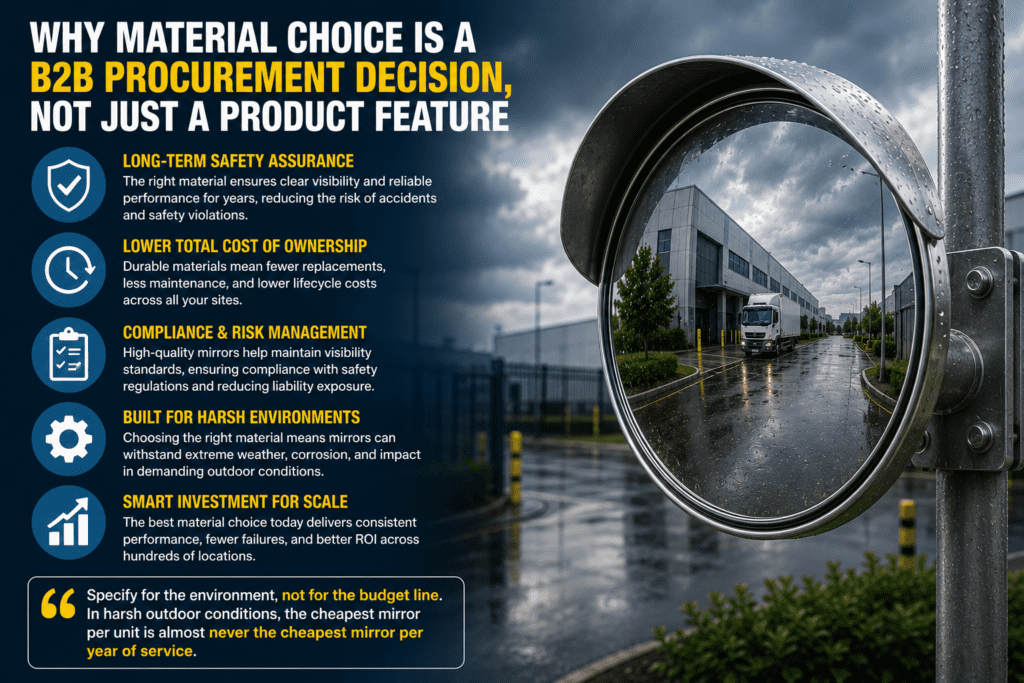
Why Material Choice Is a B2B Procurement Decision, Not Just a Product Feature
For individual consumers buying a driveway mirror for a residential property, material choice is a relatively low-stakes decision. For B2B procurement managers sourcing outdoor traffic mirrors at scale across multiple sites, the implications are significantly larger.
A wrong material specification for an outdoor industrial traffic mirror program can mean dozens of mirror replacements within a few years instead of a decade of reliable service. It can mean safety audit failures when degraded mirrors no longer meet visibility standards. It can mean increased insurance exposure when mirrors that should be functioning are not delivering the sightlines they were installed to provide.
Total cost of ownership is the correct framework for evaluating outdoor traffic mirror materials in a B2B context. A stainless steel convex outdoor traffic mirror might cost two to three times as much as an acrylic equivalent at point of purchase. In an environment where the acrylic mirror degrades within three to five years while the stainless steel unit delivers fifteen or more years of service, the economics shift decisively in favour of the premium material.
“Specify for the environment, not for the budget line. In harsh outdoor conditions, the cheapest mirror per unit is almost never the cheapest mirror per year of service.”
Why Material Choice Is a B2B Procurement Decision, Not Just a Product Feature
The Three Primary Materials for Outdoor Traffic Mirrors
There are three materials that dominate outdoor traffic mirror procurement across commercial and industrial sectors: stainless steel, polycarbonate, and acrylic. Each has a distinct performance profile, weather resistance capability, and total cost of ownership story. Understanding all three is essential for making the right specification decision for each installation environment.
1. Stainless Steel Convex Mirrors
Stainless steel is the premium material specification for outdoor traffic mirrors in demanding environments, and for procurement teams sourcing mirrors for harsh, high-risk, or long-lifecycle applications, it represents the most defensible specification choice available.
a. How Stainless Steel Traffic Mirrors Are Constructed
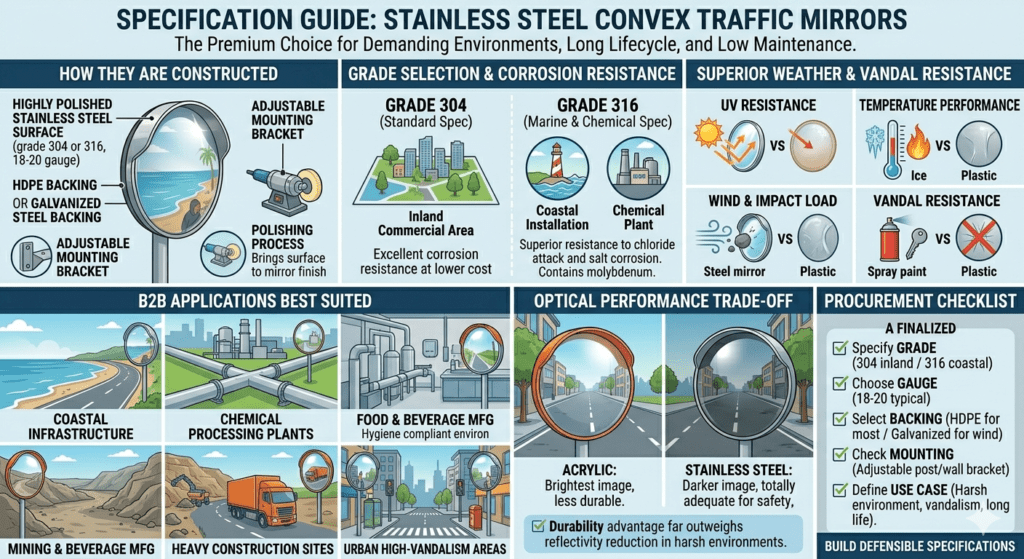
A quality stainless steel outdoor convex mirror uses a highly polished stainless steel reflective surface, typically constructed from 18 to 20 gauge grade 304 or grade 316 stainless steel. The polishing process brings the surface to a mirror finish that provides adequate reflectivity for traffic safety purposes across the full range of outdoor lighting conditions.
Grade 304 stainless steel, which is nickel and chromium plated for additional corrosion and weather resistance, is the standard specification for most commercial and industrial outdoor traffic mirror applications. Grade 316 stainless steel, which contains molybdenum in addition to nickel and chromium, offers superior resistance to chloride attack and salt corrosion, making it the preferred specification for coastal installations, marine infrastructure environments, and facilities near chemical processing operations where corrosive atmospheres are a concern.
b. Weather Resistance Properties
The weather resistance profile of stainless steel outdoor convex mirrors is unmatched across the available material options.
Corrosion resistance: stainless steel does not rust under normal outdoor conditions. Grade 304 performs reliably in most inland commercial and industrial environments. Grade 316 extends this performance to coastal and salt-spray environments where lesser materials would corrode within months.
UV resistance: stainless steel is inherently UV-resistant because its reflective metallic surface reflects rather than absorbs UV radiation. Unlike plastic lens materials that rely on surface coatings or material additives for UV stabilization, stainless steel does not degrade under prolonged UV exposure.
Temperature performance: stainless steel maintains its structural integrity and reflective properties across extreme temperature ranges, from arctic cold to high-heat industrial environments. Some plastic materials become brittle at low temperatures or warp under sustained heat exposure. Stainless steel does not.
Wind and impact load: the structural rigidity of stainless steel makes it suitable for high-wind exposure locations where plastic mirrors may flex, distort their reflective surface, or fail at mounting points under sustained wind load.
Vandal resistance: the hardness of a polished stainless steel surface makes it extremely difficult to scratch or deface compared to plastic alternatives. For outdoor traffic mirrors installed in publicly accessible locations, urban environments, or isolated industrial sites where vandalism is a realistic risk, stainless steel is the material of choice for anti-vandal traffic mirror specifications.
c. Optical Performance Consideration
One honest trade-off that procurement teams should understand when specifying stainless steel convex road safety mirrors is optical reflectivity. Polished stainless steel delivers a perceptibly darker reflected image than acrylic or polycarbonate alternatives. The difference is clearly visible in a direct side-by-side comparison. However, in practice, the reflectivity of a quality stainless steel outdoor traffic mirror is entirely adequate for traffic safety purposes across all standard installation environments.
The optical trade-off is the price of the durability advantage. For applications in mining sites, construction yards, fuel depots, exposed coastal installations, and high-vandalism urban locations, the durability advantage of stainless steel far outweighs the modest reflectivity reduction compared to plastic alternatives.
d. B2B Applications Best Suited to Stainless Steel Convex Mirrors
Stainless steel outdoor convex mirrors are the correct specification for:
Coastal facility driveways and road junctions exposed to salt air and humidity
Chemical processing plant access roads and internal junctions
Food and beverage manufacturing facility driveways where hygiene and corrosion resistance are compliance requirements
Mining, quarrying, and heavy construction site internal road networks
Public road junctions in urban areas with documented vandalism risk
Municipal infrastructure installations requiring long-term service life with minimal maintenance
Fuel depot and petrochemical facility traffic management
High-wind exposure locations where plastic mirror integrity may be compromised
e. Stainless Steel Mirror Grade Selection for Procurement Teams
For buyers specifying stainless steel weather-resistant traffic mirrors at scale:
Grade 304 stainless steel is the right specification for most inland commercial and industrial outdoor environments. It offers excellent corrosion resistance at a lower cost than grade 316 and performs reliably across the full range of standard outdoor weather conditions.
Grade 316 stainless steel should be specified for coastal locations within approximately 1 to 5 kilometres of the sea, for environments with salt spray exposure, for chemical plant applications where corrosive gases or liquids are present, and for any marine infrastructure application. The molybdenum content of grade 316 provides the additional chloride resistance that grade 304 cannot reliably deliver in these conditions.
Stainless Steel Convex Mirrors
2. Polycarbonate Convex Mirrors for Outdoor Use
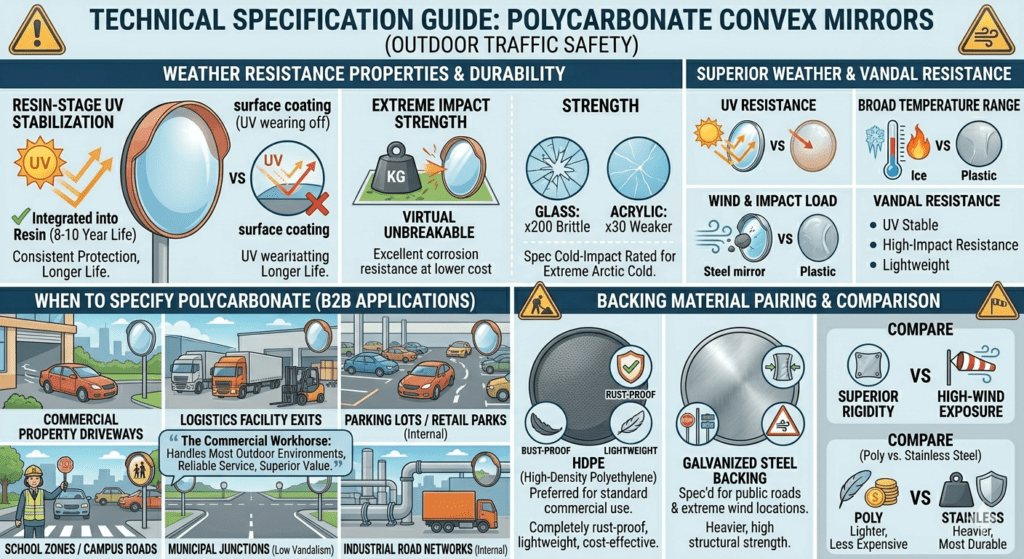
Polycarbonate is the most widely specified plastic material for outdoor traffic mirrors in commercial and industrial applications. It is approximately 200 times stronger than glass and around 30 times stronger than acrylic, giving it a durability profile that significantly exceeds other plastic alternatives while remaining considerably lighter and less expensive than stainless steel.
a. Weather Resistance Properties
Quality polycarbonate outdoor convex safety mirrors are UV-stabilized at the material level, not just at the surface coating level. This is an important distinction for procurement teams: surface-applied UV protection wears off over time, while material-integrated UV stabilization delivers consistent protection throughout the product’s service life. Always request written confirmation from suppliers that UV stabilization is a resin-stage property, not a surface coating applied post-manufacture.
UV-stabilized polycarbonate convex road mirrors for outdoor installation typically deliver a service life of 8 to 10 years in standard outdoor commercial environments before noticeable optical degradation occurs. In more protected or lower-UV environments, service life can extend further.
Polycarbonate performs well across a broad temperature range, though some formulations can become slightly more brittle at very low temperatures compared to stainless steel. For arctic or severe cold climate installations, specifying cold-impact rated polycarbonate is advisable.
b. When Polycarbonate Is the Right Outdoor Specification
Polycarbonate convex mirrors for outdoor commercial use represent the best balance of performance and cost for the majority of non-extreme outdoor traffic mirror applications. They are the standard specification for:
Commercial property driveways in standard outdoor environments
Logistics facility exits and loading dock areas
Parking lot safety mirrors for retail parks and commercial centres
School zone and campus driveway safety mirrors
Municipal road junction mirrors in lower-vandalism environments
Industrial facility internal road networks without extreme weather or chemical exposure
“UV-stabilized polycarbonate is the commercial workhorse of outdoor traffic mirror materials. It handles most outdoor environments well, costs significantly less than stainless steel, and delivers a decade of reliable service in appropriate applications.”
c. Backing Material Pairing for Polycarbonate Outdoor Mirrors
The backing material paired with a polycarbonate lens significantly affects the overall weather resistance of the mirror assembly.
HDPE (High-Density Polyethylene) backing: lightweight, completely rust-proof, and cost-effective. HDPE does not corrode, does not add significant weight to the mirror assembly, and performs well in standard outdoor environments. It is the preferred backing specification for most commercial polycarbonate outdoor traffic mirror installations.
Galvanized steel backing: heavier and more expensive than HDPE but provides superior structural rigidity for high-wind locations and is typically specified for public road installations and municipal infrastructure where long-term structural integrity is a regulatory requirement.
Polycarbonate Convex Mirrors for Outdoor Use
3. Acrylic Convex Mirrors for Outdoor Use
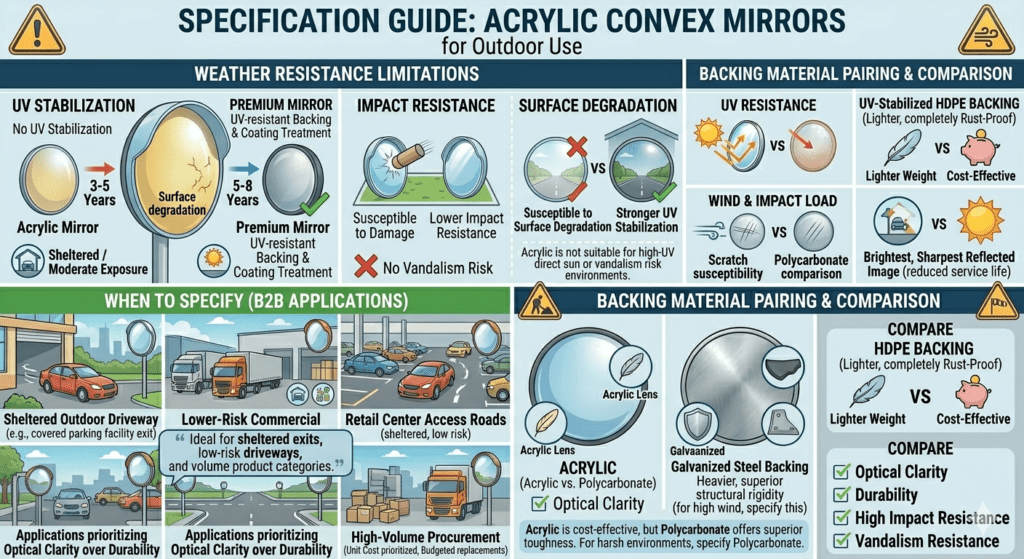
Acrylic outdoor traffic mirrors offer the highest optical clarity of the available plastic materials, transmitting approximately 92% of light and delivering the brightest, sharpest reflected image. For applications where image quality is a primary requirement and environmental stressors are moderate, acrylic convex safety mirrors for outdoor driveway use represent a cost-effective option.
a. Weather Resistance Limitations
The key limitation of acrylic for outdoor traffic mirror applications is its lower impact resistance compared to polycarbonate and its greater susceptibility to surface degradation from UV exposure if not properly UV-stabilized. Acrylic mirrors without robust UV-stable coatings or material treatments can yellow and lose optical clarity within three to five years in direct outdoor sun exposure.
Quality commercial-grade acrylic outdoor convex driveway mirrors with proper UV-resistant backing and coating treatments can deliver five to eight years of outdoor service life in sheltered or moderate exposure environments. In direct, high-UV outdoor environments without shelter, service life is shorter.
Acrylic is also more susceptible to impact damage and scratching than polycarbonate, and it is not suitable for applications where vandalism risk exists or where vehicles or equipment might make contact with the mirror surface.
b. When Acrylic Is the Right Outdoor Specification
Acrylic convex mirrors are appropriate for:
Sheltered outdoor driveway applications such as covered parking facility exits
Lower-risk commercial driveways where impact and vandalism risk is minimal
Applications where optical clarity is prioritised over maximum durability
High-volume procurement programs where unit cost is a primary constraint and replacement cycles are budgeted
For distributors serving the commercial property and light industrial market, acrylic outdoor driveway safety mirrors are a strong volume product category. For procurement managers specifying mirrors for harsh outdoor environments, acrylic is not the correct material.
Acrylic Convex Mirrors for Outdoor Use
Material Comparison for B2B Procurement Decision-Making
For procurement teams building outdoor traffic mirror specifications, the following framework maps material choice to installation environment:
Standard commercial outdoor environments (retail parks, commercial driveways, standard logistics facilities): UV-stabilized polycarbonate with HDPE backing is the default specification. Best balance of performance, durability, and cost.
Coastal and salt-spray environments: grade 316 stainless steel convex mirror is the correct specification. Polycarbonate with galvanized steel backing is an acceptable secondary option for moderate coastal exposure.
High-vandalism urban or public locations: stainless steel convex outdoor traffic mirror, grade 304 minimum. The surface hardness makes defacement significantly more difficult than any plastic alternative.
Chemical processing, food manufacturing, mining: grade 316 stainless steel specified for corrosive atmosphere resistance and hygiene compliance requirements.
High-wind exposure locations: galvanized steel backed polycarbonate or stainless steel, with appropriately rated mounting hardware specified for wind load at the installation location.
Budget-constrained high-volume programs with sheltered outdoor installation: acrylic with UV-resistant coating and backing, with planned replacement cycles accounted for in the maintenance budget.
Municipal and public road infrastructure: polycarbonate with galvanized steel backing for standard locations, stainless steel for exposed or high-vandalism locations. Compliance with local authority specifications is the primary procurement driver.
Maintenance Requirements by Material
Understanding maintenance requirements is important for total cost of ownership calculations in B2B traffic mirror procurement programs.
Stainless steel outdoor convex mirrors require minimal maintenance. The surface can be cleaned with a soft microfiber cloth and mild soap solution. The ultra-smooth polished surface resists salt deposit and airborne contaminant buildup and can be effectively cleaned by rainfall in many installation environments. Quality stainless steel mirror installations in appropriate environments require no more than periodic inspection and occasional cleaning to maintain performance for fifteen or more years.
Polycarbonate outdoor traffic mirrors should be cleaned with a soft cloth and mild soap solution, avoiding abrasive cleaners that can scratch the lens surface and accelerate UV degradation. Periodic inspection of mounting hardware and backing integrity is recommended annually. UV-stabilized polycarbonate mirrors in appropriate environments should deliver 8 to 10 years of reliable service with this basic maintenance regime.
Acrylic outdoor mirrors require similar gentle cleaning care to polycarbonate, with additional attention to early signs of UV yellowing or surface hazing that indicate the onset of optical degradation. Replacement planning should be built into facilities maintenance schedules for acrylic outdoor mirror installations in direct sun exposure environments.
Conclusion: Specifying the Right Material for Long-Term Outdoor Performance
For B2B procurement teams, EHS managers, and safety equipment distributors, the material selection decision for outdoor traffic mirrors is ultimately an environmental matching exercise. The best material is not the most expensive option or the most commonly available product. It is the material whose specific durability, weather resistance, optical performance, and maintenance profile best matches the actual conditions of the installation environment.
Stainless steel convex outdoor traffic mirrors are the correct specification for coastal environments, corrosive atmospheres, high-vandalism locations, and any application where a fifteen-plus year service life with minimal maintenance is the primary procurement objective. Polycarbonate UV-stabilized mirrors are the right choice for the majority of standard commercial and industrial outdoor applications. Acrylic mirrors serve sheltered, moderate-environment outdoor applications where optical clarity and unit cost are the primary priorities.
Get the material specification right for each installation environment, and outdoor traffic mirror programs deliver consistent safety performance, predictable maintenance costs, and total cost of ownership outcomes that justify every pound or dollar of the initial investment.
Looking for a custom convex mirror manufacturer or supplier? Struggling to find the right factory to bring your vision to life? We’ve got you covered! At our place, we craft top-quality convex mirrors with precision and care. Big or small, your needs are our mission. Let’s launch your mirror project and take your product line to the next level! Click here to contact