
Wall corners are the most vulnerable surface in any commercial or institutional building. They sit at precisely the point where foot traffic converges, where wheeled equipment turns, where carts and trolleys cut close, and where any lapse in clearance results in a chip, a gouge, or a crack in the wall finish. In high-traffic environments, this damage is not occasional. It is constant, cumulative, and expensive to ignore. For facility managers, building contractors, procurement teams, and property developers sourcing wall protection at scale, choosing the best corner guards for high-traffic areas is a decision that has direct consequences for maintenance budgets, facility presentation, and long-term asset condition.
This article covers the primary materials used in commercial corner guard manufacturing, the environments each is best suited to, what specifications matter when buying in volume, and how to match corner guard type to the specific impact risk profile of a given facility.
Why Wall Corners Fail in High-Traffic Facilities
1. The Concentration of Impact at Corner Points
A wall corner is structurally the weakest point of any interior wall finish. The corner bead that forms the 90-degree edge of a drywall or plastered corner is designed to create a clean finish line, not to absorb repeated lateral impact. When a hospital gurney clips a corridor corner, when a forklift rounds a warehouse aisle too tightly, or when a luggage trolley cuts through a hotel lobby at speed, all of the kinetic energy from that contact transfers into the smallest possible surface area: the corner edge itself. The result is chipping, cracking, deformation, or complete collapse of the corner finish.
In facilities where this kind of contact happens dozens or hundreds of times per day, unprotected corners deteriorate rapidly. The repair cycle that follows is disruptive and costly. It requires surface preparation, patching compound, drying time, matching paint, and skilled labor to restore the corner to an acceptable condition. In environments with stringent hygiene or presentation standards such as hospitals, hotels, or food production facilities, even minor corner damage can trigger compliance concerns or guest complaints that carry their own operational cost.
2. The True Cost of Unprotected Corners
The case for investing in heavy-duty corner guards for commercial walls is straightforward when the true cost of repeated corner repair is calculated. A single drywall corner repair in a commercial facility typically requires between one and three hours of skilled labor, plus materials, plus disruption to the area during the work. In a facility with dozens of high-impact corners and a repair cycle that recurs every few months, the annual maintenance cost of unprotected corners can substantially exceed the one-time cost of installing a comprehensive corner guard program across the entire facility.
Beyond direct repair costs, unprotected corners in customer-facing or patient-facing environments carry a reputational cost. A chipped, cracked, or discolored wall corner in a hotel corridor, a hospital ward, or a retail fitting area signals poor maintenance standards to the people who use the space. For facility managers operating under service level agreements or quality audits, corner condition is a visible indicator of building management competency.
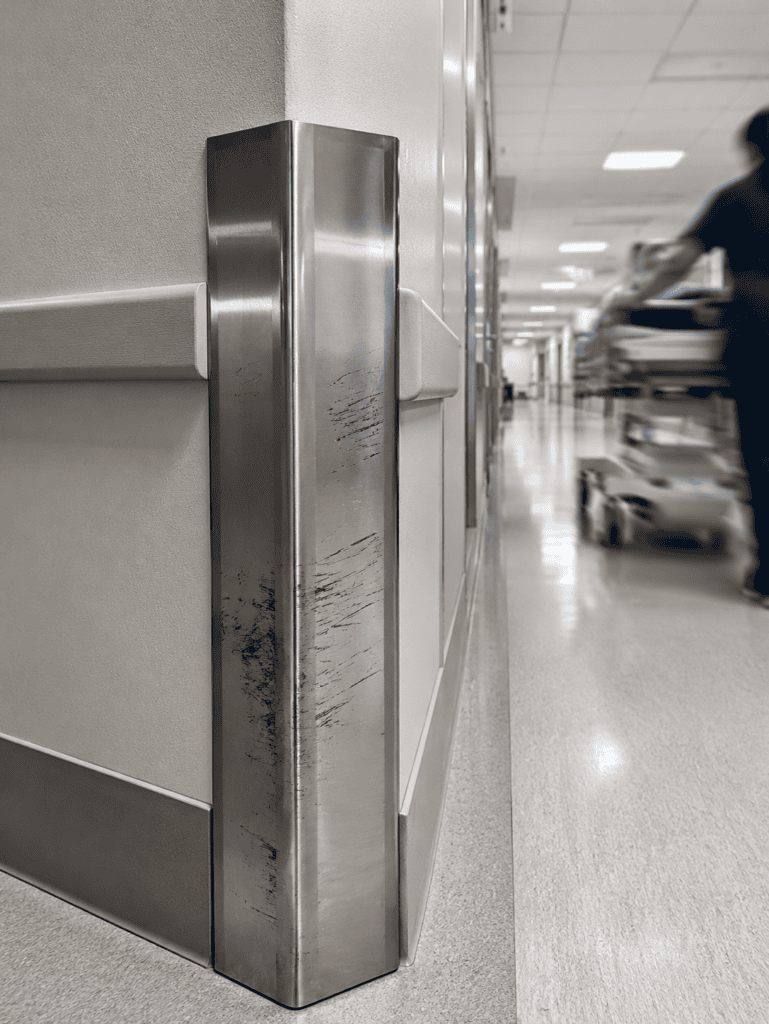
The Main Types of Corner Guards for High-Traffic Commercial Environments
1. Rubber Corner Guards for Industrial and Heavy-Impact Zones
Rubber corner guards are the appropriate specification for environments where the impact risk is severe and the primary concern is absorbing shock rather than resisting abrasion. In warehouses, distribution centers, loading docks, and manufacturing facilities, the wall corners most at risk are those adjacent to forklift routes, pallet storage zones, and goods receiving areas. In these environments, impacts are not glancing blows from pedestrians or light carts. They are full lateral collisions from heavy equipment operating at speed.
Rubber corner guards for industrial wall protection are manufactured from high-density EPDM or natural rubber compounds that flex under impact and return to their original profile rather than deforming permanently. This shock-absorbing quality is critical in heavy-impact environments because a rigid material that does not flex will transfer impact energy through to the wall structure rather than dissipating it. A rubber guard absorbs and releases. The wall behind it is protected even when the impact would have caused serious structural damage to an unprotected corner.
In outdoor or semi-outdoor applications such as loading bays, covered yards, and vehicle access points, rubber corner guards also offer weather resistance, dimensional stability across temperature ranges, and resistance to the oils, fuels, and cleaning chemicals common in industrial environments. Many rubber corner guard profiles for commercial use include pre-drilled mounting holes and are installed with mechanical fasteners into masonry or concrete, providing a secure fixing that holds under repeated heavy contact.
2. Stainless Steel Corner Guards for Hygiene-Critical Environments
Stainless steel corner guards represent the premium specification for facilities where hygiene compliance, impact resistance, and long-term surface integrity are all simultaneously required. In hospital corridors, commercial kitchens, food processing facilities, pharmaceutical manufacturing environments, and clean rooms, the wall protection system must withstand not only physical impact but also repeated aggressive cleaning with industrial disinfectants and sanitizers.
Stainless steel corner guards for hygienic facilities are manufactured from grade 304 or 316 stainless steel, with a brushed or mirror finish that resists bacterial adhesion and can be cleaned with any approved sanitizing agent without surface degradation. The material does not corrode, does not support microbial growth in the way that porous materials can, and does not require painting or periodic refinishing. A stainless steel corner guard installed correctly in a hospital or food facility corridor will remain in compliant condition for the life of the building.
From a structural standpoint, stainless steel corner guards for heavy-traffic walls provide rigid protection against the kind of repeated impact from gurneys, bed frames, wheelchairs, catering trolleys, and cleaning equipment that would destroy a lighter material within months. The rigidity that makes stainless steel less effective in extreme shock-absorption scenarios is an asset in environments where the goal is to present an impenetrable surface that deflects impact rather than absorbing it.
3. Aluminum Corner Guards for Commercial Interiors With Finish Requirements
Aluminum corner guards occupy the middle ground between the raw industrial utility of rubber and stainless steel and the cost efficiency of PVC. They are the preferred specification for commercial interiors where metal protection is required but the design context also demands finish flexibility and visual coordination with the surrounding environment. Offices, schools, universities, hospitality properties, retail environments, and multifamily residential common areas frequently fall into this category.
Aluminum corner guards for commercial walls are available in a wide range of anodized and powder-coated finishes that can be matched to wall colors, door frame finishes, and interior design palettes. This makes them suitable for environments where the corner guard must protect the wall without drawing attention to itself as a purely functional element. The material is lighter than stainless steel, easier to cut and install, and offers good resistance to moderate impact from wheeled luggage, cleaning equipment, and pedestrian traffic.
The trade-off is that aluminum corner guards for high-traffic commercial areas are not the correct specification for environments where heavy equipment contact, forklift proximity, or aggressive vehicle movement is a realistic risk. In those scenarios, the material will deform under impact rather than recover, and a deformed aluminum guard requires replacement rather than recovery.
4. PVC and Vinyl Corner Guards for General Commercial and Institutional Use
PVC and vinyl corner guards are the most widely deployed type across commercial and institutional facilities globally. They are cost-effective, available in the widest range of colors and profiles, easy to cut and install, and suitable for the broad range of moderate-impact environments that make up the majority of commercial building stock. Schools, offices, retail stores, libraries, government buildings, and mid-range hospitality properties are the natural application environment for high-impact PVC corner guards for commercial walls.
The key distinction in the PVC and vinyl category is between standard-grade and high-impact-grade products. Standard PVC corner guards provide adequate protection against pedestrian contact, light cart traffic, and incidental impacts from doors and furniture. High-impact PVC corner guards for commercial corridors are manufactured from a denser, more rigid compound that can withstand significantly greater force before cracking or deforming, making them suitable for environments with heavier traffic from wheelchairs, trolleys, and light industrial equipment.
PVC corner guards are also available in clear profiles, which allow the wall finish behind them to remain visible while still providing a protective layer over the corner edge. This is a useful specification for environments where visual disruption from a visible corner guard would be aesthetically unacceptable, such as in high-end retail, gallery, or hospitality design contexts.
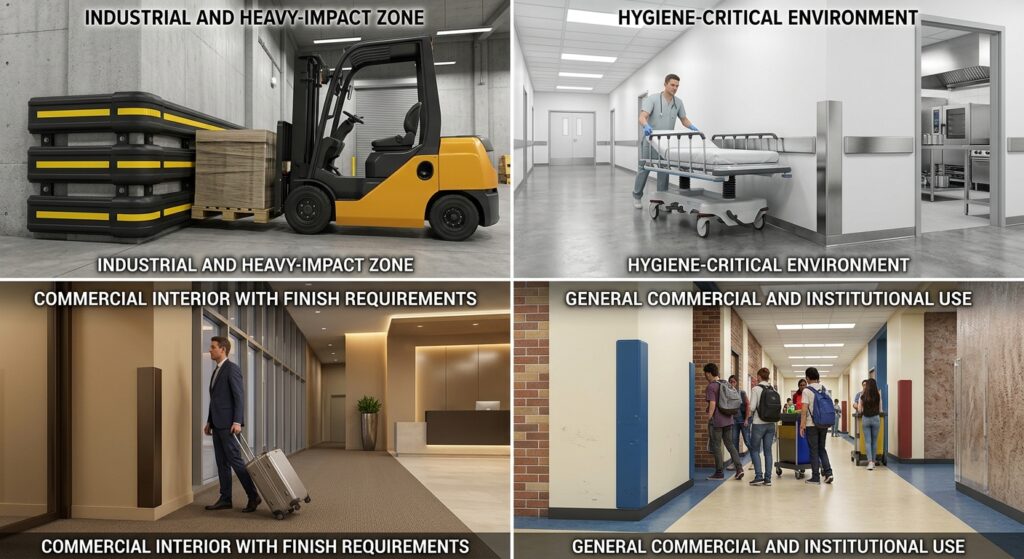
Selecting the Right Corner Guard for Your Facility
1. Matching Material to Impact Risk Level
The single most important variable in corner guard selection is the realistic impact risk at the specific location being protected. A corridor in a hospital ward where bed frames and medication trolleys pass throughout the day presents a different risk profile from the entrance lobby of the same hospital, where the primary traffic is pedestrian. The ward corridor requires a stainless steel or heavy-duty rubber specification. The lobby may be adequately served by a high-impact aluminum or PVC profile that prioritizes appearance as well as protection.
Facility managers sourcing corner guards at scale for a multi-zone building should conduct a location-by-location risk assessment before specifying a single product across the entire facility. High-impact zones including service corridors, loading areas, kitchen access routes, and equipment storage areas should be specified separately from public-facing areas, with material selection driven by the actual impact risk at each location rather than a single compromise specification applied uniformly.
2. Height and Profile Specification
Corner guards for high-traffic commercial walls are available in standard heights of 4 feet and 8 feet, with full floor-to-ceiling profiles also available for environments where the entire corner surface is at risk of impact. For most commercial corridor and room corner applications, a 4-foot height covers the zone of maximum impact risk from wheeled equipment and trolleys. An 8-foot profile is the appropriate specification where tall equipment, bed frames, or freight items present an impact risk above the standard 4-foot zone.
Profile width, meaning the flange width on each side of the corner, also affects both performance and appearance. Wider flanges distribute impact force over a larger wall surface area and provide better protection against glancing impacts that strike at a shallow angle to the corner. Narrower profiles are less visually prominent and are appropriate where appearance is a priority and the impact risk profile is moderate.
3. Fixing Method and Surface Compatibility
Corner guards for commercial walls are fixed using adhesive backing, mechanical fasteners, or a combination of both. Adhesive-fixed corner guards are faster to install, leave no visible fastener hardware, and are appropriate for smooth, clean wall surfaces in relatively light to moderate impact environments. Mechanically fastened corner guards are the correct specification for heavy-duty applications where the fixing must resist repeated significant impact force, for masonry or concrete substrates where adhesive bonding is less reliable, and for outdoor or damp environments where adhesive performance may degrade over time.
In facilities where corner guards will be subject to frequent removal and reinstallation, such as in building renovation projects or modular facility setups, clip-fixed or retainer-system corner guards that use a separate wall-mounted retainer and a snap-on cover profile allow the cover to be removed and replaced without disturbing the wall fixing. This system is particularly common in healthcare and hospitality environments where periodic deep cleaning or surface replacement is part of the maintenance programme.
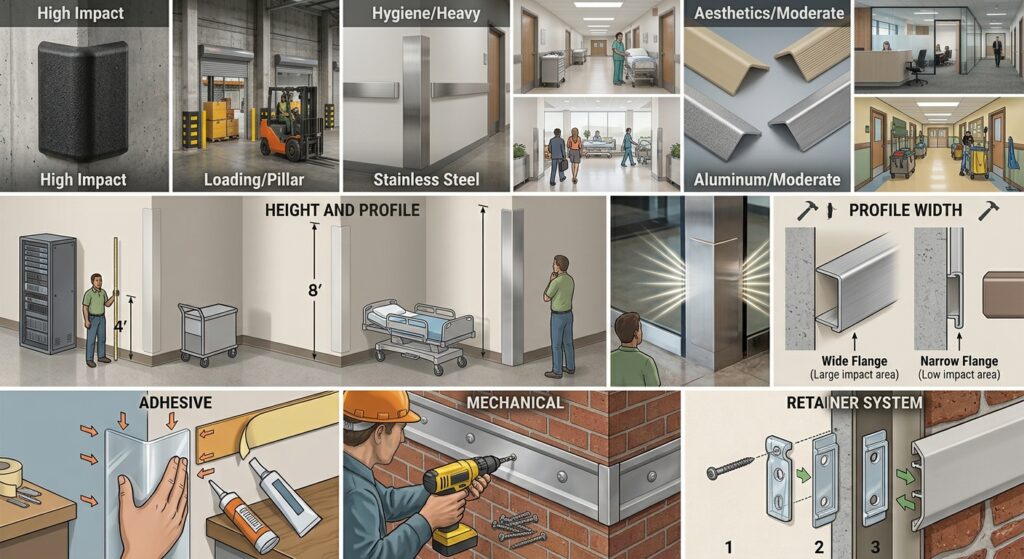
Corner Guards by Facility Type
1. Hospitals and Healthcare Facilities
The wall protection requirements of healthcare facilities are among the most demanding of any building type. High-impact stainless steel corner guards for hospital corridors must withstand continuous contact from bed frames, wheelchair footrests, IV pole bases, and catering and cleaning trolleys throughout every 24-hour period. They must also be compatible with the full range of clinical cleaning agents in regular use, maintain a surface that does not harbor pathogens, and meet fire rating requirements where applicable. Stainless steel and high-impact PVC with antibacterial properties are the standard specifications for healthcare corner guard programmes.
2. Warehouses and Distribution Centers
In warehousing environments, the wall protection priority is industrial-grade impact resistance at locations adjacent to forklift routes, pallet racking end caps, goods receiving bays, and internal vehicle circulation routes. Heavy-duty rubber corner guards for warehouse wall protection are the standard specification for these locations, supplemented by stainless steel or heavy-gauge aluminum at office-to-warehouse transition zones where both impact resistance and a cleaner visual presentation are required.
3. Hotels, Retail, and Hospitality
In customer-facing hospitality and retail environments, the corner guard specification must balance impact protection with visual discretion. Aluminum corner guards with coordinated powder coat finishes, clear PVC profiles that allow the wall finish to show through, and slim-profile stainless steel guards with brushed finishes are all appropriate depending on the design standard of the space. Service corridors, back-of-house areas, and kitchen zones within the same facility should be specified separately to the guest-facing areas, with a heavier-duty product selected for the unseen but heavily used service routes.
4. Schools and Educational Facilities
School corridors, classroom doorways, and stairwells are among the highest pedestrian traffic environments of any building type. The combination of high usage frequency, unpredictable impact direction, and the need for easy cleaning makes high-impact PVC corner guards the standard specification for educational facilities. Color selection can be used practically as well as aesthetically, with high-visibility colors such as yellow or red used at corners on stairwells or in areas where student awareness of the corner location is a safety consideration in itself.
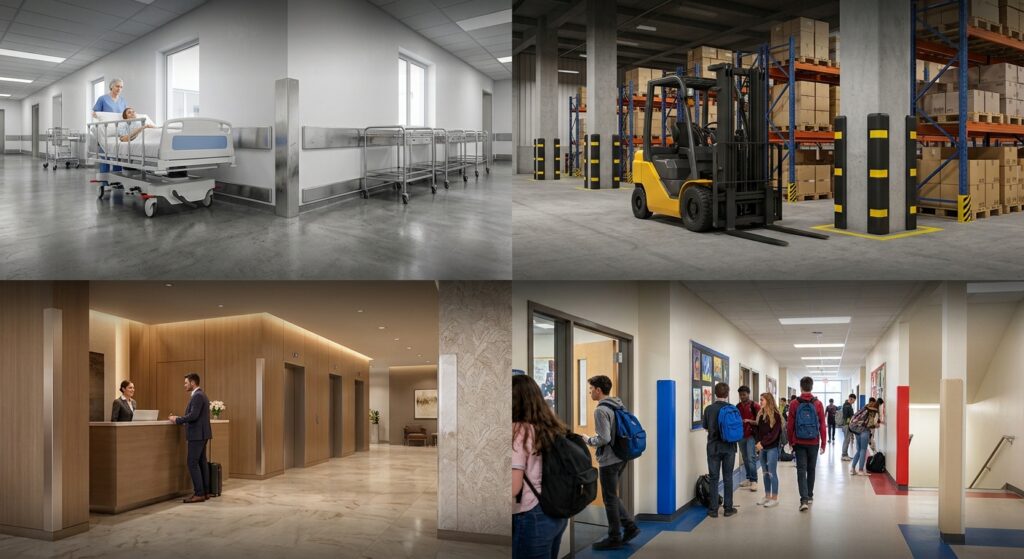
Procurement Considerations for Bulk Corner Guard Programs
1. Standardization Across a Multi-Site Portfolio
For facilities management teams, building contractors, or property developers procuring corner guards across multiple sites or a large single-site programme, standardizing on a consistent product specification across equivalent zones reduces the complexity of procurement, installation, and ongoing replacement. A standardized specification allows reorder quantities to be calculated accurately, ensures that replacement sections match installed product exactly, and simplifies the maintenance records that support compliance documentation.
When sourcing corner guards in volume from a manufacturer or wholesale supplier, confirming consistent batch quality, reliable stock availability in the specified profile and finish, and the supplier’s ability to fulfil repeat orders to the original specification over the life of the programme are all critical evaluation criteria alongside unit price.
Conclusion: Protecting Walls Is Protecting Investment
The wall corners of a commercial or institutional building are not a secondary consideration in facility management. They are among the highest-maintenance surfaces in the building, subject to continuous impact from the full range of equipment, vehicles, and personnel that use the space every day. The right corner guard programme, correctly specified by material and profile for the impact risk and environmental conditions at each location, eliminates one of the most persistent and unnecessary costs in commercial building maintenance.
For procurement teams and facility managers sourcing corner guards at scale, the decision framework is straightforward: match the material to the impact risk, specify the height and profile to the zone of maximum exposure, and choose a supplier whose product quality and stock consistency can support a long-term programme rather than a one-off installation.
The cost of protecting a corner is always a fraction of the cost of repairing one. The best corner guard is the one that never needs to be noticed.
Looking for a reliable manufacturer or wholesale supplier of rubber, stainless steel, and PVC corner guards for commercial and industrial facilities? At JessuBond, we produce heavy-duty wall protection products to commercial specification, with flexible MOQ and consistent supply for large-scale procurement programmes. Contact us here.