
1-Channel to 5-Channel Cable Protectors: Selecting the Right Drive-Over Capacity for Heavy Trucks
Cable protector ramps are procured in volume across construction sites, outdoor events, broadcast and film productions, industrial facilities, and public infrastructure projects every year. The selection decision that causes the most operational problems, product failures, and cable damage is not the choice of rubber over polyurethane or the decision between modular and fixed-length units. It is the mismatch between the channel configuration selected and the actual vehicle traffic the ramp will be subjected to on site. A one-channel ramp rated for 10,000 pounds per axle placed on a route where loaded concrete mixers cross it daily does not just wear out faster. It fails, crushes the enclosed cables, and creates a hazardous surface condition in a live traffic zone.
For procurement managers, site safety officers, and facilities teams sourcing cable protector ramps for environments where heavy trucks are part of the operational reality, the relationship between channel count, ramp body geometry, load rating, and the specific drive-over capacity required by the heaviest vehicle on site is the technical foundation every selection decision should rest on. This article covers that relationship in full, from the mechanics of how channel count affects load distribution to the specific vehicle weight classes each ramp configuration is suited for, and what additional variables beyond load rating must be confirmed before a channel specification is finalised for a heavy-truck environment.
How Channel Count Relates to Load Capacity and Body Geometry
1. The Structural Relationship Between Channel Count and Ramp Thickness
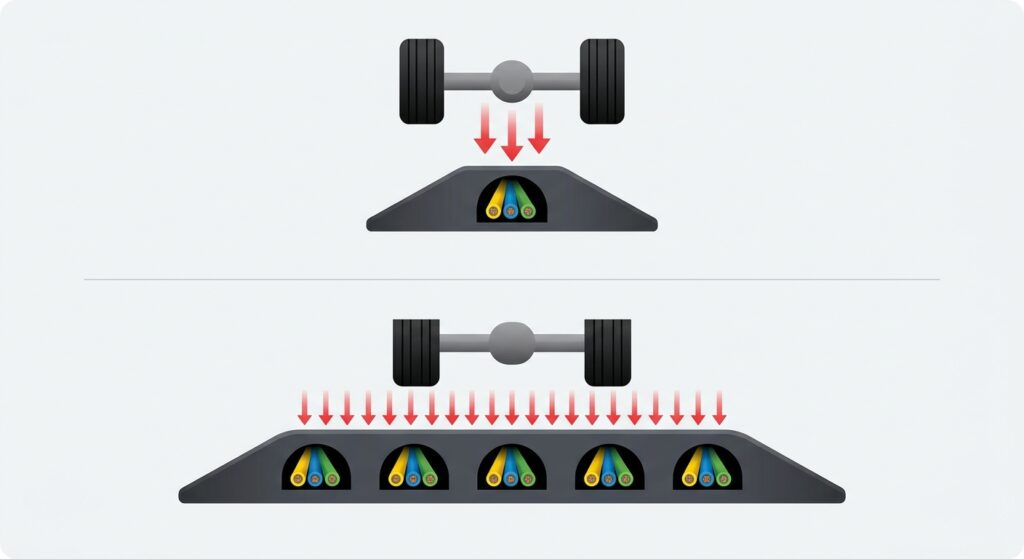
The number of channels in a cable protector ramp is not merely a cable management variable. It directly determines the external width of the ramp body, which in turn determines the footprint area across which vehicle load is distributed when a wheel crosses the ramp. A wider ramp body, which a higher channel count produces, distributes the compression load from a vehicle axle across a larger base area. This is the fundamental reason that five-channel ramps carry higher axle load ratings than single-channel ramps of equivalent rubber compound quality: the body geometry itself changes the load distribution mathematics.
A single-channel rubber cable protector ramp typically measures between 4 and 6 inches in total external width. A five-channel unit of the same rubber compound typically measures between 18 and 22 inches in external width. When a truck axle crosses the single-channel unit, the full downward load from that axle concentrates over 4 to 6 inches of ramp width. When the same axle crosses a five-channel unit, that load distributes across 18 to 22 inches. The wider base unit transfers load to the ground over a much larger contact area, reducing the peak stress on any single point of the ramp body and on the enclosed cables.
2. Why Per-Axle Load Rating Is the Correct Specification Unit
Cable protector ramp load ratings are expressed per axle, not per vehicle, and this distinction is critical for procurement decisions in heavy truck environments. A fully loaded articulated heavy goods vehicle with a gross vehicle weight of 44 tonnes does not apply 44 tonnes of force to a ramp when crossing it. Each axle of the vehicle applies its share of the total load independently as it crosses the ramp. A typical five-axle articulated vehicle distributes its gross weight across those five axles, with each carrying between 8 and 11 tonnes depending on loading distribution and axle configuration.
The ramp sees the heaviest single axle on the vehicle, not the total vehicle weight, at the moment of crossing. For procurement purposes, the correct specification question is: what is the highest axle load of the heaviest vehicle expected to cross this ramp at this site? That figure, with a recommended safety margin of 20 to 25 percent above the calculated maximum axle load, is the minimum rated axle capacity the ramp must meet. Specifying to total vehicle weight rather than peak axle load produces a dramatically over-specified and over-priced product. Specifying to a vehicle’s unladen weight when it will regularly cross the ramp fully loaded produces an under-specified product that will fail under service conditions.
Single-Channel Cable Protectors: Capacity, Cable Types, and Appropriate Applications
1. Load Rating and Structural Profile of Single-Channel Ramps
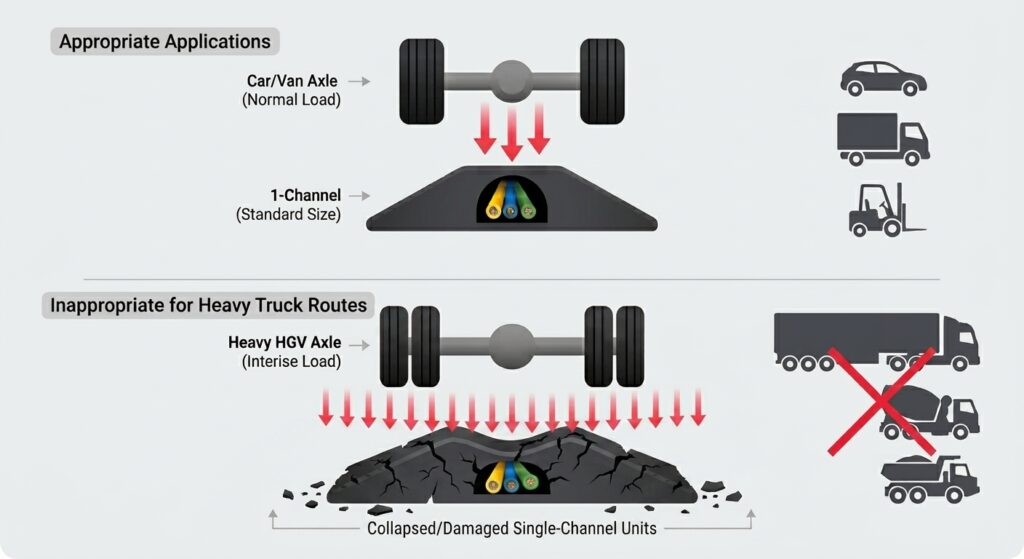
Single-channel cable protector ramps in the heavy-duty rubber category carry axle load ratings typically ranging from 10,000 to 22,000 pounds per axle depending on the rubber compound density and the external body dimensions. The channel itself in a standard heavy-duty single-channel unit measures approximately 1.25 inches wide by 1.125 inches high, accommodating cables and conduits up to approximately 1 inch in diameter. The total external width of the ramp body is typically between 4 and 6 inches, and the ramp height at the crown is between 1.25 and 1.5 inches.
The single-channel configuration in the heavy-duty band is appropriate for sites where one cable or conduit of up to approximately 1 inch in diameter must cross a vehicle route, and where the heaviest vehicle crossing is a light commercial vehicle, a passenger car, a van, or a small rigid truck with an axle load not exceeding the ramp’s rated capacity. For most site office access routes, parking lot pedestrian crossings, and internal facility access lanes where forklift traffic is the heaviest vehicle class, a heavy-duty single-channel ramp at the 22,000-pound per axle rating provides adequate coverage.
2. Where Single-Channel Ramps Are Inappropriate for Heavy Truck Routes
On routes where fully loaded rigid trucks, articulated vehicles, concrete mixer trucks, or other heavy construction plant will cross the cable protector, a single-channel ramp in any standard rubber compound rating is not the appropriate specification. The narrow body width concentrates the axle load over too small a footprint to distribute it effectively, regardless of the nominal per-axle rating. Even where a single-channel unit’s rated capacity nominally exceeds the expected axle load, the narrow contact geometry creates high localised stress in the rubber body at the ramp crown that leads to accelerated deformation, cracking, and eventual channel collapse under repeated heavy crossings. Heavy truck routes require the wider body geometry of a three-channel or five-channel unit to achieve the load distribution the application demands.
Two-Channel Cable Protectors: Capacity Profile and Use Cases
1. Structural Characteristics and Load Rating Range
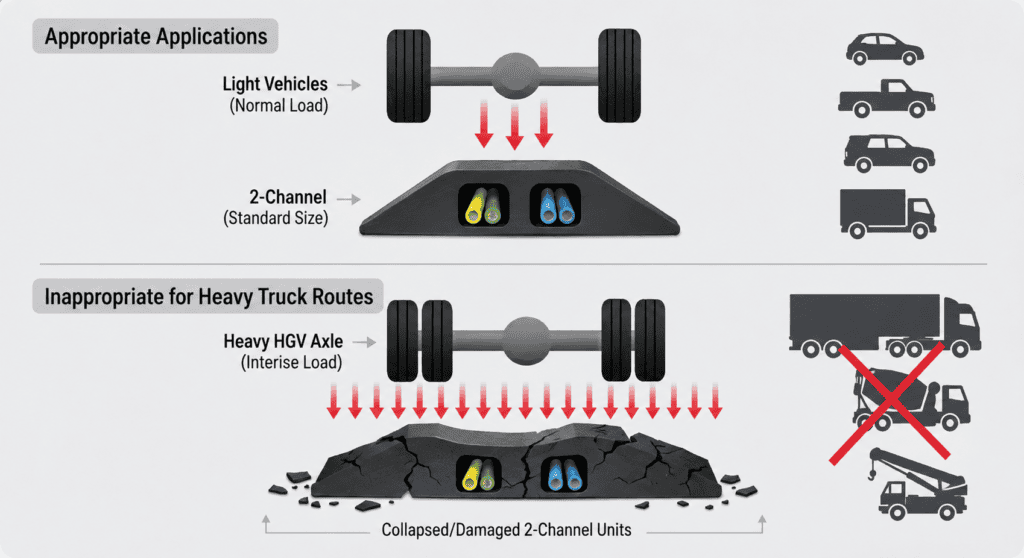
Two-channel rubber cable protector ramps span an external width of approximately 8 to 12 inches and carry axle load ratings typically between 10,000 and 26,000 pounds per axle in the heavy-duty rubber category. Each channel accommodates cables up to approximately 1.25 to 1.5 inches in diameter depending on the specific channel dimensions of the product. The wider body compared to the single-channel unit distributes axle load over a meaningfully larger footprint and allows the ramp to perform more reliably under the repeated crossings typical of a busy site access route.
Two-channel configurations are the standard specification for applications that require separation between power cables and data or signal cables in the same cable run, as routing them in separate channels eliminates the risk of electromagnetic interference from the power cable affecting the data cable at the point where they cross a vehicle route together. For many temporary outdoor events, broadcast outside broadcasts, and construction site access points where the cable management requirement involves one power feed and one data or communication cable, the two-channel unit represents the most compact and cost-effective configuration that serves both the cable separation and the load distribution requirements.
2. Vehicle Classes Appropriate for Two-Channel Ramps
At the upper end of the two-channel heavy-duty rating range, 22,000 to 26,000 pounds per axle, the configuration is appropriate for routes where light rigid trucks, pickup trucks, SUVs, and standard delivery vehicles constitute the heaviest traffic. It is not the recommended specification for routes carrying Class 8 heavy trucks, loaded concrete mixers, or mobile cranes, where axle loads can approach or exceed 20,000 pounds on a single axle and the repeated crossing frequency creates cumulative fatigue loading that demands the wider body geometry of a three or five-channel unit.
Three-Channel Cable Protectors: The Heavy Truck Threshold Configuration
1. Why Three-Channel Represents the Entry Point for True Heavy Truck Applications
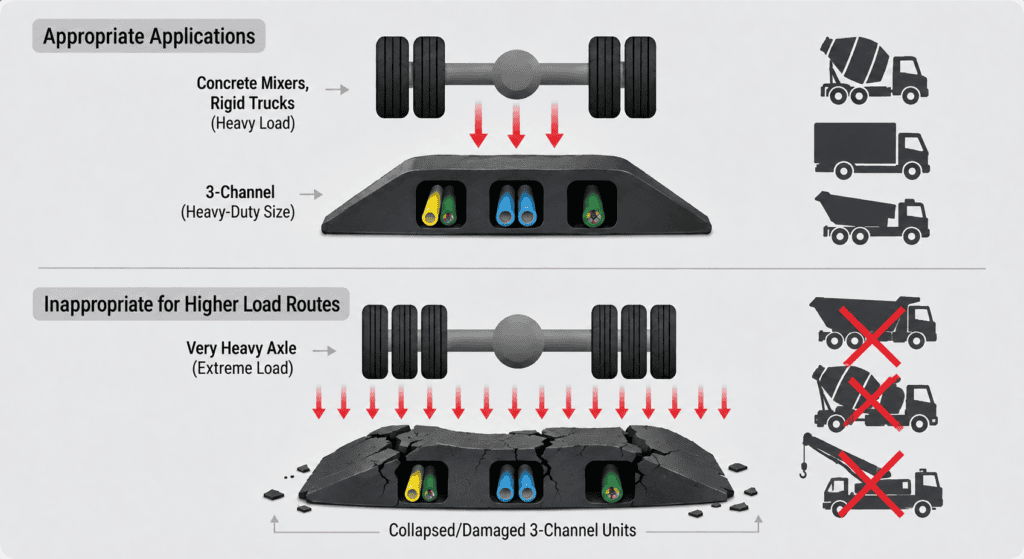
Three-channel rubber cable protector ramps carry axle load ratings typically between 14,000 and 33,000 pounds per axle and span external widths of approximately 12 to 16 inches. The wider body geometry of the three-channel unit provides substantially better load distribution under heavy vehicle axles than either the single or two-channel configurations, making it the entry-level specification for sites where genuine heavy truck traffic, defined as vehicles with gross vehicle weights above 26,000 pounds, is a regular operational condition.
The three-channel configuration also opens up cable management options that single and two-channel units cannot provide. Three discrete channels allow separation of power, data, and a third cable type such as a pneumatic hose, compressed air line, or fibre optic conduit, within a single ramp unit. For construction sites running both electrical power and pneumatic tool supply across an active vehicle route, a three-channel heavy-duty ramp provides a single installation point that manages all three cable types simultaneously without requiring multiple ramps positioned side by side, which creates a wider crossing profile and increases the risk of vehicles driving between rather than over the ramps.
2. Load Distribution Performance Under Concrete Mixer and Rigid Truck Axles
A fully loaded concrete mixer truck with an 8-cubic-meter drum typically has a rear axle load in the range of 16,000 to 20,000 pounds when the drum is full. A three-channel heavy-duty rubber ramp rated to 26,000 pounds per axle provides a 30 percent safety margin above this axle load, which is the minimum margin recommended for cable protector ramp applications where the crossing frequency is high and the rubber compound will be subject to repeated compression and recovery cycles throughout the day.
The three-channel body width, at 12 to 16 inches of external footprint, distributes the mixer truck’s rear axle load across a contact area sufficient to keep the compressive stress in the rubber body within the elastic recovery range of the compound, meaning the ramp returns to its full profile height between crossings rather than taking a permanent set. A ramp operating at the upper limit of its rated capacity on a high-frequency heavy truck route will deform progressively over its service life and eventually fail to recover its profile between crossings, at which point the enclosed cables are no longer protected from direct compressive loading and the ramp must be replaced.
Four-Channel Cable Protectors: The High-Capacity Bridge Configuration
1. Where Four-Channel Sits in the Load and Cable Management Spectrum
Four-channel rubber cable protector ramps are the least frequently discussed configuration in the product category, largely because the commercial market tends to position three-channel and five-channel as the dominant heavy-duty options. This creates a gap in procurement awareness that is worth addressing directly: the four-channel unit occupies a genuine and useful position between the three-channel entry-level heavy truck specification and the maximum-capacity five-channel unit, and it is the correct choice for a specific set of applications that neither the three nor five-channel configuration serves as efficiently.
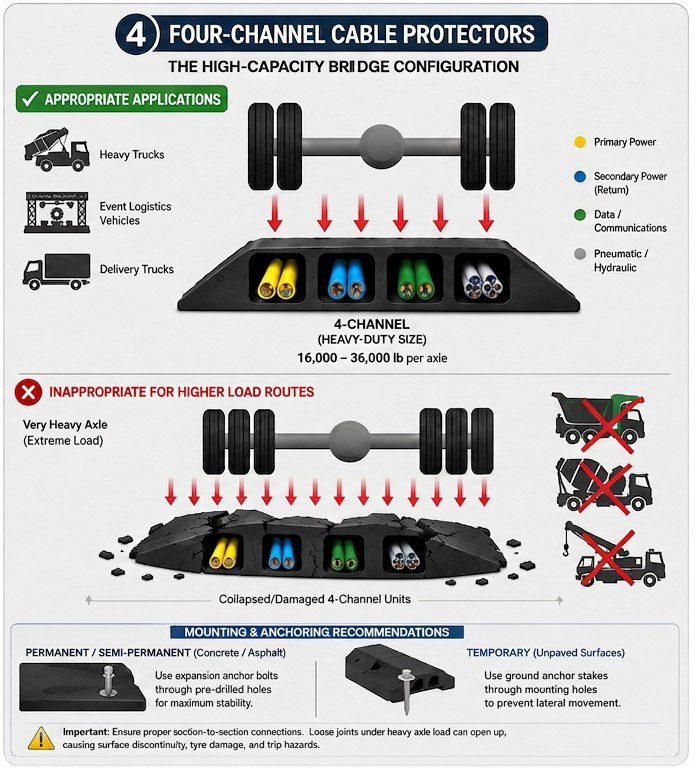
Four-channel ramps carry axle load ratings typically between 16,000 and 36,000 pounds per axle and span external widths of approximately 14 to 18 inches. This places the four-channel unit above the three-channel in both load capacity and body width, giving it better load distribution geometry under heavy axle crossings, while keeping the total ramp width narrower than a five-channel unit, which matters on sites where lane width is constrained and a 20-inch ramp body would encroach on available vehicle clearance on either side of the crossing.
2. Cable Management Advantages of Four-Channel Configurations
The four-channel configuration is the correct specification when the cable management requirement at a crossing point involves four discrete cable or conduit types that must be kept separated for operational or compliance reasons. A common example is a construction site or large outdoor event crossing that must simultaneously manage a primary power feed, a secondary power return, a data or communications cable, and a pneumatic or hydraulic hose. Routing all four through separate channels in a single four-channel ramp unit keeps them separated, prevents cross-contamination between power and signal cables, and maintains a single defined crossing point rather than requiring multiple narrower ramps positioned side by side.
The four-channel unit also provides a useful specification option when the five-channel configuration would leave one channel unused at a given crossing location. An unused channel in a cable protector ramp under heavy truck traffic is not structurally neutral: it represents a void in the ramp body that reduces the effective load-bearing cross-section at that position and creates a localised weak point under repeated axle crossings. Where only four cable types are present at a crossing, a four-channel ramp with all channels occupied is structurally more appropriate than a five-channel ramp with one channel empty, and it costs less per unit and per section length.
Five-Channel Cable Protectors: Maximum Capacity for the Heaviest Traffic Environments
1. Load Rating, Body Dimensions, and Cable Capacity of Five-Channel Units
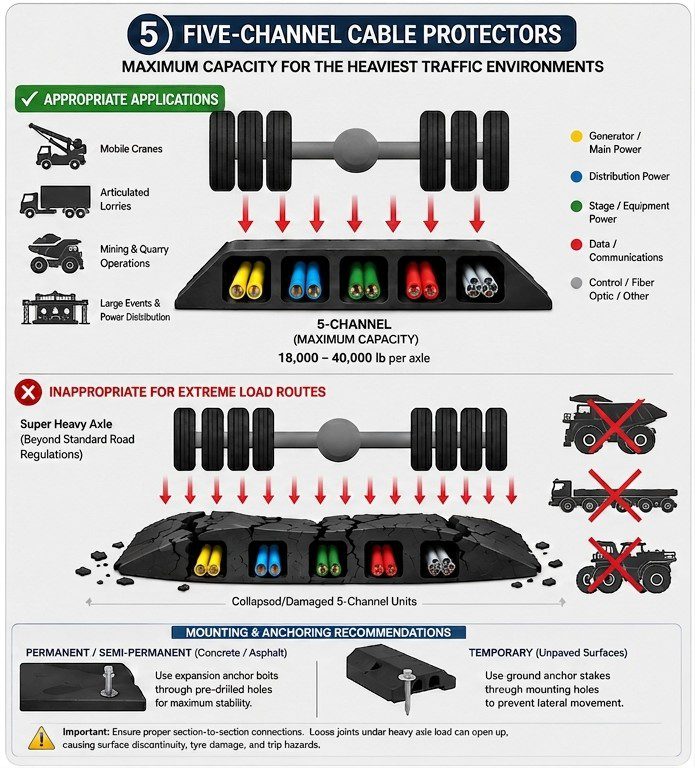
Five-channel rubber cable protector ramps represent the highest-capacity configuration in the standard commercial product range, carrying axle load ratings between 18,000 and 40,000 pounds per axle depending on the rubber compound specification and the specific body geometry of the product. External widths typically range from 18 to 22 inches, and each of the five channels accommodates cables or conduits up to approximately 1.5 to 2 inches in diameter depending on the specific channel dimensions.
The five-channel unit is the correct specification for the most demanding heavy truck environments: active construction sites carrying fully loaded articulated lorries, sites with regular mobile crane crossing movements, mining and quarrying operations with heavy haul vehicle traffic, and outdoor power supply installations for large public events where generator feed cables, distribution cables, stage power cables, and data cables must all cross a live vehicle route in a single managed installation. At the upper end of the five-channel axle rating, 33,000 to 40,000 pounds per axle, the ramp is suitable for all standard road-legal heavy truck configurations operating under normal gross vehicle weight regulations in most markets.
2. Mounting and Anchoring Requirements for Five-Channel Units Under Heavy Truck Traffic
The mass of a five-channel heavy-duty rubber ramp, typically between 35 and 55 pounds per section depending on rubber density and body dimensions, provides natural resistance to lateral displacement under vehicle approach and crossing forces. However, on active construction sites or outdoor event sites where the crossing angle is not perfectly perpendicular to the ramp, or where vehicle approach speeds are higher than the walking-pace ideal, mechanical anchoring of the ramp sections to the surface is strongly recommended.
Five-channel units manufactured for permanent or semi-permanent installation include pre-drilled mounting holes in the base that accept expansion anchor bolts into concrete or asphalt surfaces. For temporary installations on unpaved surfaces, ground anchor stakes through the base mounting holes provide lateral stability without requiring surface drilling. The heavier body mass of a five-channel unit makes proper section-to-section connection at the interlocking joints particularly important: an improperly connected joint between two five-channel sections under heavy axle load will open under the crossing force, creating a surface discontinuity that can damage tyres and create a trip hazard at the joint line.
Variables Beyond Channel Count That Determine Ramp Suitability for Heavy Trucks
1. Rubber Compound Density and Temperature Performance
Not all rubber cable protector ramps with equivalent channel counts and nominal axle load ratings perform equally under heavy truck traffic in outdoor environments. The rubber compound specification determines how the ramp body responds to impact loading at different temperatures, how quickly it recovers its profile after compression, and how long it maintains its rated load capacity across its service life.
Standard recycled rubber compounds perform adequately across the temperature range of most temperate climate applications, but in high-temperature outdoor environments above 40 degrees Celsius, standard recycled rubber softens measurably and its load distribution performance degrades. For sites in hot climates or where the ramp surface will be exposed to direct sunlight throughout the day, virgin rubber or EPDM compound ramps with higher thermal stability maintain their load rating and profile recovery performance more reliably than standard recycled rubber units at equivalent specifications.
In cold climate applications below minus 10 degrees Celsius, standard rubber compounds can become brittle, reducing impact absorption and increasing the risk of surface cracking at the ramp edges and channel lids. Ramps specified for cold climate heavy truck routes should confirm low-temperature flexibility ratings, typically expressed as the minimum operational temperature at which the rubber compound retains its stated impact resistance, before the channel configuration and load rating are finalised.
2. Channel Dimensions Versus Actual Cable Diameter
The load rating and channel count of a cable protector ramp are meaningless if the channels are too small to accommodate the cables that must be routed through them. This sounds obvious but it is one of the most consistent specification errors in cable protector procurement: buyers confirm the channel count and load rating without confirming the internal channel dimensions against the actual cable diameters and bend radii of the cables being managed.
A cable forced into a channel with insufficient clearance cannot lie flat in the channel base. It sits proud of the channel base, meaning the channel lid cannot close flush, which means the cable is not fully protected from overhead compression loading and the lid is not performing its load-bearing function. The effective load rating of a ramp with a partially open or poorly seated channel lid is substantially lower than the rated capacity of the fully closed unit. Before finalising any cable protector ramp specification for a heavy truck environment, the internal channel width and height of the proposed product must be confirmed against the actual outer diameter of the largest cable to be routed, with a minimum clearance of 10 percent on each dimension to allow the cable to lie naturally in the channel without forced bending.
3. Crossing Angle and Approach Gradient
The rated axle capacity of a cable protector ramp assumes a perpendicular crossing, meaning the vehicle crosses the ramp at 90 degrees with both wheels of the axle contacting the ramp simultaneously and the load distributing symmetrically across the full ramp width. On sites where vehicle routes approach the cable crossing at an oblique angle, the crossing is sequential rather than simultaneous: one wheel contacts the ramp before the other, loading one side of the ramp body before the load has transferred to the other side. This asymmetric loading condition concentrates stress on the first-contact side of the ramp and effectively reduces the practical load capacity below the rated axle figure.
Where crossing angles cannot be controlled to within 30 degrees of perpendicular, the ramp should be specified one capacity band above the calculated requirement to compensate for the asymmetric loading condition. Approach gradient also affects loading: a vehicle approaching a ramp on a downhill grade applies a higher effective axle load to the ramp at the moment of contact than the same vehicle approaching on flat ground, because the downhill momentum adds a dynamic impact component to the static axle weight. For sites with grades above 5 percent approaching the cable crossing, the dynamic load factor should be applied to the static axle weight calculation before selecting the ramp specification.
Selecting the Right Configuration: A Framework for Heavy Truck Environments
1. The Specification Decision Sequence
For procurement teams and site managers selecting cable protector ramps for heavy truck environments, the selection sequence that produces a correct specification every time follows a consistent logic. The first step is to identify the heaviest vehicle that will cross the ramp at this specific location and establish its maximum per-axle load at the crossing point under fully loaded operating conditions. The second step is to apply the appropriate safety margin above that axle load figure, a minimum of 20 percent for standard crossing conditions and 30 to 35 percent for oblique crossings or downhill approaches, to arrive at the minimum rated axle capacity required.
The third step is to confirm the number and diameter of cables to be routed through the ramp at this location, match those dimensions against the internal channel dimensions of products in the required capacity band, and select the channel count that accommodates all cables with adequate clearance. The fourth step is to confirm the rubber compound specification against the ambient temperature range at the installation location and the expected crossing frequency over the product’s intended service life. The fifth step is to confirm the mounting and anchoring method appropriate for the surface type and the crossing geometry before ordering.
This sequence eliminates the two most common specification errors in heavy truck cable protector procurement: selecting by channel count without confirming load rating adequacy, and selecting by load rating without confirming channel dimension compatibility with the actual cables being managed.
Conclusion: Channel Count Is a Starting Point, Not the Full Answer
The channel count of a cable protector ramp is the most immediately visible specification parameter and the one most commonly used as a shorthand for product selection in procurement conversations. It is a useful starting point because it signals the approximate width and load distribution geometry of the ramp body, but it is not the complete specification decision for any heavy truck application. A five-channel ramp in a standard rubber compound rated to 18,000 pounds per axle is the wrong product for a route carrying loaded concrete mixers with rear axle loads approaching 20,000 pounds. A three-channel ramp in an EPDM compound rated to 33,000 pounds per axle with correct channel dimensions for the cable types being managed is the right product for the same route.
For procurement teams sourcing cable protector ramps at volume for construction, infrastructure, industrial, or large-scale event applications where heavy trucks are part of the operational environment, the investment in getting the specification right at the selection stage avoids product failures, cable damage, and surface hazard conditions that cost substantially more to resolve after installation than the incremental cost of the correct product at the time of order.
The right ramp is the one that is still performing correctly at the end of the heaviest day on site. The wrong ramp announces itself by failing on that day.
Looking for heavy-duty rubber cable protector ramps in 1-channel through 5-channel configurations, rated for construction and heavy truck environments? At JessuBond, we manufacture cable protection ramps to commercial specification with flexible MOQ and consistent lead times for project and volume procurement. Contact us here.