
A convex safety mirror that has degraded past the point of functional clarity is not just an aesthetic problem. It is a safety liability. A mirror face that has yellowed, hazed, cracked, or developed distortion is no longer delivering the wide-angle visibility it was installed to provide. In a warehouse aisle, a parking garage exit, or a blind road junction, a mirror that looks present but performs poorly gives operators and drivers false confidence without the actual sightline extension the installation requires. Knowing when a damaged convex safety mirror can be repaired, when re-coating or resurfacing is the right intervention, and when the only appropriate decision is full replacement is a practical competency for any facilities manager, safety officer, or procurement team responsible for maintaining a mirror programme across a commercial or industrial site.
This article covers each of those three decisions in detail: what damage types are repairable, how the re-coating process works for acrylic and polycarbonate mirror faces, and how to assess the replacement threshold correctly so that mirrors are neither replaced prematurely nor kept in service past the point where they remain effective.
Understanding What Damages a Convex Safety Mirror
1. UV Degradation and Surface Hazing
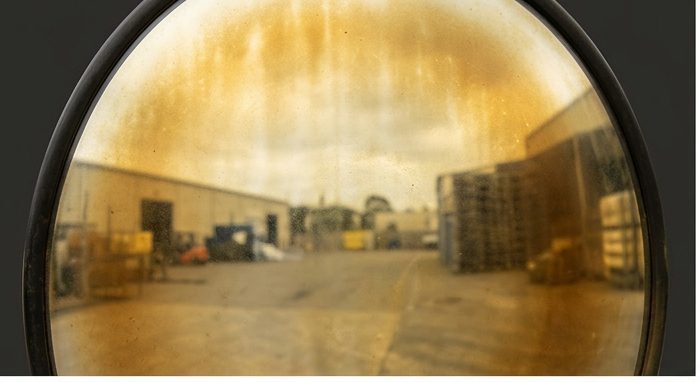
The most common form of damage affecting outdoor convex safety mirrors is UV-induced degradation of the mirror face material. Both acrylic and polycarbonate, the two materials used for virtually all commercial convex safety mirror faces, are thermoplastic polymers whose optical clarity depends on the stability of their polymer chain structure and the integrity of their surface coatings. Prolonged exposure to ultraviolet radiation breaks down these polymer chains at the molecular level, producing the yellowing, cloudiness, and surface micro-crazing that characterise an aged outdoor mirror face.
The rate at which UV degradation progresses depends on the material specification, the UV stabiliser content of the formulation, and the intensity of UV exposure at the installation location. For acrylic mirror faces without high-grade UV stabilisation, mild yellowing typically begins between year two and year three of outdoor exposure, with surface micro-crazing developing by year three to five and replacement becoming necessary by year five at the latest. For polycarbonate mirror faces with co-extruded UV-stabilised coatings, optical clarity holds within specification for three to five years, with surface haze developing between year five and year seven and replacement typically required at the seven-year mark for fully exposed outdoor installations. Indoor mirrors, where UV exposure is absent or minimal, are not subject to this degradation pathway at all and deteriorate only through physical damage or surface contamination.
2. Surface Scratching and Abrasion
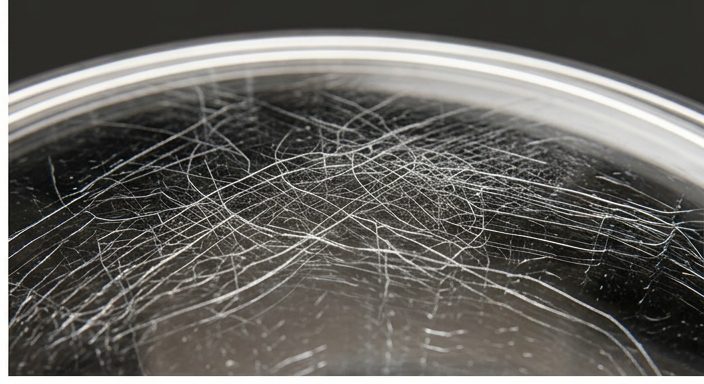
Surface scratching is the second most common damage pathway for convex safety mirrors in commercial and industrial environments. In warehouses, the mirror face may be contacted by passing loads, dust accumulation cleaned with abrasive materials, or direct impact from equipment. In outdoor installations, airborne grit, cleaning with inappropriate materials, and vandalism are the primary scratch sources. Surface scratches scatter light that would otherwise pass cleanly through the mirror face and reflect from the metallised backing, reducing optical clarity and creating a hazy, diffuse image rather than a sharp, wide-angle reflection.
The significance of surface scratching depends on the depth and distribution of the scratches and on the mirror face material. Fine, shallow surface scratches on an acrylic face are addressable through polishing, because acrylic is a homogeneous material through its full thickness and the degraded surface layer can be progressively removed with fine abrasives to reveal the clear material beneath. Polycarbonate presents a fundamentally different situation because its clarity depends on a thin UV-protective hard coat applied at the surface during manufacture. Once that hard coat is scratched through or worn away, the bare polycarbonate beneath it degrades rapidly and the scratched surface cannot be polished back to clarity in the same way that acrylic can be restored.
3. Physical Impact Damage
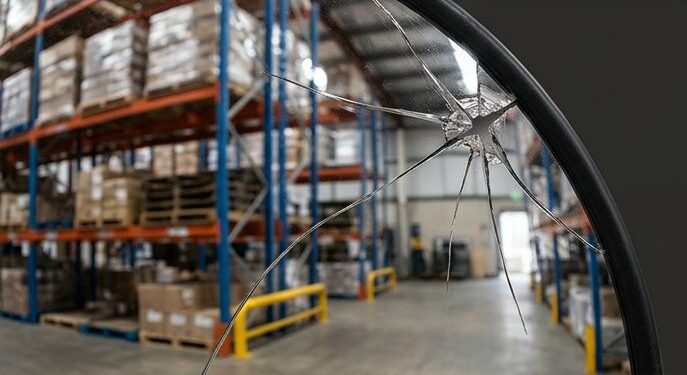
Physical impact damage to a convex safety mirror ranges from minor surface denting of the mirror body or bracket to full cracking or shattering of the mirror face. Acrylic faces, while impact-resistant under normal conditions, can crack under sufficient blunt force and the cracked pieces, while less dangerous than glass, create sharp edges and compromise the optical integrity of the entire mirror face. Polycarbonate faces are significantly more impact-resistant than acrylic and will typically deform under impact rather than cracking, but extreme force can produce stress fractures that propagate across the face over time even if the initial damage appears minor.
Bracket and mounting hardware damage is a separate but equally important damage category. A mirror face that is optically intact but mounted on a damaged, misaligned, or structurally compromised bracket is not performing correctly because the mirror angle determines the zone that is reflected. A bracket that has been struck and bent out of alignment reflects the wrong area of the environment, and the safety function of the installation is lost even though the mirror itself appears undamaged at a casual glance.
4. Chemical Contamination and Coating Failure
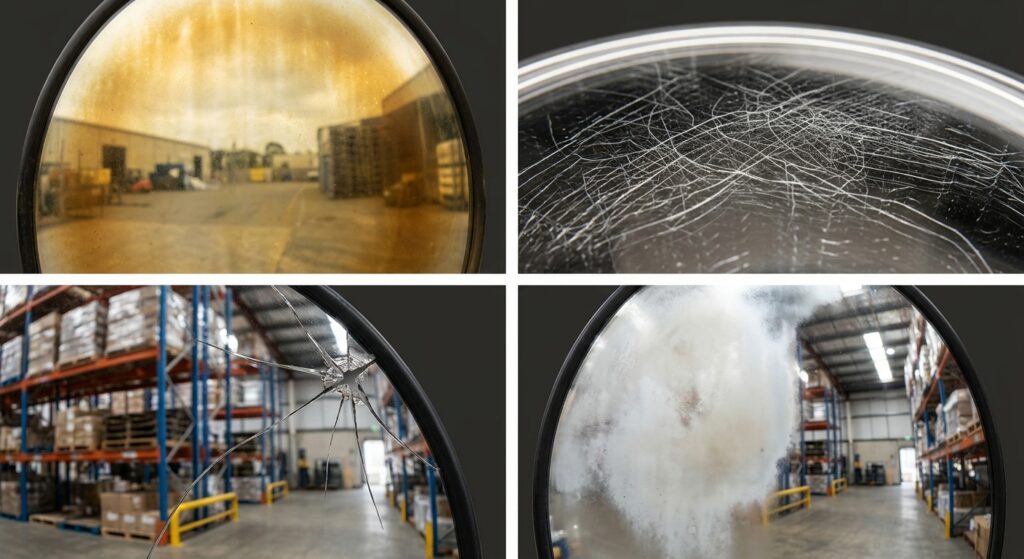
In industrial environments, convex safety mirrors are exposed to the full range of chemicals used in warehouse and facility cleaning, including ammonia-based glass cleaners, solvent-based degreasers, and high-alkalinity floor cleaners. Ammonia and many organic solvents attack both acrylic and polycarbonate surfaces, causing surface clouding, micro-cracking, and delamination of protective coatings that cannot be reversed by cleaning or polishing. This form of damage is entirely preventable through correct cleaning protocol specification, but it is frequently encountered in facilities where mirror cleaning has been delegated to cleaning staff without material-specific guidance.
When Repair Is the Right Decision
1. Repairing Minor Surface Scratches on Acrylic Mirror Faces
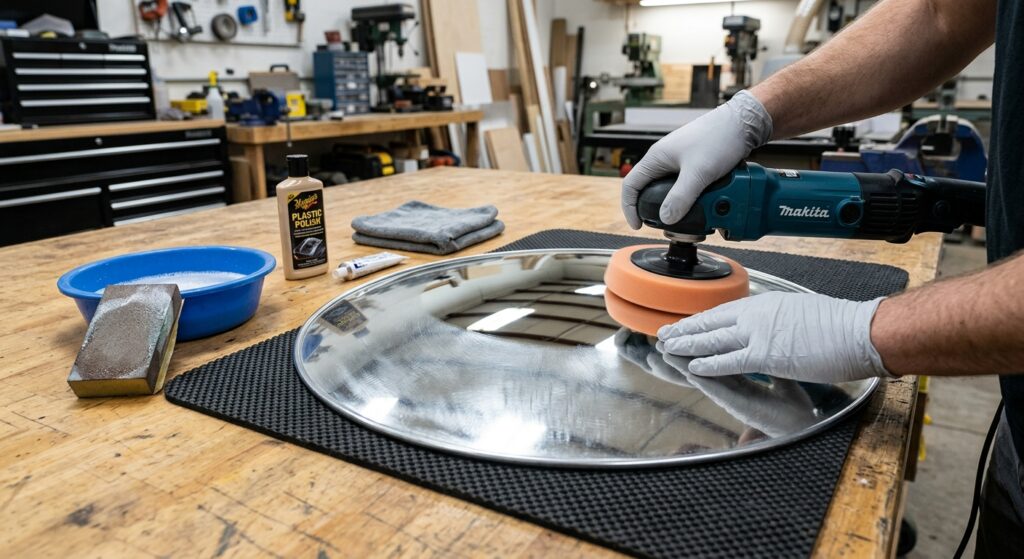
Light to moderate surface scratching on an acrylic convex mirror face is the most straightforward damage category to address through repair. The process uses progressively finer abrasives to remove the scratched surface layer and reveal the clear acrylic beneath, followed by polishing to restore optical smoothness. It is the same fundamental process used for automotive headlight lens restoration and for restoring clarity to scratched acrylic boat windows and caravan skylights.
The correct abrasive progression for restoring a scratched acrylic convex mirror face begins with wet sanding at P800 to P1200 grit to remove the oxidised or scratched surface layer, followed by P1500 to P2000 to eliminate the scratches left by the previous stage, and finishing at P2500 to P3000 before moving to a fine plastic polishing compound applied with a low-speed polisher or a microfiber cloth. Each stage must fully remove the scratch marks left by the previous stage before progressing. Skipping a grit step leaves subsurface scratches that reappear as residual haze against strong light and cannot be removed without returning to the coarser stage that created them.
Temperature management during polishing is critical with acrylic. Both acrylic and polycarbonate are thermoplastics that soften under friction heat. A polishing pad moving too fast or pressing too hard against the acrylic surface can generate enough heat to warp or distort the curved mirror face, producing optical distortion in the reflection that cannot be corrected without replacing the face. Work in small sections, use water as a lubricant during the wet sanding stages, and keep polishing pad speed low throughout the process.
2. Bracket Realignment and Hardware Repair
A mirror whose face is optically sound but whose bracket has been knocked out of alignment is a repair candidate rather than a replacement candidate. Bracket realignment requires loosening the mounting bolts, repositioning the bracket to the correct angle for the intended viewing zone, and retightening to the specified torque. On adjustable bracket systems, this is a straightforward process. On fixed-angle brackets that have been bent by impact, the bracket itself requires replacement while the mirror face is retained if its condition is adequate.
Mounting hardware inspection should be a standard component of every scheduled mirror maintenance visit. Bracket bolt loosening under vibration and repeated impact is a progressive process that goes unnoticed if not specifically checked. A bracket that has lost one of its two mounting bolts and is held by a single bolt will shift under wind load or vehicle vibration, gradually moving the mirror out of its correct viewing angle without any obvious external indication that the installation has been compromised.
When Re-coating Is the Right Decision
1. Re-coating Polycarbonate Mirror Faces After Surface Degradation
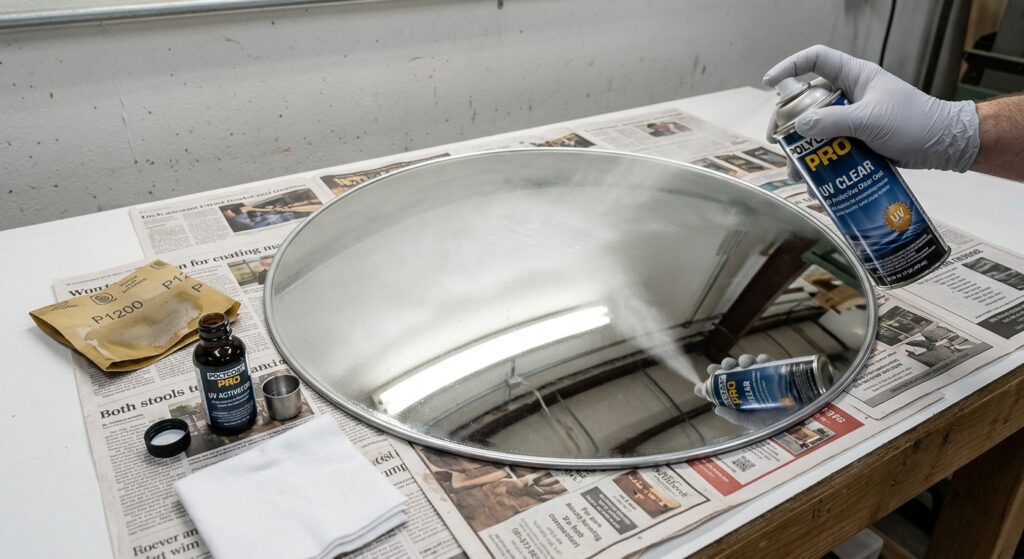
Polycarbonate mirror faces present a specific restoration pathway that differs from acrylic because of their reliance on a surface hard coat for both scratch resistance and UV protection. Once the original factory hard coat has degraded, worn through, or been chemically damaged, the correct restoration approach is to remove the remaining degraded coating, lightly abrade and clean the bare polycarbonate surface, and apply a new UV-protective clear coat rather than attempting to polish the polycarbonate itself.
Polishing bare polycarbonate without recoating it restores temporary clarity but leaves the surface without UV protection, and without that protection the material will yellow again within six to twelve months of re-exposure to outdoor UV. This is the critical technical distinction between restoring an acrylic mirror face and restoring a polycarbonate one: acrylic polishing is a self-contained restoration because the material is homogeneous through its thickness, while polycarbonate restoration is only durable if it concludes with the application of a new UV-protective coating that replaces the function of the original factory hard coat.
UV-protective clear coats for polycarbonate surfaces are available in spray and brush-applied formulations. Products formulated with benzotriazole or benzophenone UV absorbers embedded in the coating matrix provide the longest-lasting protection and are the correct specification for outdoor mirror face recoating. After application, the coated face requires the full cure time specified by the coating manufacturer before being returned to service. A coating applied to a mirror that is immediately reinstalled outdoors before full cure will not achieve its rated UV protection lifespan.
2. The Limits of Re-coating: When Deep Degradation Disqualifies Restoration
Re-coating is only effective when the degradation of the mirror face is confined to the surface layer. When yellowing has penetrated beyond the surface into the bulk of the polymer, producing a colour change that is visible when the mirror face is viewed from its edge cross-section rather than just its surface, polishing and recoating will not restore functional clarity. The discolouration is structural, produced by changes to the polymer chain chemistry throughout the material thickness, and no surface treatment can reverse it.
The practical assessment test is straightforward. Clean the mirror face thoroughly and examine the reflection in diffuse natural light. If the image remains significantly yellow, cloudy, or distorted after cleaning, and if the edge cross-section of the face shows yellow or amber colouration through its thickness, the degradation is structural and replacement is the correct decision. If the surface appears hazy or scratched but the edge cross-section shows clear or near-clear material, surface restoration through polishing and recoating is likely to be effective.
When Full Replacement Is the Right Decision
1. Assessing the Replacement Threshold Correctly
The replacement threshold for a convex safety mirror is not a matter of aesthetics. It is a safety performance threshold defined by whether the mirror still delivers the wide-angle visibility that the installation was designed to provide. A mirror that looks aged or discoloured but still produces a clear, undistorted image of the full intended viewing zone is still performing its safety function. A mirror that looks intact but produces a distorted, hazy, or significantly yellowed reflection is not performing its safety function regardless of its physical condition.
The practical assessment for the replacement threshold involves standing at the approach position where the mirror is intended to be viewed, at the distance and angle from which a driver or pedestrian would normally use it, and evaluating the reflection directly. If the reflection clearly shows the full viewing zone with adequate definition to identify an approaching vehicle or person at the distance the installation is designed to cover, the mirror is still functional. If the reflection is sufficiently degraded that a vehicle or person at the intended detection distance could be missed or misidentified, the mirror has fallen below the safety performance threshold and must be replaced.
2. Face-Only Replacement Versus Full Assembly Replacement
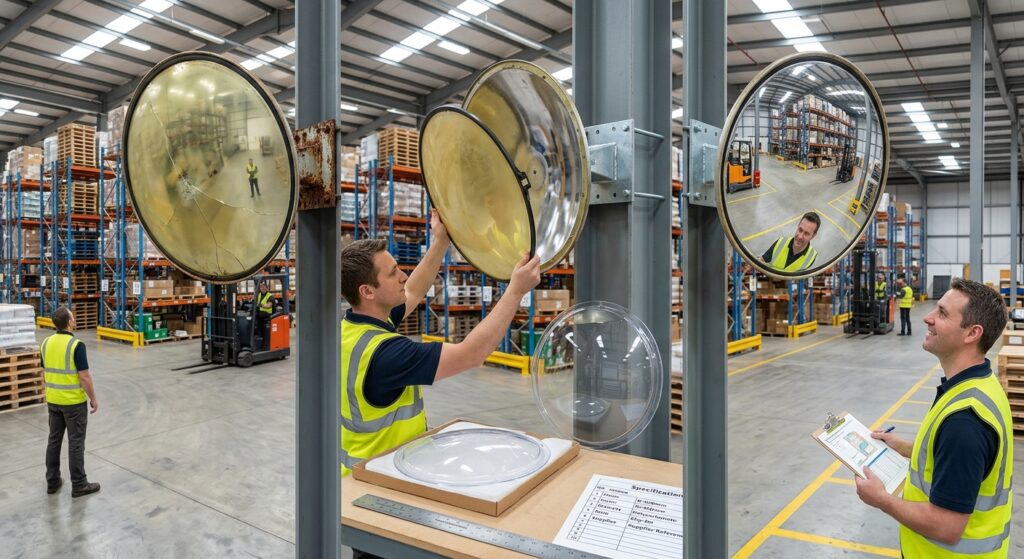
A critical procurement and cost management distinction in convex mirror replacement programmes is that the face and the hardware are separate components with different service lives. The mounting hardware, including brackets, poles, and fixings, is typically manufactured from galvanized steel, powder-coated steel, or stainless steel and has a service life that substantially outlasts the mirror face under most installation conditions. Replacing only the mirror face when it reaches the end of its optical service life, while retaining the existing hardware, significantly reduces the per-replacement cost and the disruption of the replacement process.
A facility running a convex mirror programme across a large site over a fifteen-year period will typically replace the mirror face two or three times at each location while retaining the same bracket and mounting hardware throughout. This face-only replacement cycle is the correct procurement model for any site-wide mirror programme and should be reflected in the initial product specification: mirrors should be selected on the basis that the face is a replaceable component that can be sourced separately from the hardware assembly, not as a single integrated unit where face degradation requires full assembly replacement.
3. Specifying the Replacement Face Correctly
When sourcing replacement faces for an existing convex mirror installation, the replacement face must match the original installation in diameter, curvature radius, and backing attachment method. A face with a different curvature radius fitted to the existing backing will produce a different viewing angle and coverage zone from the original specification, which may leave part of the intended viewing zone uncovered without the facility manager being aware of the change.
For procurement teams managing a standardised mirror programme across multiple sites, maintaining a specification record for each installed mirror that includes the face diameter, material, curvature specification, and supplier reference allows replacement faces to be sourced precisely without requiring a site visit to measure each mirror before ordering. This record-keeping discipline also simplifies the compliance documentation that demonstrates the mirror programme is being maintained to its original safety specification.
Building a Mirror Maintenance Programme That Prevents Premature Failure
1. Cleaning Protocol and Material Compatibility
The single most preventable cause of premature convex mirror face degradation is cleaning with incompatible chemical agents. Ammonia-based glass cleaners, solvent-based degreasers, acetone, methylated spirits, and any abrasive cleaning compound will damage both acrylic and polycarbonate mirror faces, producing surface cloudiness, micro-cracking, or coating delamination that cannot be reversed and accelerates the degradation timeline significantly.
The correct cleaning protocol for all plastic convex mirror faces is a soft microfiber cloth dampened with mild soap and water, applied with light pressure and working with the curvature of the face rather than across it. For outdoor mirrors with heavy soiling from bird droppings or industrial contamination, a longer dwell time with the damp cloth softens the deposit before wiping, eliminating the need for mechanical pressure that would scratch the surface. Paper towels, rough cloths, and scouring pads are all abrasive enough to introduce fine scratches that accumulate into visible haze across multiple cleaning cycles and must never be used on mirror faces.
2. Inspection Schedule and Condition Recording
A structured inspection schedule is the operational foundation of a mirror programme that consistently delivers the safety performance it was designed for. The minimum recommended inspection frequency for outdoor mirrors is quarterly for cleaning and annual for full structural and optical condition assessment. Indoor warehouse mirrors in high-traffic locations benefit from a more frequent inspection cycle, with a visual check of bracket tightness and face condition recommended monthly given the elevated risk of contact damage in those environments.
Condition recording at each inspection, noting any scratching, yellowing, bracket movement, or physical damage at each mirror location, creates the documentation trail that supports both maintenance decision-making and compliance demonstration. A mirror that shows early-stage yellowing at one annual inspection can be tracked through subsequent inspections to determine whether the degradation rate warrants near-term replacement or whether the current performance remains adequate for another inspection cycle.
Conclusion: Maintenance Extends Value, But Replacement Protects Safety
A convex safety mirror programme that is actively maintained through correct cleaning, timely bracket inspection, targeted face restoration where appropriate, and disciplined replacement at the correct optical performance threshold delivers substantially more value per installed mirror than one where mirrors are either replaced at the first sign of aging or left in service long past the point of effective performance. The distinction between repair, re-coating, and replacement is not a cost-saving choice made at the expense of safety. It is a technically informed maintenance decision made on the basis of what the mirror face material can and cannot recover from.
For facilities managers and procurement teams managing mirror programmes at scale, the investment in structured inspection records, correct cleaning protocol training, and a clearly defined replacement specification yields a programme where mirrors consistently perform at the safety level they were installed to deliver, and where the cost of maintaining that performance is managed efficiently across the full service life of the installation.
A mirror that cannot be clearly seen in is no longer a safety tool. It is a false reassurance. Know the difference before it matters.
Looking for replacement convex mirror faces, full mirror assemblies, and commercial-grade mounting hardware for facility-wide safety mirror programmes? At JessuBond, we supply acrylic and polycarbonate convex mirror faces and complete assemblies to consistent specification, with flexible MOQ for maintenance and replacement procurement. Contact us here.