
Parking lots are among the most consistently underestimated security environments in any commercial or institutional facility. They are wide, often poorly supervised, and packed with visual obstructions that create opportunity for accidents, theft, and unauthorized activity. Structural columns, parked vehicles, ramp curves, and narrow entrance lanes all generate blind spots where neither drivers nor security personnel have adequate sightlines. For facility managers, property owners, and procurement officers responsible for the safety of commercial parking environments, convex mirrors for parking lot security remain one of the most reliable, cost-effective, and immediately deployable tools available.
This article examines exactly how convex safety mirrors address the core security and safety vulnerabilities of parking lots, what specifications matter when sourcing them at scale, and why they continue to outperform technology-heavy alternatives in many real-world deployment scenarios.
Why Parking Lots Are High-Risk Security Environments
1. The Structural Blind Spot Problem
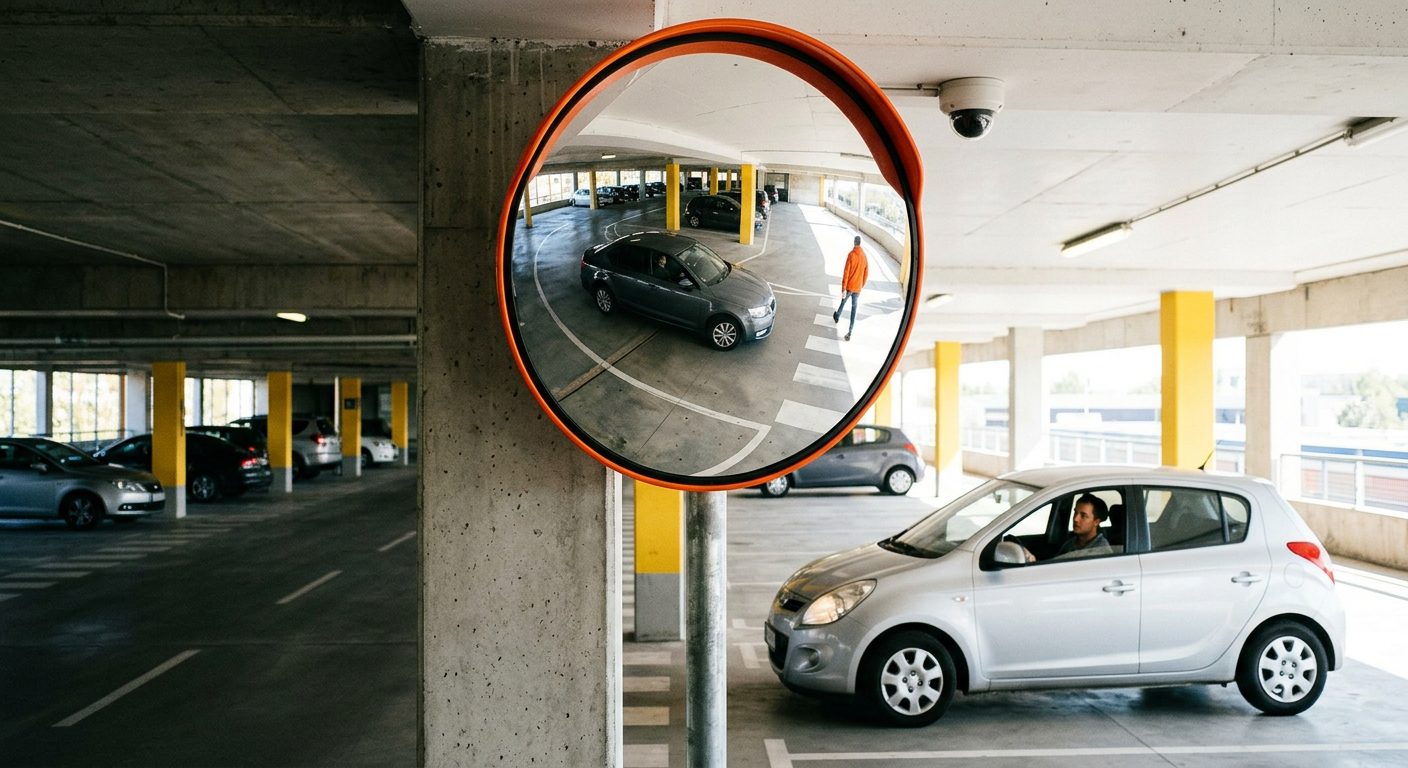
Unlike open road environments, parking lots are designed in ways that inherently restrict visibility. In multi-storey parking garages, concrete pillars and ramp curves prevent drivers from seeing what is ahead until they are already in potential conflict with it. In open-air lots, parked vehicles obstruct sightlines at cross-aisles, exit lanes, and pedestrian walkways. Even well-lit facilities can have significant dead zones where neither a driver in a moving vehicle nor a security guard on foot can see what is happening.
The result is a consistent pattern of incidents that facility operators know well: vehicles pulling out of bays without adequate warning of oncoming traffic, pedestrians struck at exit lanes, delivery vehicles reversing into staff, and unauthorized individuals lingering in unmonitored corners without being challenged. Each of these scenarios shares a common root cause: limited or obstructed sightlines at critical points within the parking environment.
2. Security Risk Beyond Traffic Accidents
Parking lots present security threats that go well beyond vehicle collisions. Vehicle theft, break-ins, vandalism, and personal assaults consistently occur at higher rates in parking environments than in other public spaces. A significant contributing factor is the abundance of visual cover that parked vehicles and structural elements provide. Areas that cannot easily be seen from a central security station, a guard position, or a CCTV camera are naturally more attractive to those engaging in opportunistic criminal behavior.
Wide-angle security mirrors for parking facilities address this problem directly by expanding the field of vision across areas that would otherwise remain unmonitored. A well-positioned convex parking lot mirror gives both drivers and security personnel a real-time, zero-latency view of what is around corners, behind pillars, and across areas where camera coverage is either absent or obstructed.
3. Pedestrian Vulnerability in Mixed-Traffic Zones
Parking lots are one of the most dangerous mixed-traffic environments for pedestrians. Children, elderly visitors, cyclists, and individuals with reduced mobility are all present in the same space as moving vehicles, often without adequate separation or visual warning systems. A driver exiting a bay or rounding a tight aisle corner may have only a fraction of a second to react to a pedestrian who appears suddenly from behind a parked car. Convex mirrors for pedestrian safety in parking lots give both the driver and the pedestrian advance visibility of each other before they reach a potential collision point, substantially increasing reaction time and reducing incident frequency.

How Convex Mirrors Actually Work in a Parking Environment
1. The Physics of Wide-Angle Reflection
A convex mirror features an outward-curving reflective surface. When light from objects within the mirror’s field strikes this curved surface, it diverges outward, creating an image that compresses a much larger area of the surrounding environment into a single viewable reflection. This is the fundamental property that makes parking lot blind spot mirrors so effective: they show drivers and security personnel more of the space around them than any flat mirror or unaided sightline could provide.
In a typical parking lot application, a properly sized outdoor convex safety mirror can provide a viewing angle of between 120 and 160 degrees. This means that from a single glance at the mirror, a driver can see across an aisle, around a corner, or into a zone that would otherwise be completely hidden. The image is somewhat compressed and objects appear smaller than in reality, but the safety gain from seeing potential hazards in advance far outweighs the minor distortion.
2. Real-Time Visibility With Zero Latency
One of the most operationally significant advantages of convex mirrors over CCTV-based security systems is that they provide real-time, zero-latency visual information directly to the person who needs to act on it. A camera requires a monitor, a monitoring team, and a communication chain before a response can occur. A parking garage convex mirror requires none of that infrastructure. The driver or the pedestrian sees the hazard immediately, without any delay, and reacts accordingly.
This matters most in precisely the situations where accidents and security incidents are most likely to occur: fast-moving vehicle approaches to blind corners, pedestrian crossings at uncontrolled exit lanes, and moments when a driver is reversing out of a bay into a live aisle. In each of these scenarios, the value of instant visual feedback cannot be overstated.
3. Deterrence Effect on Criminal Activity
Beyond their direct safety function, convex parking lot security mirrors have a measurable deterrence effect on opportunistic criminal behavior. Individuals considering vehicle break-ins, theft, or personal assaults in parking areas actively look for unobserved spaces. A convex mirror positioned to cover a previously blind area removes the perception of privacy from that zone. It signals that the area is visible to anyone approaching, to other drivers, to pedestrians, and to security personnel, which increases the perceived risk of being observed and challenged.
This deterrence function does not require a monitoring team. The mirror’s presence alone changes the risk calculation for someone considering criminal activity in the area it covers.
Key Security Applications of Convex Mirrors in Parking Facilities
1. Exit Lanes and Driveway Blind Spots
The transition point where a vehicle exits a parking structure onto a public road or internal access road is one of the highest-risk locations in any parking facility. Visibility is often restricted by walls, fencing, hedges, or the geometry of the exit lane itself. A wide-angle outdoor convex mirror mounted opposite the exit gives the driver a clear view of approaching traffic before pulling out, and gives pedestrians on the footway a view of approaching vehicles before stepping into the exit path.
For commercial and retail parking operators, a convex driveway security mirror at each exit point is a standard component of duty-of-care compliance. The cost of a single personal injury claim or vehicle collision at an unmirrored exit substantially exceeds the lifetime cost of a quality polycarbonate convex mirror installation.
2. Ramp Curves and Level Transitions in Parking Garages
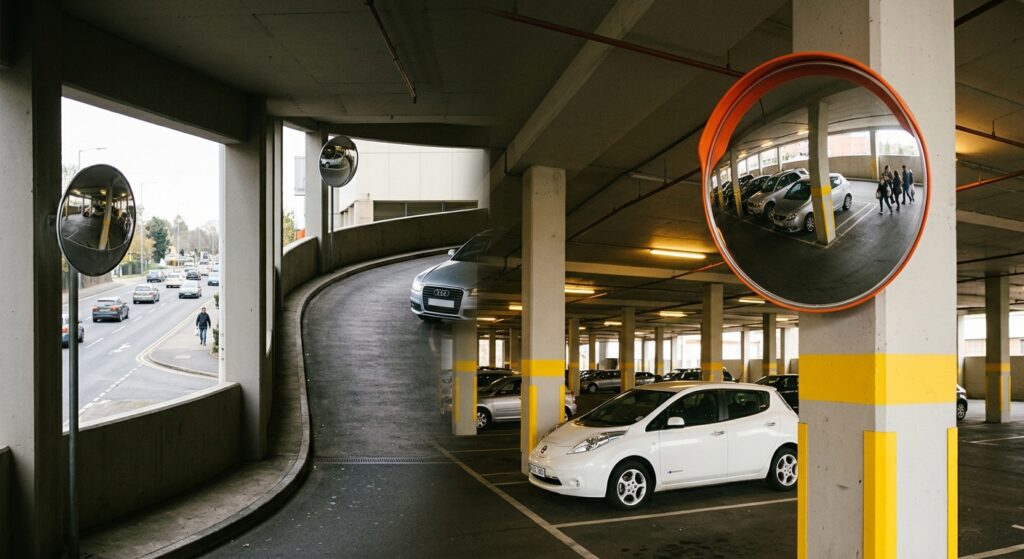
Multi-storey parking garages present acute blind spot challenges at ramp curves and level transition points. A vehicle ascending or descending a ramp curve cannot see oncoming vehicles until they are within metres of each other, and braking distances at ramp gradients are reduced compared to flat surfaces. Parking garage convex mirrors positioned at the apex of each ramp curve give drivers visibility of oncoming traffic before the blind point, allowing speed reduction before conflict occurs.
The same logic applies at the transition between ramp levels and open parking decks, where drivers emerging from a ramp frequently face pedestrians and vehicles moving laterally across their path without warning.
3. Pillar and Structural Column Zones
In covered parking structures, the concrete pillars that support the building create a grid of visual obstructions throughout the parking deck. Vehicles parked adjacent to pillars create combined blind zones where both the pillar and the adjacent vehicle block sightlines from multiple angles. Convex safety mirrors for parking garages mounted on or near pillars allow drivers to see past both the structural element and adjacent parked vehicles before committing to a maneuver.
4. Perimeter and Low-Surveillance Areas
The perimeter of large open-air parking lots, particularly near boundary walls, rear access gates, and loading zones, is frequently the least observed part of the facility. These are the zones where unauthorized vehicle access, vandalism, and personal safety incidents are most likely to go unwitnessed. Outdoor convex security mirrors for parking lot perimeter zones extend effective surveillance coverage without requiring additional personnel or CCTV infrastructure.
Selecting the Right Convex Mirror for Parking Lot Security
1. Mirror Size and Viewing Distance
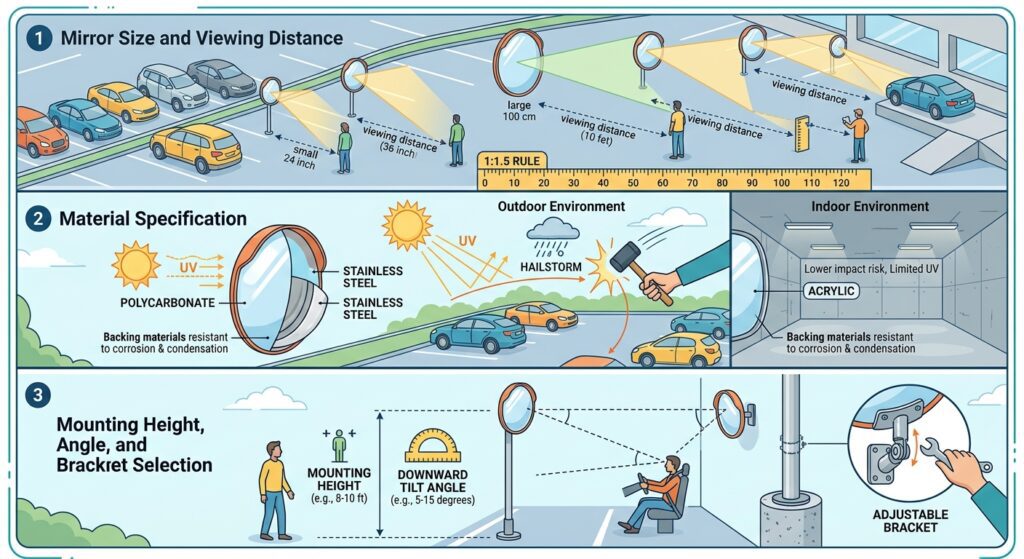
Choosing the correct mirror diameter for the viewing distance is the single most important procurement decision for parking lot convex mirrors. A mirror that is too small for the intended viewing distance will produce an image that is too compressed to be useful. A mirror that is oversized for a close-range indoor application wastes budget without meaningfully improving performance.
The widely applied guideline is the 1:1.5 rule: every one inch of mirror diameter covers approximately 1.5 feet of effective viewing distance. For most parking lot aisle cross-sections and exit approaches, mirrors in the 24 to 36 inch range are the appropriate specification. For ramp curves in parking garages where the viewing distance may be shorter but the risk is higher, a 24 inch polycarbonate convex parking mirror is a common specification. For open-air lot perimeter applications where viewing distances can exceed 10 metres, mirrors of 80 to 100 centimetres diameter provide the coverage required.
2. Material Specification for Outdoor and Indoor Environments
Outdoor parking environments demand mirrors specified for UV stability, weather resistance, and impact durability. Polycarbonate convex mirrors for outdoor parking lots are the standard recommendation for exposed installations, offering superior resistance to impact, UV degradation, and extreme temperature variation compared to acrylic alternatives. For open-air lots in coastal or industrial locations where corrosive exposure is a concern, stainless steel parking security mirrors with polycarbonate lenses are the appropriate specification.
Indoor parking garages, where UV exposure is limited and impact risk is lower, can be effectively served with acrylic lens mirrors that offer excellent optical clarity at a lower price point. The backing material should still be weather-resistant even in covered structures, as condensation, cleaning water, and exhaust exposure create a corrosive environment over time.
3. Mounting Height, Angle, and Bracket Selection
Correct mounting is as important as correct product selection. For outdoor parking lot applications, the standard mounting height is 8 to 10 feet to the mirror center, with a downward tilt of 5 to 15 degrees toward the driver eye-line at approximately 4.5 feet. This positioning ensures the mirror reflects the critical zone of the parking aisle or exit approach rather than the sky or the upper structure of the facility.
Adjustable bracket mirrors are particularly valuable in parking environments because installation conditions are rarely perfectly aligned with theoretical specifications. The ability to fine-tune mirror angle after installation without replacing the mounting hardware reduces installation costs and allows positioning to be optimised based on on-site observation. For pole-mounted installations in open-air lots, galvanized steel poles with concrete footings provide the structural stability required for large-diameter mirrors under wind load conditions.
Convex Mirrors Versus CCTV: A Practical Comparison for Parking Lot Security
1. When Mirrors Outperform Cameras
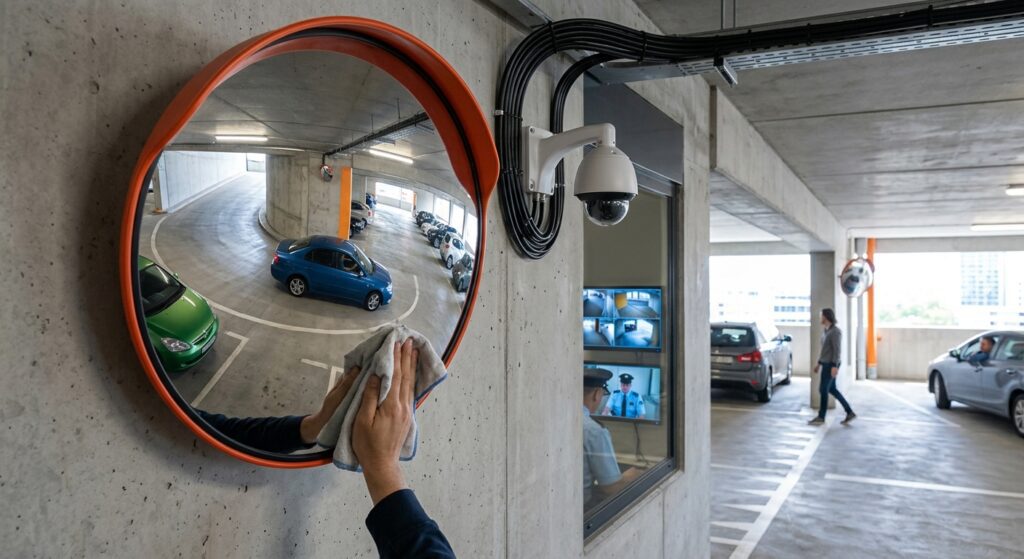
CCTV systems are an important part of parking security infrastructure, but they have significant limitations that convex parking lot mirrors do not share. Cameras require power, network infrastructure, ongoing monitoring, and maintenance. Their effectiveness depends on the availability of a trained operator watching multiple feeds in real time. In most commercial parking operations, cameras function primarily as a recording and post-incident tool rather than a real-time hazard prevention system.
Convex wide-angle security mirrors for parking facilities work at the moment of need, without infrastructure, without power, and without a monitoring team. They inform the driver directly, at the point of action, with zero lag. In the specific use cases of blind corner navigation, exit lane clearance checking, and ramp curve approach management, mirrors outperform cameras on every practical metric.
The most effective parking security strategies use both systems in complementary roles: convex mirrors for real-time driver and pedestrian awareness at specific high-risk points, and CCTV for broader area surveillance, post-incident recording, and perimeter monitoring.
The Procurement Case for Commercial Parking Lot Mirror Programs
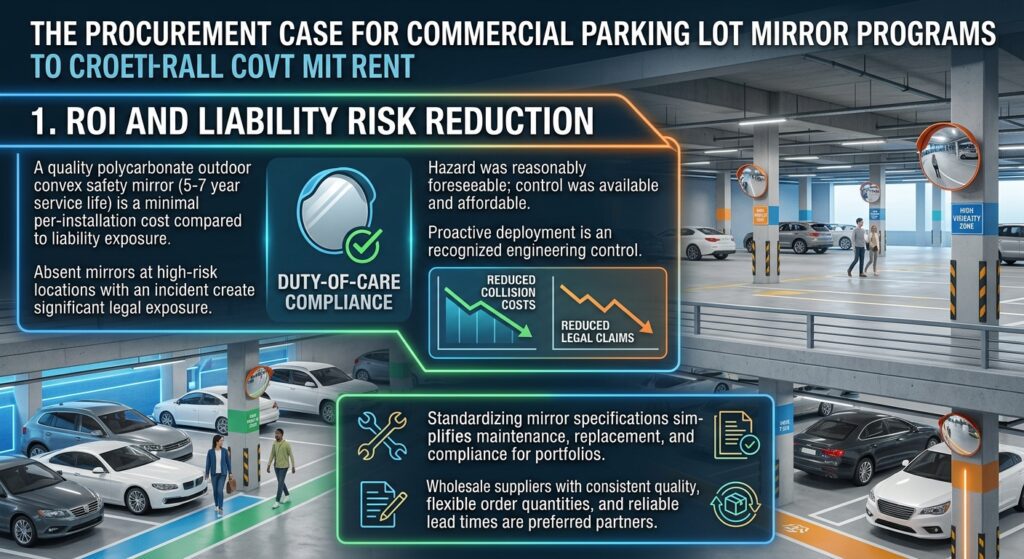
1. ROI and Liability Risk Reduction
For property managers, parking operators, and facilities procurement teams, the investment case for convex parking lot security mirrors is straightforward. A quality polycarbonate outdoor convex safety mirror with a service life of five to seven years represents a minimal per-installation cost compared to the liability exposure of a single vehicle-pedestrian collision or a personal injury claim resulting from a known blind spot.
Facilities where blind spot mirrors are absent at documented high-risk locations, and where a subsequent incident occurs, face significant legal exposure on the basis that the hazard was reasonably foreseeable and the control measure was readily available and affordable. Proactive deployment of parking lot blind spot mirrors demonstrates duty-of-care compliance and is a recognized engineering control measure in workplace safety frameworks.
For large commercial property portfolios or multi-site parking operators, standardizing convex mirror specifications across all locations simplifies maintenance, replacement procurement, and compliance documentation. Wholesale convex mirror suppliers offering consistent product quality, flexible minimum order quantities, and reliable lead times are the preferred sourcing partners for this type of programme.
Conclusion: Convex Mirrors as a Foundation of Parking Lot Security
Parking lot security is not a problem that technology alone can solve. The specific hazards of parking environments, blind corners, obscured exit lanes, column-blocked sightlines, and low-surveillance perimeter zones, are best addressed by solutions that work at the moment of action, without infrastructure or mediation. Convex safety mirrors for parking lot security do exactly that.
For facility managers, EHS officers, property developers, and safety equipment procurement teams, the decision to deploy a structured programme of wide-angle parking lot mirrors is not a luxury, it is a baseline competency in managing foreseeable risk. The right mirror, correctly specified for the viewing distance and environment, correctly mounted at the appropriate height and angle, and systematically placed at every identified blind spot in the facility, is one of the highest-value safety investments available in the commercial property management toolkit.
A parking lot that cannot be seen cannot be managed. Convex mirrors close that visibility gap faster, cheaper, and more reliably than almost any alternative.
Looking for a reliable manufacturer or wholesale supplier of outdoor convex safety mirrors for parking lots, parking garages, and commercial facilities? At Jessubond, we manufacture high-performance polycarbonate and stainless steel convex mirrors to commercial specification, with flexible MOQ and consistent lead times for bulk procurement programmes. Contact us here.