
Understanding the complete cost structure for bulk traffic cone procurement extends far beyond simple per-unit pricing to encompass volume discounts, contract terms, shipping logistics, customization options, and value-added services that collectively determine total cost of ownership. Organizations purchasing traffic cones in significant quantities possess substantial negotiating leverage that single-unit buyers cannot access, yet many procurement professionals fail to fully exploit this advantage through incomplete understanding of pricing mechanisms and available contract structures. Comprehensive knowledge of B2B traffic cone pricing enables informed negotiations that optimize value while securing supply chain reliability essential for operational continuity.
Base Pricing Structures and Volume Discount Tiers
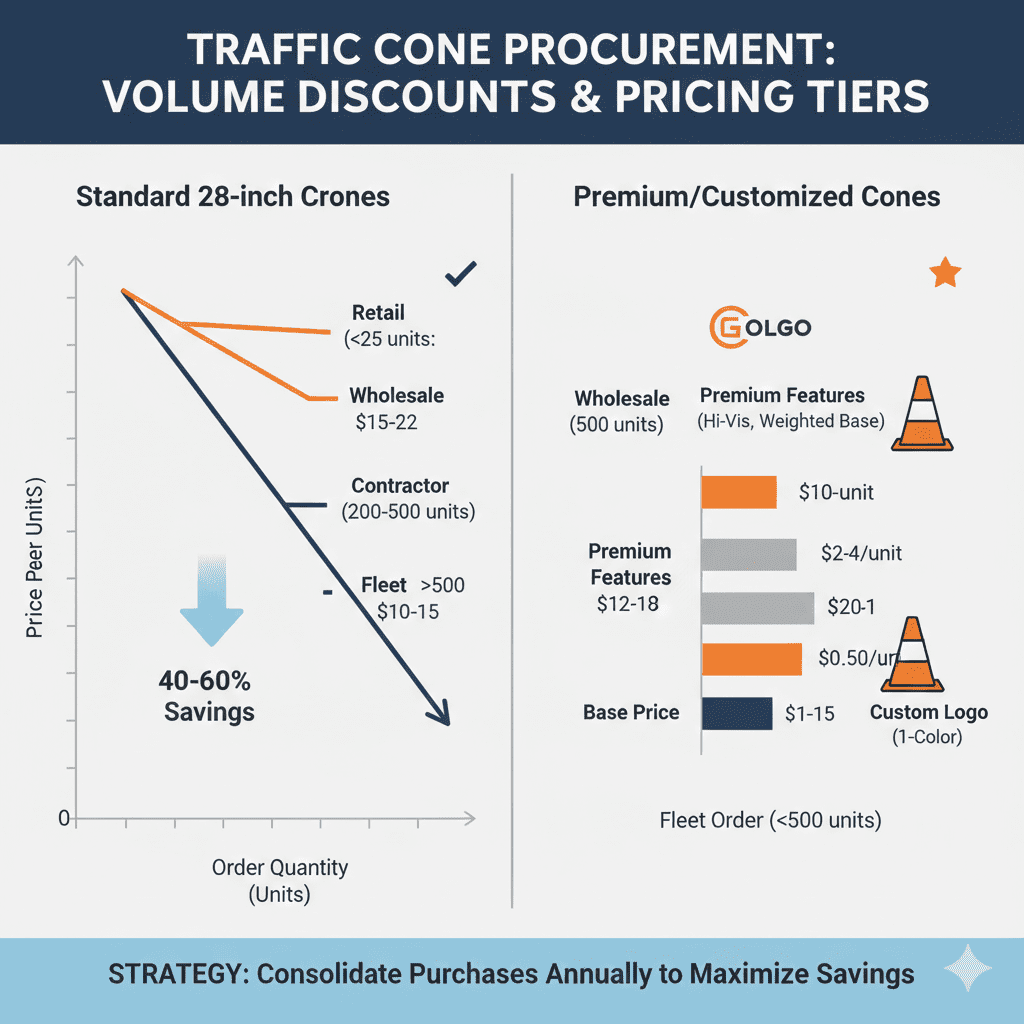
Traffic cone pricing operates on tiered structures where per-unit costs decrease substantially as order quantities increase beyond commodity threshold levels. Standard 28-inch orange traffic cones suitable for general traffic control applications typically carry retail prices of $20-30 per unit for orders under 25 units, representing pricing that includes substantial retail markups and reflects the handling costs associated with small-quantity transactions. Organizations ordering 50-100 cones often access wholesale pricing tiers dropping per-unit costs to $15-22, while purchases exceeding 200 units frequently qualify for contractor-level pricing in the $12-18 range depending on specific models and supplier relationships.
The most aggressive volume discounts emerge at order quantities exceeding 500 units, where major suppliers recognize genuine fleet procurement justifying competitive pricing that approaches or reaches cost-plus-minimal-margin levels. Organizations ordering 500-1000 units should expect pricing in the $10-15 range for standard construction traffic cones, while truly massive orders exceeding 2000 units can potentially negotiate pricing below $10 per unit when suppliers view orders as significant business opportunities worth accommodating through reduced margins. These volume discount percentages, often reaching 40-60% off retail pricing, underscore the importance of consolidating purchases rather than making frequent small orders that forfeit available discounts.
Premium cone features including enhanced reflectivity, specialized colors beyond standard orange, weighted bases, or ruggedized construction for demanding applications typically carry 20-40% price premiums over basic models. Organizations requiring these enhanced specifications should request specific volume pricing at anticipated order quantities rather than assuming that premium features maintain constant percentage markups across all volume tiers. Suppliers sometimes offer more aggressive discounting on premium products for large orders, recognizing that customers committing to substantial purchases deserve pricing reflecting their volume even when selecting higher-specification products.
Customization options including company logos, reflective striping in custom colors, or specialized cone configurations introduce additional costs that volume discounts partially offset. Basic logo application might add $2-4 per cone at small quantities but potentially drop to $0.50-1.50 per unit for orders exceeding 500 units as setup costs amortize across larger production runs. Organizations requiring customization should clearly communicate anticipated annual volumes when requesting quotes, as suppliers structure pricing differently for one-time custom orders versus ongoing supply relationships promising recurring business.
Contract Structures and Long-Term Pricing Agreements
Organizations with predictable ongoing traffic cone requirements benefit substantially from establishing formal supply contracts rather than making spot purchases as needs arise. Annual supply agreements guarantee predetermined pricing throughout contract periods regardless of market fluctuations, providing budget predictability that simplifies financial planning while potentially securing favorable rates that suppliers offer to lock in committed volumes. These contracts typically specify minimum annual purchase quantities triggering favorable pricing, with tiered pricing structures offering incrementally better rates if actual purchases exceed minimum commitments.
Blanket purchase orders represent another contract structure where organizations commit to maximum purchase quantities over specified periods while retaining flexibility about release timing and exact quantities within committed totals. This approach allows organizations to secure favorable volume pricing based on total committed purchases while avoiding the inventory carrying costs and storage challenges that taking delivery of entire quantities simultaneously would create. Suppliers appreciate blanket POs providing revenue visibility and production planning certainty, often offering pricing 5-10% below equivalent one-time purchase pricing to secure these preferred contract structures.
Multi-year agreements extending 2-3 years deserve consideration for organizations with stable long-term requirements, as extended commitments provide suppliers maximum planning certainty justifying the most aggressive pricing. These agreements typically include annual price adjustment mechanisms tied to commodity indices or fixed escalation percentages protecting suppliers from inflation while still offering buyers predictable costs and guaranteed supply. Organizations should negotiate price adjustment terms carefully, potentially capping maximum annual increases or requiring documented cost increases justifying adjustments that protect against arbitrary price escalation.
Consignment inventory arrangements where suppliers maintain cone inventories at customer facilities represent sophisticated contract structures appropriate for high-volume users requiring immediate access to substantial cone quantities without capital tied up in inventory. Under consignment terms, ownership transfers only when organizations withdraw cones from consignment stock for actual use, with periodic reconciliation and replenishment maintaining agreed inventory levels. While consignment typically doesn’t reduce per-unit pricing, the working capital benefits and guaranteed availability prove valuable for organizations whose operations depend on reliable cone access.
Shipping, Logistics, and Delivery Cost Considerations
Freight costs represent significant components of total landed costs for bulk cone orders, particularly when suppliers operate from distant locations requiring lengthy transportation. Standard LTL freight for 500-cone shipments typically runs $200-600 depending on destination and cone sizes, translating to $0.40-1.20 per cone in freight costs that buyers must add to quoted unit prices when calculating total costs. Larger orders qualifying for full truckload shipments might reduce per-unit freight costs to $0.20-0.50 per cone through better space utilization, though still representing meaningful percentages of total project costs requiring consideration during vendor selection and budget planning.
Free freight thresholds where suppliers absorb shipping costs for orders exceeding specified minimums represent common promotional strategies and negotiation opportunities. Organizations ordering quantities approaching but slightly below free freight thresholds should consider increasing order sizes to capture freight savings that may provide better value than the incremental cone costs. Many suppliers establish free freight at $2,000-3,000 order totals, translating to roughly 150-250 standard cones depending on pricing levels achieved through negotiations.
Regional supplier selection based partially on proximity to minimize freight costs deserves consideration, though distance considerations must be balanced against total landed cost including both product pricing and freight. A distant supplier offering 15% lower unit pricing might deliver better total value than local suppliers despite higher freight costs, making comprehensive analysis essential rather than reflexive preferences for nearby vendors. Organizations should request delivered pricing quotes from multiple suppliers at various distances, comparing total costs rather than evaluating unit prices and freight separately.
Delivery terms including minimum order quantities for free delivery, lead times, and stocking arrangements affect operational convenience beyond simple cost considerations. Suppliers requiring minimum order quantities of 200-500 units for free delivery may force organizations to order larger quantities than immediate needs dictate, creating inventory carrying costs and storage challenges that effectively increase total costs even when per-unit pricing appears favorable. Organizations should factor these operational implications into supplier selection rather than focusing solely on achieved unit pricing that ignores secondary costs that operational constraints impose.
Payment Terms, Financing, and Cash Flow Management
Payment terms significantly impact effective costs through time value of money considerations that sophisticated financial analysis recognizes even when procurement personnel focus primarily on unit pricing. Standard terms requiring payment within 30 days represent baseline expectations, while extended terms of 60-90 days provide cash flow benefits worth 1-3% annually depending on organizational cost of capital. Organizations should negotiate for extended payment terms particularly when large orders require substantial capital deployment, as maintaining cash flow flexibility provides genuine economic value beyond nominal price reductions.
Early payment discounts of 1-2% for payment within 10 days create opportunities for organizations with available cash to reduce effective costs, though the arithmetic suggests that declining these discounts in favor of standard payment terms typically proves economical unless organizations face unusually low financing costs. The common 2/10 net 30 terms offering 2% discounts for payment within 10 days translates to roughly 36% annual interest rate for money borrowed for the additional 20 days, making discount acceptance generally advantageous for organizations with adequate liquidity or access to lower-cost financing.
Progress payment structures for very large orders permit organizations to spread payments across delivery schedules rather than funding entire purchases upfront. For orders exceeding $25,000-50,000 delivered in multiple shipments spanning several weeks or months, progress payments aligned with delivery milestones manage cash flow while providing suppliers adequate working capital to execute orders. These arrangements require clear documentation specifying payment triggers and delivery schedules avoiding disputes about whether payment obligations have been triggered by partial deliveries or whether complete delivery is required before payment becomes due.
Equipment leasing or rental options represent alternatives to outright purchase for organizations needing large cone quantities for defined project durations but lacking desire to maintain permanent inventories. Leasing typically costs 15-25% of purchase price per month, making it economical for projects lasting 4-6 months or less but expensive for longer-term needs. Organizations uncertain about long-term requirements might lease initially while evaluating actual usage patterns, purchasing permanent inventories once operational needs clarify and purchase economics become favorable compared to continued leasing.
Quality Specifications and Price-Performance Optimization
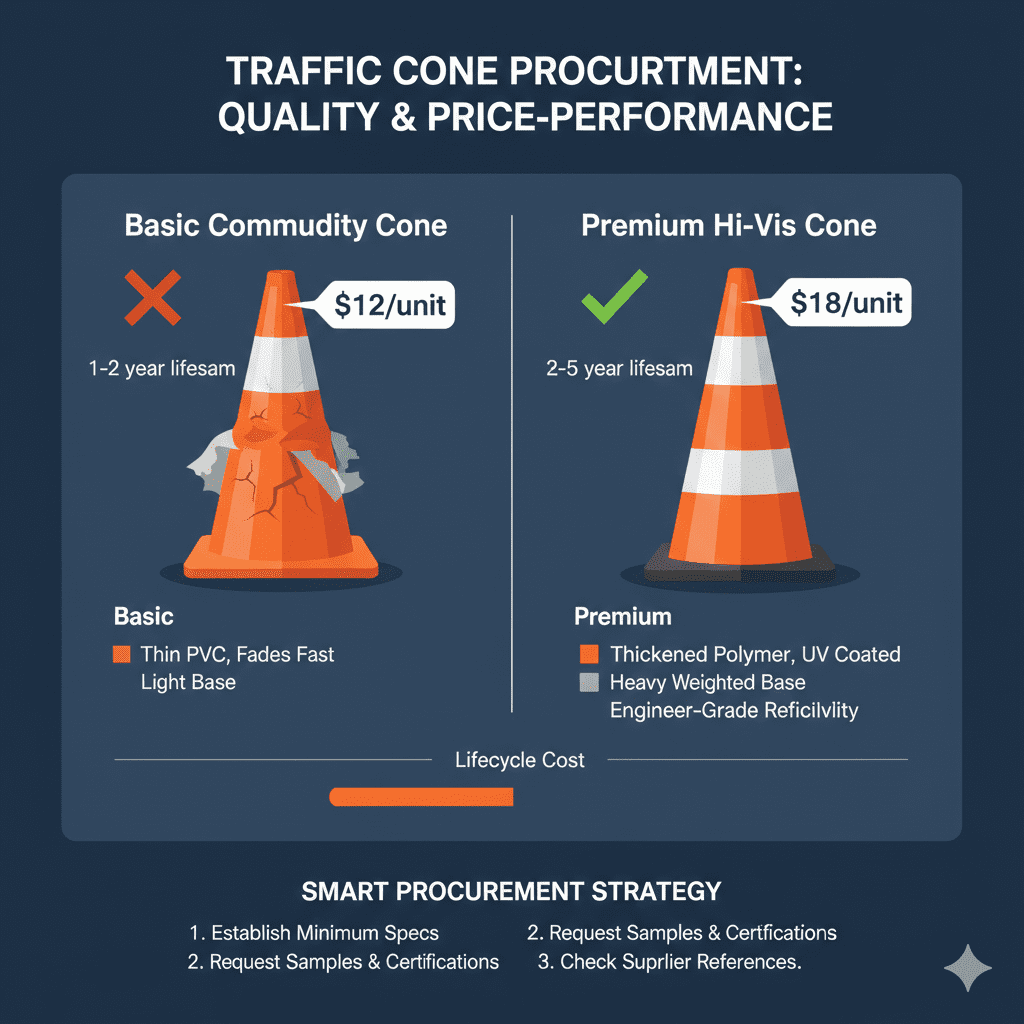
Traffic cone pricing reflects quality variations that procurement professionals must understand to avoid false economy through purchasing inadequate equipment requiring premature replacement. Basic commodity cones manufactured to minimum acceptable standards cost substantially less than premium products featuring enhanced UV resistance, impact-resistant construction, and superior reflectivity. While premium cones might cost 30-50% more than basic alternatives, their 2-3x longer service lives often deliver better lifecycle economics despite higher initial costs.
Organizations should establish minimum acceptable specifications addressing material thickness, base weight, reflective striping quality, and UV protection appropriate for intended applications and operating environments. Requesting that suppliers certify compliance with these specifications and provide supporting documentation ensures purchased cones meet requirements rather than discovering inadequacy after delivery when returns and replacements create project delays and administrative burdens. Detailed specifications also facilitate accurate bid comparisons by ensuring all quoted products meet baseline requirements rather than comparing dissimilar products where lower pricing reflects inferior specifications.
Sample evaluation before committing to large purchases allows organizations to verify product quality, assess whether specifications translate into acceptable real-world performance, and confirm that quoted products meet expectations. Most suppliers willingly provide samples for evaluation when large orders are contemplated, recognizing that sample costs represent minor investments toward securing significant business. Organizations should test samples under conditions mimicking actual use, evaluating stability, visibility, durability, and any specialized features critical to application success.
Reference checking with other customers who previously purchased large quantities from prospective suppliers provides insights about product performance, supplier reliability, and any post-purchase issues that organizations should anticipate. Suppliers should provide references willingly if their products and services merit confidence, while reluctance to provide references or inability to name satisfied large customers raises concerns warranting additional scrutiny before committing substantial capital to untested supplier relationships.
Strategic Vendor Relationship Management
Long-term supplier relationships built through consistent purchasing and professional interactions create value beyond transaction-specific pricing through priority service, flexible accommodation during supply disruptions, and willingness to customize solutions for unique requirements. Organizations treating suppliers as strategic partners rather than interchangeable commodity vendors often receive preferential treatment during periods when supply constraints force suppliers to allocate limited inventory among competing customers. These relationship benefits prove impossible to quantify precisely but represent genuine value that experienced procurement professionals cultivate through fair dealing and mutual respect.
Consolidating purchases with fewer suppliers strengthens relationships while simplifying administrative overhead compared to managing multiple small suppliers. Organizations requiring traffic cones alongside other traffic control equipment might negotiate bundled pricing covering multiple product categories, leveraging total purchase volume across categories to achieve better overall pricing than optimizing each category independently. Suppliers value customers providing substantial business across multiple categories, often offering pricing or service accommodations recognizing total relationship value beyond any single product line.
The strategic approach to bulk traffic cone procurement recognizes that achieving optimal value requires comprehensive analysis extending beyond simple per-unit pricing to encompass contract structures, logistics costs, quality considerations, and long-term supplier relationships. Organizations investing effort to understand complete pricing dynamics and negotiate sophisticated agreements consistently achieve superior outcomes compared to buyers accepting standard terms and pricing without recognizing available opportunities for value optimization through informed negotiation and strategic partnership development.
Looking for a Custom Traffic Cones Manufacturer or Supplier? Struggling to find the right factory to bring your vision to life? We’ve got you covered! At our place, we craft top-quality traffic cones with precision and care. Big or small, your needs are our mission. Let’s launch your cones project and take your product line to the next level! Click here to contact