
Organizations managing traffic control operations face strategic decisions about equipment specifications that significantly impact operational efficiency, storage logistics, and total cost of ownership over multi-year equipment lifecycles. The choice between collapsible traffic cone designs and traditional rigid models represents one such decision, with each option offering distinct advantages and limitations that make them optimal for different operational contexts. Conducting comprehensive cost-benefit analysis comparing these alternatives enables fleet managers, operations directors, and procurement professionals to make informed selections aligned with actual operational requirements rather than defaulting to familiar options or accepting superficial cost comparisons that overlook critical performance and lifecycle considerations.
Understanding Design Differences and Performance Characteristics
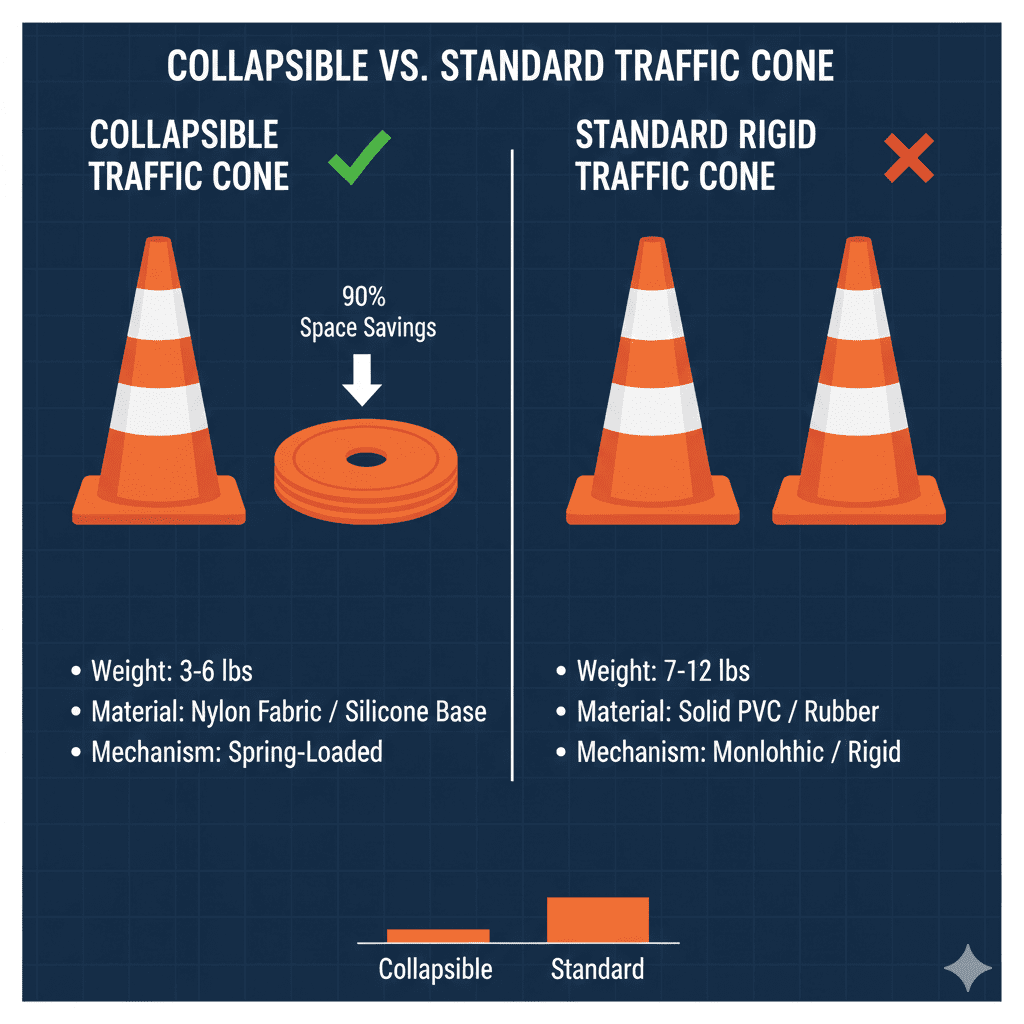
Collapsible traffic cone designs utilize telescoping or folding construction allowing compact storage by reducing cone height to a fraction of deployed dimensions. Quality collapsible units compress from standard 28-36 inch deployed heights to 2-4 inches when collapsed, delivering dramatic space savings compared to rigid cones requiring full-height storage regardless of whether actively deployed. This compression typically operates through spring-loaded mechanisms, magnetic closures, or simple weight-activated designs that pop up when placed and collapse when lifted, requiring minimal user effort during deployment and retrieval operations.
Standard rigid orange traffic cones utilize monolithic construction from base to tip, maintaining constant dimensions that never change regardless of storage, transport, or deployment status. This fixed-dimension design eliminates moving parts, mechanical complexity, and the potential failure modes that articulating mechanisms introduce, delivering maximum simplicity and reliability at the cost of storage efficiency. The material selection for standard cones, typically solid rubber or heavy-duty PVC, provides durability and stability that collapsible designs sometimes struggle to match despite engineering advances improving collapsible cone performance.
Weight differences between cone types affect both stability during deployment and handling efficiency during setup and retrieval operations. Standard cones weighing 7-12 pounds depending on size provide inherent stability resisting displacement from wind or vehicle wash effects, though this weight requires more physical effort during frequent repositioning. Collapsible cones typically weigh 3-6 pounds due to lighter materials and hollow construction necessary for compression functionality, offering easier handling but potentially greater vulnerability to wind displacement requiring weighted bases or more frequent repositioning.
Durability considerations distinguish the two categories significantly, as mechanical components in collapsible designs introduce potential failure points that monolithic standard cones avoid. Springs, hinges, or locking mechanisms enabling compression functionality can break, wear, or malfunction over time, potentially rendering collapsible cones non-functional or stuck in partially collapsed states that compromise visibility and safety. Standard cones lacking such mechanisms prove more resistant to failure though certainly not immune to damage from vehicle strikes, weather exposure, or material degradation from UV radiation and temperature cycling.
Initial Purchase Cost Comparison and Budget Implications
Purchase price differentials between collapsible and standard cones reflect the additional manufacturing complexity and materials that collapsible designs require. Basic standard traffic cones suitable for general traffic control applications typically cost $12-25 per unit depending on size and construction quality, representing commodity pricing that volume discounts further reduce for large purchases. Collapsible traffic cone options generally range $18-40 per unit, with premium models featuring robust mechanisms and high-visibility materials commanding prices at the upper end of this range.
For organizations procuring large cone quantities, these unit price differences translate to substantial budget implications. A fleet of 500 cones purchased as standard units at $18 each costs $9,000, while equivalent collapsible units at $30 each total $15,000, a $6,000 differential representing 67% higher initial investment. This cost difference must be justified through operational benefits or lifecycle cost advantages that collapsible designs deliver, making thorough analysis essential rather than assuming premium features automatically justify premium prices regardless of actual operational requirements.
Volume pricing structures differ between cone categories, with standard cones benefiting from competitive commodity markets offering aggressive discounts for large orders while collapsible cones maintain higher margins due to more limited supplier competition and lower production volumes. Organizations negotiating pricing should request quotes for both cone types at anticipated order quantities, evaluating actual pricing rather than assuming catalog prices accurately reflect negotiated rates. Some suppliers bundle storage solutions with collapsible cone purchases, potentially offering carrying bags or storage carts at discounted rates that partially offset higher cone costs.
Budget planning should account for replacement cycles and the likelihood that different cone types may require replacement at different intervals due to varying durability characteristics. If collapsible cones require replacement every 3-4 years while standard cones deliver 5-7 years of service, the annualized cost differential narrows despite higher initial collapsible cone prices. Organizations should request durability information and warranty coverage from suppliers, using this data to project lifecycle costs rather than focusing solely on initial purchase prices that represent incomplete cost pictures.
Storage and Transportation Efficiency Analysis
Storage efficiency represents the primary value proposition for collapsible traffic cones, with compressed dimensions enabling organizations to store dramatically larger cone quantities in equivalent space compared to standard models. A storage room accommodating 200 standard cones might hold 800-1000 collapsible units due to compression ratios allowing 4-5 collapsed cones to occupy the space of one standard cone. For organizations facing storage constraints in urban facilities where real estate costs prove substantial, this space efficiency translates to genuine economic value beyond simple convenience.
The monetary value of storage space savings depends on facility-specific circumstances including whether additional space must be rented, whether existing space could be repurposed for revenue-generating activities, or whether storage limitations actually constrain operations. Organizations currently renting external storage for traffic control equipment can calculate concrete savings by determining how many storage units become unnecessary through collapsible cone adoption. Facilities with adequate storage space may find that storage efficiency provides minimal economic benefit despite seeming advantageous in principle.
Transportation efficiency similarly favors collapsible designs, as compressed cones allow standard service vehicles to transport larger quantities per trip compared to standard cones. A pickup truck bed accommodating 50 standard cones might transport 200 collapsible units when properly packed, quadrupling per-vehicle capacity and potentially reducing the vehicle fleet necessary for supporting multi-site operations. Organizations deploying traffic control across numerous locations or conducting frequent setup-teardown operations should calculate how transportation efficiency affects fuel costs, vehicle requirements, and labor productivity to quantify this benefit accurately.
However, the deployment and retrieval time required to collapse and expand cones during each use cycle represents a productivity consideration offsetting some transportation efficiency gains. While individual cone manipulation adds only seconds per unit, these seconds accumulate across hundreds of cones deployed multiple times daily. Organizations should time actual deployment operations with both cone types under realistic conditions, measuring whether any time differences prove significant enough to affect overall productivity or whether the differences prove negligible in practice.
Operational Flexibility and Application Suitability
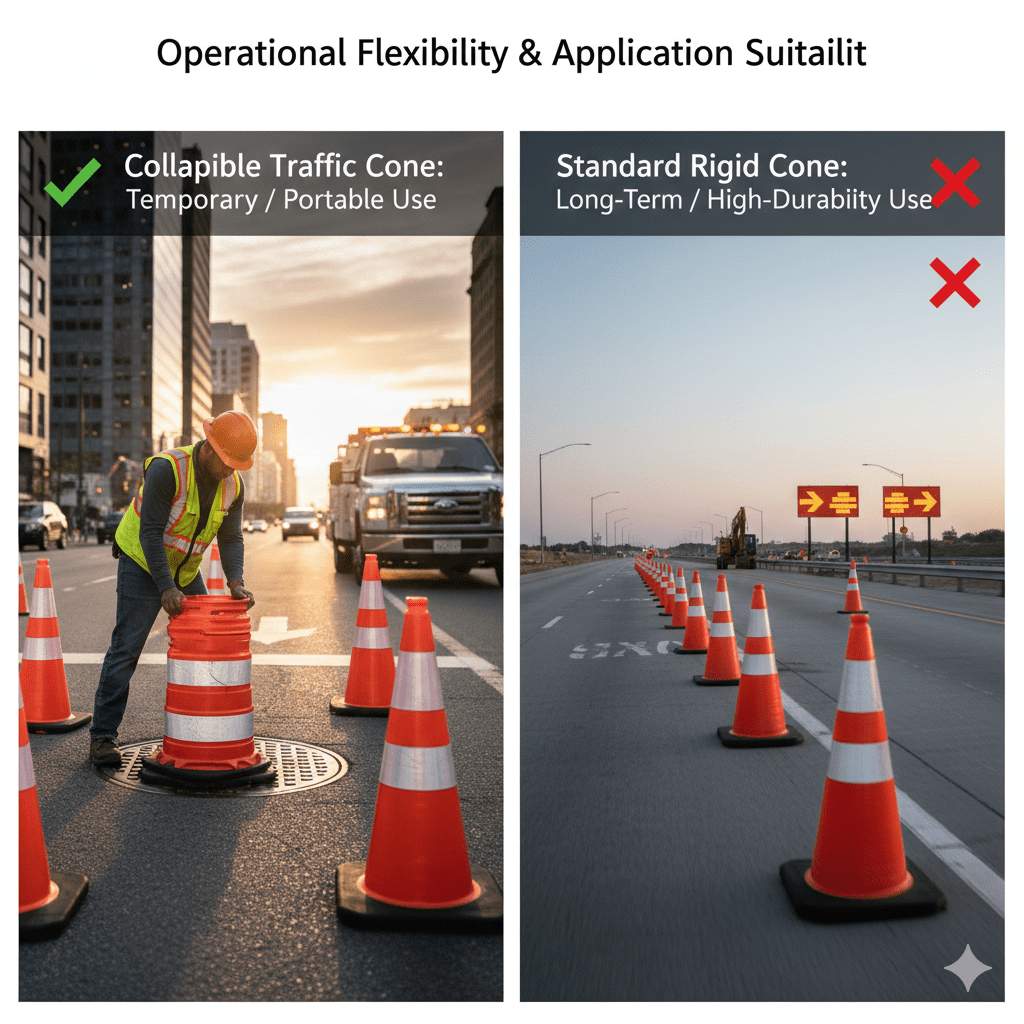
Collapsible traffic cone designs excel in applications requiring frequent transportation between sites, temporary deployments for special events or short-duration projects, and situations where storage space limitations significantly constrain operational flexibility. Event management companies conducting dozens of events monthly across various venues benefit substantially from collapsible cone portability and storage efficiency, as these features enable supporting more simultaneous events with given vehicle and storage resources. Similarly, utility contractors conducting brief service calls at multiple locations daily realize productivity gains from transporting adequate cone supplies without dedicating entire vehicles to traffic control equipment.
Conversely, standard rigid cones prove superior for extended deployments in challenging conditions where stability, visibility, and durability priorities outweigh storage efficiency considerations. Highway construction projects maintaining work zones for months or years benefit from standard cone robustness and lower likelihood of mechanical failure that could compromise safety-critical traffic control. The visual prominence of rigid cones may also provide psychological advantages, as the substantial appearance of standard units potentially commands greater driver respect compared to lighter collapsible alternatives that might appear less substantial.
Weather resistance considerations favor standard cones in harsh environments where extreme temperatures, high winds, or intensive UV exposure create demanding conditions. While quality collapsible cones incorporate weather-resistant materials and protective coatings, the mechanical components enabling compression functionality introduce vulnerabilities that extreme weather potentially exploits. Organizations operating in severe climates should request environmental performance data from suppliers, evaluating whether collapsible designs deliver adequate durability for local conditions or whether standard cones represent safer investments despite storage inefficiency.
Regulatory compliance requirements sometimes influence cone selection, as specifications for public roadway work zones may mandate certain cone weights, dimensions, or construction standards that collapsible designs struggle to meet. Contractors bidding public projects should verify that collapsible cones satisfy all specification requirements before committing to these models, as non-compliant equipment could trigger contract disputes or require expensive equipment replacement if inspectors reject collapsible cones during project oversight.
Total Cost of Ownership and Long-Term Value
Comprehensive cost analysis must extend beyond initial purchase prices to encompass all ownership costs throughout realistic equipment lifecycles. Standard cone total cost of ownership includes purchase price, storage costs, transportation expenses, maintenance requirements, and replacement costs spread across 5-7 year service lives. Collapsible cone ownership costs include higher purchase prices, potentially shorter replacement cycles, any specialized maintenance requirements for mechanical components, but lower storage and transportation costs that may offset the higher acquisition expenses.
A worked example illustrates the analysis approach: An organization requires 500 traffic cones stored in rented warehouse space costing $15 per square foot annually. Standard cones requiring 400 square feet of storage incur $6,000 annual space costs, while collapsible cones needing 100 square feet cost $1,500 annually, a $4,500 annual savings. Over 5 years, storage savings total $22,500, easily justifying the $6,000 higher initial purchase price and potentially covering any additional costs if collapsible cones require earlier replacement due to reduced longevity.
Organizations without storage constraints naturally realize less dramatic savings, as the primary collapsible cone advantage provides minimal value when adequate storage exists. These organizations might determine that standard cone simplicity and proven durability justify selection despite collapsible models offering portability benefits that operational requirements don’t actually demand. The key insight involves matching cone characteristics to genuine operational requirements rather than pursuing features that seem advantageous but deliver little practical value in specific organizational contexts.
Insurance and liability considerations might affect cone selection if certain designs create elevated risks that impact insurance costs or liability exposure. While this factor rarely proves determinative, organizations should consider whether cone stability differences affect accident risks or whether mechanical failure modes in collapsible designs could contribute to traffic control failures that generate liability claims. Consultation with insurance carriers and legal advisors provides input for organizations concerned about these potential implications.
Making the Selection Decision
Organizations facing collapsible versus standard cone decisions should begin with honest assessment of actual operational requirements including typical deployment durations, transportation frequencies, storage constraints, environmental conditions, and budget parameters. This assessment identifies which cone characteristics prove most valuable for specific operations rather than assuming that premium features automatically justify premium prices across all applications. Some organizations may determine that mixed fleets incorporating both cone types optimize overall performance by deploying each type where its specific advantages prove most relevant.
Pilot programs testing collapsible cones on limited scale before committing to large purchases allow organizations to validate anticipated benefits under actual operating conditions rather than relying on theoretical advantages that practice might not confirm. Acquiring 50-100 collapsible cones for trial in representative applications provides hands-on experience informing larger procurement decisions while limiting financial exposure if trials reveal that collapsible designs don’t deliver expected benefits or prove less suitable than standard alternatives for specific operational contexts.
The collapsible versus standard traffic cone decision ultimately depends on careful analysis balancing initial costs, operational benefits, storage economics, and durability considerations within specific organizational contexts. Neither option proves universally superior, making thoughtful evaluation essential for optimal selection rather than defaulting to familiar standard cones or pursuing collapsible models because storage efficiency seems inherently valuable regardless of whether operations genuinely require this characteristic.
Looking for a Custom Traffic Cones Manufacturer or Supplier? Struggling to find the right factory to bring your vision to life? We’ve got you covered! At our place, we craft top-quality traffic cones with precision and care. Big or small, your needs are our mission. Let’s launch your cones project and take your product line to the next level! Click here to contact