
Forklift operations represent one of the most hazardous activities in warehouse and industrial environments, with collision incidents causing worker injuries, equipment damage, product losses, and operational disruptions that collectively cost American industry billions of dollars annually. While comprehensive forklift safety programs incorporate operator training, traffic management systems, and speed controls, strategic placement of convex security mirrors addresses the fundamental visibility limitations that contribute to most collision incidents. Understanding where and how to position mirrors for maximum collision prevention effectiveness enables safety managers and operations leaders to implement cost-effective visibility solutions that dramatically reduce incident frequencies while supporting regulatory compliance and demonstrating proactive risk management.
Understanding Forklift Visibility Challenges and Collision Patterns
Forklift operators face unique visibility constraints that passenger vehicle drivers never encounter, including obstructed forward vision when carrying loads, elevated seating positions creating downward blind spots, and equipment design features that block sight lines during reversing operations. These inherent visibility limitations combine with operational pressures encouraging rapid movement and warehouse layouts featuring numerous blind corners to create environments where collisions occur frequently despite operators’ best efforts to maintain awareness. Analysis of forklift incident reports consistently identifies visibility limitations as primary contributing factors, suggesting that addressing these constraints through strategic convex safety mirror placement offers substantial collision reduction potential.
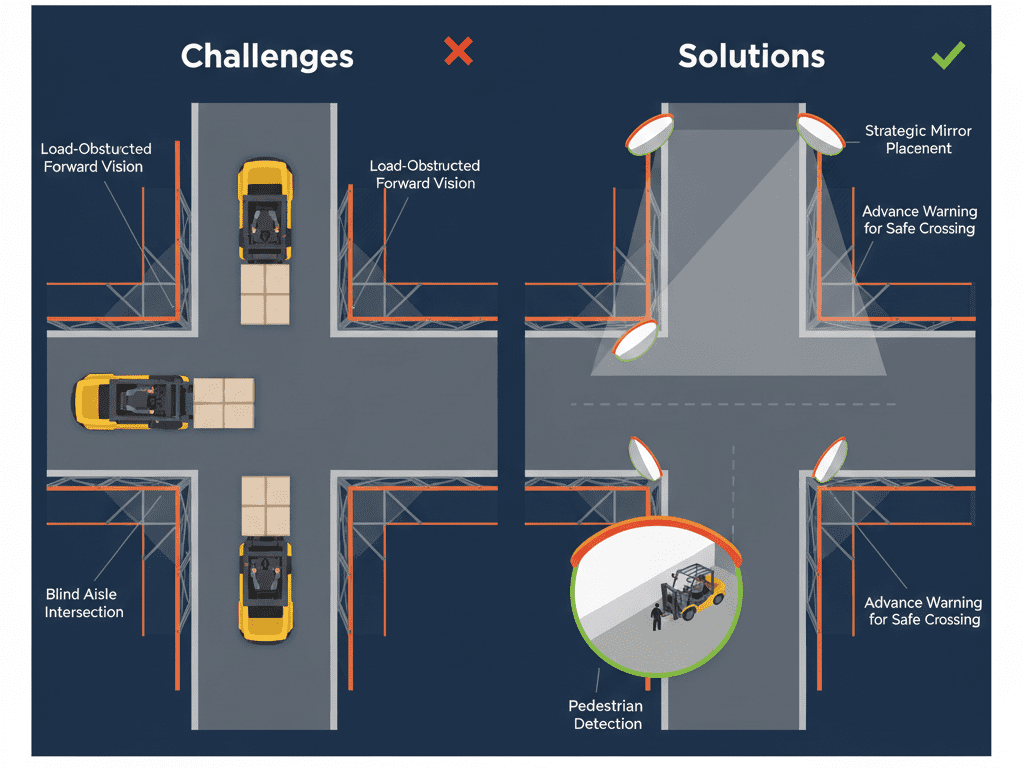
Load-obstructed forward vision represents the most obvious visibility challenge, as materials being transported block operators’ direct view of travel paths ahead. While operators can and should travel in reverse when loads obstruct forward visibility, reverse travel creates its own visibility challenges through limited rearward sight lines and the practical difficulty of maintaining directional control while looking backward for extended distances. Convex mirrors positioned along travel routes provide operators with visibility around transported loads or viewing angles showing rearward paths during reverse travel, allowing safer navigation regardless of travel direction.
Aisle intersection collisions occur with disturbing frequency as operators traveling perpendicular aisles converge at intersection points where racking systems completely obstruct sight lines until vehicles already occupy the intersection. Neither operator can see the approaching hazard until collision becomes unavoidable without emergency braking or evasive maneuvering that might destabilize loads or create pedestrian hazards. Strategic convex security mirror placement at these intersections provides advance warning allowing operators to slow or yield before entering conflict zones, transforming dangerous blind intersections into monitored zones where operators possess the situational awareness necessary for safe crossing decisions.
Pedestrian conflicts constitute another collision category where visibility limitations prove critical, as workers on foot move through warehouses performing picking, packing, inventory, and maintenance tasks that bring them into proximity with forklift travel paths. Operators focused on navigation and load management may fail to adequately scan for pedestrians, while workers concentrating on assigned tasks may not notice approaching forklifts despite backup alarms and other warning systems. Mirrors providing operators with wider fields of view help detect pedestrian presence earlier while offering pedestrians visibility of approaching equipment, creating mutual awareness that prevents conflicts.
Critical Mirror Placement Locations for Forklift Safety
Warehouse aisle intersections represent the highest-priority locations for convex mirror installations, as these points concentrate the collision risks that visibility improvements most effectively address. Mirrors should be positioned to provide operators traveling main aisles with clear views down perpendicular cross aisles before reaching intersection entry points, typically requiring mounting locations 10-20 feet in advance of intersections depending on forklift speeds and sight line geometries. The convex traffic mirror should be sized appropriately for viewing distances involved, generally 18 to 24 inches for typical warehouse applications, ensuring reflected images remain clear enough for operators to discern approaching traffic and make informed yield decisions.
End-of-aisle positions where forklifts transition from storage aisles onto main circulation routes warrant mirror coverage similar to mid-aisle intersections, though the specific hazards differ slightly. Operators exiting storage aisles often carry loads obstructing forward visibility and emerge into main routes potentially carrying higher-speed traffic that storage aisle operators may not anticipate. Mirrors positioned to show both directions along main routes allow exiting operators to verify safe gaps before entering circulation routes, while also alerting main route traffic to emerging vehicles they might not otherwise detect until conflicts become unavoidable.
Loading dock approaches create visibility challenges as forklifts navigate between storage areas and dock positions while dodging trucks, dock workers, and other equipment converging on limited dock space. The complexity of dock environments with multiple simultaneous activities and varying traffic types makes comprehensive visibility particularly valuable. Large convex mirror installations providing wide-angle coverage of dock areas help operators maintain awareness of the dynamic environment while supplementing direct observation that dock congestion might partially obstruct.
Equipment charging stations and maintenance areas where forklifts concentrate during non-operational periods represent often-overlooked mirror placement opportunities. These areas experience equipment movements as operators bring machines for charging or maintenance, with potential conflicts between moving equipment and stationary machines or workers performing maintenance tasks. Mirrors covering charging area entrances and interior zones help operators navigate congested spaces where close quarters and numerous obstacles create elevated collision risks.
Narrow passages, doorways, and transitions between different facility zones present visibility constraints warranting mirror coverage even when not strictly “intersections” in the traditional sense. These confined spaces often prevent operators from seeing what lies beyond thresholds until already committed to passage, creating potential for head-on conflicts if equipment approaches from opposite directions. Convex safety mirrors positioned to show beyond doorways or around tight corners provide the advance warning necessary for safe navigation through constrained spaces where emergency stopping might prove difficult due to equipment momentum and limited maneuvering room.
Optimal Mirror Positioning and Installation Specifications
The effectiveness of forklift safety mirrors depends heavily on precise positioning that accounts for typical operator sight lines, viewing distances, and the specific geometries of locations being monitored. Mounting height represents the first critical positioning parameter, with optimal heights typically ranging from 7 to 10 feet depending on specific circumstances. This height range positions mirrors within the natural sight line of seated forklift operators whose eye level typically falls between 6 and 8 feet, avoiding positions too high requiring significant upward viewing that operators might not consistently perform during routine operations.
Lateral positioning affects how effectively mirrors cover intended viewing areas, with precise placement ensuring that reflected images show the actual hazard zones requiring monitoring rather than peripheral areas providing little safety value. Professional installers verify positioning by occupying typical approach positions and confirming that mirrors show anticipated coverage areas before finalizing mounting locations. This verification step prevents installations that technically satisfy general specifications but fail to deliver expected visibility due to subtle positioning errors that seem insignificant during planning but prove critical during actual operations.
Viewing angle adjustment after installation allows fine-tuning that optimizes coverage for actual traffic patterns that may differ from planned layouts or that evolve as operations mature and informal traffic patterns develop. Quality convex blind spot mirror installations incorporate articulating mounts permitting angle adjustments without requiring complete remounting, allowing facility staff to refine mirror positions based on operational experience. Some organizations conduct formal installation reviews 30-60 days post-implementation, gathering operator feedback about mirror effectiveness and making adjustments addressing any coverage gaps or positioning issues that initial installations didn’t fully optimize.
Mirror size selection must balance providing adequate visibility at required viewing distances against cost and space constraints that might favor smaller units. The general rule suggesting 18-inch mirrors for 25-foot viewing distances and 24-inch mirrors for 40-foot distances provides reasonable starting points, though facilities should consider upsizing when uncertain about adequate sizing. The incremental cost difference between adjacent size categories rarely justifies undersizing that might compromise safety effectiveness, making prudent specification practices favor larger options when doubt exists about appropriate sizing.
Integrating Mirrors with Comprehensive Forklift Safety Programs
While strategic convex security mirror placement dramatically improves forklift operation visibility, mirrors alone cannot eliminate all collision risks or substitute for comprehensive safety programs addressing operator training, equipment maintenance, traffic management, and organizational safety culture. Effective programs integrate mirrors as one component of multi-layered approaches combining engineering controls, administrative procedures, and behavioral interventions creating redundant protection that addresses collision risks through multiple mechanisms. This systems approach recognizes that no single intervention proves perfectly reliable and that layered protections compensate for individual measure limitations.
Operator training must specifically address proper mirror usage and interpretation to ensure workers understand how to effectively utilize installed visibility aids. Training should explain that convex mirrors compress images making objects appear farther than actual distances, requiring operators to compensate when judging speeds and distances of reflected traffic. Practical exercises allowing operators to observe actual versus reflected positions help develop the perceptual skills necessary for accurate mirror interpretation during routine operations when cognitive demands limit attention available for conscious distance calculation.
Traffic management systems incorporating designated travel routes, speed limits, and right-of-way rules create operational frameworks within which mirrors provide visibility supporting compliance with established procedures. Mirrors show operators whether designated routes remain clear for safe travel and whether approaching traffic enjoys right-of-way requiring yields, but mirrors cannot enforce compliance with traffic rules absent organizational commitment to rule enforcement. Programs combining clear rules with visibility tools supporting compliance achieve superior results compared to either element implemented independently.
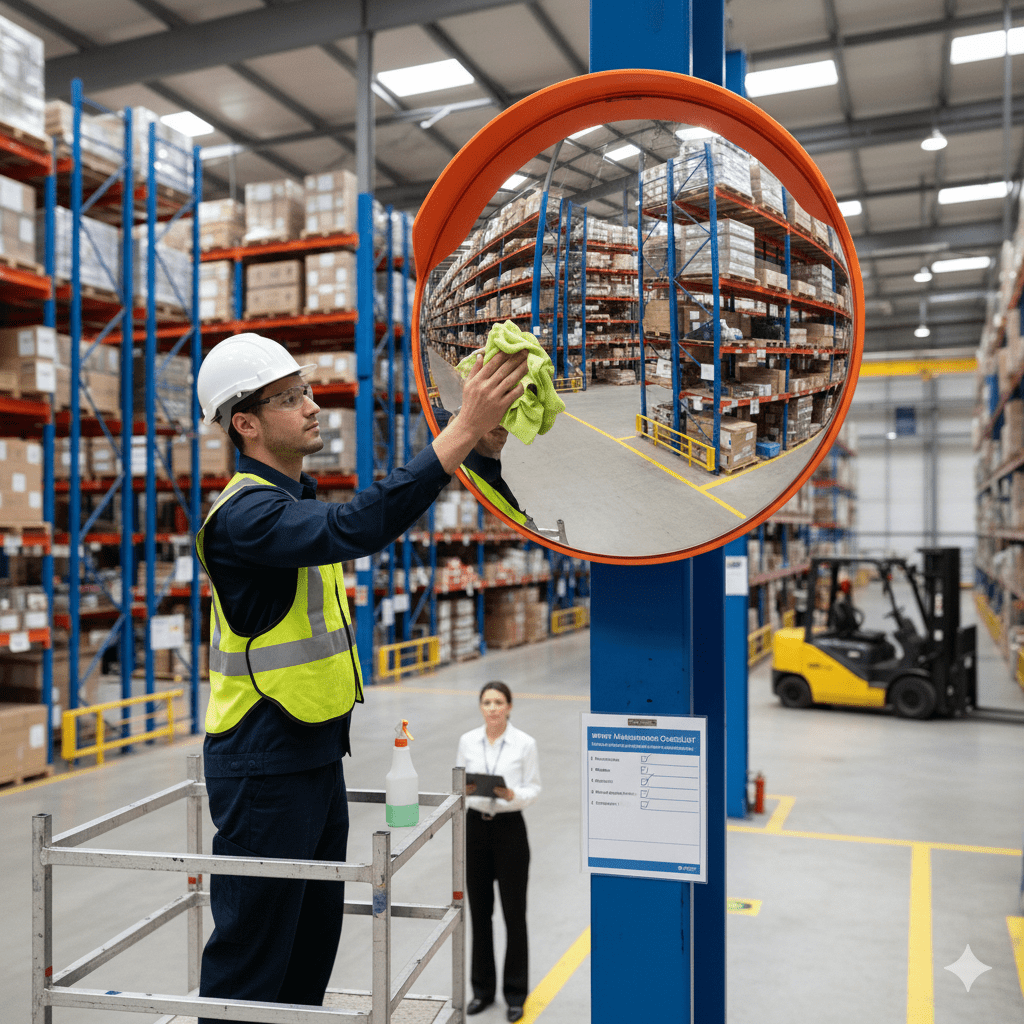
Maintenance procedures ensuring mirrors remain clean, properly aligned, and structurally sound prove essential for sustained program effectiveness. Dirty mirrors provide degraded visibility potentially worse than no mirrors since operators might rely on unclear reflections rather than exercising caution appropriate for truly blind conditions. Formal inspection protocols specifying cleaning frequencies, alignment verification procedures, and damage assessment criteria create accountability ensuring mirrors receive attention necessary for maintaining functionality throughout intended service lives.
Measuring Program Effectiveness and Continuous Improvement
Organizations implementing strategic mirror programs should establish metrics tracking collision incidents, near-misses, and property damage allowing quantification of safety improvements and identification of remaining gaps requiring additional interventions. Baseline measurements collected before mirror installation provide comparison points against which post-implementation performance can be assessed, creating evidence of program effectiveness that justifies continued investment while supporting expansion to additional locations if results prove favorable. Significant reductions in incident frequencies and severities following mirror installation validate the intervention while unchanged metrics suggest that visibility improvements alone prove insufficient and that supplementary measures warrant consideration.
Near-miss reporting systems capture incidents where collisions nearly occurred but operators successfully avoided contact through evasive action or fortunate timing. These near-miss events provide valuable data about remaining hazards and situations where existing mirrors may not provide adequate coverage or where operators fail to effectively utilize available visibility. Analysis of near-miss circumstances often reveals specific intersection geometries, traffic patterns, or operational scenarios requiring targeted interventions that general mirror deployments didn’t adequately address.
Operator feedback mechanisms allowing workers to report mirror positioning issues, coverage gaps, or maintenance needs provide qualitative insights complementing quantitative incident data. Workers using mirrors daily develop practical knowledge about effectiveness that management observations might not capture, making their input valuable for program optimization. Regular safety meetings should include specific agenda items soliciting mirror-related feedback, creating forums where workers feel comfortable sharing concerns and suggestions that continuous improvement processes can incorporate.
Cost-benefit analysis tracking program costs against prevented incident expenses demonstrates financial value that budget decision-makers appreciate during funding discussions. Even conservative analysis assuming mirrors prevent just 2-3 collision incidents annually, each costing $5,000 to $15,000 in direct expenses, suggests payback periods under one year for typical multi-mirror installations costing $3,000 to $8,000. The compelling economics make mirror programs among the most cost-effective safety investments available, easily justifying implementation when supported by proper placement strategies and integration with comprehensive safety programs.
Strategic convex security mirror placement represents proven, practical collision risk reduction that addresses fundamental visibility limitations inherent in forklift operations. Organizations implementing systematic mirror programs based on thorough facility assessment, appropriate product specifications, professional installation, and ongoing maintenance consistently achieve substantial incident reductions while demonstrating the proactive safety management that regulatory compliance and responsible operations demand.
Looking for a custom convex mirror manufacturer or supplier? Struggling to find the right factory to bring your vision to life? We’ve got you covered! At our place, we craft top-quality convex mirrors with precision and care. Big or small, your needs are our mission. Let’s launch your mirror project and take your product line to the next level! Click here to contact