
Organizations implementing convex traffic safety mirrors must navigate complex regulatory landscapes encompassing workplace safety standards, traffic control guidelines, accessibility requirements, and industry-specific best practices that collectively define compliant installations. While convex mirrors themselves rarely face explicit regulatory mandates specifying technical requirements, the broader safety obligations that mirror installations support create compliance implications that facility managers, safety directors, and operations professionals cannot ignore. Understanding applicable standards and implementing recognized best practices ensures mirror programs deliver intended safety benefits while satisfying regulatory obligations and demonstrating due diligence that protects organizations from liability exposure if accidents occur despite implemented safety measures.
OSHA Standards and Workplace Safety Obligations
The Occupational Safety and Health Administration establishes workplace safety requirements affecting how organizations must address visibility hazards that convex traffic mirrors help mitigate. While OSHA regulations don’t specifically mandate mirror installations, the general duty clause requiring employers to provide workplaces “free from recognized hazards” creates obligations to address blind spots that pose collision risks to workers. Organizations aware of blind spot hazards, through incident history, near-miss reports, or hazard assessments, face potential OSHA citations under general duty provisions if they fail to implement reasonable control measures that mirrors could provide.
Specific OSHA standards in 29 CFR 1910 addressing powered industrial trucks, walking-working surfaces, and means of egress contain provisions affecting traffic control and pedestrian protection that mirror installations support. Section 1910.176 covering facility materials handling equipment requires that “adequate lighting shall be provided” and that “permanent aisles and passageways shall be appropriately marked,” establishing visibility and traffic control obligations that convex safety mirrors help satisfy. While mirrors alone don’t fulfill these requirements, they contribute to comprehensive compliance programs addressing the underlying visibility and traffic control objectives these standards pursue.
Documentation proving systematic hazard assessment and control measure implementation provides critical evidence of OSHA compliance if enforcement actions or accident investigations occur. Organizations should document identified blind spots, evaluation of alternative control measures, rationale for selecting mirrors as appropriate controls, and ongoing maintenance ensuring continued effectiveness. This documentation demonstrates the proactive safety management that OSHA enforcement guidance emphasizes, potentially preventing citations or supporting defense against alleged violations if accidents occur and safety program adequacy becomes questioned.
Training requirements under 29 CFR 1910.178 for powered industrial truck operators and similar provisions for other equipment operators create obligations to instruct workers on facility-specific hazards and safety systems including installed mirrors. Training should explain mirror purposes, proper interpretation of compressed images showing reflected objects farther than they appear, and behavioral expectations about checking mirrors before entering blind intersections or backing vehicles. Documented training records prove compliance with these requirements while ensuring workers understand how to effectively use mirrors that investments install.

Manual on Uniform Traffic Control Devices Guidelines
The MUTCD, published by the Federal Highway Administration, establishes standards for traffic control devices on public roadways that don’t directly mandate private facility requirements but provide authoritative guidance that courts and enforcement agencies often reference when evaluating traffic control adequacy. While MUTCD primarily addresses roadway work zones, its principles regarding visibility, advance warning, and traffic channelization inform best practices for convex traffic safety mirrors in commercial and industrial settings. Organizations can strengthen their safety programs and liability defenses by demonstrating alignment with MUTCD principles even when not technically subject to MUTCD requirements.
The MUTCD emphasizes providing adequate advance warning distance allowing drivers to perceive hazards, identify appropriate responses, and execute those responses before reaching conflict points. This principle directly informs mirror placement specifications, suggesting mirrors should be positioned where approaching drivers or equipment operators can see them at sufficient distances to inform travel decisions. The specific advance warning distances depend on approach speeds and sight distances, with higher-speed environments requiring greater warning distances than low-speed warehouse aisles or parking lots.
Visibility requirements for traffic control devices including conspicuity standards, retroreflectivity specifications, and maintenance obligations outlined in MUTCD provide models for convex mirror programs even in private facilities. Mirrors serving traffic control functions should feature high-visibility mounting, adequate size for viewing distances involved, reflective striping for nighttime visibility, and maintenance ensuring continued optical clarity. Organizations implementing mirror programs consistent with MUTCD visibility principles demonstrate professional safety management even when MUTCD compliance isn’t technically required.
Color and marking standards from MUTCD inform decisions about mirror borders, mounting hardware visibility, and supplementary signage directing attention to mirrors. While orange represents standard MUTCD warning color, mirrors themselves typically utilize contrasting borders or frames that stand out against mounting backgrounds rather than adopting specific warning colors. Supplementary signage indicating “Check Mirror” or similar warnings can adopt MUTCD-compliant warning colors and formats, creating visual consistency with other traffic control elements while communicating clear messages to facility users.
Americans with Disabilities Act Accessibility Considerations
The ADA establishes accessibility requirements for public accommodations and commercial facilities that can affect mirror placement decisions when mirrors occupy or affect accessible routes. While mirrors themselves don’t typically create accessibility barriers, their mounting locations and any associated signage must not obstruct accessible pathways or create protruding hazards for individuals with visual impairments navigating using white canes or guide dogs. Mirrors mounted on poles or walls should comply with ADA protruding object provisions limiting how far objects can extend into circulation paths.
Mounting height requirements ensure that mirrors don’t create head-strike hazards for pedestrians while maintaining visibility for intended users. The ADA requires that protruding objects mounted between 27 inches and 80 inches above walking surfaces not project more than 4 inches into circulation paths. Mirror installations should account for these provisions, either mounting mirrors above 80 inches where protrusion limits don’t apply or ensuring that any protrusion remains within the 4-inch maximum. Post-mounted mirrors often prove easier to configure for ADA compliance than wall-mounted installations in constrained corridors.
Accessible route maintenance requirements mandate keeping pedestrian pathways free from obstacles that might impede wheelchair users or individuals with mobility limitations. Mirror mounting posts or supports positioned within accessible routes must provide adequate clearance for wheelchair passage, typically requiring minimum 36-inch clear width for accessible routes. Organizations should evaluate whether mirror mounting locations affect accessible route dimensions and adjust placement or mounting methods if accessibility concerns arise.
Visual contrast requirements for individuals with low vision suggest that mirrors and mounting hardware should provide adequate contrast against backgrounds allowing individuals with limited visual acuity to perceive and avoid contact with mounting structures. While these considerations primarily affect safety for visually impaired individuals rather than constituting explicit ADA requirements, attention to visual contrast demonstrates thoughtful accommodation supporting inclusive facility design beyond minimum regulatory compliance.
Industry-Specific Standards and Best Practices
Various industries have developed sector-specific guidance addressing traffic safety and visibility that informs convex mirror best practices for particular facility types. The International Warehouse Logistics Association publishes safety guidelines for warehouse operations including recommendations for visibility aids at aisle intersections and blind corners. Following industry association guidance demonstrates adherence to recognized professional standards that support liability defense if accidents occur and safety program adequacy becomes questioned during litigation.
Parking facility operations benefit from International Parking Institute recommendations addressing traffic control, visibility, and safety measures appropriate for parking structures and surface lots. IPI guidance emphasizes adequate visibility at exit points, curve approaches, and pedestrian crossing areas, precisely the locations where convex traffic mirrors deliver greatest value. Organizations managing parking facilities should review IPI best practices and document how mirror programs align with recommended approaches, creating evidence of professional safety management that insurance carriers and legal counsel appreciate during risk assessments.
Insurance carrier recommendations and underwriting guidelines often address specific safety measures including visibility aids that qualify properties for preferred risk classification or support premium reductions. Organizations should review their insurance policies and consult with carriers or insurance brokers about whether documented mirror programs contribute to favorable risk classification. Some carriers provide explicit safety checklists or recommendation guides that organizations can use to ensure mirror programs address carrier priorities, potentially supporting rate negotiations or loss control credit applications.
Manufacturing sector guidance from organizations like the National Safety Council includes visibility and traffic control recommendations applicable to production floor environments where forklifts, automated guided vehicles, and pedestrian workers interact. NSC resources emphasize hazard elimination through engineering controls, exactly the approach that strategic convex safety mirror placement represents. Documentation showing mirror programs implement NSC-recommended practices strengthens overall safety program credibility beyond mirror-specific compliance questions.
Installation Best Practices and Quality Standards
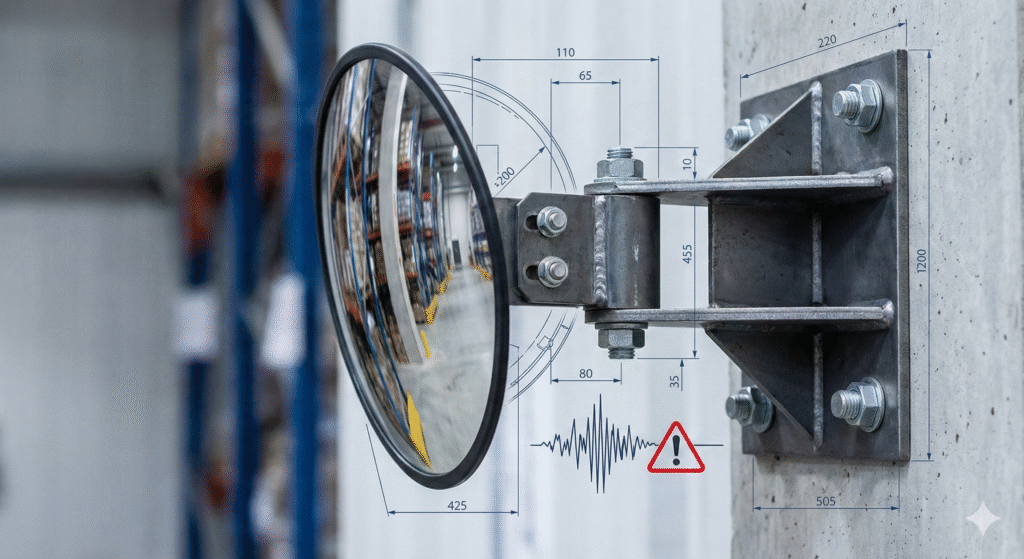
Professional installation standards affect mirror program effectiveness regardless of whether explicit regulations mandate particular installation methods. Proper surface preparation ensuring secure mounting, appropriate fastener selection for substrate types, and adequate anchoring preventing displacement under wind loads or vibration represent installation fundamentals that quality programs must address. Organizations should establish installation specifications based on manufacturer recommendations and professional standards rather than accepting informal installation methods that might prove adequate initially but fail prematurely under operational stresses.
Positioning accuracy ensuring mirrors provide intended coverage without creating false security through inadequate viewing angles requires careful installation layout and verification. Professional installers mark proposed locations with chalk or temporary marking before committing to permanent mounting, allowing stakeholders to verify that planned positions deliver expected visibility. Post-installation verification including walking or driving typical approach paths while observing mirror visibility ensures installations deliver intended functionality before declaring projects complete.
Mounting height standardization within facilities creates visual consistency while supporting predictable user behavior through familiar mirror placement. When workers encounter mirrors at consistent heights throughout warehouses or manufacturing facilities, they develop habitual checking behaviors rather than needing to consciously search for mirrors at varying locations. Standardized mounting heights also simplify maintenance by allowing crews to anticipate where mirrors will be located rather than spending time locating devices during inspection rounds.
Weather protection for outdoor installations demands attention to substrate compatibility, fastener corrosion resistance, and drainage provisions preventing water accumulation that accelerates degradation. Outdoor convex safety mirror installations should specify stainless steel or galvanized fasteners, include adequate clearance behind mirrors for air circulation preventing moisture trapping, and consider coating mounting surfaces with protective sealants if substrate porosity might allow moisture infiltration behind mirrors. These preventive measures extend service life while maintaining optical clarity critical for safety effectiveness.
Maintenance Programs and Performance Monitoring
Documented maintenance programs demonstrate ongoing commitment to safety system effectiveness rather than one-time installation efforts that organizations neglect after initial deployment. Maintenance schedules should specify inspection frequencies, cleaning protocols, criteria for determining when replacement becomes necessary, and assigned responsibilities ensuring accountability. Quarterly inspections represent reasonable starting points for most installations, with more frequent attention warranted for harsh environments or high-consequence locations where mirror failure creates elevated risks.
Performance metrics tracking near-miss incidents, accidents, and user feedback provide quantitative evidence of mirror program effectiveness supporting continued investment justification and identifying opportunities for program improvement. Organizations should establish baseline accident and near-miss frequencies before mirror installation, then monitor these metrics post-implementation to quantify safety improvements. Significant reductions validate program effectiveness, while unchanged incident rates suggest that mirror programs alone prove insufficient and that supplementary measures warrant consideration.
Continuous improvement processes incorporating lessons learned from incidents, near-misses, and operational changes ensure mirror programs evolve alongside facility modifications and operational adjustments. Regular safety committee reviews of mirror program effectiveness, supplemented by management-of-change procedures requiring visibility assessment for facility modifications, prevent situations where program effectiveness degrades as facilities evolve but mirror configurations remain static.
Organizations implementing comprehensive convex traffic safety mirror programs addressing these compliance standards and best practices position themselves for superior safety outcomes while managing regulatory obligations and liability exposure through documented professional safety management. The modest effort required to align mirror programs with recognized standards delivers substantial value through enhanced credibility, improved safety performance, and defensible practices that withstand scrutiny from regulators, insurance carriers, and legal proceedings if accidents occur despite implemented safety measures.
Looking for a custom convex mirror manufacturer or supplier? Struggling to find the right factory to bring your vision to life? We’ve got you covered! At our place, we craft top-quality convex mirrors with precision and care. Big or small, your needs are our mission. Let’s launch your mirror project and take your product line to the next level! Click here to contact