
Procuring road safety convex mirrors requires technical knowledge extending beyond simple size and price comparisons to encompass critical performance specifications that determine long-term effectiveness, durability, and regulatory compliance. Organizations purchasing mirrors without understanding essential specification requirements frequently discover that lowest-cost options fail prematurely, provide inadequate visibility, or lack features necessary for specific applications. Establishing comprehensive procurement specifications based on actual performance requirements rather than generic product descriptions ensures organizations acquire mirrors genuinely capable of delivering the safety benefits and operational longevity that justify investment.
Optical Performance and Reflective Surface Specifications
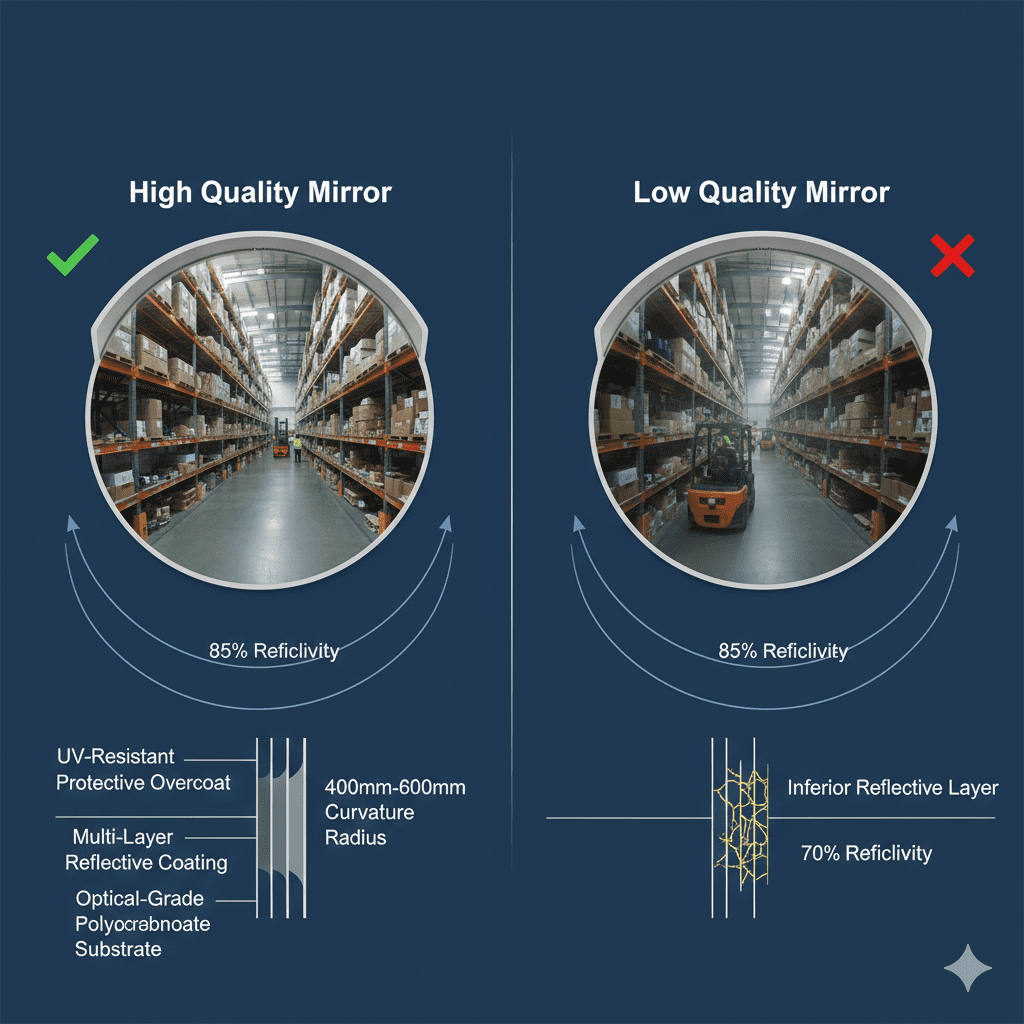
The reflective surface represents the most critical component affecting mirror performance, with material selection and surface quality determining visibility effectiveness across varying lighting conditions and viewing distances. Quality road safety convex mirror products utilize optical-grade polycarbonate or acrylic substrates providing distortion-free reflections across the entire viewing surface. Inferior materials introduce optical aberrations that create confusing reflections potentially misleading operators about actual distances or positions of reflected objects, compromising the safety purpose mirrors serve.
Surface reflectivity specifications should meet or exceed 85% across visible wavelengths, ensuring sufficient light return for clear visibility in diverse lighting conditions including dawn, dusk, and overcast weather when natural illumination provides less environmental light. Lower reflectivity ratings result in dim, unclear reflections that prove difficult to interpret, particularly for older operators whose visual acuity naturally decreases with age. Procurement specifications should explicitly require minimum reflectivity percentages rather than accepting vague claims of “high visibility” that provide no measurable performance standard.
The reflective coating system protecting the substrate and providing the actual reflective properties must resist degradation from ultraviolet radiation, moisture exposure, and temperature extremes that outdoor installations inevitably experience. Multi-layer coating systems provide superior durability compared to single-layer coatings, with premium products specifying protective overcoats that shield primary reflective layers from environmental attack. Procurement specifications should require documented coating system descriptions and ideally third-party test results demonstrating UV resistance and weathering performance rather than accepting unsupported manufacturer claims.
Curvature specifications affect the field of view and image compression characteristics that determine how much area mirrors can monitor and how users interpret reflected images. Convex mirrors with tighter curvature radii provide wider viewing angles but create more severe image compression that makes distance estimation more challenging. Conversely, mirrors with gentler curvature deliver less image compression and easier distance interpretation but monitor narrower viewing areas. Procurement specifications should specify appropriate curvature based on application requirements, with typical road safety applications utilizing curvature radii between 400mm and 600mm providing reasonable balance between viewing angle and image interpretability.
Structural Durability and Material Construction Standards
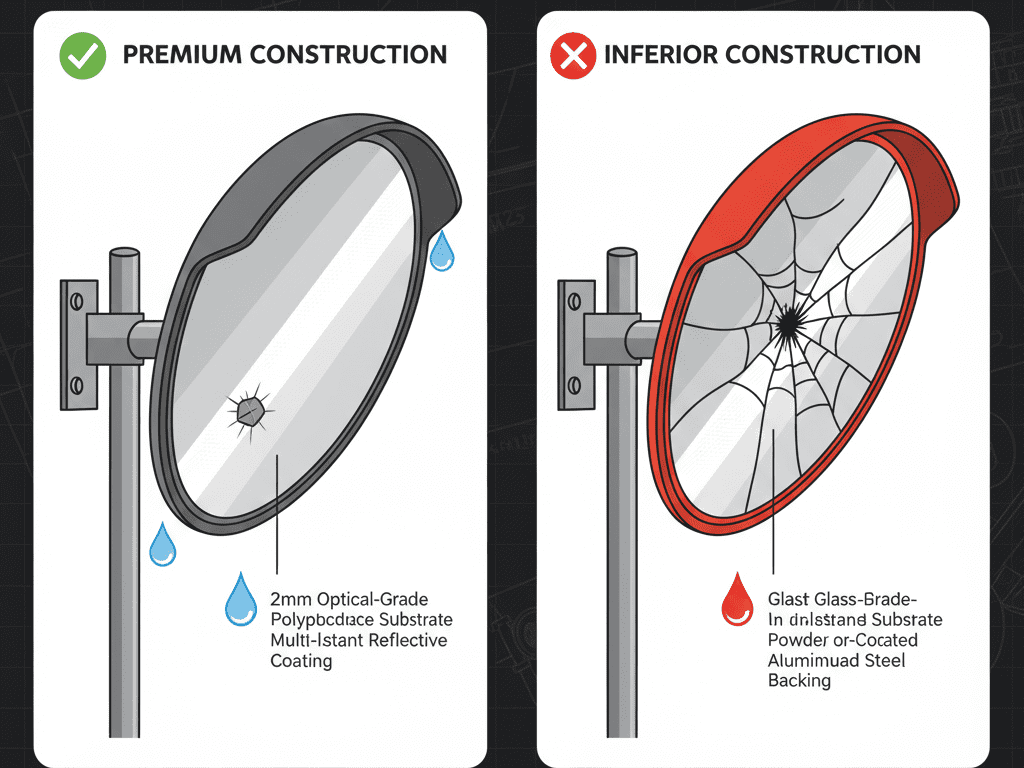
The physical construction of convex traffic safety mirrors must withstand environmental exposure, potential impact from debris or vandalism, and structural stresses from wind loading and temperature cycling throughout multi-year service lives. Premium mirrors specify impact-resistant polycarbonate or acrylic construction providing substantially greater durability than glass alternatives that shatter upon impact creating hazardous debris and complete mirror failure. Procurement specifications should explicitly exclude glass construction while requiring impact-resistant polymers meeting specific drop test or impact resistance standards.
Material thickness directly affects structural rigidity and impact resistance, with quality mirrors specifying minimum 3mm thickness for the reflective substrate. Thinner materials prove more vulnerable to damage and may flex excessively under wind loads, creating optical distortions that compromise visibility. Organizations procuring mirrors should specify minimum thickness requirements rather than assuming all products offer adequate material gauges, as cost-focused manufacturers often reduce material thickness to lower production costs while maintaining superficially similar appearance to premium alternatives.
Weather sealing systems preventing moisture infiltration behind reflective surfaces prove essential for long-term performance, as trapped moisture causes reflective coating delamination and substrate degradation that progressively destroys mirror functionality. Quality construction incorporates sealed edges using weather-resistant gaskets or bonded sealing that remains effective despite temperature cycling and UV exposure. Procurement specifications should require documented sealing systems with test data demonstrating moisture resistance rather than accepting generic claims of “weatherproof construction” lacking supporting evidence.
Backing structures supporting the reflective element must provide adequate rigidity preventing warping or flexing that would create optical distortions while resisting corrosion in outdoor environments. Aluminum backing proves superior to steel for outdoor applications due to inherent corrosion resistance, though powder-coated or galvanized steel provides acceptable alternatives when cost constraints prevent aluminum specification. Procurement documents should specify backing material and corrosion protection requirements appropriate for local environmental conditions, with coastal installations near salt air demanding more robust corrosion protection than inland environments.
Mounting Hardware and Installation System Requirements
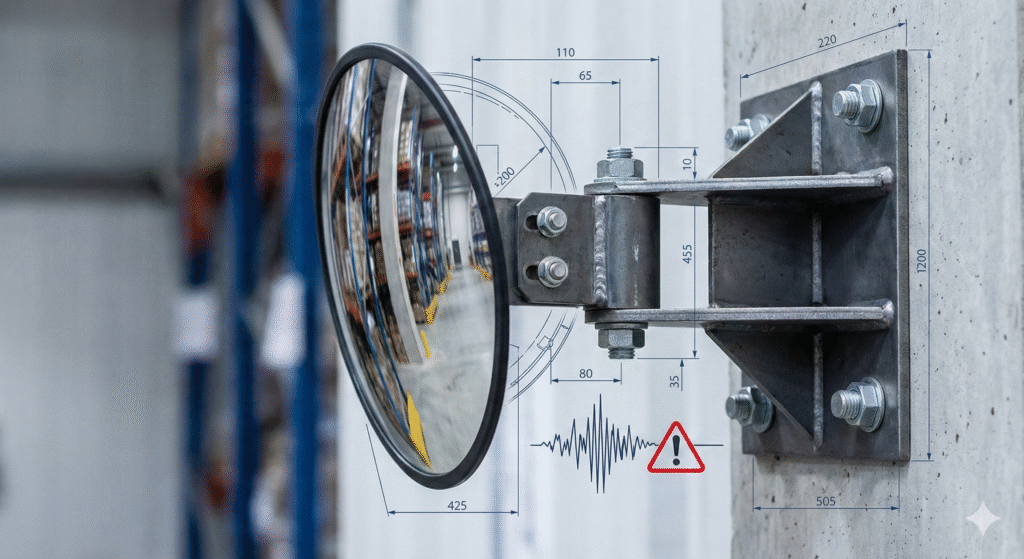
Mounting systems must provide secure attachment withstanding wind loads, vibration, and potential impact while allowing precise positioning during installation and adjustment capability for fine-tuning viewing angles after initial mounting. Universal mounting brackets accommodating various pole sizes and wall mounting configurations provide installation flexibility avoiding the need for custom hardware when standard mounting points prove unavailable. Procurement specifications should detail mounting hardware included with mirrors rather than assuming adequate hardware comes standard, as some manufacturers provide minimal mounting components requiring supplementary purchases.
Hardware materials must resist corrosion throughout anticipated service life, with stainless steel fasteners and powder-coated or zinc-plated brackets providing appropriate durability for outdoor installations. Inferior hardware corrodes rapidly in outdoor environments, leading to mounting failure even when the mirror itself remains structurally sound. Explicit specification of hardware materials prevents receipt of mirrors with inadequate fasteners requiring immediate replacement before installation, avoiding project delays and supplementary costs that inadequate initial specifications create.
Adjustment mechanisms allowing viewing angle modification after installation prove valuable for optimizing mirror coverage without requiring complete remounting. Quality mounting systems incorporate ball joints, articulating brackets, or similar mechanisms permitting angular adjustment across multiple axes. While fixed-position mounts prove adequate for some applications, the flexibility of adjustable systems justifies modest cost premiums through installation efficiency and optimization capability. Procurement specifications should identify whether adjustability is required or preferred based on application complexity and installation team experience.
Anti-theft features including tamper-resistant fasteners, security hardware, or specialized mounting systems deter opportunistic theft or vandalism that can create both replacement costs and safety hazards during periods when stolen mirrors remain unreplaced. Locations experiencing significant vandalism or theft should specify appropriate security features, recognizing that determined thieves can defeat most security measures but that basic anti-theft features deter casual opportunists responsible for most theft incidents.
Size Selection and Coverage Requirements
Appropriate mirror diameter selection depends on viewing distances and coverage area requirements, with inadequate sizing compromising visibility effectiveness regardless of other specification parameters. General guidelines suggest 12-inch mirrors for viewing distances to 15 feet, 18-inch mirrors for distances to 25 feet, 24-inch mirrors for 40 feet, and 30-inch or larger mirrors for extended distances exceeding 40 feet. These guidelines provide starting points requiring adjustment based on lighting conditions, approach speeds, and operator visual acuity considerations affecting real-world visibility requirements.
Procurement specifications should identify specific installation locations with measured viewing distances, allowing suppliers to recommend appropriate mirror sizes rather than leaving sizing decisions to purchasing personnel lacking technical expertise to properly match products to applications. Oversized mirrors unnecessarily increase costs without proportional safety benefits, while undersized mirrors fail to provide adequate visibility compromising the entire purpose of mirror installation. The modest incremental cost difference between adjacent size categories argues for selecting larger options when uncertainty exists about appropriate sizing.
Large convex mirror requirements for specialized applications such as parking structure exits or warehouse intersections with extended sight lines demand specifications addressing the unique challenges these substantial mirrors present. Increased weight requires more robust mounting systems, larger surface areas experience higher wind loads necessitating stronger attachment, and the visual prominence of large mirrors demands particular attention to aesthetic considerations in customer-facing environments. Procurement specifications for large mirrors should explicitly address mounting, wind load, and appearance requirements beyond standard specifications appropriate for smaller units.
Visibility Enhancement Features and Safety Markings
Reflective striping or high-visibility borders significantly enhance mirror conspicuity, helping drivers and operators notice mirrors before reaching decision points where mirror information becomes critical. Reflective materials should meet ASTM standards for retroreflectivity, providing adequate nighttime visibility when illuminated by vehicle headlights. Some applications benefit from fluorescent or high-visibility colored borders providing enhanced daytime conspicuity in complex visual environments where mirrors might otherwise blend into backgrounds. Procurement specifications should detail required visibility enhancement features rather than accepting basic mirrors lacking conspicuity treatments.
Integrated warning labels or instructional markings provide users with guidance about mirror interpretation and limitations, potentially including distance compression reminders or “Objects in mirror are closer than they appear” warnings familiar from vehicle side mirrors. While not technically required for most applications, these user guidance features demonstrate manufacturer attention to proper mirror usage and may provide modest liability protection if accidents occur and mirror interpretation becomes questioned during investigations.
Optional lighting features including LED illumination, solar-powered lights, or retroreflective borders provide enhanced visibility in low-light conditions or during nighttime operations. While adding cost and potential maintenance complexity through battery replacement or electrical connection requirements, lighting features prove valuable for critical locations where maximum visibility regardless of ambient lighting justifies supplementary measures. Procurement specifications should identify whether lighting features are required, preferred, or unnecessary based on specific site conditions and operational requirements.
Compliance Certifications and Quality Documentation
Quality manufacturers provide documentation demonstrating product compliance with relevant standards and performance claims, including material certifications, test reports, and quality control documentation. ISO 9001 certification indicates manufacturer commitment to quality management systems supporting consistent production standards, though certification alone doesn’t guarantee product performance meeting specific application requirements. Procurement specifications should request copies of relevant certifications and test documentation during bid evaluation, using provided documentation to differentiate between suppliers making similar claims with varying degrees of supporting evidence.
Warranty coverage reflects manufacturer confidence in product durability and performance, with premium products typically offering multi-year warranties covering material defects, coating degradation, and structural failures. Procurement specifications should establish minimum warranty requirements appropriate for expected service conditions, recognizing that longer warranties cost manufacturers more to honor and therefore indicate higher-quality construction unlikely to generate warranty claims. Organizations should review warranty terms carefully, understanding exclusions that might limit practical coverage despite impressive headline warranty periods.
Country of origin declarations help organizations preferring domestically manufactured products or avoiding products from specific regions due to quality concerns or procurement policy requirements. While country of origin doesn’t automatically indicate quality levels, some organizations maintain preferences or requirements that procurement specifications should reflect. Suppliers should clearly declare manufacturing locations rather than obscuring origins through vague references to “international production” that prevent informed purchasing decisions.
Establishing comprehensive procurement specifications addressing these essential parameters ensures organizations acquire road safety convex mirrors genuinely capable of delivering expected performance throughout anticipated service lives. The modest effort invested in developing detailed specifications prevents costly mistakes that plague organizations accepting lowest-bid products without verifying capability to meet actual application requirements, ultimately delivering superior value through proper initial selection rather than requiring premature replacement of inadequate equipment.
Looking for a custom convex mirror manufacturer or supplier? Struggling to find the right factory to bring your vision to life? We’ve got you covered! At our place, we craft top-quality convex mirrors with precision and care. Big or small, your needs are our mission. Let’s launch your mirror project and take your product line to the next level! Click here to contact