
Temporary speed control solutions have become essential tools for event organizers and construction site managers who must create safe environments without the permanence, expense, and infrastructure disruption that traditional concrete speed bumps require. The evolution of portable traffic calming technology now offers sophisticated alternatives specifically engineered for temporary deployment while delivering performance characteristics approaching those of permanent installations. Understanding the selection criteria, performance characteristics, and proper application of temporary speed bumps enables organizations to implement effective speed management programs that protect workers, attendees, and the public while maintaining the flexibility that temporary operations demand.
Understanding Temporary Speed Bump Technology and Design
Temporary speed bumps represent a distinct product category from permanent installations, engineered specifically for portable deployment, rapid installation, and frequent relocation without requiring specialized tools or extensive labor. Unlike concrete speed bumps that demand professional installation, removal requires jackhammering, and relocation proves essentially impossible, temporary systems utilize modular rubber or polymer construction allowing single workers to deploy effective speed control in minutes. This fundamental difference in design philosophy creates unique capabilities that make temporary systems optimal for applications where permanent installations would prove impractical or economically unjustifiable.
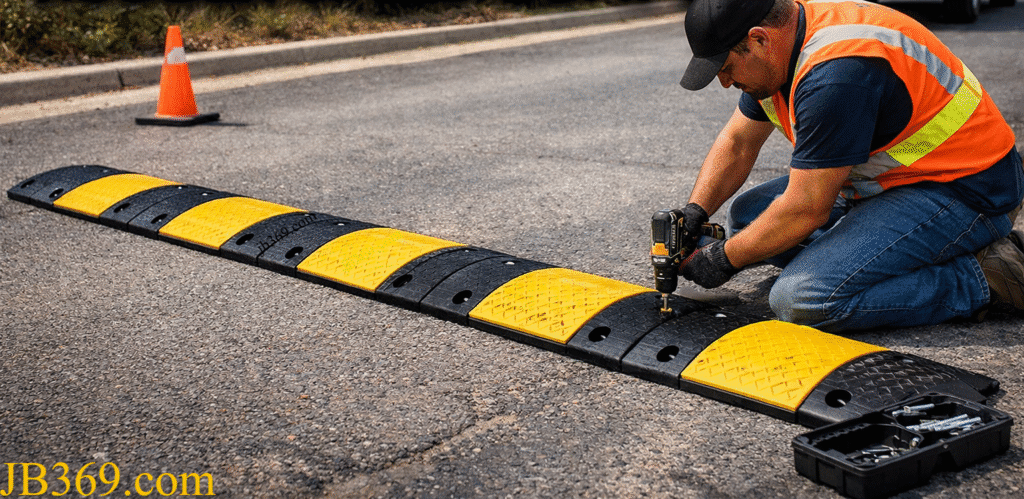
The most common temporary speed bump designs utilize interlocking rubber segments that connect via built-in attachment hardware creating continuous speed control devices spanning desired roadway widths. Individual segments typically measure 24 to 48 inches in length, allowing customization to specific lane widths through addition or removal of segments. This modularity provides installation flexibility impossible with monolithic permanent speed bumps while simplifying transportation and storage when systems aren’t deployed. Quality temporary systems feature engineered connection mechanisms that prevent segment separation under traffic loads while remaining simple enough for field personnel to assemble without specialized training.
Material selection significantly affects temporary speed bump performance and durability. Recycled rubber compounds dominate the market due to favorable characteristics including impact resistance, weather durability, temperature stability, and environmental sustainability. Premium temporary systems often specify virgin rubber formulations or specialized polymers engineered for specific performance characteristics such as enhanced visibility, reduced noise, or improved cold-weather flexibility. The material choice influences not just durability but also ride characteristics, with different formulations creating varying levels of vehicle deflection and occupant discomfort that affect speed reduction effectiveness.
Weight and anchoring systems distinguish quality temporary speed bumps from inferior products. Effective temporary systems must remain stable under vehicle crossings despite lacking the permanent attachment that concrete speed bumps achieve through installation into roadway surfaces. Heavy-duty rubber construction provides inherent stability through mass, while integrated anchoring systems using spikes, adhesives, or weighted bases further resist displacement. Understanding the anchoring options and their suitability for different surface types proves critical when selecting temporary systems for specific applications, as inadequate anchoring leads to displacement that compromises both safety and effectiveness.
Applications for Temporary Speed Bumps in Event Management
Special events ranging from festivals and concerts to sporting competitions and community gatherings create temporary traffic control challenges requiring speed management in locations never previously needing such measures. Parking areas established in fields or vacant lots, temporary access roads created specifically for event logistics, and pedestrian zones where vehicles must travel slowly to prevent conflicts all represent scenarios where temp speed bumps provide essential traffic calming without requiring permanent infrastructure modifications that would prove inappropriate once events conclude.
Festival and concert venues frequently deploy temporary speed bumps along access routes serving vendor areas, VIP parking zones, and backstage logistics where pedestrian activity creates heightened collision risks. The ability to establish speed control exactly where needed without regard for existing permanent infrastructure allows event organizers to create safety zones optimized for specific event layouts rather than compromising with permanent installations positioned for different purposes. Following event conclusion, temporary systems remove completely, leaving no trace and restoring original site conditions without residual damage or ongoing maintenance obligations.
Parking management represents another critical event application for temporary speed bumps. Large events converting agricultural fields, vacant lots, or recreational areas into temporary parking facilities need speed control preventing dangerous speeds in improvised parking environments where drivers may lack familiarity with layouts and pedestrians move unpredictably between vehicles. Driveway speed bumps installed temporarily at parking area entrances, within interior circulation routes, and near pedestrian crossing points create enforceable speed limits that verbal instructions or signage alone cannot achieve. The psychological and physical effects of speed bumps prove far more effective than posted speed limits when managing drivers in chaotic event parking scenarios.
Marathon and cycling events that temporarily close public roadways require traffic control at intersection points where event courses cross side streets or where limited vehicle access remains necessary for emergency services and event operations. Temporary speed bumps deployed at these critical intersection points ensure that permitted vehicles travel at speeds compatible with athlete safety while providing clear physical demarcation of controlled zones. The highly visible nature of quality temporary speed bumps also communicates to athletes that vehicles may be present, encouraging heightened awareness that contributes to mutual safety for both participants and drivers.
Corporate events, graduation ceremonies, and other institutional gatherings on college campuses, corporate parks, or similar environments benefit from temporary speed bump deployment during periods of elevated pedestrian activity. Rather than maintaining permanent speed bumps year-round in locations where they’re only occasionally needed, institutions can deploy temporary systems during specific high-risk periods, removing them once normal traffic patterns resume. This flexibility prevents the ongoing driver annoyance and emergency vehicle impedance that permanent installations create during normal operations when speed control proves less critical.

Construction Site Applications and Safety Benefits
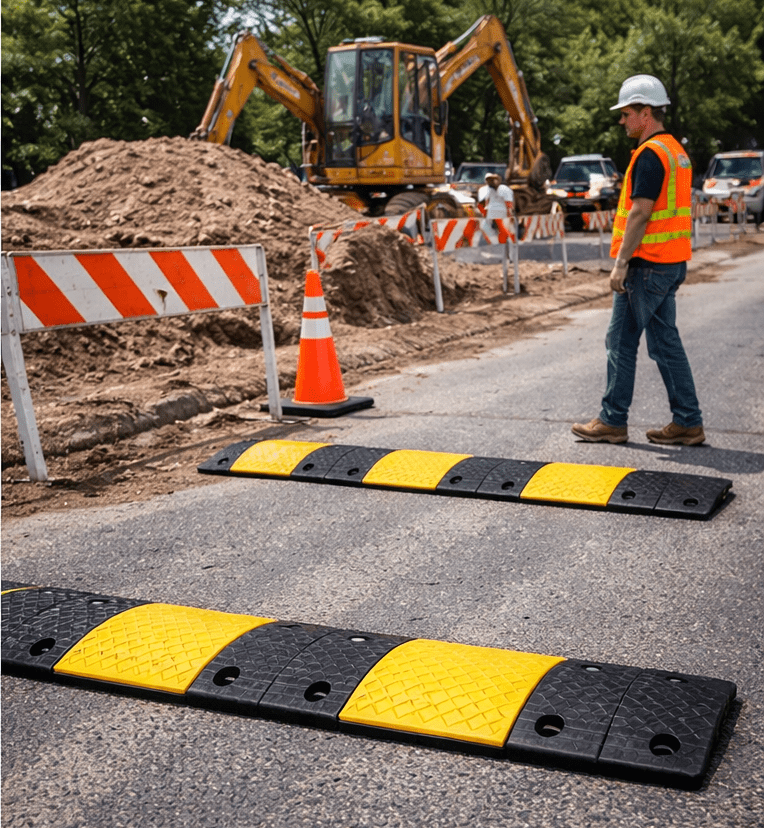
Construction sites present unique speed control challenges due to constantly evolving layouts, temporary access roads that may shift as projects progress, and high volumes of heavy equipment moving through areas where workers concentrate. Temporary speed bumps address these challenges while accommodating the dynamic nature of construction environments where permanent installations would quickly become obsolete as site conditions change. The ability to relocate speed control as project phases evolve ensures that traffic calming remains optimally positioned throughout project duration rather than becoming ineffective as original installation locations lose relevance.
Haul routes within construction sites that serve multiple projects or connect different work areas frequently require speed control preventing dangerous speeds where equipment operators may lack complete visibility or where workers must cross vehicle pathways. Rubber speed bump installations at strategic locations along these routes enforce safe speeds without requiring the permanent infrastructure that would need removal or abandonment once construction concludes and sites return to other uses. The industrial-grade construction of quality temporary systems withstands the heavy loads and demanding conditions that construction equipment creates, performing reliably despite punishment that would quickly destroy residential-grade products.
Visitor and delivery access points represent another critical construction site application. Where construction sites maintain active operations within occupied facilities, such as hospital expansions, campus renovations, or infrastructure upgrades in functioning industrial plants, controlling speeds at interface points between construction traffic and regular facility operations proves essential for preventing accidents. Temporary speed bumps deployed at these entry points establish clear speed zones while accommodating the changing access requirements that multi-phase construction projects create as different areas transition between active construction and return to normal operations.
Worker parking areas and pedestrian routes within construction sites benefit from temporary speed bump installation preventing dangerous speeds in zones where off-duty workers, visitors, or support personnel move between vehicles and work locations. Unlike public roadways where all users theoretically understand traffic rules and exercise appropriate caution, construction sites include personnel with varying levels of site familiarity and safety awareness. Physical speed control through temporary speed bumps provides positive enforcement that doesn’t rely on driver judgment or compliance with posted limits that construction site chaos might cause workers to overlook.
Staging areas where materials and equipment concentrate before deployment into active work zones require speed control preventing damage to stored items and protecting workers conducting inventory, loading, or organization activities. The ability to establish speed bumps surrounding staging areas as they’re created, then relocate or remove devices as staging areas shift to different locations, provides dynamic traffic control matching the fluid nature of construction logistics. This adaptability proves impossible with concrete speed bumps that would require reinstallation each time staging requirements changed.
Comparing Temporary and Permanent Speed Bump Solutions
Understanding when temporary speed bumps represent the optimal choice versus situations requiring permanent installations helps organizations make appropriate selections rather than defaulting to whichever option seems most familiar or readily available. Temporary systems excel in applications characterized by uncertain duration, evolving layouts, multiple potential relocation needs, or installation surfaces unsuitable for permanent attachment. Events that occur annually but only last days or weeks, construction projects with defined completion dates, and seasonal applications such as summer recreational facilities all favor temporary solutions over permanent alternatives.
Permanent installations using concrete speed bumps or professionally installed rubber systems prove more appropriate for locations requiring indefinite speed control, high-traffic environments where installation stability becomes critical, or situations where the visual permanence of installed devices contributes to driver compliance psychology. Commercial parking lots, residential communities, school zones with ongoing pedestrian conflicts, and similar permanent traffic situations justify the higher installation costs and reduced flexibility that permanent systems entail. The installed cost per year of service often favors permanent systems for truly long-term applications despite higher upfront expenses.
Performance characteristics differ between temporary and permanent systems in ways that influence suitability for specific applications. Quality temporary speed bumps deliver speed reduction approaching that of permanent installations when properly deployed on suitable surfaces, but may allow slightly higher speeds or provide less consistent speed enforcement than anchored permanent systems. For applications requiring absolute minimum speeds, such as areas adjacent to schools during dismissal periods, permanent installations may prove preferable. Temporary systems adequately serve most other applications where reducing speeds to safe ranges rather than enforcing specific minimums represents the primary objective.
Maintenance requirements differ substantially between temporary and permanent systems. Temporary speed bumps require periodic inspection to verify anchoring integrity and prompt repositioning if displacement occurs, but avoid the ongoing maintenance that weather exposure, substrate deterioration, and vandalism create for permanent installations. The ability to remove temporary systems during adverse weather prevents winter damage from snowplow strikes that frequently destroys permanent speed bumps in cold climates. This maintenance flexibility can significantly reduce total cost of ownership for applications in harsh environments where permanent installation attrition proves expensive.
Critical Selection Criteria for Temporary Systems
Surface compatibility represents the first critical selection criterion when specifying temporary speed bumps. Different temporary systems utilize varying anchoring mechanisms optimized for specific surface types. Asphalt installations typically employ spike anchors that penetrate pavement surfaces providing mechanical attachment resisting displacement forces. Concrete surfaces may require adhesive anchoring or weighted systems since spike penetration into harder concrete proves more difficult than asphalt penetration. Gravel, dirt, or unpaved surfaces present particular challenges requiring heavy-duty weighted systems or specialized earth anchors appropriate for unstable substrates.
Traffic volume and vehicle types affect durability requirements and appropriate system specifications. Light-duty temporary speed bumps designed for occasional passenger vehicle crossings prove inadequate for construction sites where loaded concrete trucks, equipment haulers, and other heavy commercial vehicles cross repeatedly. Commercial-grade temporary systems specify reinforced construction, heavier-gauge materials, and robust anchoring capable of withstanding commercial traffic without rapid deterioration. Organizations should honestly assess anticipated traffic characteristics and specify systems engineered for actual rather than wishful usage patterns to avoid premature failure and frequent replacement.
Installation and removal frequency influences system selection, with applications requiring daily or weekly repositioning favoring lightweight modular designs optimizing portability over systems engineered for semi-permanent deployment. Event organizers who install speed bumps Friday afternoon and remove them Monday morning need systems balancing effectiveness with rapid deployment capabilities, while construction sites establishing speed control for months-long project phases can utilize heavier, more robust systems that trade some portability for enhanced stability and durability during extended deployments.
Visibility requirements vary based on ambient lighting, traffic speeds, and driver familiarity with installation locations. High-visibility systems incorporating reflective striping, contrasting color schemes, or even integrated lighting provide enhanced conspicuity for nighttime applications or locations where drivers may not anticipate speed control devices. Applications in well-lit environments with familiar user populations may adequately serve with basic rubber speed bump designs lacking enhanced visibility features, though most professional applications benefit from high-visibility specifications ensuring devices remain obvious regardless of lighting or weather conditions.
Installation Best Practices and Safety Considerations
Proper installation proves critical for temporary speed bump effectiveness and safety. Surface preparation including cleaning to remove debris, oil, or contaminants that might prevent anchoring adhesion represents the first installation step. Failure to adequately prepare surfaces leads to premature displacement regardless of how well-engineered the speed bump system may be. Professional installers understand that five minutes of surface preparation prevents installation failures that create safety hazards and require complete reinstallation.
Positioning requirements for speed bumps include adequate advance warning signage alerting drivers to devices ahead. Drivers encountering unexpected speed bumps at high speeds may brake violently creating rear-end collision risks or swerve dangerously attempting to avoid devices. Signage positioned at sufficient distances for prevailing speeds allows drivers to reduce speed gradually rather than reacting abruptly. The specific warning distance depends on approach speeds and sight distances, with higher speeds and limited visibility requiring more advance notice than slower, open approaches.
Alignment across roadway widths ensures that speed bumps create uniform speed reduction rather than allowing drivers to partially avoid devices by steering toward roadway edges. Properly aligned installations span full lane widths with no gaps permitting circumvention that would defeat speed control purposes. Modular temporary systems require careful attention during installation ensuring segment connections align properly and create continuous devices without gaps, offsets, or height variations that might create tripping hazards or allow partial avoidance.
Americans with Disabilities Act compliance considerations affect temporary speed bump installations in public accommodations and commercial facilities. While speed bumps serve legitimate safety purposes, installations must ensure that accessible routes remain usable by individuals using wheelchairs, walkers, or other mobility assistance devices. This typically requires either limiting speed bump deployment to vehicle-only routes while maintaining alternative accessible pathways, or specifying low-profile speed bump designs that mobility device users can traverse safely. Organizations serving the public should consult ADA guidelines and potentially seek advice from accessibility specialists when planning temporary speed bump deployments.
Cost Analysis and Budget Planning
Temporary speed bump costs vary widely based on system quality, features, and vendor. Basic residential-grade units might cost $50-100 per linear foot of coverage, while commercial-grade systems suitable for construction sites or high-traffic event applications typically range $100-200 per linear foot. Premium systems with enhanced visibility features, specialized anchoring, or engineered performance characteristics can exceed $200 per linear foot. Organizations should resist the temptation to select lowest-cost options without considering whether specifications match actual application requirements, as inadequate systems ultimately cost more through premature failure and replacement needs.
Installation labor represents another significant cost component, though temporary systems generally require far less labor than permanent installations. Two workers can typically install 50-100 feet of temporary speed bumps hourly depending on system type and surface conditions, translating to labor costs of perhaps $50-150 per installation for typical event or construction site applications. Removal labor proves equally modest, making the total installation and removal cost quite reasonable compared to permanent installation expenses that might reach thousands of dollars for similar coverage.
Rental options deserve consideration for organizations needing temporary speed bumps infrequently or for single events where purchasing proves uneconomical. Traffic control equipment rental companies maintain temporary speed bump inventories available for daily, weekly, or monthly rental at rates typically representing 10-20% of purchase prices per week. For applications requiring speed control for a few weeks annually, rental costs over five years might total less than purchase prices while eliminating storage responsibilities and avoiding equipment depreciation from weather exposure during periods when speed bumps aren’t needed.
Long-term cost comparisons should evaluate total cost of ownership including purchase prices, installation labor, removal labor, storage costs, and replacement frequency rather than focusing solely on initial acquisition costs. A slightly more expensive commercial-grade temporary system requiring replacement every five years proves more economical than a bargain-priced residential system needing replacement every two years when installation labor and removal labor are factored into calculations. Organizations deploying temporary speed bumps regularly should develop comprehensive cost models incorporating all lifecycle expenses to guide purchasing decisions toward options delivering best value rather than simply lowest initial costs.
Legal and Liability Considerations
Liability concerns influence temporary speed bump deployment decisions and proper implementation practices. Organizations installing speed control devices assume responsibilities for proper installation, adequate warning, and maintenance ensuring devices don’t create hazards exceeding the collision risks they’re intended to prevent. Improperly installed temporary speed bumps that cause vehicle damage, injury to occupants from unexpected impacts, or pedestrian trips create liability exposure that proper planning and professional installation practices help prevent.
Warning signage represents a key liability protection measure beyond its safety value. Courts frequently consider whether reasonable warning was provided when evaluating liability claims arising from speed bump encounters. Organizations should document signage deployment including photographs showing sign placement and visibility to establish evidence of adequate warning if claims later arise. This documentation proves particularly important for temporary installations where signs may be removed before anyone photographs the complete installation configuration.
Insurance considerations affect temporary speed bump programs with some commercial liability policies specifically addressing or excluding coverage for traffic control device installations. Organizations should review insurance policies and potentially consult with insurance advisors before implementing temporary speed bump programs to understand coverage implications and whether policy modifications might be appropriate. Event organizers in particular should verify that temporary traffic control falls within event liability policy coverage since claims arising from speed bump-related incidents could prove expensive without adequate insurance protection.
Municipal permits or permissions may be required for temporary speed bump installations on public property or within public right-of-ways even when installations are clearly temporary. Event organizers using public streets, parks, or other municipal property should investigate permit requirements early in planning processes to avoid last-minute complications when permit applications reveal unexpected requirements or restrictions. Construction sites may similarly require traffic control approvals from local authorities before deploying temporary speed bumps affecting public access or nearby roadways.
Future Trends and Emerging Technologies
Temporary speed bump technology continues evolving with innovations addressing traditional limitations and expanding application possibilities. Smart speed bumps incorporating sensors that detect approaching vehicle speeds and adjust profiles dynamically represent emerging technology promising more sophisticated speed control than static devices can deliver. These systems might remain flat for vehicles approaching at safe speeds while deploying height for vehicles exceeding limits, reducing the universal discomfort traditional speed bumps create for compliant drivers while still enforcing limits on speeders.
Sustainable materials and manufacturing processes increasingly influence temporary speed bump specifications as organizations emphasize environmental responsibility. Recycled rubber formulations, bio-based polymers, and cradle-to-grave recyclability represent features distinguishing environmentally responsible products from conventional options. While sustainable specifications once carried significant cost premiums, improving manufacturing efficiency and market acceptance have reduced price differentials making environmentally responsible choices increasingly accessible for budget-conscious organizations.
Modular systems with enhanced versatility allowing single product platforms to serve multiple applications through different configurations represent another development trend. Rather than maintaining separate inventories of specialized products for different applications, emerging modular systems allow organizations to reconfigure components for varying needs. A single inventory might serve both speed control and channelization applications, or adapt between low-profile accessibility-compliant configurations and more aggressive speed reduction profiles depending on specific deployment requirements.
The strategic selection of temporary speed bumps for events and construction sites requires balancing performance requirements, installation practicality, cost constraints, and liability considerations within comprehensive traffic safety programs. Organizations approaching temporary speed control systematically, with clear understanding of available technologies and proper application criteria, consistently achieve superior safety outcomes while managing costs effectively and maintaining the operational flexibility that temporary solutions provide. Whether protecting event attendees, construction workers, or the general public, appropriate temporary speed bump deployment represents a proven, practical solution for traffic calming needs that permanent installations cannot adequately address.
Looking for a Custom Speed Bumps Manufacturer or Supplier? Struggling to find the right factory to bring your vision to life? We’ve got you covered! At our place, we craft top-quality Speed Bumps with precision and care. Big or small, your needs are our mission. Let’s launch your Speed Bumps project and take your product line to the next level! Click here to contact