
Outdoor environments subject safety equipment to relentless challenges that indoor installations never face. Temperature extremes, ultraviolet radiation, wind loads, precipitation, and physical impacts from debris all conspire to degrade mirror performance over time. For businesses investing in convex safety mirror outdoor installations, understanding the engineering characteristics that separate premium products from inferior alternatives becomes critical to achieving acceptable return on investment and maintaining reliable safety performance throughout extended service lives.
Material Science and Reflective Surface Engineering
The reflective surface represents the most critical component of any outdoor convex safety mirror, and material selection profoundly impacts durability and optical performance. Traditional glass mirrors offer excellent optical clarity but present serious limitations for outdoor safety applications. Glass shatters upon impact, creating hazardous debris and complete mirror failure. Weight considerations also complicate installation and mounting requirements for larger diameter mirrors.
Premium convex safety mirrors designed for outdoor use employ advanced polycarbonate or acrylic reflective surfaces that deliver impact resistance far exceeding glass capabilities. These engineered plastics absorb impact energy that would shatter glass, allowing mirrors to survive collisions with vehicles, equipment, wind-blown debris, and vandalism attempts that would destroy glass-based alternatives. The flexibility of these materials also provides advantages in extreme temperature conditions where thermal expansion and contraction cycles stress rigid materials.
However, not all plastic reflective surfaces deliver equivalent performance. Quality outdoor convex safety mirror products utilize optical-grade polycarbonate with specialized surface treatments that enhance scratch resistance, reduce static electricity accumulation that attracts dust, and improve resistance to chemical exposure from road salt, cleaning agents, and environmental pollutants. These surface treatments significantly extend the functional lifespan of mirrors operating in demanding outdoor environments.
The reflective coating applied to the polycarbonate or acrylic substrate determines optical clarity and long-term performance. Superior mirrors employ multiple-layer coatings that enhance reflectivity while providing protection against UV degradation, moisture penetration, and chemical exposure. Single-layer coatings found in economy products deteriorate rapidly when exposed to weather, resulting in cloudy, hazy reflections that compromise visibility and defeat the mirror’s safety purpose.
UV Resistance and Weather Protection
Ultraviolet radiation represents one of the most destructive forces affecting outdoor mirrors. Continuous UV exposure degrades unprotected plastics, causing yellowing, brittleness, and eventual mechanical failure. The reflective coatings on inferior mirrors also deteriorate under UV attack, losing clarity and reflectivity until the mirror becomes essentially useless despite appearing physically intact.
Quality convex mirror for road safety applications incorporate UV inhibitors throughout the reflective substrate, not just as surface treatments. These inhibitors absorb harmful UV radiation before it can damage the material structure, maintaining optical clarity and mechanical properties throughout years of sun exposure. The difference in longevity between UV-protected and unprotected mirrors operating in high-sun environments can exceed 500%, making UV resistance essential rather than optional for outdoor installations.
Advanced mirror designs also feature UV-resistant protective housings that shield the reflective surface from direct exposure during periods when the mirror isn’t actively being viewed. These housings serve multiple protective functions while ensuring that reflected images remain visible from appropriate viewing angles. The housing materials themselves must resist UV degradation to maintain structural integrity and protective capabilities throughout the mirror’s service life.
Weather sealing systems prevent moisture infiltration that causes reflective coating delamination and backing deterioration. Premium outdoor convex safety mirror products employ multi-stage sealing with weather-resistant gaskets, drainage channels, and vented designs that prevent condensation buildup while excluding precipitation. Inferior mirrors lack adequate sealing, allowing moisture to penetrate behind reflective surfaces where it causes irreversible damage that progressively degrades mirror performance.

Structural Integrity and Mounting System Design
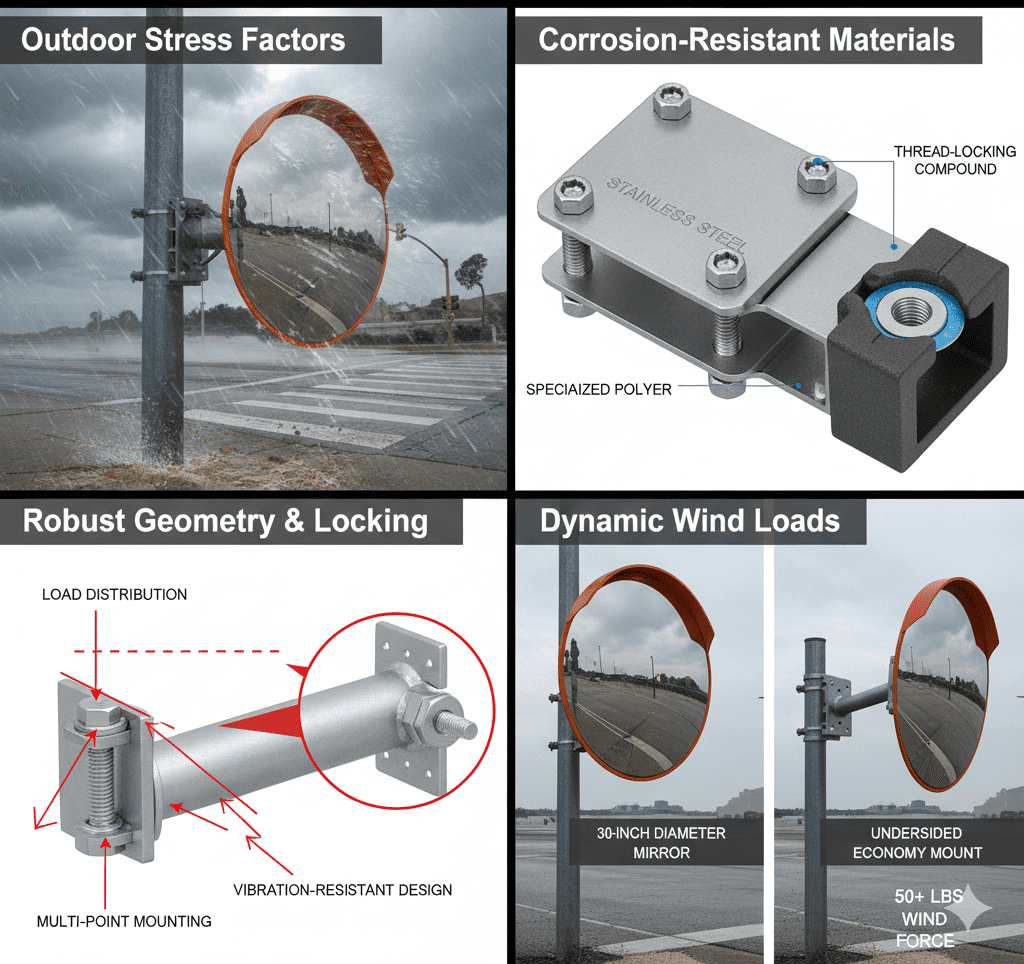
The most optically perfect mirror delivers no safety value if mounting failures allow it to sag, rotate, or detach completely. Outdoor installations face wind loads, vibration from passing traffic, thermal expansion cycles, and potential impact forces that stress mounting systems far beyond what indoor mirrors experience. Engineering mounting hardware capable of maintaining precise mirror positioning despite these forces requires careful attention to materials, geometry, and installation methods.
Quality convex traffic safety mirrors feature mounting brackets manufactured from corrosion-resistant materials such as stainless steel, powder-coated aluminum, or specialized polymers engineered for outdoor exposure. These materials maintain strength and dimensional stability throughout temperature ranges from -40°F to 150°F while resisting corrosion from road salt, acid rain, and environmental pollutants that rapidly degrade standard steel hardware.
The geometry of mounting systems significantly affects long-term reliability. Superior designs distribute loads across multiple mounting points, preventing stress concentration that leads to fastener failure or substrate damage. Adjustable mounting systems that permit precise positioning during installation should maintain those settings despite vibration and thermal cycling. Quality products employ locking mechanisms such as set screws, lock washers, and thread-locking compounds that prevent gradual position drift.
Large convex mirror installations require particularly robust mounting solutions due to increased surface area exposed to wind loads. A 30-inch diameter mirror may experience wind forces exceeding 50 pounds during severe weather events. Mounting hardware must not only support the mirror’s static weight but also resist dynamic loads without allowing movement that compromises viewing angles. Undersized mounting brackets represent a common failure point in economy mirror products that appear adequate during installation but fail prematurely under operational stresses.
Impact Resistance and Vandalism Protection
Outdoor safety mirrors inevitably face physical impacts from various sources including vehicle collisions, equipment strikes, thrown objects, and deliberate vandalism. While no mirror survives severe direct impacts completely unscathed, quality products employ design features that minimize damage and often allow continued operation despite contact that would destroy inferior mirrors.
Polycarbonate reflective surfaces demonstrate remarkable impact absorption capabilities. The material flexes upon impact, distributing force across a larger area rather than fracturing. This flexibility allows convex security mirror installations to survive low to moderate impacts with only superficial damage rather than catastrophic failure.
Edge protection systems enhance impact resistance by reinforcing vulnerable perimeter areas where cracks typically initiate. Quality mirrors feature reinforced edges or protective trim that absorbs impact energy before it reaches the reflective surface.
Vandalism-resistant designs incorporate features that discourage deliberate damage. Tamper-resistant mounting hardware prevents removal without specialized tools, while protective housings shield the reflective surface from paint and scratching tools. Some premium products offer replaceable protective films that absorb damage, allowing restoration without replacing the entire mirror.
Thermal Performance and Dimensional Stability
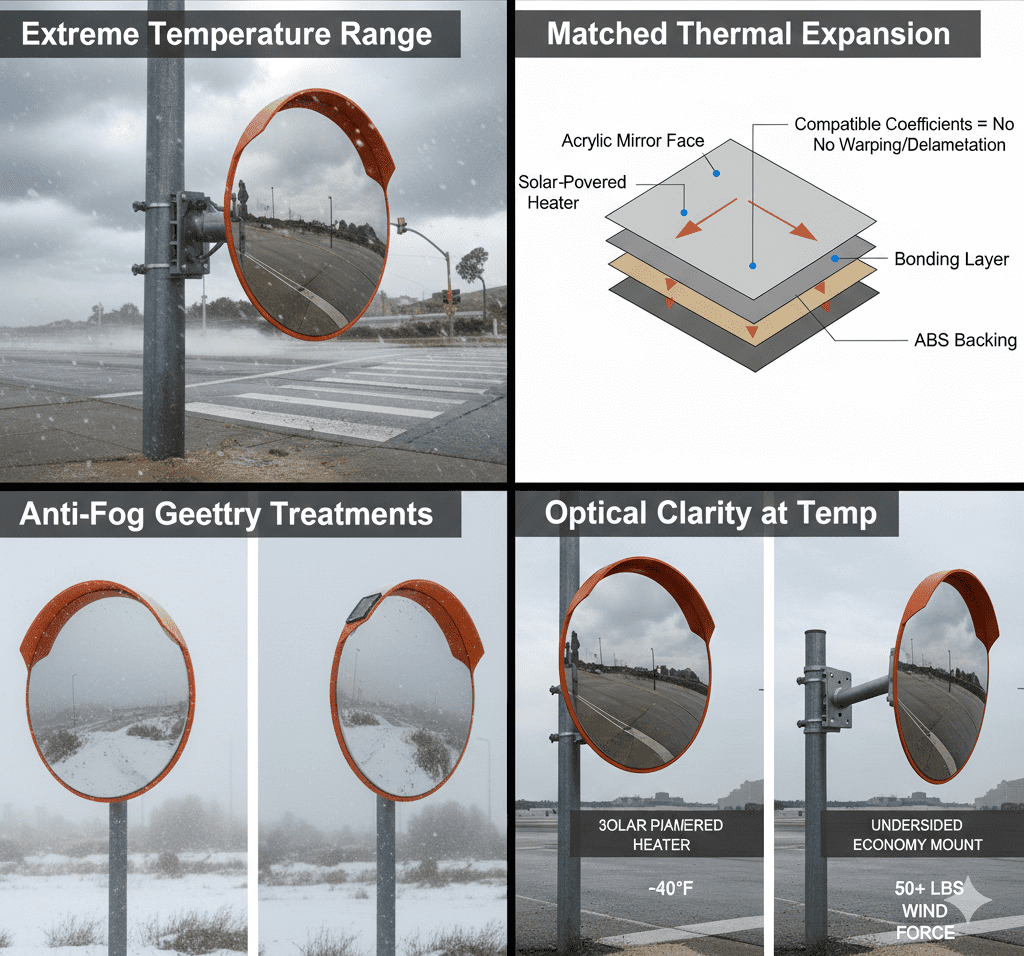
Temperature extremes challenge outdoor mirrors through multiple mechanisms. Direct solar heating can elevate surface temperatures significantly above ambient air temperature, while nighttime cooling and winter conditions expose mirrors to sub-zero temperatures. Quality outdoor convex safety mirror products maintain optical performance and structural integrity across these temperature ranges through careful material selection and thermal engineering.
Thermal expansion coefficients must be matched between reflective surfaces, backing materials, and mounting hardware to prevent stress buildup during temperature cycles. Mismatched materials create differential expansion that causes warping, delamination, or mounting failure. Premium mirrors employ materials with compatible expansion characteristics.
Optical clarity can deteriorate in extreme temperatures if materials or coatings weren’t engineered for the full operational temperature range. Quality products maintain clear reflections from -40°F to 150°F, ensuring reliable performance regardless of seasonal variations.
Anti-fog treatments prevent condensation buildup that obscures visibility during high-humidity conditions or rapid temperature changes. Advanced mirrors may incorporate solutions such as mild heating elements powered by solar panels that maintain surface temperatures above dew point during critical conditions.
Maintenance Requirements and Service Life
Even the most robust outdoor mirrors require periodic maintenance to sustain optimal performance. Quality products minimize maintenance requirements through self-cleaning surface treatments, corrosion-resistant materials, and designs that naturally shed debris and water. Understanding maintenance needs during product selection ensures realistic expectations and appropriate budget allocation.
Self-cleaning surface coatings utilize hydrophobic treatments that cause water and contaminants to bead up and roll off rather than spreading across reflective surfaces. These coatings significantly reduce cleaning frequency and often allow rain to naturally wash away light dust and pollen. Premium coatings maintain effectiveness for years, while inferior treatments degrade within months.
Accessible design facilitates necessary maintenance activities. Mirrors positioned for optimal viewing angles may be difficult to reach for cleaning and inspection. Quality installations consider maintenance access during planning, potentially incorporating articulating mounts or mounting heights that permit servicing from ground level.
Realistic service life expectations vary dramatically between economy and premium products. Basic outdoor mirrors might deliver 2-4 years of acceptable performance before degradation necessitates replacement. Quality convex traffic mirrors engineered for harsh outdoor environments often provide 10-15 years of reliable service, with some premium products exceeding 20 years in moderate climates.
Certification and Performance Standards
Professional-grade outdoor convex safety mirrors often carry certifications demonstrating compliance with relevant performance standards. Quality manufacturers voluntarily subject their products to rigorous testing that verifies performance claims regarding impact resistance, UV stability, temperature range, and optical quality.
Third-party testing provides objective verification of manufacturer claims. Independent laboratories evaluate mirrors according to standardized protocols that measure critical performance parameters. Products carrying certifications from recognized testing organizations offer buyers greater confidence in actual capabilities.
Warranty coverage reflects manufacturer confidence in product durability. Premium mirrors typically carry multi-year warranties covering material defects, UV degradation, and reflective coating delamination. Economy products often provide minimal warranties or exclude environmental damage, effectively acknowledging limited durability. Warranty terms provide valuable insight into expected product longevity.
Total Cost of Ownership Analysis
Initial purchase price represents just one component of total cost for outdoor mirror installations. Comprehensive cost analysis includes installation labor, maintenance requirements, replacement frequency, and downtime during failures. Quality products consistently demonstrate superior value despite higher upfront costs.
Consider a parking facility installing outdoor mirrors at critical intersection points. Economy mirrors costing $150 each might seem attractive compared to premium units at $400 each. However, if economy mirrors require replacement every three years while premium products deliver twelve years of service, the premium mirrors cost just $33 annually versus $50 for economy options. Installation labor and business disruption during replacement further favor quality products.
Safety implications of mirror failures add another dimension to cost analysis. A degraded mirror that fails to prevent a parking lot collision results in costs far exceeding any savings from cheaper mirror selection. Insurance claims, vehicle repairs, and potential injuries all represent real costs that quality mirrors help prevent.
Making Informed Procurement Decisions
Selecting quality outdoor convex safety mirror products requires looking beyond initial price to evaluate the engineering characteristics that enable reliable performance in harsh conditions. Premium mirrors justify higher costs through superior materials, advanced coatings, robust mounting systems, and design features that deliver extended service life.
Facility managers should request detailed specifications addressing UV resistance, impact testing results, temperature range, warranty coverage, and expected service life. Manufacturers willing to provide this information demonstrate confidence in their products. Vague specifications often indicate products that won’t deliver acceptable performance.
The investment in quality outdoor convex safety mirrors protects both immediate safety needs and long-term financial interests. By understanding what separates premium products from economy alternatives, businesses can specify mirrors that truly withstand harsh conditions while delivering reliable visibility essential for preventing accidents throughout years of demanding outdoor service.
Looking for a custom convex mirror manufacturer or supplier? Struggling to find the right factory to bring your vision to life? We’ve got you covered! At our place, we craft top-quality convex mirrors with precision and care. Big or small, your needs are our mission. Let’s launch your mirror project and take your product line to the next level! Click here to contact