
Industrial facilities face unique challenges when it comes to road safety and traffic management. Whether managing internal vehicle movement in warehouses, monitoring loading docks, or securing outdoor parking and access roads, choosing the right mirror technology can mean the difference between a safe operation and a costly accident. The debate between convex mirrors and flat mirrors continues to be relevant for facility managers, safety directors, and operations leaders who must make informed decisions about visibility solutions that protect workers, visitors, and company assets.
Understanding the Fundamental Differences
Before diving into specific applications, it’s essential to understand how these two mirror types function differently. Flat mirrors, also known as plane mirrors, reflect images at the same size and distance as the actual object. What you see is precisely what exists in terms of scale and proportion. This one-to-one reflection provides accurate depth perception and distance judgment, which can be advantageous in certain situations.
Convex safety mirrors, on the other hand, feature an outward-curved reflective surface that creates a wider field of view by compressing the reflected image. A single convex mirror for road safety can monitor a significantly larger area than a comparable flat mirror, making them ideal for locations where broad visibility is more important than precise distance estimation. This fundamental difference drives most of the practical considerations when selecting mirrors for industrial applications.
Field of View Comparison in Industrial Settings
The most significant advantage of convex traffic safety mirrors lies in their expanded viewing angle. In industrial environments where blind spots create serious safety hazards, the ability to monitor wide areas with a single mirror installation proves invaluable. A properly positioned convex safety mirror can provide visibility around corners, across intersections, and into areas that would otherwise require multiple flat mirrors or complex camera systems.
Consider a typical warehouse intersection where forklift traffic crosses pedestrian walkways. A flat mirror might provide clear visibility of a single approach angle, but an operator would need to check multiple mirrors to gain complete situational awareness. A strategically placed large convex mirror can show all approach vectors simultaneously, allowing the operator to make informed decisions with a single glance.
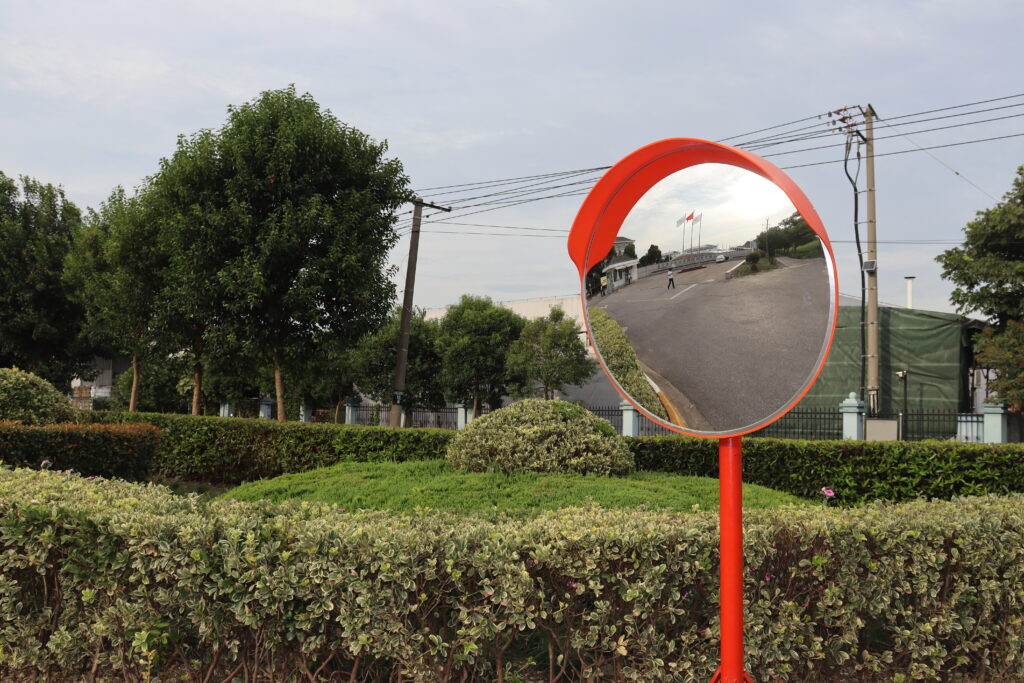
This expanded coverage becomes even more critical in outdoor applications. Road safety convex mirror installations at facility entrances, parking lot intersections, and loading dock approaches provide drivers with the advance warning they need to navigate safely. The compressed wide-angle view shows approaching vehicles, pedestrians, and obstacles that would be completely invisible in a flat mirror positioned at the same location.
Accuracy and Distance Perception Considerations
While convex mirrors excel at providing broad visibility, they do present challenges in distance and speed estimation. The compressed image created by the curved surface makes objects appear smaller and farther away than they actually are. For industrial applications where precise distance judgment is critical, this characteristic requires careful consideration and appropriate worker training.
Flat mirrors maintain accurate size and distance relationships, which can be advantageous in situations requiring precise maneuvering or when operators need to judge exact spacing between vehicles or equipment. Loading dock operations, for example, might benefit from flat mirrors when backing vehicles into tight spaces where precise distance estimation helps prevent collisions with dock equipment or adjacent trailers.
However, in most industrial road safety applications, the expanded visibility provided by convex safety mirrors outweighs the distance perception limitations. Workers can be trained to compensate for the compressed perspective, and the advance warning provided by the wider field of view typically provides more safety value than precise distance estimation. The key is matching the mirror type to the specific operational requirements of each installation location.
Durability and Environmental Performance
Industrial environments demand robust equipment that can withstand harsh conditions, physical impacts, and environmental exposure. Both mirror types face these challenges, but material construction and mounting configurations significantly impact long-term performance.
Premium convex safety mirror outdoor models feature shatterproof polycarbonate or acrylic faces specifically engineered for industrial use. These materials resist impact damage from debris, equipment contact, and vandalism while maintaining optical clarity over extended service lives. The curved construction of convex mirrors actually provides some structural advantages, as the dome shape distributes impact forces more effectively than flat surfaces.
Flat mirrors, particularly glass-based models, may be more susceptible to shattering from impacts. While acrylic and polycarbonate flat mirrors address this concern, the surface area and mounting configuration can still make them vulnerable in high-traffic industrial areas. The choice of mounting hardware, protective housings, and positioning relative to traffic patterns significantly influences durability for both mirror types.
Outdoor convex safety mirror installations must contend with weather exposure, temperature fluctuations, and UV radiation. Quality convex mirrors designed for industrial outdoor use feature weather-resistant housings, corrosion-resistant mounting hardware, and UV-protective coatings that prevent degradation. These same considerations apply to flat mirrors, though the different surface geometries may affect water drainage and cleaning requirements.

Installation Flexibility and Coverage Optimization
One often-overlooked advantage of convex security mirror systems is their installation flexibility. Because a single convex mirror can monitor areas that would require multiple flat mirrors, facility managers can achieve comprehensive coverage with fewer installation points. This reduces hardware costs, simplifies maintenance schedules, and creates cleaner sightlines that don’t clutter the visual environment.
In complex industrial facilities with multiple intersections, blind corners, and traffic convergence points, this efficiency becomes particularly valuable. A comprehensive safety mirror convex program might require 30-40% fewer installation points compared to achieving equivalent coverage with flat mirrors. The reduced installation count translates to lower labor costs, fewer potential mounting points that could fail, and simplified system management over time.
However, certain applications genuinely benefit from flat mirror installations. Security checkpoints where guards need accurate views of vehicle undercarriages, inspection stations requiring precise visual assessment, and areas where workers need true-size representations for quality control purposes may all warrant flat mirror solutions despite their limited viewing angles.
Cost Analysis for Industrial Deployment
Initial purchase price represents just one component of total cost of ownership when comparing mirror solutions. While basic flat mirrors may carry lower unit costs, the number of units required to achieve adequate coverage, installation labor, and ongoing maintenance expenses all factor into comprehensive cost analysis.
A typical industrial facility implementing convex traffic mirrors might spend more per unit but require significantly fewer total units to achieve comprehensive coverage. When installation labor and mounting hardware are factored in, the total program cost often favors convex mirror solutions for applications prioritizing broad visibility.
Long-term durability also impacts cost calculations. Premium convex safety mirrors constructed from impact-resistant materials may deliver 10-15 years of reliable service in demanding industrial environments. Cheaper alternatives that require replacement every 2-3 years may actually cost more over typical equipment lifecycle periods.
Strategic Applications for Each Mirror Type
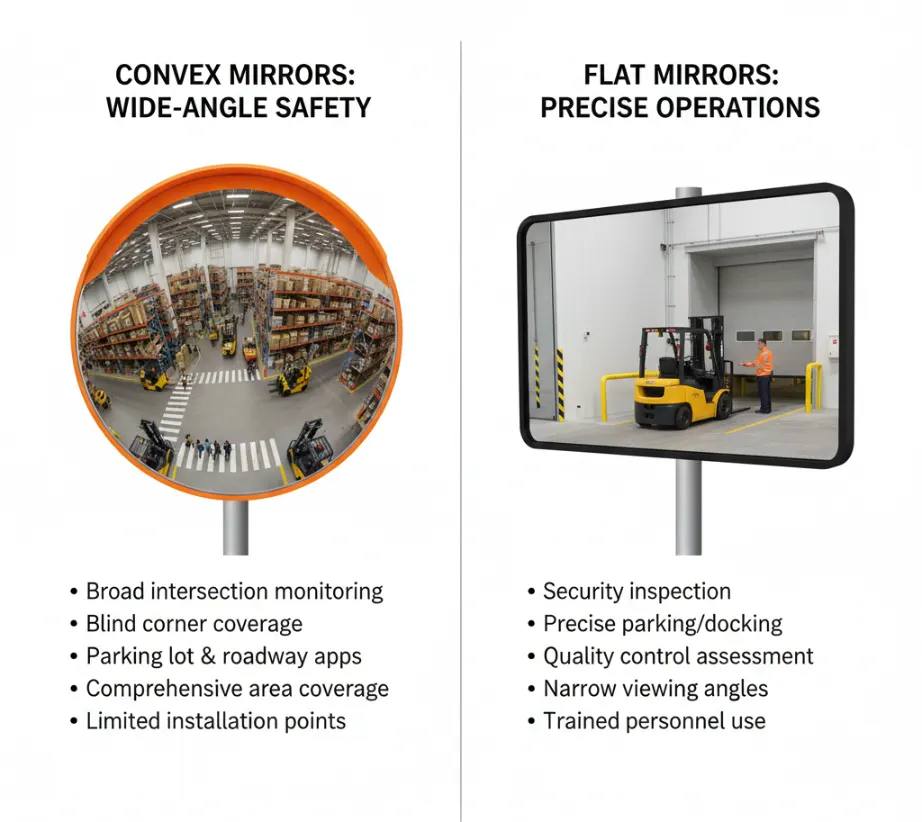
Understanding which mirror type suits specific industrial applications helps optimize safety outcomes while managing costs effectively. Convex traffic safety mirrors excel in situations requiring:
- Broad intersection monitoring where multiple approach angles must be visible simultaneously
- Blind corner coverage where advance warning of approaching traffic is paramount
- Parking lot and roadway applications where vehicles approach from various directions
- Areas where a single mirror must provide comprehensive coverage of a large space
- Locations where installation points are limited but coverage requirements are extensive
Flat mirrors prove more appropriate for:
- Security inspection points requiring accurate size representation
- Precise parking and docking operations where exact distance judgment is critical
- Quality control stations where true-size visual assessment is necessary
- Applications where viewing angle requirements are narrow and well-defined
- Situations where workers are specifically trained to use flat mirror feedback for precise maneuvering
Many industrial facilities ultimately implement both mirror types strategically, deploying each where its specific strengths provide maximum value. A warehouse might use convex blind spot mirror installations at aisle intersections while employing flat mirrors at loading dock positions where precise backing is required.
Integration with Modern Safety Systems
Contemporary industrial safety programs increasingly integrate traditional visibility solutions with advanced technologies. Convex mirrors complement backup cameras, proximity sensors, and collision avoidance systems by providing passive, always-on visibility that doesn’t depend on power, processing, or operator interaction with electronic systems.
This redundancy proves valuable when technology fails or in situations where electronic systems may not provide optimal coverage. A convex security mirror continues functioning during power outages, requires no maintenance beyond occasional cleaning, and provides instant visual feedback without processing delays.
Maintenance and Long-Term Performance
Both convex and flat mirrors require periodic maintenance to maintain optimal performance. The curved surface of convex mirrors may require more attention to cleaning technique, though the dome shape naturally sheds water and debris more effectively than flat surfaces.
Regular inspection protocols should verify that mirrors remain properly aimed, mounting hardware remains secure, and reflective surfaces maintain clarity. For outdoor convex safety mirror installations, seasonal inspections should assess weather seal integrity and check for UV-related degradation.
Establishing clear maintenance schedules ensures that both mirror types deliver consistent performance over their service lives. Many facilities incorporate mirror inspection into routine safety audits, assigning responsibility to specific personnel and documenting condition assessments.
Making the Right Choice for Your Facility
Selecting between convex and flat mirrors for industrial road safety applications ultimately depends on specific operational requirements, environmental conditions, and safety priorities. For most industrial facilities, the expanded coverage and broad visibility provided by convex safety mirrors deliver superior safety outcomes compared to flat mirrors, particularly for applications involving vehicle and pedestrian traffic management.
The compressed perspective of convex mirrors does require worker training and appropriate application selection, but these considerations rarely outweigh the fundamental safety advantages of broader visibility. When workers can see approaching hazards earlier and from more angles, they have more time to respond appropriately, creating safer operations even if precise distance estimation requires additional attention.
Facility managers should approach mirror selection as part of comprehensive safety planning rather than isolated purchasing decisions. Site assessments that identify specific visibility challenges, combined with clear understanding of operational workflows and traffic patterns, enable informed decisions about where each mirror type provides optimal value. In many cases, the answer involves strategic deployment of both technologies, each applied where its unique characteristics address specific safety requirements most effectively.
The goal isn’t simply selecting the cheapest mirror option or defaulting to whichever technology seems most familiar. Instead, thoughtful analysis of actual visibility needs, combined with realistic assessment of environmental conditions and usage patterns, leads to mirror solutions that genuinely enhance safety while delivering long-term value. For most industrial road safety applications, that analysis consistently points toward convex safety mirrors as the superior choice for protecting workers, visitors, and assets while supporting efficient operations in demanding environments.
Looking for a custom convex mirror manufacturer or supplier? Struggling to find the right factory to bring your vision to life? We’ve got you covered! At our place, we craft top-quality convex mirrors with precision and care. Big or small, your needs are our mission. Let’s launch your mirror project and take your product line to the next level! Click here to contact