
Railway construction and maintenance projects operate within uniquely demanding environments where traffic control devices must satisfy rigorous performance standards addressing both vehicular traffic management and railway-specific safety requirements. Transit agencies, railway contractors, and infrastructure maintenance organizations require traffic cones that withstand extreme operational conditions including high-speed rail operations, heavy construction equipment, and extended outdoor exposure while maintaining regulatory compliance with Federal Railroad Administration (FRA) guidelines and railway industry safety standards. Engineering managers, procurement specialists, and safety coordinators responsible for railway project equipment must understand the technical specifications that differentiate railway-grade traffic cones from standard highway products, ensuring that specified equipment delivers reliable performance throughout demanding construction environments while protecting workers and maintaining operational safety for active rail lines.
Railway Construction Environment and Unique Requirements
Railway construction projects encompass diverse activities including track installation and replacement, electrification system construction, signal and communications infrastructure, station platform modifications, and bridge and tunnel rehabilitation. These projects frequently occur on active rail corridors where construction activities proceed adjacent to operating train traffic, creating complex safety environments requiring absolute reliability in temporary traffic control equipment. The proximity of high-speed passenger trains traveling at velocities exceeding 100 mph generates substantial aerodynamic forces that can displace inadequately weighted traffic cones, while freight operations involving trains weighing thousands of tons create ground vibrations that gradually migrate equipment from intended positions.
Construction equipment including ballast regulators, track tampers, rail grinders, and heavy cranes operates in confined railway right-of-way areas where inadvertent contact with traffic control devices occurs regularly despite careful equipment operation. Traffic cones deployed in these environments must possess structural resilience that enables survival of incidental contact without fracturing into debris that could foul track infrastructure or damage railway equipment. Environmental exposure duration for railway projects often exceeds typical highway construction timelines, with some railway modernization initiatives spanning multiple years and requiring traffic control equipment to maintain functional integrity through extended service periods encompassing all seasonal weather conditions.
Federal Railroad Administration Compliance and Industry Standards
The Federal Railroad Administration establishes comprehensive safety regulations governing railway operations and construction activities affecting active rail corridors. While FRA regulations do not prescribe specific traffic cone specifications, the Manual on Uniform Traffic Control Devices for Streets and Highways (MUTCD) provides standards for traffic control devices used on roadways approaching railway grade crossings and on roadways within railway construction work zones. Railway contractors must ensure that traffic cones deployed for vehicular traffic control comply with MUTCD Part 6 temporary traffic control standards, including specifications for cone size, color, retroreflective material, and placement patterns.
Railway industry consensus standards developed by organizations including the American Railway Engineering and Maintenance-of-Way Association (AREMA) provide additional guidance addressing railway-specific construction safety practices. AREMA Manual for Railway Engineering contains chapters addressing construction zone protection and worker safety requirements that inform equipment specifications for railway projects. Transit agencies and Class I railroads often maintain internal engineering standards that supplement federal regulations and industry guidelines, establishing proprietary requirements for traffic control equipment deployed on their infrastructure. Procurement specifications must reference applicable agency standards and verify that proposed equipment satisfies all governing requirements.
Physical Specifications and Dimensional Requirements
Traffic cone dimensions significantly influence visibility, stability, and functional effectiveness in railway construction applications. MUTCD establishes minimum cone heights for various traffic control applications, with 28-inch minimum height specified for most temporary traffic control uses and 36-inch height required for high-speed roadways exceeding 45 mph. Railway construction projects affecting adjacent roadway traffic should specify cone heights appropriate to posted speed limits and traffic control plan requirements, typically requiring 36-inch cones for work zones on arterial roadways and highways.
Base Diameter and Weight Requirements
Cone stability depends critically on base diameter and overall weight, which must resist wind forces, train-induced air pressure fluctuations, and ground vibrations without toppling. Railway-grade cones should specify minimum base diameters of 12 inches for 28-inch height cones and 14 to 18 inches for 36-inch cones, providing adequate moment resistance against overturning forces. Base weight represents an equally critical parameter, with railway applications requiring heavier base configurations than standard highway cones due to aerodynamic forces from passing trains.
Standard highway traffic cones typically weigh 7 to 10 pounds, adequate for normal roadway applications but insufficient for railway environments where train-induced wind gusts can exceed 60 mph. Railway construction specifications should require cone weights of 10 to 15 pounds minimum for standard applications, with heavier 15 to 20-pound configurations specified for high-speed rail corridors or areas with limited clearance to active tracks. Some manufacturers offer detachable weighted bases that increase stability while maintaining portability through removable weight components that can be added for deployment and removed for transportation and storage.
Material Composition and Durability
Polyvinyl chloride (PVC) and low-density polyethylene (LDPE) represent the primary materials used in traffic cone manufacturing, each offering distinct performance characteristics relevant to railway applications. PVC cones provide superior rigidity and dimensional stability, maintaining vertical profiles under high temperatures and extended sun exposure. However, PVC formulations can become brittle at low temperatures, increasing fracture risk from impact during winter operations. Railway projects spanning multiple seasons should evaluate PVC temperature performance specifications, ensuring that materials remain ductile at minimum expected service temperatures.
LDPE cones offer excellent low-temperature impact resistance and flexibility that enables cones to withstand repeated contact without fracturing. The inherent flexibility of LDPE can reduce wind resistance as cones flex under aerodynamic loads rather than presenting rigid profiles that catch wind. However, LDPE softens at elevated temperatures, potentially causing cones to deform or lose height under intense summer sun exposure, particularly when cones remain deployed continuously without daily retrieval. Railway procurement specifications should define material requirements appropriate to project climate conditions and deployment patterns, considering both winter cold and summer heat extremes.
Advanced material formulations incorporating ultraviolet stabilizers, impact modifiers, and color-fast pigments extend service life and maintain appearance throughout extended railway project durations. Specifications should require UV stabilization adequate for minimum three-year outdoor exposure without significant color fading or material degradation, acknowledging that railway projects often exceed initial schedule estimates and equipment must remain serviceable throughout project extensions.

Retroreflective Material Requirements
Traffic cone visibility during nighttime and low-visibility conditions depends entirely on retroreflective sheeting applied to cone surfaces, which returns light from vehicle headlights toward drivers to create visible objects at distances sufficient for safe response. MUTCD specifies minimum retroreflective material requirements for traffic cones, requiring that cones used in nighttime applications include retroreflective material visible from all approach directions. Railway construction projects affecting roadway traffic must specify cones meeting or exceeding these retroreflectivity standards to ensure regulatory compliance and adequate visibility.
Retroreflective Sheeting Types and Performance Classes
ASTM D4956 establishes performance classifications for retroreflective sheeting used on traffic control devices, categorizing materials into Types I through XI based on retroreflective intensity and durability characteristics. Type III and Type IV engineer-grade prismatic sheeting represent common specifications for traffic cone applications, offering good retroreflectivity and reasonable durability at moderate cost. Type VIII and Type IX high-intensity prismatic sheeting provide superior retroreflective performance for demanding applications, though at premium cost appropriate for high-visibility priority areas or extended-duration projects where maintenance-free performance justifies higher initial investment.
Railway construction specifications should define minimum retroreflective sheeting types appropriate to project conditions and visibility requirements. High-speed rail construction affecting highways with speed limits exceeding 55 mph benefits from Type VIII or IX sheeting providing maximum visibility at extended viewing distances. Urban transit construction on city streets with lower speed limits may adequately serve with Type III or IV sheeting, balancing adequate performance with economic procurement. Specifications should explicitly reference ASTM D4956 performance types rather than generic terms like “high-visibility” or “engineer-grade” that create ambiguity in technical requirements.

Retroreflective Band Configuration and Coverage
Retroreflective material on traffic cones typically appears as horizontal bands encircling cone circumferences at specified vertical intervals. MUTCD requires minimum 6-inch wide retroreflective bands, with two bands separated by minimum 4-inch spacing for cones used in temporary traffic control applications. Railway project specifications should verify that proposed cones incorporate compliant band configurations meeting minimum width and spacing requirements, as non-compliant cones may result in traffic control plan rejections during regulatory inspections.
Some railway agencies specify additional retroreflective coverage beyond MUTCD minimums, requiring three bands or wider band dimensions that enhance visibility in complex railway environments where multiple visual distractions compete for worker and motorist attention. Additional retroreflective material increases per-unit costs but may justify expenditure for critical visibility applications including areas where construction workers operate within minimal clearance to active tracks or where multiple railway lines create complex operational environments.
Color Requirements and Visibility Standards
Standard traffic cone color specifications require fluorescent orange coloration conforming to color tolerances established in MUTCD standards, specifically referencing Federal Standard 595C Color 12197 for orange traffic control devices. Fluorescent pigments provide enhanced daytime visibility compared to standard orange pigments by converting ultraviolet light into visible wavelengths, creating apparent brightness exceeding what pure reflected light produces. Railway construction specifications should require fluorescent orange coloration meeting MUTCD standards, ensuring consistent color appearance across equipment from multiple manufacturers or procurement lots.
Color consistency proves particularly important for large railway projects procuring cones from multiple suppliers or adding equipment to existing inventories over multi-year project durations. Specifications should establish color measurement protocols using standardized colorimetry equipment that quantifies color coordinates and verifies compliance with established tolerances. Delta E color difference measurements comparing new equipment against reference standards prevent gradual color drift across procurement cycles that could result in visually non-uniform traffic control installations.
Some railway projects utilize alternate cone colors for specific applications, including lime-yellow cones for maintenance-of-way equipment marking or blue cones for utility infrastructure delineation. These specialized applications should reference appropriate color standards ensuring adequate visibility and differentiation from standard orange traffic control cones. Project specifications must clearly define which cone colors serve specific functions, preventing confusion among field personnel and ensuring that traffic control patterns communicate intended information to motorists and railway workers.
Wind Resistance and Aerodynamic Performance
Railway construction adjacent to active train operations subjects traffic cones to severe aerodynamic forces exceeding those encountered in typical highway environments. High-speed passenger trains generate bow waves and trailing turbulence that creates sudden wind gusts affecting equipment within 30 feet of track centerlines. Freight trains, while slower, generate sustained air pressure fluctuations from passing railway cars that can gradually displace equipment over time through cumulative effects of repeated train passages.
Design Features for Enhanced Stability
Cone manufacturers offer specialized designs incorporating aerodynamic features that reduce wind resistance and improve stability in high-wind environments. Vented cone designs include vertical slots or circular perforations that allow wind to pass through cone structures rather than presenting solid surfaces that catch wind. These ventilation features reduce overturning moments while maintaining structural integrity and visual appearance. Railway specifications should evaluate whether vented designs offer advantages for specific project conditions, particularly for installations within close proximity to high-speed rail operations.
Weighted base designs incorporating molded-in ballast chambers or detachable weight components provide mechanical stability enhancement that complements aerodynamic improvements. Railway procurement should specify minimum weight requirements appropriate to site-specific wind exposure, considering both natural environmental winds and train-induced aerodynamic effects. Conservative design approaches should assume worst-case scenarios including simultaneous natural wind gusts during train passage events, ensuring adequate stability margins under combined loading conditions.
Testing Protocols for Wind Resistance Verification
Traffic cone wind resistance capabilities should be validated through standardized testing procedures that quantify the wind velocities required to overturn cones under specified conditions. While no universally adopted wind resistance standard exists specifically for traffic cones, procurement specifications can establish project-specific testing requirements adapted from related standards. Testing protocols should define wind velocity increments, cone orientation relative to wind direction, and acceptance criteria establishing minimum wind speeds that cones must withstand without toppling.
Railway contractors can reference general principles from NCHRP Report 350 crash testing or AASHTO work zone safety standards that address traffic control device performance, adapting relevant concepts to cone-specific applications. Documentation of wind resistance testing by manufacturers provides procurement verification that specified equipment achieves stated performance objectives, though project-specific testing may be warranted for critical applications or when selecting non-standard equipment configurations.

Impact Resistance and Damage Tolerance
Construction equipment operation in confined railway right-of-way areas creates elevated risk of incidental contact with deployed traffic cones. Equipment including track maintenance machines, hi-rail vehicles, and construction trucks regularly operate within inches of traffic control devices, occasionally contacting cones despite operator care. Railway-grade traffic cones must withstand these impacts without shattering into debris or developing sharp edges that create secondary hazards.
Material Toughness and Fracture Resistance
Material selection significantly influences cone impact performance, with some polymer formulations offering superior toughness compared to alternatives. Impact-modified PVC formulations incorporating elastomeric modifiers provide enhanced fracture resistance compared to unmodified rigid PVC, though at incremental material cost. Procurement specifications should require impact testing verification using standardized drop-weight test methods or pendulum impact procedures that quantify material energy absorption before fracture occurs.
ASTM D256 Izod impact testing and ASTM D3763 instrumented impact testing provide standardized methodologies for characterizing polymer impact resistance, though these laboratory tests evaluate small material samples rather than complete cone assemblies. Practical field testing involving intentional vehicle strikes at controlled speeds offers more realistic assessment of cone survivability under actual operational conditions, though these tests prove expensive and time-consuming for routine procurement verification. Procurement specifications can reference manufacturer impact testing documentation while reserving the option for project-specific verification testing if concerns arise regarding equipment adequacy.
Damage Tolerance and Graceful Degradation
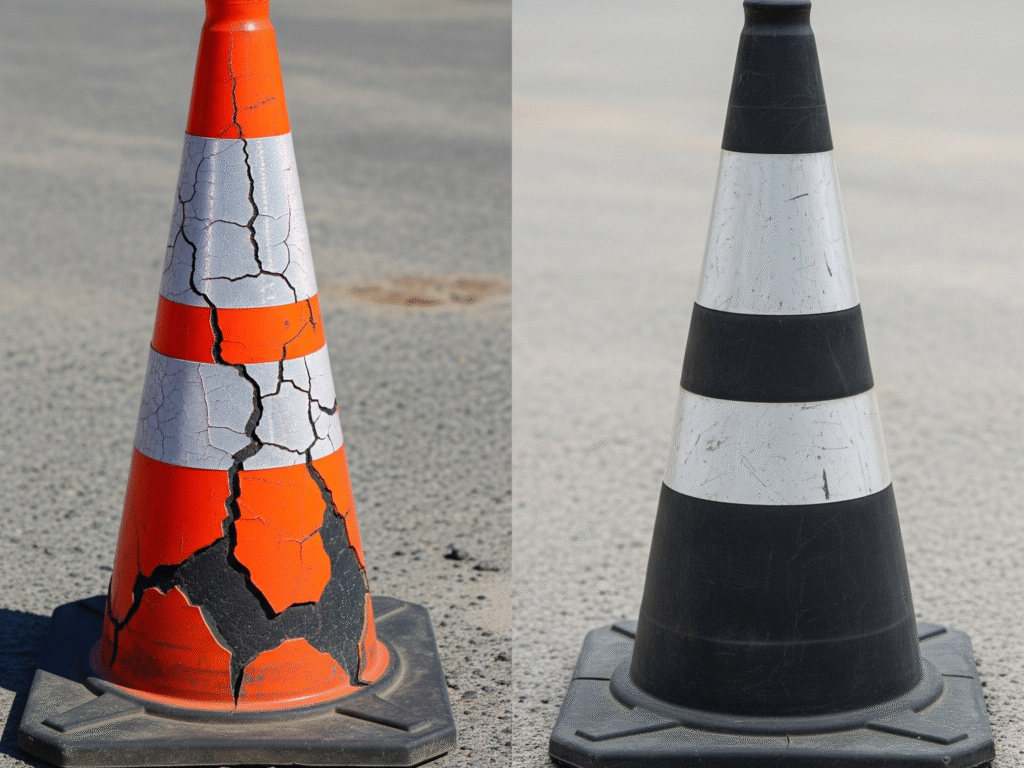
Even impact-resistant cones eventually sustain damage from repeated contact or particularly severe impacts. Railway specifications should address how damaged cones perform, preferring designs that exhibit gradual degradation rather than catastrophic failure. Cones that crack but remain structurally intact provide continued functionality, albeit at reduced effectiveness, while cones that shatter into multiple fragments create hazardous debris requiring immediate cleanup and offering no residual traffic control capability.
Procurement criteria should evaluate cone failure modes through examination of damaged cones from manufacturer demonstrations or field service history. Visual inspection of damaged samples reveals whether cracks propagate gradually with obvious visual indicators or whether fractures occur suddenly without warning. Railway contractors benefit from cones exhibiting obvious damage that triggers replacement before complete failure occurs, preventing situations where seemingly intact cones suddenly disintegrate during handling or deployment.
Storage and Transportation Considerations
Railway construction projects require efficient cone storage and transportation systems that maintain equipment organization and enable rapid deployment to work sites. Cone stackability influences storage density and transportation efficiency, with stackable designs enabling vertical nesting that minimizes required storage footprint and truck bed space during mobilization operations.
Stackable Cone Designs
Most traffic cone designs incorporate tapered profiles enabling cones to nest inside one another when inverted for storage, creating compact stacks containing 10 to 20 cones depending on specific geometries. Stack height specifications should ensure that nested cone assemblies remain stable during transportation without risk of toppling from vehicle movement or wind exposure. Railway projects involving frequent mobilization between work sites benefit from highly stackable cone designs that maximize transportation efficiency and reduce equipment handling labor.
Some heavy-duty cone designs with substantial base weights or rigid construction exhibit limited stackability, requiring more storage space and transportation capacity than standard designs. Procurement decisions should balance stackability advantages against performance requirements, recognizing that optimal technical specifications for railway applications may involve tradeoffs accepting reduced stackability in exchange for superior stability or durability.
Storage Rack Systems and Organization
Organized equipment storage systems incorporating dedicated cone storage racks prevent equipment damage during storage periods and facilitate efficient inventory management. Mobile storage racks mounted on trailers enable complete cone inventories to be transported between project areas as construction fronts advance, maintaining equipment organization throughout mobilization activities. Railway contractors managing large equipment inventories benefit from systematic storage approaches that prevent cone damage, enable rapid inventory counts, and reduce time required for daily equipment deployment and retrieval operations.

Procurement Strategies and Supplier Qualification
Railway construction procurement demands attention to supplier capabilities beyond simple price competition, evaluating manufacturer quality control systems, product consistency, and delivery reliability that affect project schedule and equipment performance. Qualified suppliers maintain documented manufacturing processes, conduct systematic quality testing, and provide technical support addressing application-specific questions that arise during specification development or equipment deployment.
Volume Procurement and Price Negotiations
Large railway infrastructure projects requiring thousands of traffic cones create procurement volumes justifying negotiated pricing arrangements with manufacturers or distributors. Volume purchase agreements securing favorable unit pricing should balance immediate procurement needs against anticipated future requirements, avoiding excessive inventory accumulation that ties up working capital while ensuring adequate equipment availability throughout project duration. Procurement strategies should consider staggered delivery schedules that align equipment receipts with construction phase requirements, minimizing storage requirements while maintaining uninterrupted equipment availability.
Supplier selection criteria should emphasize total value rather than lowest unit price alone, recognizing that premium equipment offering superior durability or performance may deliver lower total ownership costs through extended service life and reduced replacement frequency. Life cycle cost analysis comparing initial procurement costs, expected service life, and replacement expenses provides more comprehensive procurement evaluation than purchase price comparisons alone.
Quality Assurance and Acceptance Testing
Large-scale procurement contracts should incorporate quality assurance provisions requiring manufacturers to demonstrate compliance with technical specifications through submittal of test reports, material certifications, and sample equipment for purchaser evaluation. Third-party testing laboratories accredited under ISO/IEC 17025 provide independent verification of specification compliance, offering unbiased assessment that protects railway contractors from receiving substandard equipment.
Acceptance testing protocols should define inspection procedures for receiving equipment shipments, including visual examination for defects, dimensional verification, and sample testing of critical characteristics including retroreflectivity measurements and weight verification. Statistical sampling plans adapted from ANSI/ASQ Z1.4 acceptance sampling standards establish appropriate sample sizes and acceptance criteria based on lot quantities and acceptable quality levels. Documented inspection procedures create objective acceptance records supporting payment authorization and providing evidence of due diligence if equipment subsequently proves defective.
Maintenance Requirements and Service Life Expectations
Traffic cone service life varies substantially depending on deployment intensity, environmental exposure, and maintenance practices. Railway construction projects benefit from establishing systematic maintenance programs that preserve equipment functionality and maximize useful service life through proper cleaning, damage inspection, and timely replacement of deteriorated equipment.
Cleaning Protocols and Appearance Maintenance
Traffic cones deployed in railway construction environments accumulate dirt, dust, ballast residue, and oil contamination that degrades visibility and compromises professional appearance. Periodic cleaning using water spray, mild detergent solutions, and soft brushes removes accumulated contamination while avoiding aggressive cleaning methods that could damage retroreflective sheeting or polymer surfaces. Cleaning frequency should align with contamination rates, ranging from weekly cleaning for cones in particularly dirty environments to monthly maintenance for equipment in relatively clean applications.
Retroreflective sheeting requires particular care during cleaning to prevent scratching or delamination that would compromise nighttime visibility. Specifications should prohibit abrasive cleaners, petroleum-based solvents, or high-pressure water jets that could damage sheeting adhesive bonds or prismatic optical structures. Training for maintenance personnel should emphasize proper cleaning techniques and identify signs of sheeting deterioration requiring cone replacement.
Inspection Criteria and Replacement Thresholds
Systematic inspection programs identify cones requiring replacement due to structural damage, color fading, or retroreflectivity loss. Inspection criteria should establish objective thresholds for various defect types, such as cracks exceeding specified lengths, color fading beyond acceptable Delta E values, or retroreflectivity measurements falling below minimum ASTM D4956 performance values. Clear quantitative criteria enable consistent decision-making and prevent premature disposal of serviceable equipment while ensuring that degraded cones are removed from service before they compromise safety.
Retroreflectivity testing using portable retroreflectometers provides objective measurements of sheeting performance, enabling data-driven replacement decisions based on actual reflective intensity rather than subjective visual assessment. Railway projects prioritizing nighttime visibility may establish conservative retroreflectivity thresholds that trigger replacement before sheeting degrades to minimum MUTCD values, maintaining optimal performance throughout equipment service life.
Environmental Considerations and Sustainable Practices
Railway construction environmental management plans increasingly address equipment sustainability, encouraging procurement of products manufactured from recycled materials and designing end-of-life management programs that divert used equipment from landfills. Traffic cone manufacturers offer products incorporating recycled polymer content, typically ranging from 25% to 50% post-industrial recycled material that reduces virgin polymer consumption while maintaining adequate performance characteristics.
Recycled Content Specifications
Procurement specifications requiring minimum recycled content percentages support organizational sustainability objectives and may satisfy environmental requirements imposed by project funding sources or regulatory permits. Specifications should clearly define acceptable recycled material types, distinguishing between post-consumer recycled content derived from used products and post-industrial recycled content from manufacturing scrap, as these classifications carry different environmental value in sustainability assessment frameworks.
Performance requirements must not be compromised by recycled content mandates, as inferior equipment undermines safety objectives and may require premature replacement that negates environmental benefits from initial recycled content. Procurement documents should require manufacturers to demonstrate that recycled-content cones satisfy all performance specifications through testing verification, ensuring environmental objectives align with functional requirements.
Equipment End-of-Life Management
Worn traffic cones reaching end of useful life present disposal challenges, as large volumes of polymer waste create environmental burdens if directed to landfills. Progressive railway contractors implement equipment recycling programs partnering with polymer recyclers who process used cones into recycled feedstock for manufacturing new products. These circular economy approaches reduce environmental impact while potentially generating modest revenue from scrap material sales that offsets disposal costs.
Equipment recycling programs require systematic collection and segregation of used cones, separating polymer types to facilitate recycling processing. Mixed polymer waste proves difficult to recycle due to incompatible material properties, while segregated material streams enable efficient recycling. Procurement strategies that standardize on single polymer types across equipment inventories simplify end-of-life recycling and improve recycling economics.
Documentation and Record-Keeping Requirements
Railway construction contract requirements often mandate comprehensive documentation of traffic control equipment including procurement records, inspection reports, and deployment documentation. Systematic record-keeping demonstrates regulatory compliance, supports warranty claims for defective equipment, and provides historical data informing future procurement decisions.
Equipment Inventory Management
Detailed equipment inventories tracking cone quantities, purchase dates, manufacturers, and condition assessments enable effective asset management throughout project duration. Digital inventory systems incorporating barcode or RFID tracking provide real-time visibility into equipment locations and status, supporting efficient resource allocation and identifying equipment shortages before they impact operations. Railway contractors managing multi-site projects benefit from centralized inventory systems that enable equipment sharing among work locations and optimize overall equipment utilization.
Compliance Documentation
Traffic control plan implementations require documentation demonstrating that deployed equipment satisfies plan specifications and regulatory requirements. Photographic documentation of traffic control installations, equipment specification submittals to regulatory agencies, and inspection records create comprehensive compliance documentation supporting audit responses and incident investigations. Well-organized documentation systems facilitate rapid information retrieval when responding to questions from railway agency inspectors, regulatory authorities, or internal quality assurance personnel.
Conclusion (Specification Rigor for Railway Safety Excellence)
Traffic cone specifications for railway construction projects demand technical precision addressing the unique operational demands of railway environments while satisfying regulatory compliance requirements and supporting project safety objectives. Procurement professionals who develop comprehensive specifications considering dimensional requirements, material properties, retroreflective performance, and environmental resistance ensure that purchased equipment delivers reliable service throughout demanding railway construction applications. While detailed specifications require greater procurement effort than generic equipment requisitions, the investment in specification development yields substantial returns through improved equipment performance, extended service life, and enhanced project safety that protects both railway workers and the traveling public. Railway contractors who prioritize equipment quality and specification rigor distinguish themselves through superior safety performance and operational professionalism that builds reputation and creates competitive advantages in securing future railway infrastructure projects.
Looking for a Custom Traffic Cones Manufacturer or Supplier? Struggling to find the right factory to bring your vision to life? We’ve got you covered! At our place, we craft top-quality traffic cones with precision and care. Big or small, your needs are our mission. Let’s launch your cones project and take your product line to the next level! Click here to contact