
Multi-level parking structures represent significant capital investments for commercial real estate developers, healthcare systems, educational institutions, and corporate campuses. However, inadequate visibility within these facilities creates substantial liability exposure, reduces operational efficiency, and diminishes the user experience that drives customer satisfaction and tenant retention. B2B stakeholders including property management firms, parking operators, and facility development teams must implement comprehensive visibility enhancement strategies that address both vehicular and pedestrian safety while optimizing long-term operational costs and regulatory compliance.
The Business Case for Enhanced Parking Structure Visibility
Poor visibility in parking structures translates directly to measurable business impacts that affect multiple organizational stakeholders. Insurance carriers increasingly scrutinize parking facility design and maintenance practices when underwriting commercial property policies, with inadequate visibility cited as a contributing factor in liability claims exceeding $2 billion annually across North American commercial properties. Corporate risk management departments recognize that collision incidents, pedestrian injuries, and personal security concerns create financial exposure far exceeding the capital investment required for proper visibility systems.
Beyond liability considerations, parking facility revenue optimization depends on customer perception of safety and convenience. B2B clients in hospitality, retail, healthcare, and commercial office sectors report that parking experience directly influences customer retention metrics and net promoter scores. Studies demonstrate that enhanced visibility contributes to reduced dwell times, improved traffic flow efficiency, and decreased operating costs through reduced incident response and maintenance requirements. For property management companies operating multi-tenant facilities, superior parking infrastructure becomes a competitive differentiator in lease negotiations and tenant retention strategies.
Comprehensive Visibility Assessment and Strategic Planning
Effective visibility enhancement begins with systematic facility assessment that identifies specific problem areas and quantifies improvement opportunities. B2B facility consultants utilize structured evaluation methodologies that examine sight line obstructions, lighting adequacy, traffic pattern conflicts, and architectural elements that compromise visibility. This data-driven approach enables procurement teams to prioritize capital investments and develop phased implementation strategies that deliver measurable safety improvements while managing budget constraints.
Traffic Pattern Analysis and Conflict Zone Identification
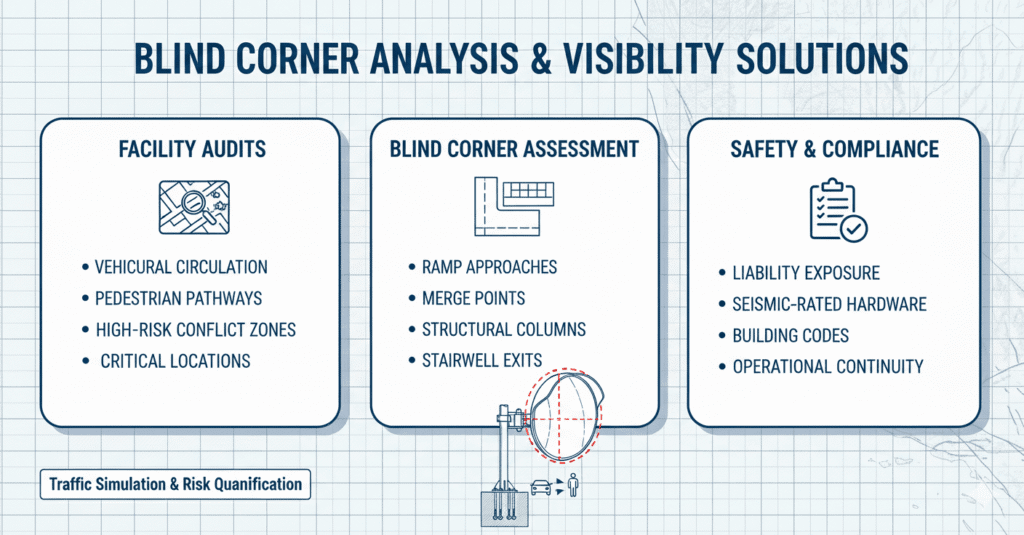
Professional parking facility audits map vehicular circulation patterns and pedestrian pathways to identify high-risk conflict zones where visibility limitations create collision potential. Ramp approaches, merge points from parking aisles to drive lanes, and pedestrian crossings represent critical locations requiring enhanced visibility solutions. B2B consultants employ traffic simulation software to model vehicle interactions and quantify the visibility improvements necessary to achieve target safety performance levels.
Blind corner analysis constitutes a fundamental component of visibility assessment, particularly at changes in grade, structural column locations, and enclosed stairwell exits. Each blind corner represents a liability exposure point where visibility enhancement technology or architectural modifications can eliminate hazardous conditions. Procurement specifications for visibility equipment should reference specific problem locations identified during assessment, ensuring that capital investments address actual facility conditions rather than generic safety concerns.
Lighting Quality and Uniformity Evaluation
Inadequate illumination ranks among the most common visibility deficiencies in multi-level parking structures, particularly in facilities designed before contemporary lighting standards were established. B2B facility managers must evaluate both overall lighting levels measured in foot-candles and lighting uniformity ratios that indicate consistent illumination across the facility. Modern parking facility standards specify minimum maintained illumination of 5 foot-candles in active parking areas and 10 foot-candles in pedestrian pathways, with uniformity ratios not exceeding 4:1 between brightest and darkest areas.
Corporate sustainability initiatives increasingly influence lighting system specifications, with LED technology offering compelling total cost of ownership advantages through reduced energy consumption and maintenance requirements. B2B procurement teams evaluating lighting upgrades should analyze lifecycle costs over 10-year periods, incorporating energy costs, lamp replacement expenses, and potential utility incentive programs that subsidize efficient lighting retrofits. Many utility providers serving commercial customers offer rebate programs covering 25% to 40% of LED conversion costs, significantly improving project economics while delivering visibility improvements.
Convex Mirror Systems for Blind Spot Elimination
Strategic placement of industrial-grade convex mirrors represents one of the most cost-effective visibility enhancement solutions for multi-level parking structures. These optical devices expand driver sight lines around corners, at merge points, and in areas where structural elements create blind spots. B2B suppliers specializing in parking facility safety equipment offer convex mirrors in configurations specifically engineered for challenging parking structure environments.

Optimal Mirror Sizing and Placement Strategy
Mirror effectiveness depends critically on proper sizing relative to viewing distance and the field of view required to eliminate specific blind spots. Professional parking facility consultants apply optical principles to calculate appropriate mirror diameters for each installation location, typically ranging from 18 inches for close-proximity applications to 36 inches for longer viewing distances exceeding 40 feet. Procurement specifications should define mirror locations by reference to facility drawings, specifying exact mounting heights and aiming angles that optimize visibility for typical driver eye positions.
The durability of mirror systems in parking environments requires attention to construction materials and mounting hardware. Acrylic mirrors offer impact resistance superior to glass while maintaining optical quality adequate for parking applications. B2B buyers should specify UV-stabilized acrylic with minimum thickness of 0.125 inches and weather-resistant backing that prevents moisture infiltration. Mounting hardware must withstand vehicle impact, vibration from heavy truck traffic, and environmental conditions including temperature extremes and humidity, making stainless steel or hot-dip galvanized components essential for long-term performance.
Integration with Traffic Management Systems
Advanced parking facilities integrate convex mirrors with supplementary warning systems that alert drivers to approaching vehicles in blind corner conditions. LED warning beacon systems activated by motion sensors or vehicle detection loops provide active safety measures complementing passive optical solutions. B2B facility managers implementing integrated systems should specify equipment compatible with building management systems, enabling remote monitoring of system status and automated maintenance notifications that reduce operational oversight requirements.
Architectural Solutions for Enhanced Sight Lines
While equipment-based visibility enhancements provide effective remediation for existing facilities, architectural modifications during new construction or major renovations offer opportunities to eliminate visibility obstructions at their source. B2B development teams collaborating with design professionals can implement sight line optimization strategies that reduce long-term reliance on supplementary visibility equipment.
Structural Column Placement and Geometry
Structural support columns represent unavoidable visibility obstructions in multi-level parking facilities, but strategic placement minimizes their impact on traffic flow safety. Parking facility design consultants recommend column grids that position structural elements at parking space boundaries rather than within drive aisles, maintaining clear sight lines along primary circulation routes. Where columns must be located within driver sight lines, chamfered or radiused column profiles reduce the visual obstruction compared to square column geometries.
Corporate real estate development teams should engage parking facility consultants during schematic design phases when structural systems are being defined. This early collaboration enables optimization of structural bay dimensions and column spacing that balances construction cost efficiency with operational safety performance. The incremental cost of refined column placement typically represents less than 1% of total project costs while delivering substantial improvements in facility functionality and liability risk reduction.
Transparent Barrier Systems and Open Railings
Perimeter barrier systems required by building codes to prevent vehicle or pedestrian falls from elevated parking levels significantly impact visibility within facilities. Traditional solid concrete parapet walls create extensive blind zones that compromise safety, while transparent barrier alternatives maintain fall protection while preserving sight lines. Structural glass railings, perforated metal panels, and cable railing systems provide code-compliant barriers that enhance rather than obstruct visibility.
B2B procurement specifications for transparent barrier systems must address both safety performance and long-term maintenance requirements. Laminated safety glass with minimum thickness of 5/8 inch provides adequate structural capacity for vehicle barrier applications while maintaining transparency. Anti-graffiti coatings and easy-clean surface treatments reduce maintenance costs in facilities serving public users. Cable railing systems offer economic advantages for budget-conscious projects, with stainless steel cables spaced at 3-inch intervals satisfying building code requirements while maintaining excellent visibility through the barrier plane.
Advanced Lighting Technologies and Control Systems
Modern lighting technology enables visibility enhancement strategies that were economically impractical with legacy lighting systems. LED luminaires with advanced optical designs deliver targeted illumination to critical visibility zones while reducing energy consumption by 60% to 75% compared to high-pressure sodium or metal halide fixtures common in older parking structures. B2B facility managers implementing lighting upgrades should evaluate fixtures specifically designed for parking applications, which incorporate optical distributions optimized for low mounting heights and wide spacing between fixtures.
Intelligent Lighting Controls and Adaptive Systems
Networked lighting control systems provide operational flexibility that optimizes both visibility performance and energy efficiency. Occupancy-based lighting control maintains full illumination in active parking areas while reducing lighting levels in unoccupied zones, delivering energy savings of 30% to 40% beyond LED conversion alone. B2B procurement teams should specify lighting control systems with open protocols that integrate with building management platforms, avoiding proprietary systems that create vendor lock-in and limit future expansion capabilities.
Time-scheduled lighting control enables programming tailored to facility usage patterns, with higher illumination levels during peak entry and exit periods when traffic density creates greater collision risk. Dusk-to-dawn photocell control maintains appropriate lighting relative to natural daylight contribution in open-air parking structures, optimizing energy consumption while ensuring adequate visibility throughout daily operational cycles.
Emergency Lighting and Backup Power Integration
Code-compliant emergency lighting systems serve dual purposes in parking structures, providing egress illumination during power outages while maintaining baseline visibility that supports safe vehicle operation during emergencies. B2B facility managers should coordinate emergency lighting system design with architectural consultants to ensure emergency fixtures provide adequate coverage for both pedestrian egress routes and vehicular circulation paths. Battery backup systems with 90-minute minimum capacity satisfy building code requirements while maintaining operational functionality during extended utility outages common in severe weather events.
Wayfinding Systems and Visual Communication
Clear visual communication throughout parking facilities reduces driver confusion that contributes to erratic vehicle behavior and collision risk. Comprehensive wayfinding systems incorporating directional signage, level identification graphics, and parking space availability indicators enhance visibility by improving driver awareness of their environment and reducing hesitation or sudden direction changes.
Digital Parking Guidance Systems
Technology-enabled parking guidance systems provide real-time information on parking space availability, reducing the time drivers spend searching for available spaces and the associated visibility risks from slow-moving vehicles scanning parking aisles. LED indicators at individual parking spaces communicate occupancy status, while digital signage at decision points directs drivers to areas with available capacity. B2B parking operators report that digital guidance systems reduce parking dwell time by 35% to 45% while improving space utilization through more efficient distribution of vehicles throughout the facility.
The business case for digital parking guidance extends beyond safety improvements to encompass revenue optimization through increased turnover rates and enhanced customer satisfaction. Healthcare facilities report reduced patient stress and improved on-time appointment rates attributed to streamlined parking processes, while retail and hospitality operators cite parking convenience as a measurable factor in customer satisfaction surveys. Enterprise-grade parking guidance systems integrate with mobile applications and reservation platforms, creating comprehensive parking management ecosystems that serve both operational efficiency and customer experience objectives.
Surface Treatments and Contrast Enhancement
Parking surface conditions significantly influence visibility by affecting vehicle dynamics and providing visual cues that communicate traffic patterns and pedestrian zones. Strategic use of surface treatments, markings, and contrast enhancement improves driver awareness and reduces ambiguity about expected vehicle behavior.
High-Visibility Pavement Marking Systems
Parking space delineation, directional arrows, and pedestrian crossings require durable pavement markings that maintain visibility throughout their service life despite vehicle traffic and environmental exposure. B2B facility managers should specify high-performance marking materials including thermoplastic or epoxy coatings with glass bead additives that provide retroreflectivity under vehicle headlight illumination. The incremental cost of premium marking materials represents 30% to 50% higher initial investment compared to conventional traffic paint, but delivers service life improvements of 300% to 400%, reducing long-term maintenance costs and improving consistent visibility.
Color-coded level identification systems using colored pavement markings or decorative concrete toppings improve driver orientation within multi-level facilities, reducing driver confusion and the erratic behavior that creates collision risk. Corporate standards for parking facility design increasingly incorporate distinctive visual themes for each parking level, with procurement specifications requiring color-matched lighting, signage, and floor treatments that create cohesive wayfinding systems.
Contrast Enhancement at Critical Locations
High-visibility surface treatments at conflict zones including pedestrian crossings, ramp approaches, and merge areas alert drivers to locations requiring heightened awareness. Yellow thermoplastic crosshatch patterns, red-pigmented concrete at stop locations, and textured surface treatments that provide both visual and tactile cues enhance visibility through multiple sensory channels. B2B consultants designing visibility enhancement strategies should identify specific high-risk locations warranting enhanced surface treatments, with procurement specifications defining performance requirements for durability, slip resistance, and color retention.
Maintenance Programs and Sustained Performance
Visibility enhancement systems deliver intended safety benefits only when maintained in proper operating condition throughout their service life. B2B facility management organizations should implement structured preventive maintenance programs that preserve visibility system performance while managing lifecycle costs through predictive maintenance strategies that prevent premature equipment failures.
Lighting System Maintenance and Performance Monitoring
LED lighting systems require significantly less maintenance than legacy technologies, but systematic inspection and cleaning protocols remain essential for sustained performance. Luminaire surfaces accumulate dirt, oil residue, and environmental contaminants that reduce light output by 20% to 30% within two years without proper maintenance. B2B facility management contracts should specify annual cleaning cycles for parking structure lighting, with inspection protocols that identify failed drivers, damaged lenses, and mounting hardware deterioration requiring corrective action.
Advanced lighting control systems with embedded monitoring capabilities enable predictive maintenance strategies that identify impending failures before they impact visibility. Networked fixtures report operating hours, input voltage conditions, and thermal performance data that facility management teams analyze to predict remaining useful life and schedule proactive replacements. This condition-based maintenance approach reduces emergency service calls, minimizes dark zones that compromise visibility, and optimizes maintenance labor deployment across multi-facility portfolios.
Vendor Partnerships and Technology Integration
Successful visibility enhancement initiatives require coordination among multiple specialty contractors and equipment suppliers. B2B procurement strategies should emphasize vendor qualifications beyond price competition, evaluating technical capabilities, integration expertise, and post-installation support that ensures long-term system performance. Developing preferred vendor relationships with suppliers offering comprehensive solutions across lighting, traffic management, and wayfinding systems streamlines project execution while ensuring compatibility among interconnected systems.
Conclusion (* Strategic Investment in Parking Facility Visibility *)
Multi-level parking structures represent critical infrastructure assets that support broader organizational objectives including customer satisfaction, operational efficiency, and risk management. Comprehensive visibility enhancement strategies address safety concerns while delivering measurable returns through reduced liability exposure, improved facility utilization, and enhanced user experience that supports tenant retention and customer loyalty. B2B stakeholders who prioritize visibility investments recognize that parking infrastructure quality directly influences organizational success across diverse industries, making systematic visibility enhancement an essential component of responsible facility management and corporate real estate strategy.
Looking for a custom convex mirror manufacturer or supplier? Struggling to find the right factory to bring your vision to life? We’ve got you covered! At our place, we craft top-quality convex mirrors with precision and care. Big or small, your needs are our mission. Let’s launch your mirror project and take your product line to the next level! Click here to contact